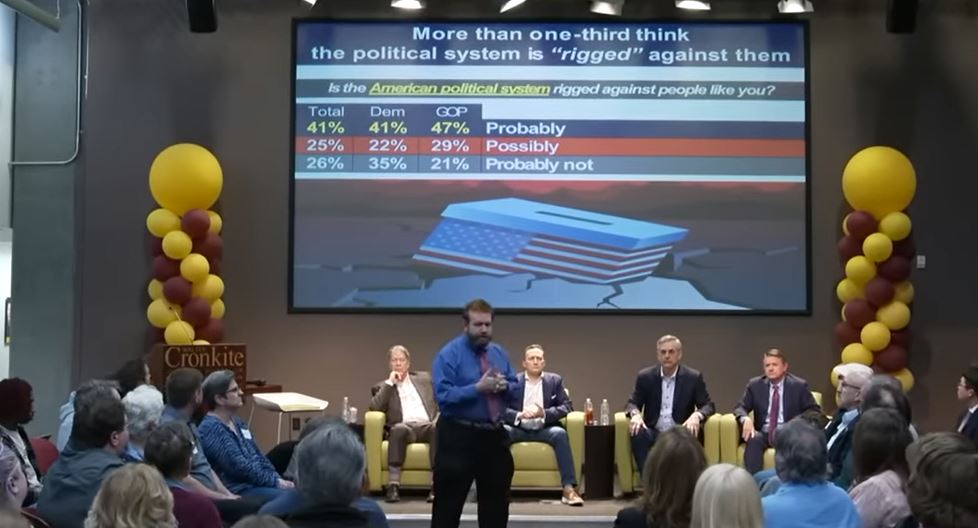
Arizona State University (ASU) hosted a panel discussing “election denialism” and President Donald Trump’s “Big Lie” about the 2020 election on Monday.
The event featured faces from the last two contentious election cycles, including Maricopa County Supervisor Bill Gates. Gates and several other panelists responded to questions from a group of “self-identifying election-deniers” placed in the center of a room as an audience of college students and faculty watched and occasionally posed questions themselves.
Nearly all of the “election-deniers” raised their hands when asked if they thought Trump had won the 2020 election.
Gates assured the crowd that the 2020 election was the “most scrutinized in the world.” Gates reminded them of some of the results of investigations over the years, such as that the election machines weren’t connected to the internet.
“If you don’t believe what happened in 2020, then you don’t believe your neighbors, your family members — they were the ones who ran the election,” said Gates.
Gates then urged those who challenged the results of the 2020 election to sign up as poll workers or volunteers to better understand the process. He expressed that he was upset by those who didn’t have confidence in the election processes.
“I want you to understand, we care about you,” said Gates. “If you guys don’t think it doesn’t hurt my heart to hear this tonight, it does. We want to convince you guys, we want to give you faith in [elections].”
Gates then said that he isn’t a fan of progressive dark money mega-donor George Soros, and urged the crowd to believe him that he’s been a Republican his entire life.
If you care about the future of our country, please watch this focus group led by the legendary Frank Luntz. I am grateful to have participated in this open and honest discussion with Maricopa County voters in a productive and non-confrontational forum. https://t.co/urQkd0JQNV
Other members of the panel were Georgia Secretary of State Brad Raffensperger, CBS News Washington correspondent Major Garrett, and Center for Election Innovation & Research (CEIR) Executive Director and Founder David Becker. Longtime political and communications consultant Frank Luntz moderated the event. In addition to ASU’s McCain Institute, support came from CBS, University of Southern California, and Greater Phoenix Leadership.
Although the panel didn’t focus on this most recent election, controversies remain concerning its administration in Arizona. Last month, Maricopa County announced it was investigating the mass failures of its ballot-on-demand (BOD) printers on Election Day. Over 17,000 voters were affected by the incident.
NEW: Former AZ Supreme Court Chief Justice Ruth McGregor will lead independent investigation into Election Day printer issues. We look forward to her findings. Statement ⬇️ pic.twitter.com/mOhkWideou
Tensions appear to remain between Maricopa County and GOP lawmakers.
The county initially refused to meet former State Sen. Kelly Townsend’s deadline for a subpoena of election records. The county explained it was busy with court proceedings; at the time, they were facing GOP gubernatorial candidate Kari Lake’s challenge of the election results.
Townsend announced early last month that she did receive the records, though didn’t say when or where they might be publicized. Several weeks later, she said that much of the audit information still needed to be reviewed and scanned.
Yesterday the audit materials were picked up for review. The seals had been broken and the contents reviewed by staff to ensure no sensitive voter info was inside that needed to be redacted. There is a lot of information to be reviewed so it will take time to scan.
Earlier this month in response to a report that State Sen. Wendy Rogers (R-LD07) asked fellow lawmakers not to use the phrase “conspiracy theory” during Senate Elections Committee meetings, the county quipped that some lawmakers based their bills on conspiracy theories.
It's too bad some election legislation is based on blueberry pancakes. It would be beneficial if we kept pancakes out of lawmaking altogether. https://t.co/xrdygTGp9t
Over the past three years, many parents in a number of school districts across the nation have demanded more transparency and involvement with their children’s education. The Republican-led Arizona Legislature has been working on solutions, and Members have introduced new bills this session to give parents the access and information that they have been requesting.
Representative Justin Heap has introduced one of those bills, HB 2786, which deals with requirements for parental notification for teacher training. The bill “mandates a school district governing board develop parental notification and access procedures if the school district is involved with a training for teachers or administrators,” according to the bill overview provided by the Arizona House of Representatives. If passed by the Legislature and signed into law, the bill would “require a school governing board to notify parents of these trainings and give parents access to any printed or digital materials used for the training.” It also stipulates that the governing boards adopt “a policy to provide parents the information contained in its parental involvement policy in an electronic format.”
In an exclusive interview with AZ Free News on why he introduced this legislation, Representative Heap stated, “Transparency will have the added benefit of bringing school district and school boards back into alignment with the values of the parents of the students they serve. The knowledge that their training materials must be made public will discourage school districts from implementing policies that are hateful to the parents of students in their districts. If any school district official, any school board member, principal, or teacher believes that what is going on in their schools should be hidden from the parents in their district, then they have no business being involved in education.”
The legislation currently has ten co-sponsors: Representatives Neal Carter, Lupe Diaz, Liz Harris, Rachel Jones, Teresa Martinez, Cory McGarr, Barbara Parker, Jacqueline Parker, Michele Peña, and Beverly Pingerelli.
On Tuesday, February 14, HB 2786 cleared the House Education Committee with a 6-4 party-line vote. Republican Representatives David Cook, Liz Harris, Lupe Diaz, Michele Peña, David Marshall, Sr (Vice Chairman), and Beverly Pingerelli (Chairman) voted in favor; while Democrat Representatives Jennifer Pawlik, Laura Terech, Judy Schwiebert, and Nancy Gutierrez voted against passage.
Representative Pingerelli gave the following statement to AZ Free News on why she decided to hold a hearing on this bill in her committee: “Parents should have information readily available about what teachers are learning as part of their professional development programs. Are they receiving instruction about better ways to teach reading, math, or science? Or, as was pointed out during the February 14 hearing and testimony, are the topics covered controversial, ideological or morally objectionable to parents? As I’ve always stated, the focus in K-12 education should be academics. Since it is a reasonable assumption that the training teachers receive is translated into classroom instruction, parents should have the right to be informed. That’s why I decided to hear House Bill 2786 in my committee.”
HB 2786 generated much opposition leading up to and during the hearing in the Education Committee, starting with the Arizona House Democrats. They posted that Representative Heap’s bill demands that “parents get to review every type of training teacher gets (including copyrighted materials),” adding that “he was upset when he learned teachers can get training about equity, inclusion and cultural sensitivity. The Arizona Education Association tweeted that “teachers need to focus on students’ learning – not spend all their time trying to satisfy the demands of people who see our classrooms as a way to score political points.”
Representative Heap disagrees with these analyses of the bill, saying, “I believe that sunlight is the best disinfectant. My bill does not ban this teacher training, or any training, which a school district wishes to implement. It simply requires that if a school district requires, endorses, recommends, funds, or facilitates teacher training programs then they must make all those materials used (Digital or Physical) in that training available for parents to review.”
Due to the partisan breakdown of HB 2786s support and opposition in the early stages at the Arizona Legislature, it is highly likely that Democrat Katie Hobbs would veto this bill should it pass through both chambers and reach the Ninth Floor later this session.
Daniel Stefanski is a reporter for AZ Free News. You can send him news tips using this link.
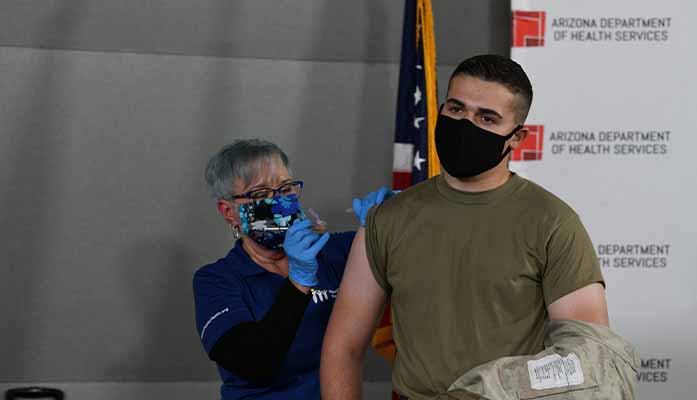
A bill that would ban vaccine mandates for government employees died in committee on Monday after a Republican lawmaker voted with Democrats.
State Rep. Matt Gress (R-LD04) said that while he opposed vaccine mandates, he believed that the bill’s language was problematic and “overly broad.” Gress specifically noted his concern that this bill would inhibit the readiness of the armed forces.
“I have deep concerns about our military being ready to address any issues that may arise, including being dispatched to other parts of the world,” said Gress.
Not true. I’ve long been on record on this issue. I do NOT think employers (government or private) should be able to force employees to get the the COVID vaccine. It’s an issue of individual liberty. 1/2 https://t.co/u8MdL8dA3O
The bill, HB2316, would prohibit the government and public accommodations from discriminating against individuals based on their vaccination status, in addition to banning a mandate. These prohibitions wouldn’t apply to health care institutions, schools, and child care facilities. State Rep. Rachel Jones (R-LD17) introduced the bill, along with clean-up language from a strike-everything amendment from State Rep. Barbara Parker (R-LD10).
Several members of the Arizona Freedom Caucus, State Reps. Jacqueline Parker (R-LD15) and Joseph Chaplik (R-LD03), spoke out against Gress’ vote. Parker called Gress’ opposition to the bill “unacceptable,” with Chaplik retweeting her remarks.
Not acceptable. Take notice LD4. 👇 Your reps are NOT representing your interests. https://t.co/HWPKMK598b
During Monday’s committee hearing, Jones said that her husband, a Border Patrol agent, recounted how she was inspired to introduce this legislation because he and others faced the vaccine mandate. Jones said that she and Sen. Justine Wadsack (R-LD17) were inundated with calls from federal employees and contractors worried about the government’s vaccine mandate. Jones testified that they helped over 3,000 individuals retain their jobs.
“I really did make this promise to a lot of the federal employees that I met a year ago that I would come up here and make sure that I would protect them as Arizona citizens from any further overreach from the federal government,” said Jones.
Jones declared that the COVID-19 vaccine should never have been mandated in the first place.
“I think the 10th Amendment gives us the right to protect our citizens if the federal government is potentially overreaching,” said Jones.
Jones also read an anonymous letter from a Customs and Border Patrol (CBP) agent denied religious accommodations. The individual had served 17 years in the Air Force: 4 years active duty and 13 years in the reserves.
“’It was unsettling to think that I spent the last 17 years of my life ready to defend the constitutional rights of our citizens and never once did I realize that I somehow gave up my own constitutional rights in the process,’” read Jones. “’Here I am about to lose everything because I want medical freedom and, dare I say it, religious freedom.’”
Parker said that Arizona would be taking back authority from the federal government.
“A ‘yes’ vote means you will never allow a bureaucracy to use pseudoscience to destroy your civil liberties ever again,” said Parker.
Rep. Patricia Contreras (D-LD12) said that the bill was unnecessary, and claimed that the vaccine prevented COVID-19 deaths.
Among those who signaled opposition to the bill were the ACLU, Greater Phoenix Chamber of Commerce, Arizona Public Health Association, American Cancer Society, Coconino County, Arizona Academy of Family Physicians, and the American Academy of Pediatrics.
Corinne Murdock is a reporter for AZ Free News. Follow her latest on Twitter, or email tips to corinne@azfreenews.com.
Governor Katie Hobbs’ nominee to head up Arizona’s health services department failed to earn the support of a majority of Senate members on Tuesday.
Last week, the Arizona Senate’s bipartisan Committee on Director Nominations held its first hearing to vet the nominations of two of Governor Katie Hobbs’ appointments to lead state agencies. One, Angie Rodgers, who was nominated to lead the Department of Economic Security, received unanimous support from all five committee members (three Republicans and two Democrats). The other, Dr. Theresa Cullen, who was nominated to run the Department of Health Services (DHS), received an unfavorable recommendation after lawmakers had ample time to review her record and statements.
This week, the full Arizona Senate took up the nominations and rejected the governor’s choice to lead DHS. This was not any ordinary vote, however. Senate Democrats – and Governor Hobbs – claimed that the nomination was withdrawn, and the vote was moot. President Warren Petersen informed Senators that he had not received the withdrawal notice, and so the vote proceeded as scheduled. AZ Free News was told that the Governor attempted to withdraw her nomination of Dr. Cullen, but nothing was received by the Senate’s Secretary.
The Senate’s course was expected after the committee hearing, in which Petersen served up a warning following perceived inconsistencies in Dr. Cullen’s answers, tweeting, “Any nominee who gets caught lying at a confirmation hearing is not fit to serve the state of Arizona.”
Any nominee who gets caught lying at a confirmation hearing is not fit to serve the state of Arizona. The 9th floor could learn from Napolitano. Napolitano did not appoint radical lefties as directors.
In an exclusive interview with AZ Free News, Senator Jake Hoffman, the chairman of the Director Nominations Committee, had the following to say after the floor action and the governor’s attempt to frame Dr. Cullen’s defeat as a Republican-forced withdrawal:
“Personnel is policy, and Katie Hobbs demonstrated with the nomination of Theresa Cullen that her policy agenda is an extreme, authoritarian one that will have no problems infringing the civil liberties of the people of Arizona. Cullen’s record is one of lockdowns, curfews, school closures, forced vaccinations, shaming Pima County citizens, and lying during her confirmation hearing. The people of Arizona deserve better.”
After the Senate’s vote, the Senate Republican Caucus released statements from its leadership team, reacting to the latest development with Governor Hobbs’ problematic nomination. Senate President Petersen said, “We now hope that the Governor takes a more pragmatic approach to this process and appoints individuals in the mainstream, without a political agenda, and who are ready to answer questions from the public.”
Senate President Pro Tempore T.J. Shope stated, “We heard some pretty damning testimony in last week’s committee hearing that was only made worse with lies from Dr. Cullen. Presenting us with this kind of nominee only highlights a failure from the Hobbs administration.”
Senate Majority Whip Sine Kerr responded, “If only Governor Hobbs would have taken the time to conduct the same thorough vetting process as my colleagues and I did at the Senate, we would not be here today, voting on – and ultimately rejecting – a nominee who clearly is not an appropriate fit for this position.”
Governor Hobbs, on the other hand, was furious about the Senate’s action in rejecting her nominee for DHS, writing, “As long as Republicans choose politics over the people of Arizona, some of the most talented and qualified candidates will choose not to enter state service, and it is the people of Arizona who will suffer most because of these political games.” She characterized the behavior of “some Republicans on the State Senate’s committee on director nominations” as “nothing short of harassment,” and she bemoaned the rejection of a nominee with a “mountain of expertise and an immense track record of public health success.”
The Arizona Senate Democratic Caucus claimed in a tweet that Hobbs’ letter was “hand delivered and sent via email to ensure (the Republicans’) symbolic nonsense vote wasn’t necessary.
According to Arizona Senate sources, Governor Hobbs has now transmitted nine total nominations to the legislature, including the failed nomination of Dr. Cullen. The governor is expected to name a replacement nominee for Dr. Cullen, though she blasted Senate Republicans for her current dilemma: “If the Senate’s Director Nominations Committee is unwilling to acknowledge the skill and expertise of Dr. Cullen, there may be no public health professional in the State they would endorse.”
Daniel Stefanski is a reporter for AZ Free News. You can send him news tips using this link.
Public schools who refuse to have armed officers on campus won’t receive grant money for school safety.
In a press release last Wednesday announcing the latest round of $80 million in funding from the School Safety Grant Program, Arizona Department of Education (ADE) Superintendent Tom Horne told schools to prioritize having armed law enforcement. Otherwise, the superintendent said that ADE wouldn’t recommend the school for funding to the State Board of Education.
“Every school should have a law enforcement officer to protect students and staff, and this should be accomplished on an urgent basis,” said Horne. “Delay in implementing this goal could leave schools more vulnerable to a tragic catastrophe. Schools that currently have no armed presence yet submit grants applications that do not request an officer will not receive a recommendation from this Department to the State Board of Education.”
Superintendent Horne is urging schools to prioritize having armed officers from law enforcement or highly trained security on campus. Our office is accepting school safety grant program applications here >>> https://t.co/6bTNomHqvqpic.twitter.com/W4h4HVGStO
— Arizona Department of Education (@azedschools) February 8, 2023
Under former Superintendent Kathy Hoffman, funding from the grant program could be applied to school resource officers or counselors. One of Hoffman’s main priorities during her first term and re-election campaign was to shrink the disparity between the number of students and counselors.
Hoffman stated that her administration slashed the student-to-counselor ratio by 20 percent. However, Horne’s administration noted that school violence has increased in recent years.
Under my leadership, @azedschools has cut the student-to-school counselor ratio by 20%. Even with this, we still have more work to do, and I will continue advocating for student's mental and physical health.
The ADE cited an increase in reported incidents of school threats, real and fake weapons found on campus, and “disturbing” social media posts inferring school violence. ADE also reported numerous receiving phone calls from Phoenix-area high school teachers about fights that, in at least one instance, risked a female teacher’s safety.
Horne noted in the ADE press release that this push for schools to have armed officers wasn’t in order to exclude other school safety measures that the program funds, such as counselors. He recalled his support for counselors as far back as 1978 during his services as a school board member, when he voted against eliminating counselors from their district.
“Schools still ought to have counselors but providing a safe school atmosphere that requires an armed presence is the first priority,” said Horne.
Horne later toldABC 15 that there wasn’t any reason why schools should refuse police protection on campuses.
“I can’t understand how anybody doesn’t understand how important it is that we be sure we don’t have any massacres in Arizona,” said Horne. “The first priority has to be the safety of the students and we don’t want a situation where 20 or 30 students are killed because no one was there to defend them.”
In a tweet, ADE posed a hypothetical, asking what a school would do if an armed “maniac” invaded a school that only had counselors and no armed officers.
Superintendent Horne supports having a counselor in every school, but if a maniac invades your school with a gun determined to kill people, what's the counselor going to do?https://t.co/RVL7Lt7ioi
Several days after ADE announced its decision on school safety grants, a 13-year-old Cottonwood-Oak Creek School District student making a “kill list” was arrested; school officials determined that the student posed a credible threat.
School Safety is a team effort. Thank you to the administrators, school resource officer, and counselors who helped avoid a tragedy. https://t.co/T80tNsxlNU
State Rep. Jennifer Pawlik (D-LD13) called Horne’s decision “disappointing.” Pawlik also criticized the decision to make the announcement during National School Counselors Week.
The ACLU of Arizona asserted that school safety couldn’t be achieved with police presence on campus.
School safety is not achieved by placing armed cops on campuses. It’s achieved when schools are well-resourced and students have the mental health support they need.
Forcing schools to follow these requirements prevents communities from deciding what’s best for their students. https://t.co/whefParndA
In addition to this funding, ADE is working with former Phoenix Police Department leaders to provide additional safety resources and procedures to schools.
Opposition to armed officers on campus often comes from concerns over a racial divide. Tensions heightened in one school district last year over discussions of funding school resource officers (SROs), about one month after the Uvalde school shooting. Chandler Unified School District (CUSD) Board Member Lindsay Love said that she and too many others, including children and parents, felt uncomfortable with having more police officers on campus.
Corinne Murdock is a reporter for AZ Free News. Follow her latest on Twitter, or email tips to corinne@azfreenews.com.
Two weeks after the Arizona Senate passed the state’s budget for 2023-2024, the House followed suit, setting the stage for another early legislative session showdown with Democrat Governor Katie Hobbs’ office.
Last week, the Arizona House attempted to pass a budget, but Republican Liz Harris voted with Democrats to stop progress on this front in a narrowly divided chamber. Rep. Harris tweeted after her February 9 vote that she “will reject this budget until we right size and restore it to a level that is commensurate with our economic growth.”
Time was ultimately on Speaker Ben Toma’s side, and this week, all House Republicans came together to join their Senate colleagues in passing the $15.8 billion budget. According to the communication from the Arizona Senate Republican Caucus on February 1, this budget is “$2.3 billion less than the state budget that was approved last year and $1.3 billion less than the Governor’s proposed budget.”
Also, “to absorb any revenue loss, this approved budget leaves $1.8 billion in cash available by the end of fiscal year 2024, in addition to the $1.4 billion available in the state’s Rainy-Day Fund.”
In a release sent out by the Arizona House Republicans touting the passage of this budget, Speaker Toma proclaimed victory and challenged the governor to sign the legislation for the good of all Arizonans:
“House Republicans have acted today to pass a responsible state budget. It’s one that was crafted with the needs of the state, and of Arizona’s families in mind, families who are struggling during this economic recession caused by reckless federal overspending and far-left priorities….This budget passed today continues the same budget which was approved less than a year ago with a bipartisan majority and was cheered at the time by Governor Hobbs and Democratic Minority Leader Cano.”
🚨FOR IMMEDIATE RELEASE🚨@AZHouseGOP Pass Responsible Budget Fully Funding Priorities of the State of Arizona
Speaker Toma’s reference to then-Secretary of State Hobbs supporting the last budget was highlighted by Rep. Jacqueline Parker, who shared a tweet from Hobbs from the conclusion of last year’s process:
We’ll see if it takes her a whole day to change her mind & abuse her veto power, or if she’ll take the time to pretend like she’s actually reading bills before she vetoes them. 🤔 👇 pic.twitter.com/16notqaSAp
Other House Republicans celebrated the budget passage after their votes on the floor. Rep. Austin Smith tweeted, “I voted YES on the budget today to keep the government running so no Arizonan is held hostage to special interests. Democrats keep threatening a veto from Katie Hobbs. They are willing to shutdown the government to protect special interests. SAD!”
I voted YES on the budget today to keep the government running so no Arizonan is held hostage to special interests. Democrats keep threatening a veto from Katie Hobbs.
They are willing to shutdown the government to protect special interests. SAD! pic.twitter.com/aF7rVDxKX5
House Majority Leader Leo Biasiucci stated, “Arizona House passes budget to avoid Arizona shutdown. Will Governor Hobbs Veto this bipartisan budget or will she do what’s right for every resident of Arizona?”
Arizona House passes budget to avoid Arizona shutdown. Will Governor Hobbs Veto this bipartisan budget or will she do what's right for every resident of Arizona? 🇺🇲 pic.twitter.com/gUyXax0AqA
Arizona House Democrats were much less complimentary of this week’s action to pass the budget and transmit to the governor’s office.
Rep. Laura Terech tweeted, “This is a budget that is destined for a veto. Hopefully, we will be sitting down together soon to do the real work of finding meaningful bipartisan solutions for Arizonans.”
This is a budget that is destined for a veto. Hopefully, we will be sitting down together soon to do the real work of finding meaningful bipartisan solutions for Arizonans. https://t.co/OXXhIolHRX
Minority Whip Marcelino Quiñonez said, “The dynamics in Arizona politics changed in November 2022, & this rushed budget headed to the Governor’s desk ignores that reality. The final budget we pass as a body this session must be bipartisan, everything until then is only a distraction. The work starts after the veto.”
The dynamics in Arizona politics changed in November 2022, & this rushed budget headed to the Governor’s desk ignores that reality. The final budget we pass as a body this session must be bipartisan, everything until then is only a distraction.
The Republican-led budget is dead on arrival at the Ninth Floor. Governor Hobbs released a statement in opposition to the incoming budget, saying, “The issues Arizonans are facing require more than business as usual. I will not sign a budget that is just more of the same and does nothing to demonstrate a desire to move our state forward.”
The issues Arizonans are facing require more than business as usual. I will not sign a budget that is just more of the same and does nothing to demonstrate a desire to move our state forward.