This past week, Arizona teachers flocked to an annual leadership conference on reshaping K-12 education to prioritize social justice, focusing mainly on controversial ideologies like social emotional learning (SEL). The Arizona K12 Center — a Northern Arizona University (NAU) affiliate, established leader of 23 years in professional educator development and gatekeeper to National Board Certification — hosted the conference. (National Board Certification has long been held as the highest and most respected teacher certification).
Two of the featured guest speakers at the conference, Shane Safir and Jamila Dugan, lectured at length about equity and a concept called “street data,” a term the pair focused on in their eponymous book on anti-racism, “Street Data: A Next-Generation Model for Equity, Pedagogy, and School Transformation.”
“Street data” appears to be a term that Safir and Dugan coined. They argue that schools currently rely on “satellite data,” or measurable marks of proficiency and success like test scores and graduation rates. Safir and Dugan advocate for the eradication of satellite data. Instead, they insist teachers should focus on “street data,” such as students’ “brilliance, cultural wealth, and intellectual potential” and other experiential data from parents, teachers, and even the community. However, the emphasis is on a pedagogy built around students who would serve as “agents of their own learning” according to the authors.
“Education can be transformed if we eradicate our fixation on big data like standardized test scores as the supreme measure of equity and learning. Instead of the focus being on ‘fixing’ and ‘filling’ academic gaps, we must envision and rebuild the system from the student up―with classrooms, schools and systems built around students’ brilliance, cultural wealth, and intellectual potential. Street data reminds us that what is measurable is not the same as what is valuable and that data can be humanizing, liberatory and healing,” read the book description.
Their book also declared that there was no defined end goal for equity because it’s a dynamic journey, not a destination.
The conference focused on social justice issues with ongoing concerns about student achievement. Arizona Department of Education (ADE) assessment of test score data from the 2020/2021 school year revealed an overall 4 percent drop in English-Language Arts scores, with a passage rate of 38 percent, and an 11 percent drop in math scores, with a passage rate of 31 percent.
The vice chair of the Arizona K12 Center is the ADE Deputy Associate Superintendent, Bruce DuPlanty. The ADE gave $7.5 million to the Arizona K12 Center in 2021 for a teacher residency program and to expand their reach across the state. During the summer of 2020, ADE partnered with the Arizona K12 Center to release Arizona’s Induction Program Standards. They’ve received millions more from the ADE since their inception in 1999.
Government employees on the board of directors include: Pinal County School Superintendent Jill Broussard, Mesa Public Schools Superintendent Andi Fourlis, Prescott Unified School District Professional Development Director Kelli Bradstreet, Yuma Union High School District Chief Academic Officer Eric Brooks, Roosevelt School District Innovation and Learning Executive Director Richard Ramos, Scottsdale Unified School District Psychologist Yadira Flores, Phoenix Elementary School District teacher Yolanda Wheelington, and Flowing Wells Unified School District teacher Ben Collinsworth. Also on the board is former Arizona State Board of Education member Janice Mak.
Arizona Public Service (APS), the largest electric company in the state, has a seat at the table: their vice president, controller, and chief accounting officer, Beth Blankenship, serves on the board of directors.
Arizona School Boards Association (ASBA) former President Ann O’Brien is also among those on the board of directors.
All three of Arizona’s public universities are also represented on the board of directors: University of Arizona (UArizona) College of Education Dean Bruce Johnson, Arizona State University (ASU) Mary Lou Fulton Teachers College professor Laura Corr, and NAU College of Education Dean Ramona Mellott.
In the past, the Arizona K12 Center has received a collective total of millions from the Bill and Melinda Gates Foundation, the National Board for Professional Teaching Standards, and the Department of Education since their inception. The center began with former Republican Governor Jane Dee Hull.
Corinne Murdock is a reporter for AZ Free News. Follow her latest on Twitter, or email tips to corinne@azfreenews.com.
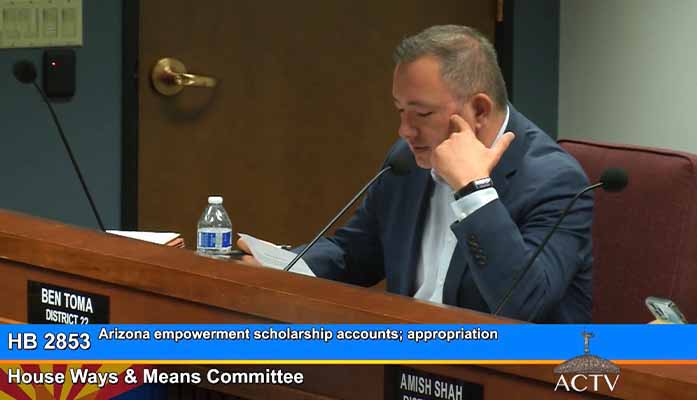
On Wednesday, the State House Ways and Means Committee passedlegislation establishing school choice for all parents who choose to use it. The 6-4 approval marks a historic advancement for expansion of the state’s school choice program, Empowerment Scholarship Account (ESA).
The legislation, HB2853, comes from State Representative Ben Toma (R-Peoria) about 11 years after the ESA Program launched.
I just introduced legislation to provide every Arizona child the ability to go to the school of their family’s choice. #HB2853pic.twitter.com/9uoU3UN7GZ
Bipartisanship was far from the committee during discussion of this bill. Democrats insisted that voters in the past rejected universal ESA expansion, that families would spend their ESA dollars frivolously or wastefully, that there weren’t enough regulations on non-public schools, and that public schools would be bled of crucial funds. Republicans insisted that post-pandemic voters support universal school choice, and that parents knew what was best for their children and would choose accordingly.
Toma challenged the idea that Arizona’s public schools were underfunded, something that Democrats like State Representative Kelli Butler (D-Paradise Valley) and Arizona Education Association (AEA) President-elect Marisol Garcia testified. Toma asked for a definitive number that constituted “fully funded.” Garcia suggested that outranking other state’s funding totals would constitute “fully funded.” In response, Toma pointed out that education funding increased by 48 percent during his tenure in the legislature, adding that much of those funds didn’t end up in teacher’s salaries.
State Representative Brenda Barton (R-Payson) concurred with Toma’s assessment, saying that in her 11 years she’s never gotten a hard answer from any public school proponents or officials of what “fully funded” meant for them.
Chairwoman Shawnna Bolick (R-Phoenix) estimated 25,000 students might utilize the ESA program if expanded under HB2853.
“If we’re helping a student get a lifeline, at the end of the day I’ll actually know we’re doing a good job as a legislature,” said Bolick.
Several Democrats insisted that they wanted to see long-term data on ESA students’ performance rates. Toma said there wasn’t a way to issue a fair comparison of those students because a majority of current users had disabilities, and comparing performance across different disabilities wasn’t an “apples to apples” comparison.
"Arizona has really been a leader on school choice …
"Some of our friends on the left are going to make the argument that the government should be the arbiter and the decider of where children go to school — and I respectfully disagree."
State Representative Pamela Powers Hannley (D-Tucson) argued that program effectiveness could still be measured through methods like sheer counts of private and charter school students.
“I think it’s important to know how many students are enrolled across the state because this is state money,” said Powers Hannley.
There are about 1.1 million charter and public school students.
State Representative Mitzi Epstein (D-Chandler) compared private schools to Walmart stores, insinuating that they were a less desirable option that communities were stuck with. Epstein also challenged why taxpayers should have to pay for children to visit the school they desire.
As a rebuttal for worry over potential private waste of public dollars, Toma pointed out the controversy over Buckeye Elementary School District paying its superintendent over $1.7 million in “additional compensation” from 2016 to 2021. Toma doubted that one individual’s misuse of ESA funds would reach that amount. He added that whenever people are involved, misuse is bound to happen.
“There are issues with any sort of system in which human beings are involved,” said Toma. “Fraud [with ESAs], if there is fraud, is less than one percent.”
In an attempt to cite waste of school funds, Butler listed allowable ESA expenditures she found objectionable, such as a bouncy castle and a tonal home gym costing thousands of dollars. Both Bolick and Toma reminded Butler that the Arizona State Board of Education (SBE) and the Arizona Department of Education (ADE) approved the handbook, clarifying further that Superintendent Kathy Hoffman’s office was responsible for writing it.
The two GOP legislators suggested that their Democratic peer take up her grievances with Hoffman.
Bolick also noted that bounce houses are within individualized education plan (IEP) parameters for curriculum-related therapies. Butler said that was besides her point. She went on to claim the state can’t afford to give every special needs child in the state their own bounce house for several hundred dollars — rather, schools should just purchase one for all special needs students. Butler called the tonal home gym “beyond the pale,” at which point Bolick cut her off for “beat[ing] a dead horse.”
Bolick and Butler contended over whether the entirety of Arizona’s 1.1 million charter and private school students would actually use ESAs.
Butler referenced access to ESA funds as “debit cards” repeatedly, to which Toma and Cobb objected. They, along with Bolick, explained to Butler that she was referring to an outdated system. They also contended with Butler’s attempted characterization of ESA funds as “thousands of dollars in a bank account.” At that point, Bolick suggested again to Butler that she seek out instruction from Hoffman about how the ESA Program works currently.
Among those to testify in favor of ESA Program expansion was Jennifer Clark, a mother of five. She explained that ESAs have helped several of her children with special learning needs like dyslexia and disabilities.
Clark further described how the public school system was currently failing her daughter with its stalled processing of her educational needs. She insisted that HB2853’s allowance for outside assessments would expedite solutions for situations like her daughter’s.
“All Arizonan families deserve equitable access to ESAs regardless of their income or zip code,” said Clark.
Drew Anderson, a South Phoenix Democrat and pastor, pointed out that the majority-white crowd protesting with the likes of Save Our Schools against the bill didn’t represent or understand the needs of minority parents — especially those in inner city schools like the Roosevelt School District.
“I don’t see anybody screaming ‘save our schools’ in south Phoenix,” said Anderson. “I hear them screaming ‘save our children.'”
Anderson described how inner-city children in his area, many from the Roosevelt School District, had to do school at McDonalds during the pandemic because they didn’t have internet at home.
The pastor then explained that one of his church members admitted to selling drugs on the side to get his siblings out of public schools. Their mother is deceased, Anderson explained, and one of the man’s younger sisters was attacked by a group of 14-year-old girls at her school.
“He had to find whatever means he could to try to get his brothers and sisters into private schools. He’s putting his freedom on the line to do that,” said Anderson. “Why is it that the rich kids can afford to go to these better schools, but these poorer kids can’t?”
HB2853 would empower parents with access to taxpayer funds already allocated for their students to apply to the schooling of their choice. The bill would appropriate $2.2 million and 26 full-time equivalent positions from the state general fund in 2023 to the ADE.
HB2853 would also enable ESA funds to be used for public transportation; computer hardware; educational technology like calculators, personal computers, laptops, tablets, microscopes, telescopes, and printers; consumable educational supplies like paper, pens, and markers; and additional disability services and education plan costs.
As for enrollment eligibility, the legislation would reduce the number of hours needed for K-12 online students to qualify by about half. It would also require students in grades 3-12 take nationally standardized tests, which may be swapped out for exams chosen by parents or qualified schools. Students with disabilities would be exempted from that examination requirement. Additionally, qualified schools with 50 or more ESA students must issue the aggregate test scores of all enrolled students or all ESA students annually.
Furthermore, the bill would expand the appeal deadline to 15 business days, and allow parents to represent themselves or designate non-attorney representatives in appeals hearings.
If passed as introduced, HB2853 includes a retroactivity clause rendering it effective as of July 1 of this year.
HB2853 angered school choice opponents. They claimed that the bill would rob public schools of their funding and award it to private schools and special interests.
No. You just introduced legislation to rob public schools at the bidding of private schools & special interests. You are expanding unaccountable entitlement programs for the wealthy, while AZ public schools remain LAST in the nation in funding 😡#NoNewVouchers#NoHB2853https://t.co/qPsD8SKZuS
At the time of press, GOP gubernatorial candidates Matt Salmon and Karrin Taylor Robson signaled support for HB2853.
Freedom is the foundation of any successful educational system.
Every parent across AZ deserves the opportunity to choose the school that best fits their children's individual needs, and they should be able to take their tax dollars with them. #HB2853https://t.co/3ISEBsFgwRpic.twitter.com/q1mHdXksvu
AZ has been a school choice leader for decades. #HB2853 will expand opportunity for every student & vault our state to the front of the educational freedom movement. As Governor, I look forward to build upon this legislation for years to come. #AZgovhttps://t.co/auSuQ52s5c
— Karrin Taylor Robson for Arizona (@Karrin4Arizona) June 15, 2022
Corinne Murdock is a reporter for AZ Free News. Follow her latest on Twitter, or email tips to corinne@azfreenews.com.
Correction: A former version of this story identified Anytown Leadership Program as the source of the controversial programming. Anytown Leadership Program responded to our request for comment post-publication to clarify that the programming came from their predecessor organization, identified as Anytown Arizona.
On a further note: As news of this controversy circulated, threats against the campers and staffers were reported. This is impermissible. AZ Free News does not condone or encourage threats of violence of any kind.
Another club within Scottsdale Unified School District (SUSD) has stirred up controversy over its social justice programming, “Unitown,” for its engagement with hot-button issues like sexuality and anti-racism. Though they’ve attracted national attention, SUSD’s Unitown clubs aren’t new or unique to the district. Unitown clubs and camps have existed within Arizona schools for decades.
The Arizona Daily Independent first reported on SUSD’s Unitown. They shared emails in which SUSD staff and teachers discussed implementation of the sexuality programming offered by the now-defunct social justice instructional organization Anytown Arizona: the “Safe Zone” and “Sexual Orientation” curriculum.
The Sexual Orientation curriculum included a skit titled “Herman’s Head,” in which a gender-confused child deals with their upset and confused parents, church, best friend, and current partner while dealing with the happiness of their potential partner. The minor playing the role of the gender-confused child is encouraged to pretend to contemplate suicide with a toy gun after pretending to handle the pressures of their friends and family.
That curriculum also included a “Sexual Orientation Exercise,” which asked the following questions of students:
What do you think caused your heterosexuality?
When and how did you first decide that you were a heterosexual?
Is it possible that your heterosexuality is just a phase that you may just grow out of?
Is it possible that your heterosexuality stems from a neurotic fear of others of the same sex?
If you’ve never slept with a person of the same sex, is it possible that all you need is a good gay/lesbian lover?
To whom have you disclosed your heterosexual tendencies?
Why do you heterosexuals feel compelled to seduce others into your lifestyle?
Why do you insist on flaunting your heterosexuality? Can’t you just be who you are and keep quiet?
Would you want your children to be heterosexual, knowing all the problems they’d face?
A disproportionate majority (side note: the actual figure is 98 percent) of child molesters are heterosexuals. Do you consider it safe to expose our children to heterosexual teachers?
Even with all the societal support marriage receives, the divorce rate is spiraling. Why are there so few stable relationships among heterosexuals?
Why do heterosexuals place so much emphasis on sex?
Considering the menace of overpopulation, how could the human race survive if everyone were heterosexual?
Could you trust a heterosexual therapist to be objective? Don’t you fear that the therapist might be inclined to influence you in the direction of his/her own learnings?
How can you become a whole person if you limit yourself to compulsive exclusive heterosexuality and fail to develop your natural, healthy homosexual potential?
There seem to be very few happy heterosexuals. Techniques have been developed that might enable you to change if you really want to. Have you considered electro-shock therapy?
Anytown Arizona wrote on the questionnaire that the goal was to reduce homophobia and create more straight allies. They wrote that homophobia was “an unrealistic fear or generalized negative attitude based on sexual orientation or gender identity.”
.@ScottsdaleUSD reportedly hosted a student club to “promote leadership and diversity” which was actually a cover for teaching gender identity and sexuality.
The Safe Zone curriculum included the “Gender Unicorn,” one of the common visuals to argue that gender and sexuality exist on a spectrum — similar to “Genderbread,” as reported on last year by AZ Free News. The visual was paired with reading assignments explaining further what’s taught using the Gender Unicorn.
SUSD launched their Unitown decades ago alongside a “Minitown.” Former SUSD Superintendent David Peterson described the programs in 2015 as opportunities to recognize and address racism, bigotry, bullying, prejudice, and intolerance. However, Unitown existed in SUSD for years before that. Back in 2005, students toldEast Valley Tribune that they were focusing on stereotyping, racial issues, and diversity in the SUSD club.
Other Arizona schools hosted or advocated for Unitown clubs and camps for decades. Up until around 2015, Greenway High School in the Glendale Union High School District engaged in Unitown activities.
As reported in the East Valley Tribune, the city of Chandler launched Unitown camps in 2003 based on the Anytown Leadership Camp. Even then, they focused on social justice issues in addition to leadership. It doesn’t appear that the Chandler-sponsored Unitown camp occurs anymore.
Some are confusing SUSD’s Unitown with the Unitown offered by Anytown Leadership Program, whose predecessor and affiliated organizations came up with Unitown decades ago. Their president, Amber Checky, told AZ Free News that SUSD has been running their Unitown independently since Anytown Arizona was shuttered around 2009.
In addition to Unitown, Anytown Leadership Program offers “Anytown Junior” workshops on social-emotional learning for K-5 students, the “Empowertown” in-school program on social justice issues for grades 6-12, and the “Minitown” condensed version of the summer camp for middle school students.
Anytown Leadership Program announced that they’re working on “CampusTown” for college students. The program plans on contracting with Arizona’s colleges to “create inclusive campuses and support activism and advocacy.”
Checky told AZ Free News that no schools are utilizing these current school programs at present.
The organization classifies their school programs as condensed versions of their $490 annual week-long camp occurring for 75 high schoolers. Of note, program staffers confiscate campers’ phones and prohibit them from speaking to their families while attending. In return, the high schoolers receive 50 hours of certified leadership training/service.
This year, the program has over 42 high schools represented.
The woke, TikTok famous elementary school teacher nominated by the Arizona Secretary of State’s office last year for her classroom activism, Amanda Delphy, is one of the camp staffers. In a TikTok posted this week, Delphy credited the camp for making her into the person she is today.
What’s YOUR favorite part about Anytown?
Don’t have an Anytown memory yet? Don’t fret! There’s still time to apply for Anytown Leadership Camp! Share with teens 14-19 today!
— Anytown Leadership Camp (@AnytownCamp) May 23, 2022
The Anytown Leadership Program receives taxpayer dollars for work. The organization recently received a grant from Arizona Humanities, a nonprofit and affiliate of the National Endowment for Humanities — the funding source of their grants.
We are excited to announce that Anytown received a grant from @AZHumanities!
— Anytown Leadership Camp (@AnytownCamp) June 7, 2022
Anytown Leadership Program began in the 1950s, arising from a 1927 initiative responding to anti-Catholic and anti-Jewish sentiments at the time: the National Conference for Christians and Jews (NCCJ), later renamed in 1998 to the National Conference for Community and Justice (NCCJ). They closed their operations and had a brief hiatus in the early 2000s before relaunching under new leadership.
Prior to 2009, each Arizona high school nominated two students to represent them at one of the program’s eight Anytown Leadership Camps held every summer.
The 2008 recession caused the original Anytown Leadership Camp to be shuttered in 2009. Alumni resurrected the program in 2014, making it into its present-day form focusing on social justice issues like diversity, equity, and inclusion.
– My existence is revolutionary. – I am worthy of love and acceptance. – I deserve to take up space. – My pronouns and gender identity are valid. – I deserve to feel safe & protected everywhere I go. – I give myself permission to shine.#WeAreAnytownpic.twitter.com/HqE6lxB2kI
— Anytown Leadership Camp (@AnytownCamp) June 3, 2022
NCCJ offers an “Anytown” programming similar to the Phoenix-based Anytown Leadership Program.
Upcoming sessions for virtual NCCJ Anytown programming concern “dismantling anti-blackness,” anti-racism, DEI (short for diversity, equity, and inclusion), and “understanding sizeism” (prejudice or discrimination against individuals based on their weight). These sessions focus on one or several of the “9 Identities”: ageism, dress code sexism, heterosexism, human trafficking, microaggressions, racism, religionism, sexism, and sizeism.
The 9 Identities have forthcoming bulletins on the NCCJ resource page to explain their place in the world of social justice. The other bulletins address social justice definitions as a whole, ableism, adultism, Black Lives Matter, cissexism, classism, colorism, consent, cultural appropriation, environmental justice, homelessness, internalization, intersectionality, neurodiversity, privilege, veteran’s affairs, and women’s rights.
State Senator Nancy Barto (R-Phoenix) lamented Anytown’s shift in focus.
Parents have traditionally had a positive view of Anytown. A trusted place where their kids have fun and learn civics-not a brainwashing clinic. No more. https://t.co/t9luWissni
SUSD parent Amanda Wray — one of the individuals included in the dossier compiled by former SUSD board president Jann-Michael Greenburg’s father, Mark Greenburg — told AZ Free News that the programming should inspire parents to rethink their approach when addressing these controversial topics.
“Conservatives need to stop using the term ‘CRT.’ What’s happening isn’t about a legal framework being taught in schools — we know K-12 students are not learning legal theories. What is happening is radical, racial division being taught not only to distract from the decline in public school academics, but it is indisputably to train students to become social activists,” said Wray. “This camp, which started out years ago as a wonderful way to unite students and respect other‘s differences, seems to have morphed into yet another form of social justice activist training. And it’s unwittingly being funded by taxpayers.”
A number of recognizable names are listed among Anytown Leadership Program supporters: the Arizona Coyotes, the Fiesta Bowl, Starbucks, Peoria Diamond Club, Amazon, Bank of America, PayPal, Target, Aldi, and CVS Health.
— Anytown Leadership Camp (@AnytownCamp) May 11, 2022
Those who fund over $7,500 to Anytown Leadership Program include the Arizona Community Foundation, the Arizona Coyotes Foundation, the David Frazier Endowment Fund, and the Fiesta Bowl Charities. Those who fund between $5,000 to $7,500 include Phoenix Pride, the Robert Cialdini and Bobette Gorden Family Foundation, Rob Jaimes, Sandy Fromm, and Voya Financial.
Those who fund between $1,000 to $5,000 include the Peoria Diamond Club; the Starbucks Foundation; David Gass; Fromm, Smith, & Gadow, P.C.; and Matt Case. Those who fund over $500 to $1,000 annually include Bank of America, Brock Insurance Services, David Gale, Diane Geimer, Jennifer Gadow, John Boyle, Leida and Greg Davis, Lisa Stone, Nancy Fromm, Phoenix Pediatrics, and Spire Health Club.
Corinne Murdock is a reporter for AZ Free News. Follow her latest on Twitter, or email tips to corinne@azfreenews.com.
On Sunday, Maricopa County used its official social media accounts to tell residents to educate themselves about the LGBTQ+ history. The post comes midway through what some of the country recognizes to be Pride Month, acknowledgment and celebration of LGBTQ+ lifestyles.
During #PrideMonth, take time to educate yourself and others about the history of LGBTQ rights in America. @mcldaz has a collection of books sharing the history and experiences of people in the LGBTQ community to get you started: https://t.co/aDCfCMr2rBpic.twitter.com/qwu8ogtVeO
The county directed residents to utilize resources from the Maricopa County Library District (MCLD). The district organized adult, teen, juvenile, and children reading lists as well as film and TV suggestions for Pride Month.
For those under 10 years old, the picture books were “Strong” by Eric Rosswood, about the world’s only openly-gay powerlifter; “The Rainbow Parade” by Emily Neilson, about a lesbian couple who help their little girl work past her nerves to attend her first Pride parade; “Twas the Night Before Pride” by Joanna McClintick, about families preparing for a Pride parade; “My Moms Love Me” by Anna Membrino, and “Plenty of Hugs” by Fran Manushkin, about children raised by lesbian couples; “What Are Your Words” by Katherine Locke, about gender identity pronouns; “Two Grooms on a Cake” by Rob Sanders, about the first wedding between two gay men before it was legalized; “Sam is My Sister” by Ashley Rhodes-Courter, about a family encouraging their gender-confused little boy to become a transgender girl; “Daddy & Dada” by Ryan Brockington, about a little girl raised by two gay men; “It Feels Good to Be Yourself” by Theresa Thorn, about gender identity and transgenderism; “Kind Like Marsha” by Sarah Prager, about historic LGBTQ+ individuals; and “Cinderelliot” by Mark Ceilley, a retelling of Cinderella but with two gay men.
Most reactions to the post were negative. Residents asked why the county was advocating for certain ideologies over others.
“I don’t think government-run institutions should be telling citizens what they should ‘accept and affirm,’ much less celebrate,” replied one Twitter user.
“I wonder, you push ‘Pride Month,’ do you present ‘heterosexual’ lifestyles by offering book readings from the Bible?” replied one Facebook user. “And, in the same book, you can find our creator’s thoughts on LGBTQ+ — since LGBTQ+ isn’t new, it has been around since the earliest times of history (refer to Genesis 19).”
Other residents lamented that the county was focused on social justice agendas instead of issues plaguing the city like the homelessness and violent crime surges.
“This is why Maricopa County must be broken up. Get busy and stop crime. Help with the homeless problem,” replied another Twitter user.
Pride Month originated from the Stonewall Riots, or Stonewall Uprising, in June 1969. The six days of riots were in response to a police raid on a gay bar in Manhattan, New York. At that time, homosexual relations were illegal. A year later, LGBTQ+ activists commemorated the riots with gay pride marches in Chicago, Los Angeles, New York, and San Francisco.
Corinne Murdock is a reporter for AZ Free News. Follow her latest on Twitter, or email tips to corinne@azfreenews.com.
Of nearly 400 national universities, none of Arizona’s three public universities broke the top 100 on the latest rankings of national universities. The lowest-ranked school was Northern Arizona University (NAU) at 288, followed by Arizona State University (ASU) at 117, and then University of Arizona (UArizona) at 103.
This data came from the U.S. News 2022 college rankings.
NAU tied for their 288 ranking with 10 other schools, barely eking out a ranking at all. After 288, U.S. News ranked each school without specificity in a range of 299 to 391. Among those not given a specific ranking were University of Phoenix and Grand Canyon University.
The 10 schools tied with NAU were Dallas Baptist University in Texas, East Tennessee State University, Long Island University in New York, Marshall University in West Virginia, Middle Tennessee State University, Portland State University in Oregon, South Dakota State University, University of Hawaii at Hilo, University of Puerto Rico – Rico Piedras, and University of Texas at Arlington.
NAU averaged a six-year graduation rate of 55 percent, with those who didn’t receive a Pell Grant doing better (61 percent) than those who did (50 percent).
NAU’s median starting salary for alumni is $48,100, and average an acceptance rate of 82 percent.
ASU tied for their 117 ranking with four other schools: Rochester Institute of Technology in New York, SUNY College of Environmental Science and Forestry in New York, University of South Carolina, and University of Vermont.
ASU averaged a six-year graduation rate of 69 percent, with those who didn’t receive a Pell Grant doing better (71 percent) than those who did (59 percent).
ASU ranked 1 for most innovative school, 10 for best undergraduate teaching, tied at 54 for top public schools, tied at 70 for best colleges for veterans, 139 for best value schools, and tied at 179 for top performers on social mobility.
ASU’s median starting salary for alumni is $54,400, and average an acceptance rate of 88 percent.
UArizona tied for their 103 ranking with 13 other schools: Clark University in Massachusetts, Creighton University in Nebraska, Drexel University in Pennsylvania, Loyola University Chicago in Illinois, Miami University in Ohio, New Jersey Institute of Technology, Saint Louis University in Missouri, Temple University in Pennsylvania, University of California Santa Cruz, University of Illinois Chicago, University of San Francisco in California, University of South Florida, and University of Tennessee Knoxville.
UArizona averaged a six-year graduation rate of 64 percent, with those who didn’t receive a Pell Grant doing better (68 percent) than those who did (59 percent).
UArizona tied at 46 for most innovative school and for top public school, tied at 62 for best colleges for veterans, ranked 122 for best value school, and tied at 143 for top performers on social mobility.
UArizona’s median starting salary for alumni is $55,600, and average an acceptance rate of 85 percent.
The top ten national universities were, in order: Princeton University ranked at 1; Columbia University, Harvard University, and Massachusetts Institute of Technology tied at 2; Yale University ranked at 5; Stanford University and University of Chicago tied at 6; University of Pennsylvania ranked at 8; and California Institute of Technology, Duke University, Johns Hopkins University, and Northwestern University tied at 9.
The remaining three of the eight Ivy League schools — Brown University, Cornell University, and Dartmouth College — fell outside the top 10 but ranked within the top 20.
Corinne Murdock is a reporter for AZ Free News. Follow her latest on Twitter, or email tips to corinne@azfreenews.com.
$1.2 million from the Arizona Department of Education (ADE) will fund the University of Arizona’s (UArizona) “identity exploration” efforts for indigenous children.
Specifically, the grant was awarded to the Native Student Outreach, Access, and Resiliency (SOAR) program within UArizona’s College of Education. Native SOAR is a “multigenerational mentoring program culturally grounded in indigenous teachings and Ways of Knowing.”
Native SOAR Director Amanda Cheromiah explained in a press release that the program uses culturally responsive teaching to improve indigenous students’ college enrollment. Culturally responsive teaching aligns with the controversial Critical Race Theory (CRT).
“Historically, Indigenous students have lower enrollment, retention, and graduation rates in higher education compared to other student populations,” said Cheromiah. “Native SOAR closes educational gaps by providing culturally responsive programming and mentorship that increases the number of indigenous students who enter and graduate from college.”
The program also promotes other, similar controversial ideologies such as Diversity, Equity, and Inclusion (DEI) and concepts like systemic racism.
We’re in New Orleans for #NMI19 because we want to grow in our ability to articulate the complexities of diversity, inclusion & equity work. Not only bc @uarizona needs it but also bc we are raising up future leaders. pic.twitter.com/4tfOLnJnlR
“It's difficult for one single person to eliminate or decrease the impact on institutional systemic racism,” said @fjtucson, Native SOAR grad assistant https://t.co/XkuaLUEBqE@uarizona@UAZEducation
“Advocating for access and equity is personal/exhausting, [especially] when you are constantly centering the uninformed with the realities of genocide, slavery, and institutional racism,” tweeted Native SOAR.
TY, Native fac, SA warriors, emerging scholars & non-Native allies for your support of NA students. Advocating for access & equity is personal/exhausting, esp when you are constantly centering the uninformed in the realities of genocide, slavery and institutional racism. We TY❤️ pic.twitter.com/LNbCiVSD0I
The 10-week program has UArizona students mentor middle and high school students for three to four hours a week on college, cultural resilience, leadership, and identity exploration. It also offers students a class worth three university credits per semester.
The grant will enable the purchase of 750 tablets loaded with the mentoring resources for students, and 65 tablets for program staff and educators. It will also pay for more workshops and K-12 educators’ professional development opportunities.
Since its inception in 2005, the Native SOAR program has earned national recognitions, including one by former First Lady Michelle Obama.
Corinne Murdock is a reporter for AZ Free News. Follow her latest on Twitter, or email tips to corinne@azfreenews.com.