Tucson Unified School District (TUSD) parents and educators say they’d rather have stricter punishments for students who issue verbal threats, not students who fight.
This preference was outlined in a recent survey conducted by TUSD. The district issued the survey to gather parental input on code of conduct revisions.
About 80 percent of parents expressed support for long-term suspensions (11-30 days), longer term suspensions (11-180 days), or expulsions (over 180 days) for students who issue verbal threats. That broke down to 53 percent for long-term suspension, and 27 percent for longer term suspension or expulsion.
However, only 20 percent of parents expressed support for stricter punishments in the case of physical altercations. That broke down to 13 percent for long-term suspension, and five percent for longer term suspension or expulsion.
Likewise, 78 percent of school staff expressed support for long-term suspensions, long-term suspensions, or expulsions for verbal threats. That broke down to 55 percent believing in long term suspension, with 23 percent believing in longer term suspension or expulsion.
Yet, 25 percent of staff said they would issue stricter punishments in the case of physical altercations. 20 percent would award long-term suspension, and only five percent would issue either a longer term suspension or expulsion.
Only 10 percent of parents believed that verbal threats warranted short-term suspension. Six percent of parents believed it warranted in-school suspension; seven percent of parents believed it warranted an in-school contract or plan.
Comparatively, 63 percent of parents believed that physical altercations warranted short-term suspension. 14 percent believed it warranted in-school suspension, and five percent believed it warranted an in-school contract or plan.
Survey respondents, identified as stakeholders, asserted that elementary, middle, and high schools should have separate codes of conduct. There were nearly 6,300 stakeholders: over 800 students, over 2,800 staff, and over 2,600 parents.
Of note, students reported that classes about drug use weren’t actually helping students who used drugs. Students also reported that there shouldn’t be a dress code in the new code of conduct, and if there were to be one, it shouldn’t be “gender-biased.”
According to the survey results, commonalities among student, staff, and parent stakeholders included the determinations that both fights and drug use should incur short-term suspensions, not lengthier suspensions or expulsions. The stakeholders added that students should have the option of an in-school- or out-of-school suspension, or a combination of the two.
The majority of stakeholders also concurred that dress codes should remain at a lower tier for code of conduct violations, and that students shouldn’t be suspended for truancy.
Corinne Murdock is a reporter for AZ Free News. Follow her latest on Twitter, or email tips to corinne@azfreenews.com.
A west valley school district governing board declined to take proactive measures against males or females using bathrooms of the opposite sex, and many parents are outraged.
Last week, the Peoria Unified School District (PUSD) Governing Board voted to reject a “motion to direct administration to prepare the first draft of a facility use policy for PUSD student bathrooms and locker rooms.” That motion was offered by board member Rebecca Hill and seconded by Heather Rooks. Board members David Sandoval, Bill Sorensen, and Melissa Ewing voted to sink the motion.
According to PUSD, “the District does not currently have a Governing Board policy regarding bathroom or locker room use, and the purpose of this agenda item was to determine whether or not the Governing Board should adopt a formal policy that limits the use of bathrooms and locker rooms based on biological sex.”
Rebecca Hill, the PUSD member who brought the motion, told her colleagues and the attendees in the crowded meeting space that during her tenure on the Peoria Unified School Board, “there has never been an issue more important to me than the one at hand tonight.” She appealed to the other board members, saying, “as leaders of this district, it is incumbent upon us to implement a policy that upholds common decency and respects the right to privacy that both our girls and boys are entitled to when using campus restrooms, locker rooms and any other private facility at our schools.”
Hill informed the audience she was of the understanding that there were multiple instances at Liberty High School in Peoria, where a young man has been allowed to enter the girls’ bathrooms based on his claim that he identifies as a female. She argued, “the fact that the district has allowed these actions to continue unabated without establishing an accommodation or implementing appropriate consequences is both irresponsible and unfathomable.”
Heather Rooks, Hill’s ally in this issue before the board, agreed with her colleague, stating that she had been dealing with this for months and hearing from parents and girls in the district. Rooks charged that parents were not made aware of the situations of boys in girls’ restrooms, adding, “Every parent in our district has a right to know what we are doing with their kids each day.” She also spoke in defense of the girls who had raised concerns over these alleged instances of boys in their restrooms, making the case that it is not wrong of girls to feel uncomfortable or to use their natural instincts when seeing biological males in women’s restrooms.
A West Valley lawmaker, State Senator Anthony Kern, attended the meeting and shared his thoughts on Twitter following the board’s lack of action to initiate the policy, writing, “Three Democrats on the Peoria Unified board meeting last night voted down protecting girls from predators in girls’ bathrooms.” He included the hashtags “Vote the Democrats Out” and “Home School” as his solutions to this decision from the board.
Three Democrats on the @PeoriaUnified11 board meeting last night voted down protecting girls from predators in girls' bathrooms; voted in favor of ZERO School Resource Officers (Police); and 23 additional marxist social workers for the schools. #VoteTheDemocratsOut#HomeSchoolpic.twitter.com/HMLwNjzPF6
Republican Tom Horne, Arizona’s Superintendent of Public Instruction, was closely following this contentious meeting and subsequent outcome, telling AZ Free News his “prediction is that many parents will not want their daughters to attend a school where biological males can come into the girls’ restrooms.” He said he had “received many texts and emails from parents who say their daughters were very upset when this happened.”
After seeing her motion end up on the losing side, Rebecca Hill wasn’t willing to accept defeat on behalf of the girls in her district who may have been – and still may be – faced with encounters with biological males in their restrooms and locker rooms. Hill stated, “I would advise parents to use their vouchers elsewhere. I don’t endorse PUSD anymore. I can’t. I would advise that parents take the ability at this time to take their vouchers, which have been given to them, and use them in private schools, use them on online, home school your kid. Choose the curriculum. Choose what happens with their livelihood, with what is going to happen with them in the future. Public education isn’t going in the right direction. This is not what I want to see for our district.”
Hill’s comments referred to the universal Empowerment Scholarship Accounts (ESA), which were expanded by the Arizona Legislature in 2022 and signed into law by then-Governor Doug Ducey. The program is run under the watchful eyes of Horne at the Arizona Department of Education, and it is rapidly increasing in popularity among Arizonans. In an email communication this past Friday, an ESA Account Holder Liaison wrote that there were now 53,704 Arizona students in this program. That number will continue to grow in the weeks ahead as more parents hear about this program and the opportunities to choose the educational direction for their children.
Daniel Stefanski is a reporter for AZ Free News. You can send him news tips using this link.
The University of Arizona Global Campus (UAGC) convinced a cop to take a social justice approach in his career, based on their online programming.
UAGC featured this police officer, Michael Ander, in an article praising his commitment to social justice. As UAGC noted, Ander was unfamiliar with the concept of social justice until he began taking university classes. UAGC initially described social justice as equality and fairness for all in their article, but then described equity-oriented implementation.
Equity proposes disparate treatment in order to achieve purportedly equal outcomes, unlike equality which proposes equal treatment that may result in unequal outcomes. Ander echoed that difference when defining social justice.
“Social justice seeks to understand the why,” said Ander. “Why people don’t have the same opportunities and why some people need more humanity than others.”
— UAGC – The University of Arizona Global Campus (@UAZGlobalCampus) April 28, 2023
As Britannica notes, “social justice” is comparative to an equity-oriented concept known as “distributive justice” — “the fair and equitable distribution of social, political, and economic benefits and burdens.”
Ander initially left community college in 2011 when he was accepted in the police academy. It wasn’t until recent years that he returned to finish his degree — not out of an unprompted desire to do so, but rather because he couldn’t advance any further in his career field without one. In order to rise above sergeant to become a lieutenant, Ander was required to obtain a bachelor’s degree.
UAGC gave Ander a full-ride scholarship in partnership with his former community college, Rio Salado College.
Ander received an online degree in UAGC’s Social and Criminal Justice program. As part of the program, students review the application of select social justice principles — equality, solidarity, and human rights — as well as apply knowledge of cultural sensitivity and diversity awareness to social and criminal justice.
One of the program chairs, Shari Schwartz, has tweeted in support of social justice policies such as gun control, Black Lives Matter, ending the death penalty, and allowing gender transitions for minors.
Narcissism at its worst: her daughter was suicidal for three years and it was inconvenient for her. Listen to her talk about herself and derogate her own daughter. https://t.co/K8uaCAaCH4
Worth watching. @RepTonyGonzales position on women’s reproductive rights irritates me but he supports gun control. Got censured by @GOP for it. @DanaBashCNN asked pointed questions and unlike many politicians, he answered directly. https://t.co/GK8jRDEpQ0
UAGC focuses heavily on expanding social justice perspectives. The university frequently hosts diversity, equity, and inclusion (DEI) events.
Forbes interviewed the UAGC chair of Forbes School of Business & Technology, Misty Resendez, about how social justice ideologies such as DEI are necessary components of education and leadership.
“My goal, my aspiration is to help educate leaders so they don’t fall to that dark side of leadership and to be aware, right, to help develop that self-awareness, that purpose-driven value leadership,” said Resendez.
Corinne Murdock is a reporter for AZ Free News. Follow her latest on Twitter, or email tips to corinne@azfreenews.com.
Arizona State University (ASU) issued a feature story this week praising the accomplishments of a student operative from a Democratic dark money organization.
The ASU feature highlighted Anusha Natarajan, a Barrett Honors College student and council member, as one of their notable 2023 spring graduates. The university mainly focused on Natarajan’s ability to balance four majors, two minors, three certificates, and at least nine extracurriculars.
Those extracurriculars included her board membership with Campus Vote Project (CVP); volunteering for Girl Up, an equity initiative for women; reporting for ASU’s student newspaper, State Press; researching as a fellow for the Center on the Future of War; representing students on the Civic Engagement Coalition; working with Changemaker Central; serving as editor-in-chief and co-founder of the Digital Humanities Journal, where students publish their research.
Natarajan said she plans to become involved in combating “election misinformation” after graduation by enrolling in a data science program at Columbia University or Vanderbilt University.
The ASU feature didn’t delve into Natarajan’s role as a student operative with CVP, a progressive elections reform activist project. CVP traces back to the Arabella Advisors’ New Venture Fund (NVF), which launched the Fair Elections Center (formerly the Fair Elections Legal Network), which then launched Campus Vote Project (CVP).
NVF has also launched a scholarship fund for illegal immigrants. Arabella Advisors is one of the most powerful and well-organized leftist dark money organizations in the country.
Last year, Gov. Katie Hobbs (while secretary of state) named Natarajan as her pick for the John Lewis Youth Leadership Award.
CVP advocates for election reforms such as accepting student IDs as a valid form of voter ID, abolishing voter ID for online registration, allowing same-day voter registration, removing proof of campus residency, granting voting rights to all individuals regardless of past convictions or incarceration status, establishing universal mail-in voting, expanding early voting, and increasing drop box locations. Arizona doesn’t accept student ID as a valid form of voter ID.
According to an archived version of their website from 2019, CVP partnered with American Association of State Colleges and Universities (AASCU) American Democracy Project, American Association of University Women (AAUW), Andrew Goodman Foundation, National Coalition on Black Civic Participation (NCBCP) Black Youth Vote, Campus Compact, Campus Elections Engagement Project, Circle, Democracy Works, Education Votes, Election Protection, Feminist Majority Foundation, NASPA, Generation Progress, HACU, iCitizen, Inspire US, Lawyers’ Committee for Civil Rights Under Law, League of United Latin American Citizens, National Association for Equal Opportunity in Higher Education (NAFEO), National Campus Leadership Council (NCLC), Young Invincibles, United States Student Association, Rock the Vote, Roosevelt Institute, The Democracy Commitment, and Bridge Alliance.
CVP no longer lists its partner organizations on its website. Most recently, they announced MTV as a partner.
Corinne Murdock is a reporter for AZ Free News. Follow her latest on Twitter, or email tips to corinne@azfreenews.com.
The state budget sits at $2.5 billion, an unanticipated increase, despite a leap in school choice enrollments.
Nearly 40,000 students have joined Arizona’s universal school choice program; 7,000 have joined this year alone. Prior to the Education Savings Account (ESA) Program extension to all students, there were just over 12,100 students enrolled. At present, there are over 51,800.
Yet, this addition of tens of thousands of students didn’t hurt the state budget; the surplus has only increased as ESA Program enrollment increased. The surplus hit $2.5 billion this month, where last June it was $1.1 billion.
The ESA Program has also reflected a cost-saving measure for the state. Each student in the ESA Program receives scholarship funds of about $7,000 — about half of what the average public school spends on each student. Based on current program participants, that means that these students originally cost the state $725 million on average while in public schools, whereas they cost just over $362 million within the ESA Program.
Following these latest figures, ADE opened up enrollment for the ESA Program for the 2023-24 school year.
Arizona’s first in the nation ESA program is officially open for the 2023-2024 school year! Every child deserves a quality education no matter their zip code, and ESAs allow parents from any income level to choose what is best for them! #InParentsWeTrusthttps://t.co/mEm56eKYd7
— Arizona Department of Education (@azedschools) April 17, 2023
Gov. Katie Hobbs has rejected the cost-saving argument of the ESA Program. Shortly after taking office, Hobbs proposed rolling back the ESA Program, making the argument that universal school choice would bleed the state of $1.5 billion over the next decade. Yet, the Arizona public school system takes about $15 billion annually, or $150 billion over the next decade.
The Goldwater Institute, a public policy think tank who pointed out this disparity in an analysis defending universal school choice, argued that Hobbs’ arguments of frugality weren’t intellectually honest.
“To argue that taxpayers can afford the latter, but somehow not the former, defies basic common sense,” stated the organization.
We have a constitutional responsibility to fund our public schools. If we continue down the current path, we will not be able to fulfill that responsibility. That's why my budget called for a rollback of the ESA program to ensure Arizona has a sustainable https://t.co/JnVBGtxuvl…
The state legislature also increased public school funding by $600 million for this year. Anti-school choice activists continue to claim that the schools don’t receive adequate funding.
🔥 States across the nation are rejecting ESA voucher scams 👏 AZ's catastrophic rollout of universal ESA vouchers has become a cautionary tale — and in many states, lawmakers on both sides of the aisle are waking up ⏰ #AZVouchersHurt#AZVoucherWatchpic.twitter.com/awhwjIdC21
The Common Sense Institute found that the state saved $500 million annually after about 31,000 students exited the public school system from 2019 and following the COVID-19 pandemic. They also projected an $8 million end-of-year surplus based on enrollment trends.
According to the Joint Legislative Budget Committee (JLBC) report issued last week, base revenue growth is projected at nearly nine percent – a nearly two percent increase from January’s forecast, or $750 million.
JLBC noted that this year’s fiscal growth rate reflected a 64 percent increase in corporate income tax collections, much higher than the 10 percent increase in the federal collections. Additionally, individual income tax refunds increased by 54 percent.
Corinne Murdock is a reporter for AZ Free News. Follow her latest on Twitter, or email tips to corinne@azfreenews.com.
The Maricopa County Public Library is stocking up on controversial LGBTQ+ and anti-racist children’s books.
Children’s books put on display at the libraries included those that teach that systemic racism is real, and that LGBTQ+ lifestyles and ideologies are healthy and cause for celebration.
Several of the LGBTQ+ and anti-racist books offered were board books: thick, durable picture books intended for infants through children up to four years old.
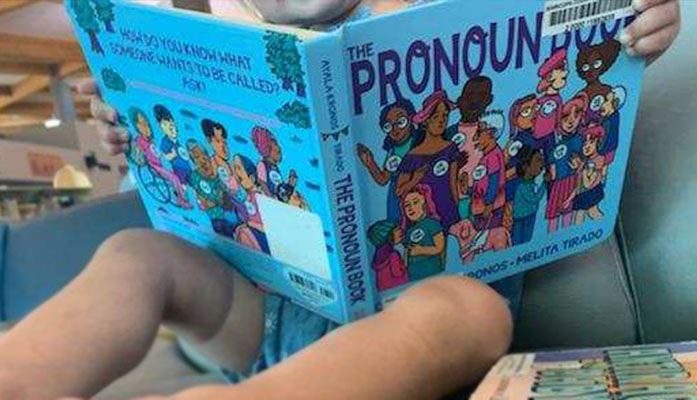
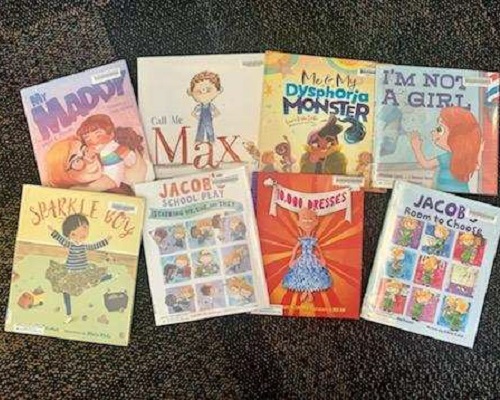
The controversial children’s books included the “Pronoun Book,” “My Two Dads,” “I’m Not a Girl,” “Antiracist Baby,” “Me & My Dysphoria Monster,” “My Maddy, “Call Me Max,” “Sparkle Boy,” “Jacob’s School Play: Starring He, She, and They” “10,000 Dresses,” “Jacob’s Room to Choose,” “Stella Brings the Family,” “Love Makes a Family,” “Lovely,” “Grandad’s Camper,” “What Riley Wore,” “My Rainbow,” “Prince & Knight,” “And Tango Makes Three,” “Mommy, Mama, and Me,” “Julian is a Mermaid,” “King & King,” “One Family,” “In Our Mothers’ House,” “Happy in Our Skin,” “Morris Micklewhite and the Tangerine Dress,” “Jacob’s New Dress,” “Uncle Bobby’s Wedding,” “Home at Last,” “This Day in June,” “Fred Gets Dressed,” “When Aidan Became a Brother,” “My Shape is Sam,” “Adventures With My Daddies,” “Papa, Daddy, 7 Riley,” “Except When They Don’t,” “Jack (Not Jackie),” “Mr. Watson’s Chickens,” “Old MacDonald Had a Baby,” “Rainbow: a First Book of Pride,” “One of a Kind, Like Me,” “Sam is My Sister,” “A Plan For Pops,” “From Archie to Zack,” “Bye Bye, Binary,” “My Shadow is Pink,” “It Feels Good to Be Yourself,” “The Truly Brave Princesses,” “The Bread Pet,” “Peanut Goes For the Gold,” and “Patrick’s Polka Dot Tights.”
LGBTQ and anti-racist children’s board books featured in a Maricopa County Public Library.
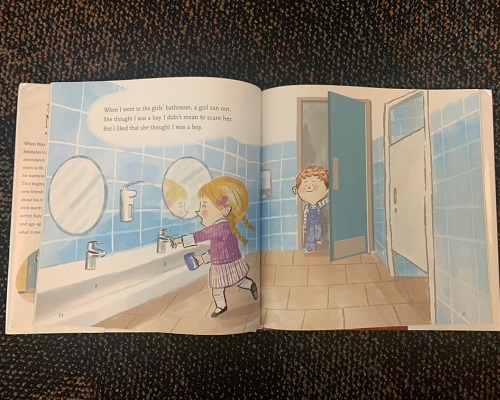
In “Call Me Max,” a little girl dressed like a boy scares another little girl as she enters the bathroom; her peer believes the little girl is actually a boy.
“When I went to the girls’ bathroom, a girl ran out,” read the book. “She thought I was a boy. I didn’t mean to scare her. But I liked that she thought I was a boy.”
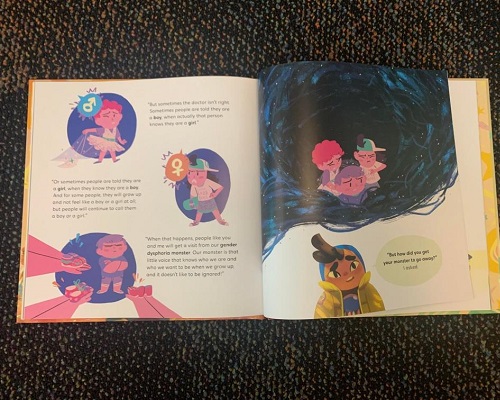
In “Me & My Dysphoria Monster,” the protagonist grapples with his gender identity.
“Sometimes people are told they are a boy when actually that person knows they are a girl,” stated the book. “Or sometimes people are told they are a girl when they know they are a boy.”
The book then advises the reader that a “gender dysphoria monster” may visit, and warns that it “doesn’t like to be ignored.” The book teaches the reader that children who ignore this gender dysphoria monster will only result in it growing bigger, and that the only remedy for it is to identify as the opposite gender. The moment of triumph between the little boy and the “gender dysphoria monster” was when he was allowed to join the girls’ soccer team.
In “Antiracist Baby,” children are taught that they must see other people’s races rather than be “color-blind,” that not every race is treated equally in society, and that they should always be watching out for instances of racism. It also included depictions of same-sex couples, teaching that no lifestyles are better or worse.
Some of these controversial books were declared “award-winning” works at one point by the American Library Association’s (ALA) Stonewall Book Awards. The award-granting organization has issued awards for LGBTQ+ works since 1971, but only began issuing awards to children’s and young adult books since 2010.
Awards were granted to: “10,000 Dresses” (2010), “Mommy, Mama, and Me” (2010), “Morris Micklewhite and the Tangerine Dress” (2014), “This Day in June” (2014), “Julian Is a Mermaid” (2019), “When Aidan Became a Brother” (2020), and “Grandad’s Camper” (2022).
Some of the younger children’s books were given special recognition with their inclusion on the 2023 Rainbow Book List, organized by the ALA’s Rainbow Round Table. The list includes nearly 200 books discussing LGBTQ+ ideology published between 2021 to present.
“The importance of this list (and others like it) cannot be understated, especially in a time when we are seeing a record number of efforts to ban both materials and support for LGBTQIA+ young people and their families,” stated the ALA. “The suppression of these books is a detriment to all youth, and we cannot ignore the damage these challenges are having on the young people in our society.”
In addition to the ALA’s Stonewall Book Awards and Rainbow Book List, there’s the Walter Dean Myers Award and the Lambda Literary Award.
Click an image in the gallery below for more images:
Corinne Murdock is a reporter for AZ Free News. Follow her latest on Twitter, or email tips to corinne@azfreenews.com.