by Staff Reporter | Jul 22, 2024 | Education, News
By Staff Reporter |
Another one of Arizona’s middle-of-the-road legislative districts may be represented by a liberal after November’s General Election if enough Democrats and left-leaning independents have their say.
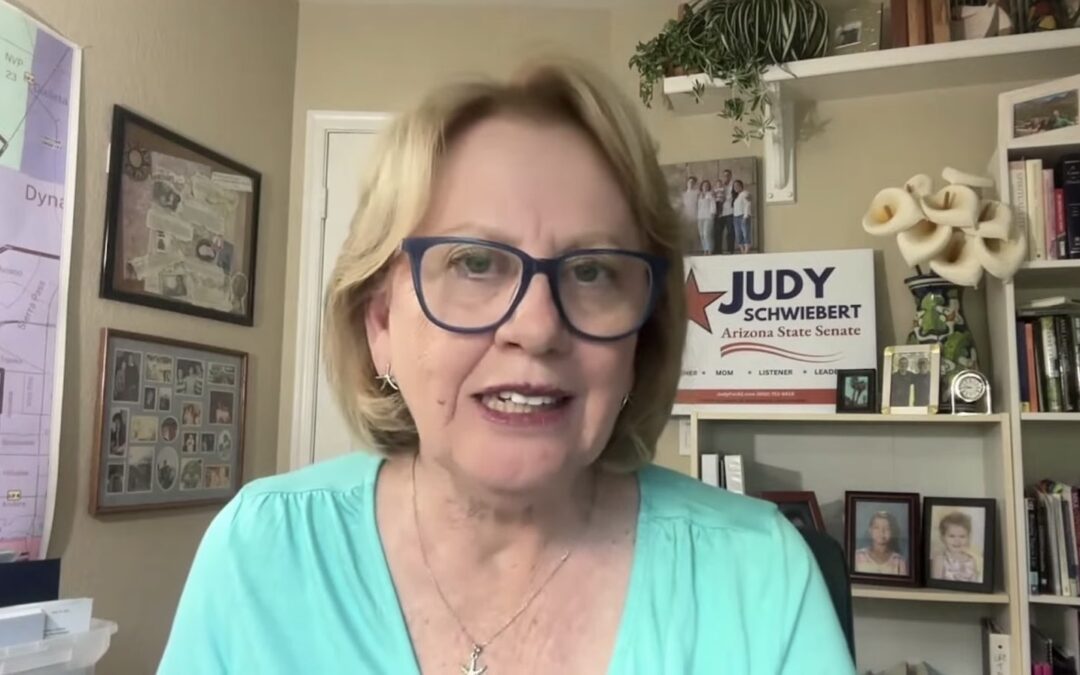
Judy Schwiebert, a Democrat, is running for the Arizona State Senate in Legislative District 2. Schwiebert currently serves as a State Representative for the district. She announced for the seat in June 2023, saying that “we need people who will work together to focus on the toughest challenges facing Arizonans including our teacher, affordable housing, and water shortage crises.”
Schwiebert posted more than 1,600 signatures at the Arizona Secretary of State’s Office earlier this spring to qualify for the ballot.
The Democrat legislator has been endorsed by several left-leaning organizations, including National Organization for Women Arizona PAC, Arizona Education Association, Moms Demand Action, Save Our Schools Arizona, Arizona List, Jane Fonda Climate PAC, the Grand Canyon Chapter of the Sierra Club, Emily’s List, Moms Fed Up, and Human Rights Campaign PAC.
If voters were to select Schwiebert over the Republican favorite in the district’s primary, Shawnna Bolick, they would be sacrificing one of the state’s strongest school choice proponents for one of the top opponents of educational opportunities and freedom for students and families. In a recent interview with a local outlet, Schwiebert set her sights on the Empowerment Scholarship Account (ESA) program, which has given tens of thousands of Arizona families the opportunity to choose the education that best suits their children, saying, “What we cannot afford is to create an entirely separate private school system – funded by taxpayer money – that siphons almost a billion dollars a year out of the state budget. That’s what the universal ESA voucher program is doing. It is creating huge deficits. It is preventing us from investing in all kinds of things that Arizonans urgently need.”
In June 2022, Representative Schwiebert voted against the bill that expanded the ESA program in the state (HB 2853), which was the first of its kind in the country.
Schwiebert’s endorsements from Arizona Education Association and Save Our Schools Arizona also speak volumes about what she would continue to do in the state senate to undermine school choice opportunities for her constituents. In its 2023 Legislative Policy Priorities, Save Our Schools Arizona wrote that “Diverting public funds away from public schools toward private schools through ESAs and STOs only exacerbates the crisis – especially with universal ESA vouchers directing state tax dollars overwhelmingly to families who never sent their children to public schools in the first place. This negatively affects Arizona students and families, leaving the next generation unprepared for success and risking our state’s future.”
On her “X” account, Schwiebert has posted her participation with Save Our Schools Arizona at different events.
The Arizona Education Association is also an ardent opponent of the state’s many educational freedom opportunities. After Democrat Governor Katie Hobbs signed the state’s budget in 2023, which she negotiated with Republican legislative leadership, the Association wrote, “It’s extremely frustrating that this budget does not address the growth of the state’s out-of-control voucher program. The extremist majority in our state legislature has ignored the will of Arizona voters and pushed through policies that bankroll private schools for the wealthy at the cost of the public schools attended by 90% of Arizona kids…This unchecked spending is completely irresponsible and is on track to bankrupt our state. The fight to repeal vouchers during next year’s legislative session starts today.”
Earlier this year, Schwiebert bemoaned the resistance of Arizona Republican legislators in the House majority “to even consider sensible legislation to raise educator pay…”
However, during the 2023 Arizona Legislative Session, Schwiebert voted against HB 2800 in committee, which would have “mandate[d] each school district and charter school increase the base salary of all eligible teachers” – according to the overview provided by the state House of Representatives. That bill, which was sponsored by Republican State Representative Matt Gress, received a green light from the House Appropriations Committee, but failed to make it out of the full chamber for the Senate’s consideration.
Schwiebert explained her vote at the time, saying, “The bottom line for me is well, this bill is really, I think, well-intentioned, and it’s good that, I’m glad to hear that Mr. Gress is acknowledging that teachers deserve higher pay, they absolutely do. But unfortunately, there are some serious flaws in this bill that I’m concerned could leave public schools in a worse financial position than they are in now.”
Representatives from both the Arizona Education Association and Save Our Schools Arizona registered opposition to the legislation on the Arizona Legislature’s Request to Speak system.
Arizona Legislative District 2 is one of the most competitive in the state, with a 3.8% vote spread in the past nine statewide elections. It is very winnable for Republicans, however, as the party has emerged victorious in six out of those nine elections. The district covers a large portion of northcentral Phoenix.
Schwiebert is running unopposed in the July primary election for Democrats. She will face off against the winner of the district’s Republican primary contest for state senator, which features incumbent, Shawnna Bolick, and Josh Barnett.
Bolick told AZ Free News that her “general election opponent was voted in shortly after she helped collect signatures for a ballot initiative that would have levied a billion dollar tax on small businesses not only hurting these business owners, but our state’s economy.” She added, “[Schwiebert] cares more about protecting special interests than voting for common sense education policies that gives every kid a chance to thrive in the school of their choice.”
AZ Free News is your #1 source for Arizona news and politics. You can send us news tips using this link.
by Staff Reporter | Jul 21, 2024 | Education, News
By Staff Reporter |
A politically middle-of-the-road legislative district may be home to one of the state’s most liberal elected officials if voters turn to Democrat representation in the November General Election.
Karen Gresham, a Democrat, is campaigning for the Arizona House of Representatives in Legislative District 4, which covers an area of northcentral Phoenix. She currently serves as a Governing Board President for the Madison Elementary School District. In addition to her run for state house, Gresham is running for re-election to this Governing Board, where she hopes to sit for another four-year term.
On March 29, Gresham announced that she and her Legislative District 4 running mates had filed their signatures to qualify for the ballot.
Gresham appears to be an unashamed liberal Democrat, who has a lengthy record of supporting Democrat organizations, causes, and candidates. On OpenSecrets.org, a Karen Gresham from Phoenix is reported to have contributed to the Democratic Party of Arizona, Save Our Schools, Planned Parenthood of Arizona, Arizona List, Hillary Clinton, Katie Hobbs, David Garcia, Fred Duval, Ruben Gallego, Adrian Fontes, Kris Mayes, Ann Kirkpatrick, Greg Stanton, LD4 Democrats, and several other Democrat interest groups, and legislative candidates and incumbents.
The Democrat candidate is endorsed by a plethora of liberal special interest and advocacy groups, including Arizona List, Moms Demand Action, Human Rights Campaign of Arizona PAC, Sierra Club, Save Our Schools Arizona, Emily’s List, and National Organization for Women Arizona PAC.
Gresham would undoubtedly give Democrats another ardent pro-abortion vote in the legislature. On June 24, she posted to her “X” account that “in the two years since the Supreme Court’s Dobbs decision, Arizonans reproductive freedom has been in a state of uncertainty. We MUST pass the Arizonans for Abortion Access initiative and flip the legislature to protect reproductive freedoms.”
When Gresham was endorsed by Emily’s List in May, she boasted that she has “been a champion for reproductive freedom for years and will continue to advocate for policies that ensure our rights.”
On her campaign website, Gresham portrays herself as a reasonable education advocate with her experience on the Madison Elementary School District board, writing, “I know what Arizona schools, teachers, and students need,” and that “I am deeply passionate about education and improving our schools.”
However, the truth appears to be far different. At a campaign event this summer, Gresham, when speaking about her views on education, said, “We’re funding three systems right now: charter schools, public schools and the ESA system. So, we need to consolidate those and bring the funding back under the public school umbrella because it all falls into place after that.”
In 2020, Gresham expressed her displeasure over “public charter schools receiving small business PPP,” adding that “this is not ok!”
Gresham is also supported by the Progressive Change Campaign Committee (PCCC), which is raising political funds for her race to “help Dems pick up the ONE SEAT they need to flip the Arizona State Legislature from red to blue.” PCCC advocates for liberal policies such as the Green New Deal, Medicare for All, and Debt-Free College. The organization also touts its partnership with Senator Elizabeth Warren on federal legislation, and its appreciation of net neutrality, which PCCC highlights was “celebrated by the Obama administration.”
She is also endorsed by Sister District Project South Bay, which posted its support of “candidates in key state legislative races where we can build momentum at the bottom of the ticket to benefit the strategic higher-ticket Democratic opportunities in states like Pennsylvania, Arizona, North Carolina, and Nevada.” The organization states that “by helping progressive candidates win elections, we aim to …enact climate actions and environmental justice now, racial and gender equity, protect reproductive rights, and so much more.”
Legislative District 4 is one of the most competitive in the state with a 3.4% vote spread between Republicans and Democrats in the past nine statewide elections, according to the Arizona Independent Redistricting Commission. Republicans have won five of those contests, compared to four for Democrats.
Gresham is running alongside former State Representative Kelli Butler in the Democrat Primary. The two will face off in November’s General Election against incumbent State Representative Matt Gress and Pamela Carter, who will both emerge from the Republican Primary.
Currently, there is only one legislator representing Legislative 4 (Gress) due to a Democrat’s resignation last month. Earlier this month, Gresham was one of three Democrats nominated to the seat (with Kelli Butler and Eric Meyer) to be considered by the Maricopa County Board of Supervisors. One of those individuals will be selected by the Board to serve for the duration of the term (until early January 2025).
AZ Free News is your #1 source for Arizona news and politics. You can send us news tips using this link.
by Staff Reporter | Jul 20, 2024 | Education, News
By Staff Reporter |
A public servant and school choice warrior of the Arizona Legislature is key to Republicans’ control of the Senate chamber in the next two sessions.
State Senator Shawnna Bolick is hoping her constituents give her the green light to come back for her first full term in the Arizona Legislature after returning from a brief hiatus. Bolick was appointed by the Maricopa County Board of Supervisors in July 2023, when then-State Senator Steve Kaiser surprisingly resigned from his office. The Phoenix-area mother of two had previously served for two terms in the Arizona House of Representatives (2019-2023).
After leaving the legislature in January 2023, Bolick turned her eyes to other priorities. In an exclusive interview with AZ Free News, Senator Bolick revealed that she and her husband were preparing to sell their house in order to downsize, being that their two children are on the cusp of setting out on their own. Additionally, Bolick and her husband Clint (an Arizona Supreme Court Justice) had started the process of setting a heavy travel schedule over the next two years at the time of her exit from politics.
In fact, the Bolicks were abroad when the call came for Shawnna’s return to the Arizona Legislature, and unsurprising to most around her, she couldn’t resist the chance to return to public service. She told AZ Free News that she was in London when the opportunity first arose for a possible appointment to the state senate, which was created by Kaiser’s vacancy. Then, she was in Prague when the Maricopa County Board of Supervisors selected her for the position. That’s when Bolick’s travel wings were temporarily clipped thanks to her commitment to the challenging schedule of legislating and campaigning for re-election.
Senator Bolick told AZ Free News that she desired to return to the frontlines of this toxic political climate because “we are facing challenging times fighting Biden’s inflationary policies at the national level and Hobbs’ woke policies are driving a stake between families and a growing nanny government.” She added, “When I was recruited back, it was to help maintain our majority and save educational freedom.”
The Republican legislator shared that she has been most influenced by William Bennett as she grew up and started down her path of public service. At age nineteen, Bolick read Bennett’s book, “The Devaluing of America: The Fight for Our Culture and Children.” She said that the book “truly called out to me and shifted my interests from wanting to be a writer to restoring hope in our education system,” and that Bennett’s words “also challenged me to want to go to D.C. and work.”
Later, Bolick studied education policy in college and graduate school. She worked in a New York City public school in 1997. It was there she realized the necessity of more school choice opportunities for everyone – especially for low-income families.
Few people are more passionate about school choice and educational freedom in Arizona than Shawnna Bolick. She noted that “When families realize they have more than one educational option available, not only does it give them hope for a better future for their kids, but families feel empowered to try to make the right decision.”
She recounted a time in New York City, when she and some colleagues went to all five boroughs to recruit families trapped in their nearby public schools to their magnet institution. The public-school employees went to fast food restaurants and street corners to inform New Yorkers about the school’s existence. Thinking back about this experience, Bolick marvels at her coalition’s willingness to “spend their free time recruiting families to a public school because it was an option other than their locally zoned neighborhood public school.”
Bolick pointed out that many of the parents they met on these incursions could not afford to send their children to private school – even though they might have been working multiple jobs. These lessons and meetings spurred Bolick on to her life in public service out west, advancing the principles of educational opportunities for all.
Back in the Arizona Legislature this time around, Senator Bolick serves as the Vice Chairman of the Senate Finance and Commerce Committee and a member of the Education Committee.
When thinking back over her time in the legislature over the past two years, Bolick highlighted a ballot referral as her proudest achievement, saying, “I sponsored Proposition 313 to put child sex traffickers in prison for natural life. If the voters pass this proposition in November, it will send a powerful message that Arizona’s children are not for sale. With a wide open border, I hope voters agree it is time to protect our children from sexual exploitation through trafficking.”
If Bolick is given the honor of representing her district again in the state senate, she is already planning the next policies she would prioritize in office. She said she has “an expandable folder sitting on my desk at the Capitol [where she] started to keep newspaper articles, policy papers, but more importantly, constituents who contacted me to research and draft future legislation.” One of the legislation ideas she is working through is “to deal with the bullying in our schools.” Bolick acknowledged that “we need to get to the root of the problem because bullying continues to get worse, leading to kids missing weeks of school.”
Arizona Legislative District 2 is one of the most competitive in the state, with a 3.8% vote spread in the past nine statewide elections. It is very winnable for Republicans, however, as the party has emerged victorious in six out of those nine elections.
Bolick is competing against Josh Barnett in the Republican primary. The winner of that contest will earn the right to face off against Judy Schwiebert, who is running unopposed in the Democrat primary election.
AZ Free News is your #1 source for Arizona news and politics. You can send us news tips using this link.
by Matthew Holloway | Jul 19, 2024 | Education, News
By Matthew Holloway |
The Dysart Unified School District Governing Board voted unanimously to reject a recent Executive Order from President Joe Biden imposing new Title IX rules on schools via the US Department of Education. The new rules would, among other impacts, redefine “sex” to include “gender identity,” therefore requiring schools to reject biological sex in favor of how a student chooses to present themselves. The new rules released on April 19, 2024, are currently enjoined by federal court orders in 15 states, preventing enforcement, but as of this report are still applicable in Arizona.
Dysart Unified School District Governing Board President Dawn Densmore told reporters from the Arizona Daily Independent on Sunday, “The resolution I created in response to President Biden’s Executive Order and the United States Department of Education was adopted by unanimous vote at our meeting on July 11th.”
She added, “It’s an honor to lead the way in efforts to protect children and our faith communities from this government overreach.”
A Louisiana Federal District court in June found that the new Title IX rules constitute a significant federal overreach with Ogletree Deakins noting from the ruling:
- “The Department exceeded its statutory authority under Title IX by redefining ‘sex’ to include ‘gender identity.’ The court found that based on the plain text and legislative history of Title IX, ‘sex’ was intended to refer to biological sex, not gender identity.
- The new rules raise First Amendment concerns by potentially compelling speech, such as requiring teachers to use students’ preferred pronouns, even if doing so conflicts with their religious beliefs, and engaging in viewpoint discrimination.
- The Department’s rulemaking was arbitrary and capricious. The Department failed to provide a reasoned explanation for departing from long-standing interpretations of ‘sex,’ left regulations in place that conflict with the new ‘gender identity’ mandate, and failed to adequately address safety concerns raised in public comments.”
In response Densmore told the Independent that the Dysart Unified School District Governing Board:
- “Will not demand that parents or guardians compel the speech of their minor children, or the First Amendment rights of our staff in a way that contradicts their family values or religious freedoms
- Already has current discrimination policies in place which protect every student, staff member and job applicants
- Is committed — while not adopting the Title IX expansion — to honoring the original intent of Title IX, our U.S. Constitution, and the Constitution of the State of Arizona
- Is committed to empowering parental involvement in education and minimizing public monies to be used to promulgate obtuse overreach into our schools.”
Arizona Women of Action shared the resolution via X on July 11 commenting, “This model conservative school board needs support.”
The board resolved in part: “WHEREAS, the Dysart Governing Board is committed to empowering parental involvement in education and minimizing public monies to be used to promulgate obtuse overreach into our local school district and criminalizing innocent children, or the people of the varying faiths that commonly and firmly believe in truth, such as a Creator of two distinct and wonderfully made sexes, and;
BE IT RESOLVED that the Dysart Unified School Governing Board has determined:
1. The United States Department of Education has created a Final Regulation which is contrary to the plain language of Title IX
2. The Governing Board, deriving authority from the Arizona Constitution, Arizona statutes and the regulations of the Arizona Administrative Code, strongly urge the Arizona State Legislature to further codify our state statutes to ensure our children are protected from the political weaponization of government, which would infringe on both federal and state constitutional rights.”
According to the Arizona Republic, the board of the Dysart Unified School District was also to receive legal guidance on the “legal process for challenging” the regulatory change.
AZ Free News has contacted Densmore and asked for the next steps the board is preparing to take and will provide an update when received.
Matthew Holloway is a senior reporter for AZ Free News. Follow him on X for his latest stories, or email tips to Matthew@azfreenews.com.
by Matthew Holloway | Jul 18, 2024 | Education, News
By Matthew Holloway |
Dr. Owen Anderson, a professor at Arizona State University’s Center for the Study of Religion and Conflict, offered an analysis of the philosophy of early communist thinker Friedrich Engels in a video posted to his Substack on July 8. He described it as “a sustained attack on the Christian family.” What resulted from this academic critique of Engels, which directly quotes his widely acknowledged public work, were a series of attacks on the professor and defenses of the communist thinker from what Anderson dubbed “anonymous (usually brand new) accounts,” and “trolls.” One of these commenters, under the screenname “RD,” replied to Dr. Anderson’s initial post claiming, in part, that Engels, “discusses in the same section of the book, that arrangement describes Greek and Roman pagan marriages as well as later Christian ones. Since these predate and do not depend on Christian ideas, he’s not attacking Christianity per se.”
Check out Dr. Anderson’s initial post here.
The commenter continued, “As for ‘radical leftists at state universities’ — the vast majority of university professors are in monogamous relationships roughly of the kind Engels describes, with the important caveat that in our time there are far greater legal protections for wives (a fantastic improvement since Engels’ writing). It’s not at all clear that they ‘hate’ this form of the family or ‘teach’ this hatred regularly. In other words, as usual, either you don’t know what you’re talking about or you have disingenuously ripped a statement out of context in order to increase your own sense of victimhood.”
Anderson responded to the commenter that he doesn’t engage with “anonymous trolls” and added rather congenially, “If you’d like to be honest about who you are I’d be happy to discuss these points. You’re mistaken about the purpose of Engels and what it means to hate.”
In response, “RD” accused the professor of being “litigious” and “thin skinned” with ASU and his colleagues citing as evidence “your very public statements on this blog, where you constantly whine about mundane matters to agents of the state.”
He added, “Only a fool would risk having you file a frivolous lawsuit over a blog post. It is enough for me that your readers would double-check your ‘work’ against the evidence of Engels’ own text, where they would very quickly see that you don’t know what you’re talking about.”
He claimed to disagree with Engels and accused Dr. Anderson of “not reading these texts honestly and accurately, the duty of any intellectual.”
WATCH MORE
In a subsequent paid post, Dr. Anderson stated in part,
“One of the surprising not surprising things I’ve experienced since calling out bias against Christians at state universities is that those who want to attack me hide behind anonymous (usually brand new) accounts. I know the internet is full of such trolls. That isn’t what surprises me. What surprises me is that these cowards claim to be either professors or know how to defend professors. They want your tax money to teach your children, but they won’t be honest about what they believe.”
He added, “If they can’t be honest about who they are then I don’t engage with them. They need to own their arguments. If they want to engage in the public square and they believe their cause is just and true, then they should be eager to attach their name to it. But they won’t. This one went on to tell me I’m thin skinned! Imagine insulting any other religion and then telling that person they are thin skinned if they call you out.” He then bid the commenter “Bye, bye.”
Anderson’s determined commenter still wasn’t finished though and launched into a criticism of the professor for his work at ASU combating academic cancel culture referring to the pervasive anti-Christian bias the professor has striven against as “free of speech,” and accusing him of “a very public campaign with Arizona legislators trying to get your colleagues fired.” He further alleged that Anderson, “constantly snitch-tag(s) politicians and media influencers on twitter, including actors like Charlie Kirk whose purpose is to intimidate and harass college professors.“
The pseudonymous “RD” concluded, “You suggested that ASU should discipline your colleague for a social media post that you claim mocks (your understanding of) Christianity, and you think politicians should concern themselves with the (non-required) recommended reading list of a program at your institution. In short, you have no respect either for free speech or for academic freedom, and so you shouldn’t be surprised when no one wants to talk to you. That’s all from me.”
In what appears to be the final exchange between the two, Dr. Anderson incisively cut to the core of the commenter’s argument and eviscerated it noting: “This post is a present. Thank you. You’ve admitted that academics don’t have to keep their own standards about sensitivity and not insulting other religions (in the name of free speech and academic freedom). I’m looking forward to seeing you apply this. No wonder you want to stay anonymous.”
“Dr. A,” to use his sobriquet from his Substack, concluded by highlighting the aforementioned exchange with a few key notes:
1. “RD didn’t respect my boundary. I said I won’t engage with anonymous trolls. RD didn’t dispute that title, but insisted I must listen to more insults. That is called stalking. It is a behavior ASU prohibits.
2. RD calls me a snitch. Is this the third grade playground? What RD doesn’t like is that I’m a whistleblower and that those he is defending are guilty of the very thing they preach against. They preach sensitivity but want to ban Christians and conservatives from campus. RD calls this freedom. He calls me defending the right for Christians and conservatives to speak on campus ‘snitching.’ The truth is I am a whistleblower and have protected rights under federal and state law as well as the ASU faculty manual. RD knows that coming at a whistleblower will result in trouble and so wants to be anonymous.
3. RD insults me for ‘snitching’ on a colleague who insulted Christians on social media. Imagine if this was any other group than Christians. RD would help fill out the disciplinary form and hand it in to ASU.
4. What hasn’t happened. I have had a handful of ASU professors come at me to insult me since I began speaking publicly about abusive behavior towards Christians. I haven’t heard them say, ‘we should examine our behavior.’ They very clearly teach that it is wrong to insult a person’s religion. However, they want to get away with doing so toward Christians. They want freedom of speech protected for their radical leftist beliefs, but they deny that same thing to conservatives.”
The professor signed off the post with a promise that he would continue to call out his critics on their hypocrisy adding, “If that means they call me names then I’m looking forward to it.” And left his readers with a quote from Socrates writing, “When one of his disciples asked Socrates, ‘aren’t you worried what people will think of you?’ he replied, ‘I only care what thoughtful people who take time to investigate the situation will think.’”
When reached for comment by AZ Free News, Dr. Anderson confirmed that the commenter “RD” has made no further effort to contact him, and they have not revealed their identity. You can subscribe to Dr. Anderson’s Substack here, to read about his ongoing work to expose academia’s hostility toward Christianity.
Matthew Holloway is a senior reporter for AZ Free News. Follow him on X for his latest stories, or email tips to Matthew@azfreenews.com.
by Daniel Stefanski | Jul 15, 2024 | Education, News
By Daniel Stefanski |
Another political battle may be brewing over Arizona’s historic school choice program.
Earlier this week, Arizona House Speaker Ben Toma sent a letter to Tom Horne, the state’s Superintendent of Public Instruction (ADE), over his department’s controversial decision to acquiesce to Attorney General Kris Mayes’ demands to increase regulation of the Empowerment Scholarship Account (ESA) program.
In his letter, Toma wrote, “I understand that you may have no choice but to cooperate with the Attorney General’s politically-motivated investigation. However, ADE is best situated to determine how to implement its policies in a way that fulfills legislative intent but does not burden parents with unnecessary bureaucratic requirements.”
Toma added, “As you implement your Department’s policies, I urge you to scrutinize Attorney General Mayes’ unsolicited legal advice expressed in her July 1, 2024, letter, consider how her interpretation of Arizona statutes would impact parents throughout the state, and reject her interpretation of the law that would lead to absurd results.”
The Republican Speaker’s communication addressed an email from ADE ESA Executive Director, John Ward, to parents within the program, informing them about a letter he had received from Mayes’ Solicitor General. According to Ward, that letter “stated that some ESA program practices are inconsistent with State law and result in payment of ESA funds without authorization of law, [and that] the Solicitor General’s Office has directed the ESA program to address the issues it identified.”
The Attorney General’s Office cited two Arizona statutes to bolster its argument that “the Arizona Department of Education has approved certain supplemental items and textbooks without requiring curricula, which may result in ‘illegal payment of public monies.’” Ward told parents that “ADE has no choice but to comply with the Solicitor General’s determination,” forcing families to “submit a curriculum with all supplemental materials requested or purchased” – something that he even noted was a practice “in place since before the current ADE administration.”
Horne’s acceptance of Mayes’ interpretation of the law was surprising to many onlookers, being that his office has been at odds with the Attorney General’s Office on almost every issue related to this program. Previously, Horne issued a number of statements that expressed his ardent opposition to the Democrat Attorney General’s persistent attacks on the ESA program and vowing to match her office step for step in defense of parents.
One of the foremost experts and defenders of the ESA program, Christine Accurso, addressed this action by Horne’s office, writing, “I joined the ESA program as a parent in 2014 and in all of the years we participated, I never had to submit curriculum that listed pencils and paper (for example) as something I can use ESA funds for. This new regulation is not what the legislature intended. If you go back and listen to the many years of committee hearings you will clearly hear the lawmakers desired to give parents access to tax dollars to provide an excellent education for their child, putting them on equal footing financially (while providing a 10% savings) to what the state funds in the public schools. I don’t know of a school district in Arizona, let alone America, who has curriculum for such obvious supplemental educational materials, as noted above.”
Accurso’s sentiments were reciprocated by Speaker Toma, who in his letter to Horne, stated, “it appears that the Attorney General’s Office is advancing an argument that documentation is required for most ESA-related expenses. The legislative record does not support such an overtly restrictive view or burdensome administration of the ESA program.”
Speaker Toma concluded his letter by expressing his appreciation for Horne’s “willingness to discuss these implementation issues with legislators who – like parents – are understandably concerned about the Attorney General’s letter.”
Daniel Stefanski is a reporter for AZ Free News. You can send him news tips using this link.