by Daniel Stefanski | Sep 19, 2024 | Education, News
By Daniel Stefanski |
Arizona’s Republican school’s chief is taking additional action to raise awareness for Holocaust education.
Earlier this week, State Superintendent of Public Instruction Tom Horne presented the Arizona Jewish Historical Society with a seven-million-dollar check for the purpose of creating the Hilton Family Holocaust Education Center.
The mission of the center, per its website, is that it will be “dedicated to exploring the lessons of the Holocaust and other crimes against humanity. The Center educates and inspires visitors of diverse backgrounds through survivor stories, artifacts, immersive media experiences, community outreach, and public programs.” Its vision is to “inspire visitors to learn from the Holocaust, to become upstanders, and to work toward a world without hatred and bigotry.”
Horne stated, “In the past year, we have seen the unbelievable and tragic targeting of the Jewish community with the horrific acts committed on innocent men, women and children by Hamas in Israel, the ignorant and misguided protests against Jews on college campuses and the endorsement of antisemitic literature in some Arizona classrooms. This cannot go unchallenged, and educating people is one of the most powerful tools to face this scourge. Developing the Hilton Family Holocaust Education Center is a needed step toward bridging understanding between people of all ethnicities and belief systems and I am grateful to be a part of this important cause.”
Joining Horne at the presentation were State Representatives Alma Hernandez and David Marshall. Arizona business leader Steve Hilton also appeared alongside the state officials.
It was bipartisan legislation spearheaded by Hernandez and Marshall that made the check presentation from the Arizona Department of Education possible for the benefit of the Center.
According to the Center’s website, the explanation for why it is being created at this time is because “Phoenix is the fifth largest city in the United States, yet it is the largest U.S. city that does not have a Holocaust museum or education center. With anti-Semitic and hate crimes on the rise over the last five years in Arizona and the United States, now is the time to build a new center to raise awareness and educate the community so that we can help to address these critical issues that affect all groups of people that may be marginalized and made vulnerable to discrimination. When one group’s freedom is curtailed, all people are susceptible to prejudice and injustice.”
Daniel Stefanski is a reporter for AZ Free News. You can send him news tips using this link.
by Staff Reporter | Sep 19, 2024 | Education, News
By Staff Reporter |
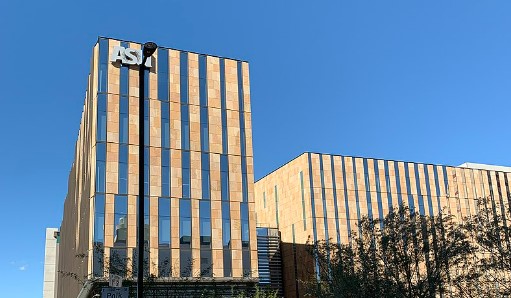
Arizona State University (ASU) hosted a forum Sunday alongside left-wing groups to mobilize young voters in both high school and college for the upcoming presidential election.
ASU’s Walter Cronkite School of Journalism and Mass Communication held the “New Generation Voter Forum,” specifically targeting Gen Z and Millennial voters (those born between 1997 and 2012, and between 1981 and 1996). Organizers billed the forum as a nonpartisan event offered to represent the facts and prepare new young voters for November.
Key organizers of the event were the Tempe Alumnae Chapter of Delta Sigma Theta Sorority alongside the historically black sorority’s ASU chapter, Iota Kappa.
Group participants within the forum included the Greater Phoenix Urban League of Young Professionals, League of Women Voters of Arizona, Black Student Union (BSU) DPC, and the National Association of Black Journalists (NABJ) at ASU.
These groups have long been advocates for left-wing causes and movements, namely Black Lives Matter.
At one table to register the young voters in attendance, a woman representing the League of Women Voters of Arizona wore a “Vote” shirt depicting the black fist to represent BLM, a uterus to represent abortion rights, and the pride flag to represent gender and gay ideologies. On the table were pamphlets on different ballot issues, including Ranked-Choice Voting.
Kara Pelletier, at-large board member for League of Women Voters of Arizona and president-elect of the Metro Phoenix Board, told Cronkite News it was “critical” to get more of the youth registered to vote. Pelletier was formerly the Arizona chapter leader for the prominent national gun control group, Moms Demand Action for Gun Sense in America.
“It’s critical that our youth get engaged and remain engaged. They’re actually a larger voting bloc than the next-largest voting bloc, which is boomers,” said Kara Pelletier of the League of Women Voters of Arizona. “That particular age group, 18 to 29, really is a huge section of the electorate, and they could really have a lot of influence and say in what goes on in our country, our politicians, what our budgets are focused on, who’s elected.”
Others also offered voter registration to the young participants: ASU through TurboVote, and Vote Everywhere. Both TurboVote and Vote Everywhere are programs of left-leaning organizations: Democracy Works and the Andrew Goodman Foundation, respectively.
The panel discussion centered around misinformation and disinformation in the media, such as deepfakes produced by artificial intelligence.
Featured panelists discussing media literacy and democracy included ASU professors Retha Hill and Pauline Arrillaga. Both professors have been vocal in their support of left-wing causes and Democrats, and critical of right-wing causes and Republicans including former President Donald Trump.
Arrillaga oversees the Carnegie-Knight News21 program within ASU. Under Arrillaga, their latest reporting projects cover stories related to the Supreme Court’s decision to overturn Roe v. Wade and the January 6 incident at the Capitol.
The forum also included roundtable discussions on the importance of voting, handling double residencies when voting, getting involved in elections as international or out-of-state students, understanding nonpartisan races, running for office, and understanding the issues on the ballot.
AZ Free News is your #1 source for Arizona news and politics. You can send us news tips using this link.
by Daniel Stefanski | Sep 13, 2024 | Education, News
By Daniel Stefanski |
Arizona’s Republican Superintendent of Public Instruction is sounding the alarm about the state’s dwindling pool of teachers.
Earlier this month, Arizona’s school’s chief, Tom Horne, announced the results of a teacher retention survey “that shows alarming numbers pointing to a crisis in the teaching profession.”
According to the release from the Arizona Department of Education, “A survey of nearly 1,000 teachers who left the profession after 2023 shows large numbers of educators left because of lack of administrative support for classroom discipline and a desire for better pay. Teachers are leaving the profession within the first few years of teaching at an alarming rate, and there are more teachers leaving than are coming into the classroom. If this were to continue, we would ultimately end up with no teachers.”
Horne said, “This is a crisis, and it needs to be addressed immediately. In the most recent legislative session, I urged the passage of a bill that would require school leaders to support classroom teachers in discipline matters. Sadly, it did not get passed by the legislature and the crisis will not only persist but will just get worse.”
He added, “I have also consistently advocated for higher teacher pay, and yet legislative efforts have been rebuffed because of political disputes that do nothing to help improve the salaries of teachers. In short, just about any classroom teacher can tell you what they need to thrive as educators and lead students to academic excellence. Better pay and robust support from administrators on discipline are vital.”
The survey from the department collected responses from 945 Arizona teachers. Per the press release, “about 67 percent cited low pay. Nearly 64 percent agreed or strongly agreed that they left teaching because of student behavior and discipline problems. Almost 47 percent said they were dissatisfied with their administration and just over 45 percent were unhappy with working conditions.”
Daniel Stefanski is a reporter for AZ Free News. You can send him news tips using this link.
by Staff Reporter | Sep 11, 2024 | Education, News
By Staff Reporter |
A Scottsdale-area mom is hoping that her success and positions on a local school district governing board will convince voters to elect her to the Arizona State Senate.
Carine Werner is currently running to represent Arizona Legislative District 4 in the state senate. She is an immigrant and small business owner, looking “to address the problems we face and help us protect the community we love together.”
Currently, Werner serves on the Scottsdale Unified School District Governing Board, where she has gained valuable experience for a potential move to the state Senate. In 2022, Werner gave an interview to the Scottsdale Progress Newspaper to outline her motivations for running for the position she would later assume, and to preview her action items and priorities for office.
She told the paper that she was running for the board because, “having experienced the past few tumultuous years with children in Scottsdale schools, I know the frustration and pain our students, families, and community experienced. I bring common-sense leadership, an enduring passion for securing our children’s future, respect for parents and teachers, and a skill for building consensus without compromising values.”
Werner then presented six promises to voters and parents of children within the Scottsdale Unified School District. The first was that she would “address parents’ rejection of SUSD.” She made this commitment because “A recent exit survey reveals that parents are concerned about failing academics, politically-charged classrooms, the promotion of ideological and anti-American rhetoric, and that they lack faith in the SUSD administration and the board.”
The Scottsdale mom added, “When I’m on the board, parental input will guide decisions made. I plan to partner with parents to curate the best educational experience for our children.”
The second promise was that she would “reverse enrollment decline and loss of funding.” Werner made this commitment because, “We cannot market our way out of this problem, nor should taxpayers’ foot the bill. We must restore academic excellence, close the achievement gap, and create a culture students will thrive in.”
The third promise was that she would “pay teachers first.” She made this commitment because “Although enrollment is down, SUSD increased administrative staff overhead. The Arizona legislature approved an additional $1 billion in year-over-year education spending, bringing the total K-12 spending for this year to $8.45 billion. In addition, federal funding and property taxes brings that total to $14.88 billion. Governor Ducey called on school board members to ensure these funds are directed to teachers. I commit to using my vote to prioritize those funds for teachers’ salaries and funding our classrooms first.”
The fourth promise was that she would “improve academic performance. Werner made this commitment because “With less than 37% of SUSD 10th graders proficient in math and ELA, a strategy to improve academic scores must be clearly stated, aggressive, and measurable. Yet, SUSD’s strategic development plan treats academics as an afterthought. We must get back to focusing on the basics. My commitment is to ensure that achievement programs will improve student proficiency and mastery of academic standards.”
The fifth promise was that she would “improve student safety.” She made this commitment because, “We must ensure the safety of our schools through support of our valued School Resource Officers, partnerships with the Scottsdale Police Department, and continuous review and improvement of our safety procedures.”
Werner also noted that, “The Arizona Legislature has approved $50 million in ongoing funding for school safety, supporting school resource officer salaries, and $20 million for the school safety interoperability program, which provides funding to county sheriffs for real-time communication solutions between schools and public safety agencies in the event of an emergency.”
The final promise was that she would “remove politics from the classroom.” Werner made this commitment because, “We must develop students’ interests, not identities. Politics and ideological rhetoric should have no place in our classrooms. I will work to remove the divisive curriculum that has been swept into our schools, restoring our education of revered American principles and ensure every student has the opportunity to thrive.”
It was this promise from Werner that led to the most controversy over her efforts to keep her commitments to constituents. Last year, Werner was unafraid to stand with Arizona Superintendent of Public Instruction Tom Horne when he addressed educational curriculum that may have been in violation of state law. Her appearance led to accusations against her from the president of the Scottsdale Unified School District Governing Board, Julie Cieniawski, claiming that Werner and another member of the board “showcased their inability to honor policy [duties and obligations] and the principles of democracy at an ‘emergency press conference,’ held by the State Superintendent of Instruction, to further complain about the outcome of the collective board decision.”
Cieniawski shared her opinion that “their public commentary contained inaccuracies, disparaged a minority population, and asserted erroneous judgments regarding the benefits SUSD students receive from a comprehensive and multi-faceted education.”
Yet, others saw this episode differently and appreciated Werner’s stand for the children and constituents of her school district. In an op-ed for the Scottsdale Progress, a retired public-school teacher, Susan Winder, defended Werner and called Cieniawski’s earlier piece “divisive, misleading, and frankly, embarrassing for our great city.”
Winder wrote, “Here’s my beef: Cieniawski has attempted to silence her fellow board members – the ones voters elected to represent them. And, while Carney and Werner attacked the content of the curriculum, Cieniawski has stooped to a new low by making personal attacks on Carney and Werner. As an SUSD stakeholder, I do not want the minority board members to be silenced by the majority members. I am grateful that we now have board members who care about the quality of curriculum SUSD offers to our students, as well as the legality of the lessons… and that they are willing to speak up.”
The promises and subsequent actions on the governing board from Werner earned her the support of several women who appeared in a campaign ad on her behalf this summer for her run for the state legislature. In that ad, the women announce their support for Werner, in large part, because of her trustworthiness to keep her commitments to her constituents.
The women say, “I’m not political. I don’t go to rallies. I don’t usually donate to candidates. But this election isn’t about politics to me. This election is about protecting our family and our community. I know Carine Werner. She’s a mom, a school board member, and most importantly she’s a fighter. She stands up for what’s right and not what is politically easy. Politicians say one thing and do another, which is why I trust Carine Werner. She’s not a politician. She’s a mom like me. Carine will fight for our families and help make our neighborhoods safe. It’s time to change who we send to the state Senate. Vote Carine Werner for state Senate. I trust Carine to stand up for us.”
The Republican candidate isn’t done making promises she intends to keep in office. She’s made more commitments to the voters in her new district should they send her to the state Senate. On her campaign website, the first of those promises is that she will fight to “increase teacher pay and reduce wasteful spending.” The second is that she will work to “empower parents.” The third is that she will strive to “empower and fund law enforcement.” The fourth is that she will vote to “secure the border.” The fifth is that she will attempt to “address homelessness with compassion and accountability.” The sixth is that she will work to “champion low-tax, business friendly environment.” The seventh is that Werner promises to advocate for policies that “generate job growth.” And finally, she vows to support efforts to “improve cost of living.”
Legislative District 4 is one of the most competitive in the state. According to the Arizona Independent Redistricting Commission, it has a 3.4% vote spread over the past nine statewide elections within its boundaries, with Republicans winning five of those contests.
Werner emerged from the Republican primary election in July and is facing off against incumbent Democrat state senator Christine Marsh for the right to represent Arizona Legislative District 4.
AZ Free News is your #1 source for Arizona news and politics. You can send us news tips using this link.
by Matthew Holloway | Sep 7, 2024 | Education, News
By Matthew Holoway |
The State of Arizona is deploying School Resource Officers (SROs) into additional schools through 2026. The firm Off Duty Management will be facilitating the deployment of armed, uniformed police officers into multiple schools across six counties as part of Superintendent Tom Horne’s agreement with the company.
According to a press release from the Arizona Department of Education, Horne announced the state’s partnership with Off Duty Management last October to facilitate the deployment of armed, trained and uniformed officers despite the shortage of police officers in many Arizona communities.
Off Duty Management is a firm founded by former law enforcement officers with a particular market in supporting law enforcement operations. It employs current officers during their off-duty time through it’s proprietary OfficerTRAK® software and mobile app enabling the officers to schedule opportunities to work as SROs at various participating schools.
Horne told reporters, “The safety of school campuses is a priority for my administration. If some armed maniac should try to invade a school, the most effective response is to have well-trained armed law enforcement officers to protect everyone on campus. Our partnership with Off Duty Management is a vital part of ensuring safety. It is proving to be a successful, effective public-private partnership and the first of its kind in the nation.”
Arizona Department of Education’s Director of School Safety Mike Kurtenbach explained, “This agreement with Off Duty Management is a complement to the School Resource Officer program and illustrates how police officers who work as school safety officers also are trusted role models for students, which brings a sense of safety to the school campus.”
He added, “With this innovation, an officer can be provided to a school even if the community where that school is located has a shortage of its own officers. Cross-jurisdictional sharing of resources makes perfect sense to use this strategy to protect children and others in schools.”
He observed that the arrangement places over 700 officers, trained and eligible under the law, to serve at the disposal of Arizona schools. Sixty districts or charters in Maricopa County and dozens more across five other counties are participating.
Speaking with AZ family, Horne said, “We didn’t say no to anybody because my nightmare is that some maniac would go into a school and kill 20 kids.” He noted that the actions of two SROs were critical to halting the rampage of a 14-year-old who attacked and killed two students and two teachers at Apalachee High School in Georgia. Horne told reporters the tragedy could have been much worse. “It saved a lot of lives,” he said.
In a post to X following the school shooting, Horne wrote, “My heart goes out to the people of Georgia today. And to those who continue to resist School Resource Officers in Arizona, please watch the news. These tragedies are recurrent nightmares demanding we prioritize safety in our schools.”
He explained that at present, “There are 228 SSOs that are full-time, then we have what are called school safety officers that are part-time,” and cited the expansion will vastly increase that number. He told the outlet that all schools requesting an SRO should get one.
Matthew Holloway is a senior reporter for AZ Free News. Follow him on X for his latest stories, or email tips to Matthew@azfreenews.com.
by Matthew Holloway | Sep 4, 2024 | Education, News
By Matthew Holloway |
Multiple sources have confirmed that two professors at Arizona State University, Dr. Angela Lober and Jenny Irish, spent an hour discussing with students “dismantling capitalism and electing a female president to restore reproductive rights.” They also asserted that, as Lober claimed, “the United States hates women and everything the female body does.”
The program in question: “Jenny Irish’s HATCH: A Speculative Future for Reproductive Rights,” was offered by the university through ASU Events on the website. The event was described as a workshop where, “Professor Irish will give a reading from Hatch, after which she’ll be joined in conversation by Dr. Angela Lober, Clinical Associate Professor and Director of the Academy of Lactation Programs at the Edson College of Nursing and Health Innovation. Come ready with your own questions and comments about the future of reproductive health in the face of climate change, misinformation, and other problems facing our present and our future.”
Hatch is a collection of prose poems from English Professor Jenny Irish. ASU described Hatch as, “This apocalyptic vision engages with the most pressing concerns of this contemporary sociopolitical moment: reproductive rights, climate crises, and mass extinction; gender and racial bias in healthcare and technology; disinformation, conspiracy theories, and pseudoscience; and the possibilities and dangers of artificial intelligence.”
The event, co-hosted by the Lincoln Center for Applied Ethics, took a decidedly apocalyptic turn according to College Fix, with Irish warning of a dystopian future for the United States complete with “cannibalism,” and “forced breeding camps.”
“So much of our reality points toward those futures,” she told attendees. Lober added, “The balance between hope and despair is an everyday experience for me.” She explained, “A couple years ago I never thought Roe v. Wade would be overturned. How could we possibly do that?”
Irish also made an ardent defense of transgenderism and claimed an “all-out assault on the trans community and people’s ability to self-identify,” exists in the U.S. She added, “It is disgusting, immoral, and wrong.” Per the Arizona Sun Times, the professors took about 15 questions via Zoom and when asked about the well-published decline in global birth rates, Lober said it doesn’t “bother” her, claiming “we are overpopulated.”
Coordinator of the ASU event, Karina Fitzgerald, told College Fix, the goal of the event was to “encourage students that are following creative pursuits or other types of worldbuilding to simply explore other elements that they haven’t thought of before in their writing, or other ways to challenge themselves in creative processes.” She described the “element of worldbuilding” for creating “fictional stories” as “a good exercise for students to get in the practice of.”
However, ASU Professor of Philosophy, Religious Studies, and Theology Dr. Owen Anderson offered a different perspective in a comment to AZ Free News. He starkly criticized his colleagues’ openly political statements that move beyond the “fictional stories.”
Dr. Anderson wrote, “ASU professors are not to use university resources to tell students how to vote in an election. Not only that, professors are to be examples of clear thinking. Instead, these professors are using cheap scare tactics and logical fallacies to try and influence students. It is a misuse of their position and creates an unfair power dynamic for students. When will ASU hold such professors accountable?”
The Shapiro Professor of Public Interest Law at George Washington University, Dr. Jonathan Turley, while noting the professors “have every right to espouse these views and it is good for students to have a wide variety of viewpoints on campus,” took note of the “hyperbolic rhetoric,” renewing his objection that conservative, moderate, and libertarian faculty have been purged from academia.
Specifically, Turley pointed to the staunchly one-sided, anti-capitalist nature of the event’s rhetoric writing, “The ASU event captures a rising call for dismantling an economic system that helped drive industrial innovation and massive wealth creation. It has also left great wealth disparities. We have sought to address poverty with social programs that offer greater opportunity for those who have not been able to escape cycles of poverty. We have much work to be done. However, the anti-capitalist movement often offers few specifics on the alternatives, as at the ASU event.”
He concluded, “This is a debate that should be welcomed but not in this type of one-sided, jingoistic presentation. Imagine how much more substantive this panel would have been with an alternative viewpoint. Let’s have a discussion on the merits of capitalism and the record of alternative systems. That would offer educational and not merely emotive benefits to our academic community.”
Matthew Holloway is a senior reporter for AZ Free News. Follow him on X for his latest stories, or email tips to Matthew@azfreenews.com.