by Matthew Holloway | May 10, 2025 | Education, News
By Matthew Holloway |
Arizona schools will be protected by more armed school campus officers, newly developed safety technology, and advanced training through a new bipartisan bill, just signed into law. The bill, HB 2074, was signed into law by Governor Katie Hobbs on Tuesday.
Sponsored by State Representative Matt Gress (R-LD4), the new law makes a massive expansion to the existing, already successful, School Safety Program and allows retired law enforcement officers to serve their communities again as school officers.
Speaking in support of the new law, Superintendent of Public Instruction Tom Horne said, “I am very pleased that this bill has become law. There is a need for more armed officers in schools and expanding the pool of available law enforcement professionals to include those who have retired in good standing is a commonsense idea that will put more officers in schools, making campuses safer. The added training and technology will increase the value of this successful program that makes our students, educators and staff safer on campus.”
“Schools must be places where all students, teachers, and staff feel safe,” said Gress in a press release. “I’m proud that this bill has been signed—crafted through collaboration with educators, certified mental health professionals, law enforcement, legislators, and Superintendent Tom Horne—into law. This marks a major step forward in implementing meaningful, commonsense school safety enhancements.”
According to a statement from the Arizona Department of Education, the new law contains provisions for Arizona schools to install new safety equipment and infrastructure. School districts and charter schools will also have access to training for safety officers on interacting with special needs students in addition to civil rights, student privacy laws, and adolescent mental issues. Each of the districts and charters must also prepare and submit a campus emergency response plan.
Matthew Holloway is a senior reporter for AZ Free News. Follow him on X for his latest stories, or email tips to Matthew@azfreenews.com.
by Staff Reporter | May 5, 2025 | Education, News
By Staff Reporter |
The Scottsdale Unified School District (SUSD) may soon adopt a new American history curriculum rooted in social justice.
The SUSD Social Sciences Curriculum Adoption Committee recommended for American and Arizona History the textbook “US History: Interactive” by Emma J. Lapsansky-Werner, Peter B. Levy, Randy Roberts, and Alan Taylor from the Savvas Learning Company. This textbook, parents argue, reinvents modern American history through a social justice lens.
Parents took issue with the portrayal of complex issues in recent history, such as race relations in America. The textbook conveys that racism against Black Americans remains an ongoing problem.
“Although Barack Obama’s election as president showed that real racial progress has been made, other events during his presidency suggested that racism remained a problem in the country,” states the textbook.
The textbook also states that law enforcement killed George Floyd in 2020. Their coverage of this pivotal incident omits critical context to include the medical examiner’s office autopsy report, which cited Floyd’s heart problems exacerbated by regular drug use as well as the presence of “a fatal level” of fentanyl (along with the presence of other illicit drugs) in his system as contributors to his death.
“If Mr. Floyd were found dead in his home (or anywhere else) and there were no other contributing factors he would conclude that it was an overdose death,” stated notes from the prosecution’s interview with Baker.
During the trial of the police officer charged with Floyd’s death, Derek Chauvin, the medical examiner behind Floyd’s autopsy, Andrew Baker, concurred that Floyd’s corpse bore no evidence of asphyxiation — consistent with his autopsy findings. Baker’s autopsy report didn’t attribute law enforcement actions to Floyd’s cause of death; Baker only added that connection after watching videos of law enforcement restraining Floyd.
The textbook also characterized Black Lives Matter (BLM) movement as an offshoot of the Civil Rights Movement and described BLM protests as “generally peaceful”; the book distanced the riots that occurred from BLM activism.
“[D]estructive riots did break out in some cities at night, often after an announced curfew. During this nighttime rioting, people burned buildings, looted stores, and clashed with the police. Innocent people were harmed. It was unclear in some cases, however, whether or not the rioters were associated with the protests,” stated the textbook.
During a board meeting last month, the committee explained they recommended this and the other four social sciences textbooks based on alignment with course descriptions, comprehensive resources, support for diverse learners, online platforms, print and online access, and competitive pricing and staff development.
Parents and community members opposed to the textbook issued written comments to the committee arguing it was filled with “biased narratives” on critical topics in modern American history.
“This is exactly what parents do not want for their children and is why they are moving out of the public school,” stated one community member.
The controversial textbook would cost the district about $146,000 out of the $674,000 total requested purchase.
The curriculum committee members are SUSD teachers Ashley Crose, Daniel Hyman, Arianna Fiandaca, Brittany Case, and Chris Haak; SUSD administrator Chad Johnson; and community member Brian Cieniawski. Committee support members included SUSD Director of Teaching and Learning Kimberly Dodds-Keran, Social Science Academic Coach Dylan Bullard, and Instructional Materials Specialist Dede Johnston.
The SUSD Governing Board will vote on the curriculum during its May 13 board meeting.
AZ Free News is your #1 source for Arizona news and politics. You can send us news tips using this link.
by Jonathan Eberle | May 4, 2025 | Education, News
By Jonathan Eberle |
The Arizona Department of Education has unveiled a new public webpage identifying which schools in the state are in compliance with the Trump administration’s recent directives targeting diversity, equity, and inclusion (DEI) programs. The move comes amid national legal battles over DEI in public education.
Earlier this month, the U.S. Department of Education issued guidance requiring schools to sign compliance letters affirming they do not engage in DEI practices that the administration deems discriminatory. Failure to comply could result in the loss of federal funding. In response, Arizona Superintendent of Public Instruction Tom Horne announced the launch of a tracking site aimed at promoting transparency around which schools have agreed to follow the guidance.
“I am committed to following the law and will abide by the latest guidance from the U.S. Department of Education to take no action against schools until further notice,” Horne said in a statement.
The federal guidance has sparked legal challenges and confusion across the country, with educators and administrators unsure what qualifies as a DEI program. Two federal judges have already intervened. In one case, U.S. District Judge Landya McCafferty of New Hampshire criticized the vague language in the compliance letters, noting that they fail to clearly define DEI initiatives or how they allegedly violate civil rights laws.
Despite the legal uncertainty, Horne has voiced strong support for the administration’s position. “Federal law and the 14th Amendment to the U.S. Constitution are clear that no person shall be discriminated [against] because of race, skin color or ethnicity, and this guidance aligns completely with my philosophy,” Horne said. “By contrast, the use of DEI programs does just the opposite and promotes racial discrimination.”
Horne said he believes the current DEI restrictions will ultimately be upheld by the U.S. Supreme Court and encouraged Arizona school districts and charter schools to take the issue seriously.
The Arizona Department of Education’s DEI compliance page can be viewed here.
Jonathan Eberle is a reporter for AZ Free News. You can send him news tips using this link.
by Matthew Holloway | Apr 29, 2025 | Education, News
By Matthew Holloway |
Superintendent of Public Instruction Tom Horne offered criticism of the Phoenix Union High School District (PXU) governing board for rejecting the urgent request of two of its high schools’ employees and administrators to place armed security officers on campus. Horne said that the decision is an “error” that is placing these schools, their students, and faculty at risk.
In a press conference Thursday, alongside three current and former educators of PXU, Horne called upon the board to reconsider its decision and authorize the deployment of armed officers at Betty Fairfax and Carl Hayden High Schools.
Horne told reporters, “The governing board made a mistake by rejecting the wishes of its district administrators and the two principals of these schools. Board members do not have to show up on campus every school day and deal with safety problems, but teachers, students and staff do. They know how bad the situation has become. Principals at these two schools requested armed officers through the state’s School Safety program that the Department of Education agreed to pay for them. The board should have respected the wishes of its own educators.”
The superintendent added, “Should the unthinkable happen and an armed maniac kills students at a school as we have seen in other states, the parents of those students would never forgive those responsible for failing to provide protection for the school.”
In the March decision, the board voted 5-2 to reject state funding to place an officer to be shared between the schools. The funding would have used excess funds under the Arizona Department of Education’s School Safety Program to hire a police officer, and the position would have been funded through June 2026. Neither school presently has an assigned officer on campus.
Phoenix Union students protested the presence of police on campus in 2020, demanding their removal. The district chose not to renew its contract with Phoenix PD shortly after, only moving to bring in School Resource Officers in 2023. There are two School Resource Officers (SROs) employed by PXU assigned to other schools full-time and four “school safety officers,” off-duty law enforcement officers assigned to schools without SROs.
Speaking at the press conference, Horne sought to make “a respectful request” of the PXU Governing Board saying, “The school board should give some thought to the safety (of teachers and administrators).”
The educators who joined Horne, Retired PXU teacher Mark Williams, Susan Groff, a National Board-Certified Teacher, and Pamela Kelley, M. Ed., suggested that the existing coverage of PXU is insufficient.
Williams said, “Superintendent Tom Horne is attempting to protect students and staff by an ever-increasing threat of violence because some parents are failing to parent, and the school board is bending to a very few but vocal community about not having their children around police officers. One should ask ‘why’?”
Groff highlighted the positive impact the presence of SROs has saying, “As a retired teacher and longtime resident of this community, I have seen firsthand the positive impact School Resource Officers have in our high schools. Their presence not only enhances safety but fosters trust and support among student and staff.”
In addition to the call for officers, Kelley suggested more action is needed: “All Phoenix Union High School District Schools need metal detectors and School Resource Officers (SROs) for the safety and security of the students, staff, and visitors.”
Matthew Holloway is a senior reporter for AZ Free News. Follow him on X for his latest stories, or email tips to Matthew@azfreenews.com.
by Matthew Holloway | Apr 28, 2025 | Education, News
By Matthew Holloway |
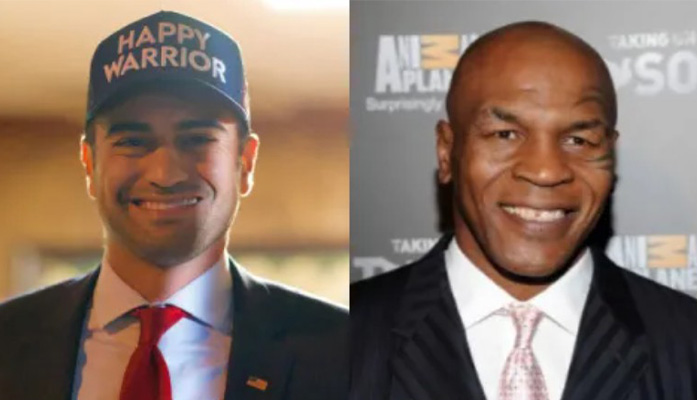
In a joint interview with boxing legend “Iron Mike” Mike Tyson, Congressman Abraham Hamadeh (R-AZ08) told Fox News earlier this month that the retired World Heavyweight Champion is working with House Republicans to roll out Rep. Hamadeh’s bill establishing the Congressional Fitness Challenge in his schools.
The new Congressional Fitness Challenge will include five core fitness tests: the 1-Mile Run/Walk, Pull-Ups/Flexed Arm Hang, Curl-Ups or Sit-Ups, Shuttle Run, and Sit-and-Reach. Students who participate can earn gold, silver, or bronze level recognition based upon attainment of “clear, age-appropriate standards.”
Students who successfully complete the challenge will receive a signed certificate from the Speaker of the House, President Pro Tempore of the Senate, and the student’s senator and congressman.
Hamadeh and Tyson described the impetus behind the resolution as an effort to combat a threat to national security presented by studies showing that 77% of fighting aged Americans from 17 to 24 would require a medical wavier in order to serve in the military.
Tyson told Hamadeh that the program, also supported by NFL Hall of Fame quarterback Brett Favre, gives him hope for the future of our nation.
With both Tyson and Favre, the congressman hearkened back to the creation of the President’s Council on Physical Fitness by President John F. Kennedy, who said at the time, “We do not want in the United States a nation of spectators. We want a nation of participants in the vigorous life.”
Hamadeh and Favre warned then, “As a Hall of Fame professional quarterback and a United States Congressman, we come from different arenas – but we stand united by a common concern. America’s youth are facing a silent crisis of physical fitness. Childhood obesity has tripled since the 1970s. Physical activity is down. Strength and stamina are declining.”
“I think this is going to improve, and people are going to get better, and people want to get healthier,” Tyson said. “I just believe that. It can be helped.”
Hamadeh answered, “I agree with ‘Iron Mike,’ and am grateful for his powerful support for the program and shared dedication to improving the health of our kids. Youth are facing a silent crisis with childhood obesity having tripled since the 1970s, so it is imperative that we do all we can to revive physical excellence among America’s youth to build a stronger nation.”
Hamadeh wrote for Outkick that the nationwide initiative is now open to all kids, ages 6 through 17, whether in public, private, or homeschool settings and that the Congressional Fitness Challenge must become part of the Make America Healthy Again (MAHA) movement, and not merely be reduced to another federal program.
“It’s voluntary, but it taps into something deep in the American spirit – the drive to push harder, to be better, and to set and conquer goals.”
Matthew Holloway is a senior reporter for AZ Free News. Follow him on X for his latest stories, or email tips to Matthew@azfreenews.com.
by Matthew Holloway | Apr 28, 2025 | Education, News
By Matthew Holloway |
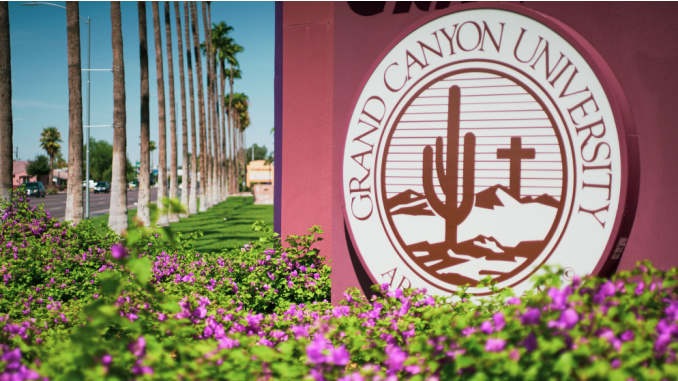
Grand Canyon University, despite a tumultuous period which saw unprecedented fines and targeting by the Biden administration, reported the largest number of graduates in the Christian university’s history for its 75th Anniversary.
According to the university, the GCU Class of 2025 will graduate 31,104 students, 5,669 of them in person at the university’s Phoenix campus and another 25,435 online. Commencement ceremonies for in-person students are already underway as of this report and will take place between April 29th and May 2nd for online students.
“This year’s record-breaking graduating class reflects the dedication of our exceptional students, the unwavering support of our faculty and staff, and our commitment to offering innovative educational opportunities across multiple delivery platforms,” said GCU President Brian Mueller.
“Whether through in-person classes, online learning, hybrid models or accelerated pathways, our flexible approach allows us to connect with students no matter their life circumstances. Increasingly, more and more families are seeking these opportunities, especially when taught from a Christian worldview perspective,” he added.
“Our focus remains on partnering directly with employers to help them address their workforce shortages, especially in critical sectors like education, healthcare, technology, engineering, social work, counseling and the military,” Mueller said. “While many universities have scaled back programs amid declining enrollments since the pandemic, GCU has introduced 148 new academic programs, emphases and certificates across our 10 colleges, all aligned with current labor market demands.”
As previously reported by AZ Free News, the U.S. Department of Education (DOE), under the Biden-Harris administration, imposed a staggering $37 million fine against Grand Canyon University despite the DOE failing to reveal any meaningful complaint against the university. In response, the Goldwater Institute launched a lawsuit against the agency demanding an explanation.
In 2024, Arizona’s Republican Superintendent of Public Instruction Tom Horne called upon the Biden administration to come to the table with GCU after Richard Cordray, the Chief Operating Officer of the Department’s Office of Federal Student Aid, claimed the university had lied to, “more than 7,500 former and current students about the cost of its doctoral programs over several years.” The claim was made despite a complete lack of legal proceedings to adjudicate it.
Horne wrote, “In the U.S., anyone accused of wrongdoing is presumed innocent and entitled to their day in court. For a Cabinet-level official, one who is sworn to uphold the U.S. Constitution, your threat against GCU is contrary to those constitutional guarantees and unworthy of your position. It is unwarranted, unjust and the latest episode of harassment against this school by the federal government.”
At the time, GCU responded to then-U.S. Education Secretary Miguel Cardona, stating, “GCU has been asked repeatedly why it believes it is being targeted by federal agencies of the Biden administration. Here’s what we can tell you: Mr. Cardona’s inflammatory comments make very clear the Department of Education’s intentions and their disdain for institutions that do not fit their ideological agenda. What’s also clear is that ED has no lawful grounds to carry out those intentions based on their disingenuous and factually unsupportable allegations.”
Despite the controversy with the DOE, the Christian university celebrated its 75th Anniversary through a Week of Service in the fall that featured over 1,000 opportunities to serve across 40 different ministries. In addition, it also held its first-ever Amethyst Gala, which raised approximately $1.5 million to benefit the university’s ambitious Five-Point Plan to transform the west Phoenix community it calls home.
GCU boasts an enrollment of almost 25,000 students taking traditional classes in Phoenix with another 98,000 or more students online around the world.
Matthew Holloway is a senior reporter for AZ Free News. Follow him on X for his latest stories, or email tips to Matthew@azfreenews.com.