by B. Hamilton | May 20, 2021 | Education, News
By B. Hamilton |
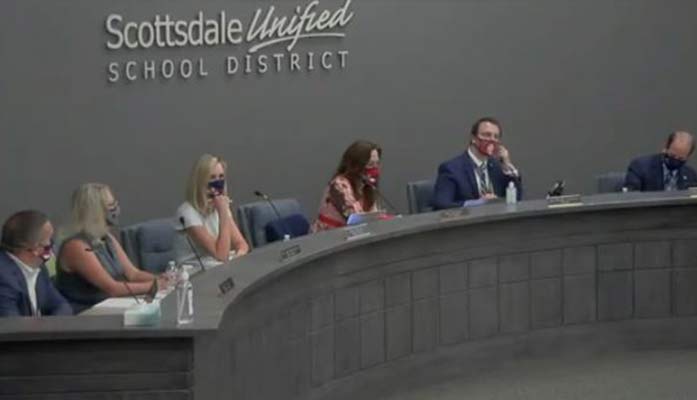
The Scottsdale Unified Governing Board canceled its meeting on Tuesday, May 18th, 2021, according to Board President, Jann-Michael Greenburg, because of “a belligerent mob.” Greenburg was referring to the parents who had come to the meeting hoping to be heard on the subjects of masks, and Critical Race Theory-based curriculum.
Even though the Board was, admittedly, well aware and prepared for the number of parents that came to attend the meeting, they still chose to recess the meeting after three minutes. The Board then opened the meeting again just long enough to scold parents before gaveling it to an end.
In an interview on the James T. Harris show on KFYI News Talk 550 AM, one attendee, Amy Carney, stated that while she had never attended a school board meeting before, the pandemic opened up many parents’ eyes to what is happening in schools and what is not happening in schools.
Carney said questions about the Scottsdale district due to the fact that private schools and religious schools were able to open classrooms while Scottsdale schools were shuttered. She noted that the private schools have not seen any more cases of COVID than her kids’ schools, leaving her and other parents to wonder why.
Carney explained that more and more parents began asking the same questions and before anyone knew it, parents are “now awake.” That “wokeness” is fueling the increase parent participation on the school board level.
Carney was shocked by the Board’s decision to shut the meeting down as the parents were neither belligerent nor out-of-line. According to Carney, the parents went from determined to defeated after the Board exerted their power. They may have felt defeated, but it was only momentary. Carney vowed future engagement as have parents across the state once they experience the heavy hand of bureaucrats.
That parental population is growing. The Scottsdale Unified School District Governing Board isn’t the first board that has decided not to hold a meeting because they disagreed with the parents that showed up. Just recently the Vail school board shut down a meeting rather than allow parents to speak.
Across the state, groups of parents are organizing to take back the education of their children, ensuring that the Scottsdale Board was not the first to face a “mob,” of mid-mannered parents, nor will it be the last.
by Corinne Murdock | May 19, 2021 | Education, News
By Corinne Murdock |
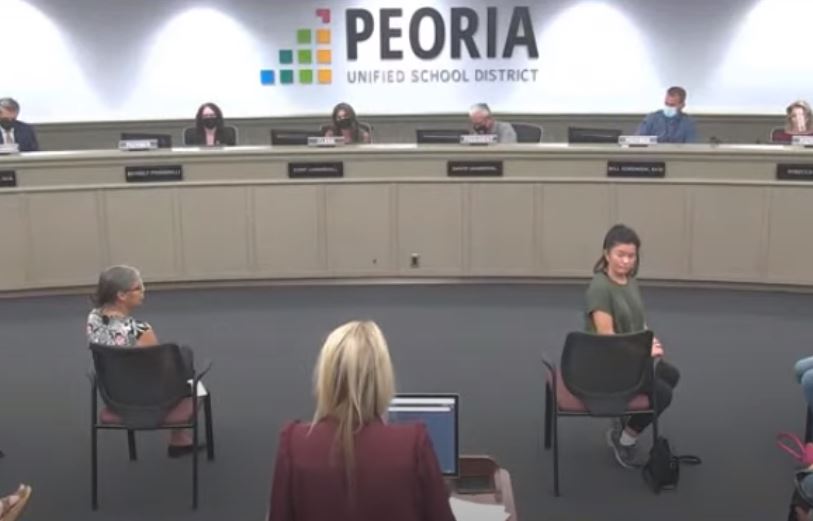
A coalition of Peoria mothers descended on a Peoria Unified School District (PUSD) Governing Board meeting last week to demand an end to critical race theory (CRT) influences in the classroom. Near the end of their public remarks, one mother warned the board members that if they didn’t eradicate CRT from PUSD, then parents would remove their kids.
“If not parents, I want you to know this: the first 100 days of the school year, you yank your kids out of this district. And you will bankrupt this district. Because at the end of the day, it’s all about money. And we all know it. So if they don’t do it, parents – first 100 days, take your kids out. It’s not worth what you will get if you let this go full circle. If you don’t believe me, go to California.”
That mother explained that she and her family fled California after CRT in their schools destroyed their communities. She said that she’d seen how, in real time, the “flowery names” of CRT, diversity, equity, and inclusion ruined schools.
“It has not a thing to do with equality. It has to do with payback. It turned our schools into war zones. [It] was insane – the ‘inclusion’ part was really great too – they break you up into little subcategories and they pit everyone against everyone. I lived it. My 21-year-old son is still dealing with the after-effects,” said the mother. “It is a nightmare. I moved to Arizona to get away from this, only to find it to take root here. And it is on your watch. You are to be the guardians of these people’s children. I don’t want their voices heard. I want their voices listened to. You remember, you had this chance to stop what people are running from. They say 240 Californians are coming here every day. And I can tell you why. It doesn’t work.”
Some mothers presented receipts: emails obtained from open records requests. Another mother documented an email exchange involving PUSD Social Studies Curriculum and Instructional Specialist Jen Mundy, which she reported was proof that teachers were being bribed by EverFi with $15 Amazon gift cards for teacher referrals.
As AZ Free News reported, EverFi is an online educational platform that specializes in social justice curriculum. In an email copy obtained by AZ Free News, one EverFi director did offer teachers $15 Amazon gift cards for each successful referral to another teacher. As we reported previously, Amazon CEO Jeff Bezos is one of EverFi’s top donors.
The mother also cited an email from an elementary school principal, which reportedly called parents “wackos” for challenging the curriculum.
“‘Parents are wackos with a platform to spread propaganda.’ Does the administration not view parents as partners?” asked the mother. “We elect you, school board members. We should be partnering together. We are entrusting our children to you for their education. Are you going to continue to condone administration speaking this way about parents? Why is the administration being told to silence parents? I will not be silenced. Parents will not be silenced.”
The mother also claimed that EverFi 306: Continuing Stories, a curriculum focused on African American history, was being paid for by the NFL and Arizona Cardinals. AZ Free News has been unable to verify that claim. EverFi markets its courses as free to K-12 educators.
That mother also brought up a survey administered to students by EverFi’s Diversity Foundations program called “Recognizing Privilege.” She said that it asked children private questions about their home life.
“This is a third-party vendor that is collecting personal data on our kids. Where is this data going and how will they use it?” asked the mother.
The mother then cited remarks made during the Arizona School Boards Association’s (ASBA) annual Equity Event, which she noted some PUSD board members attended.
“One of the guest speakers, Calvin Terrell stated that: ‘White privilege families abuse IEPs [individualized educational plans] for their kids to get into Ivy League Schools.’ I have three kids on IEPs who need these plans and services to succeed in school,” said the mother. “Because my kids are white, do they fall into this statement, President Sandoval?”
While she was on the subject, the mother took a moment to criticize the ASBA’s Equity Event. She challenged PUSD Board President David Sandoval for the content and nature of that event.
“The ASBA Equity Event tries to create a divide in America by trying to shame kids into apologizing [for] something they never were. We should be teaching our kids about seeing and valuing humanity, not colors,” said the mother. “David Sandoval, your actions speak louder than any statement you give.”
Another mother, Jodi Brackett, presented a passage printed in her son’s yearbook declaring that no lives mattered until black lives mattered. As she raised the book for the board to see, attendees gasped and booed.
“This […] should never be in any kid’s yearbook: ‘All lives won’t matter until black lives matter,’” read Brackett. “That is unacceptable. And I think everyone knows that all lives matter. And this should never be advertised in a yearbook.”
Brackett also noted that CRT shouldn’t be in schools because of its Marxist elements.
Another mother pleaded with the board members to stand strong and be leaders against CRT.
“Do not lose your authenticity in an attempt to be liked by the sick-minded who are trying to convert your schools into indoctrination factories,” said the mother. “You are also parents yourselves. It is impossible to believe that you will embrace for your own kids such [a] curriculum injected with hatred and adult content materials.”
The mother noted that she couldn’t discuss some of the curriculum because it was prohibited by board rules – though her son was learning about it in class.
“The Code of Conduct when addressing the board lists ‘no political views, no sexual content.’ So I, an adult, am not allowed in this forum, to bring for show-and-tell, pornographic material or talk about sexual orientations – but you are voting to give permission to the superintendent, to in turn give permission to [the] master of curriculum to do just that,” noted the mother.
She also pointed out that the board was being hypocritical by having police present at the meeting, though they allow EverFi educational content that promotes defunding the police through its teachings on Black Lives Matter (BLM). The mother’s point earned applause.
BLM’s call for police to be defunded, #DefundthePolice, gained traction last year after the death of George Floyd.
Another mother, Gina Blair, explained that CRT would only hurt children and divide the country further.
“What happened to looking at someone’s heart and character and judging them on that very important factor only? Isn’t that the one true way to be truly non-biased [sic] and not racist?” said Blair. “Please understand we elected you as board members
Blair explained that she was very well-versed in inclusion, considering her two school-aged children have severe disabilities, and that CRT wasn’t inclusion. She said that teaching inclusion had nothing to do with modifying history.
Watch the mothers’ full remarks here:
Corinne Murdock is a contributing reporter for AZ Free News. In her free time, she works on her books and podcasts. Follow her on Twitter, @CorinneMurdock or email tips to corinnejournalist@gmail.com.
by Corinne Murdock | May 16, 2021 | Education, News
By Corinne Murdock |
An online social justice curriculum funded by Big Tech giants, EverFi, promised $15 gift cards to teachers who successfully got other teachers to start their students on one lesson.
According to an email obtained by the AZ Free News, Peoria Unified School District (PUSD) teachers were incentivized with $15 Amazon gift cards by an EverFi director of K-12 implementation. One of EverFi’s foremost contributors is Amazon CEO Jeff Bezos through his investment company, Bezos Expeditions.
“As a thank you, earn a $15 Amazon gift card for every teacher you refer who gets students started on one EVERFI lesson – just click the Invite a Teacher button (terms) I’m here for you – schedule a time with me to support you and/or your students,” read the email.
[pdf-embedder url=”http://azfreenews.com/wp-content/uploads/2021/05/everfi.pdf”]
PUSD has incorporated EverFi for years, according to staffers.
Key resources highlighted on EverFi’s website focus on social-emotional learning, an offshoot of critical race theory (CRT); health care equity; and diversity, equity, and inclusion (DEI).
https://twitter.com/EVERFI/status/1392232687692288000
Curriculum obtained by AZ Free News showed that EverFi lesson plans included the histories of Juneteenth and affirmative action, assertion of systemic racism, and the promotion of equity instead of equality.
Last September, EverFi committed $100 million to expanding their social injustice and economic inequity lenses within their K-12 education curriculum. [RELATED: EVERFI Announces $100 Million Commitment to Address Systemic Social Injustice and Economic Inequity through Free Digital Education for Nation’s K-12 Schools]
EverFi is advertised as free for K-12 teachers. The company reportedly offsets the cost through national and regional partners.
PUSD staffers confirmed that although the district has used EverFi for around a decade, educators use it sporadically. In an email obtained by AZ Free News, Executive Director of K-12 Curriculum & Professional Development Marla Hobbs claimed that few teachers utilize Everfi. She added that those who do use the resource use it on odd occasions.
EverFi was founded in 2008, with a focus on obtaining major corporate sponsors to fund their educational initiatives.
Now, over a decade later, they have accomplished just that. Some of their noteworthy contributors over the years include Jeff Bezos, Amazon CEO; Evan Williams, founder of Twitter, Medium, and Blogger; and Eric Schmidt, Google Executive Chairman.
Other big businesses also have their hands in Arizona’s public education. Companies like Boeing and Wells Fargo are part of the Arizona Educational Foundation Board, an initiative focused on bringing social justice to classrooms. The Arizona Educational Foundation has pushed a program called “Our World,” which aims to provide educator and business training and workshops on antiracism, equity, diversity, and inclusion.
Much like EverFi, Our World is free of charge to Arizona schools.
Corinne Murdock is a contributing reporter for AZ Free News. In her free time, she works on her books and podcasts. Follow her on Twitter, @CorinneMurdock or email tips to corinnejournalist@gmail.com.
by B. Hamilton | May 14, 2021 | Education, News
By B. Hamilton |
On Thursday, the Senate Health and Human Services Committee, in a party line vote, approved HB 2035, legislation that will strengthen parental input in the Sex Education curriculum offered to their children. A previous version of the bill, SB 1456, passed this year, but was vetoed by Governor Doug Ducey.
According to Sen. Nancy Barto, sponsor of SB 1456, the issues brought forth in the governor’s veto formed the basis of the new version, sponsored by Rep. Gail Griffin. Griffin’s bill was turned into what is known as a “striker” or “strike-all-amendment” in order to attached the modified language of SB 1456.
HB 2305 “restricts sex education instruction for pupils in kindergarten through grade 4. Modifies requirements relating to sex education instruction, including curricula approval and parental permission and notification procedures.” In keeping with the governor’s recommendation, the specifies that age and grade appropriate classroom instruction on child assault awareness and abuse prevention is not prohibited.
RELATED ARTICLES:
Arizona Legislature Passes Bill Requiring Parental Permission for All Sex Ed Curriculum
Ducey Vetoes Sex Ed Bill, Issues Executive Order Instead
The bill does not prohibit or dictate any curriculum in grades 5-12; it “merely ensures that parents may opt their children into instruction on human sexuality,” according to supporters.
On April 20, 2021, the Governor issued an Executive Order related to sex education, which among other matters, requires a public review process to select sex education curricula, directs schools to make any approved sex education curricula available online and in-person and allows parents to review the materials before opting their child in to sex education courses, according to the legislative record.
by Terri Jo Neff | May 13, 2021 | Education, News
By Terri Jo Neff |
Rep. Shawnna Bolick says a tweet she wrote Wednesday was not intended as a commentary on the Senate’s ongoing audit of Maricopa County’s election process. Instead, she was simply trying to draw attention to a double-standard by many state Democrats on the issue of public-private partnerships.
Bolick (R-LD20) is a strong supporter of Empowerment Scholarship Accounts (ESA) which thousands of Arizona families can utilize to provide school choice for students. As Chair of the House Ways and Means Committee, she has championed SB1452 which seeks to expand ESA eligibility to thousands more students.
But Bolick says she has seen many Democrats who do not support giving families more choice in a child’s education if that choice involves a privately run school. Then on Wednesday morning, Bolick was reading comments about the Senate’s election audit when an article caught her attention.
That article reported on how Maricopa County does not have the administrative passwords necessary to access key voting equipment the auditors want to review. Those passwords appear to be in the control of Dominion Voting Systems, a private company which leases voting equipment to the county.
And that, Bolick says, prompted a bit of a snarky retort “comparing how the Left is okay with our democratic process being turned over to a private entity for elections, but they are not okay with kids going to, say, a private school.”
“I see so much hypocrisy in the world, so it’s fun sometimes to point out an issue that might not even be related to another issue,” Bolick said, adding she did not mean to suggest private companies should never be involved in elections. “Just a little poke on hypocrisy between different governance structures and ideas. Nothing more, nothing less.”
An amended version of SB1452 which came through Bolick’s committee is slated to be considered by the House on Thursday. If it passes the legislation will have to return to the Senate for a final vote.
Bolick also serves as Vice-Chair of the House Criminal Justice Reform Committee.
by B. Hamilton | May 13, 2021 | Education, News
By B. Hamilton |
Two topics that arise year after year, teacher’s salaries and public-school budgets, are often misunderstood and misrepresented. In fact, many say the RedForEd movement was created and nurtured with those misunderstandings and misrepresentations.
The misunderstanding and misrepresentation has led to frustration for taxpayers and parents. Many of whom feel that no matter how much they pay in taxes, nothing seems to get better in kids’ classrooms.
A new study by the Goldwater Institute indicates those feelings and frustrations might be justified.
According to Goldwater, the “20×2020” plan, approved by Arizona lawmakers in 2018, was designed to provide enough funding to give Arizona teachers a 20% raise. However, Goldwater has discovered that schools are not allocating the funds the way lawmakers intended them to be.
In The Truth about Teacher Pay in Arizona: How Arizona School Districts Have Held Back Teacher Salaries, Blamed Lawmakers, and Continually Captured Public Sympathy, Matt Beienburg, Director of Education Policy at the Goldwater Institute found that “school districts used the majority of the new 20×2020 funds simply to replace, rather than add to, existing buckets of state money for teachers (and vice versa). The result: During the 2019-2020 school year alone, teachers received at least $170 million less from their school districts in salary increases than Arizona taxpayers provided for. And it’s part of a decades-long pattern in Arizona education.”

So what are schools doing with the extra funding that is being provided?
“District spending on administration, for instance, has risen by nearly $2,000 in inflation-adjusted terms per class of 20 students, even as teacher salaries were no higher through fiscal year 2020,” according to Beienburg.
Each year, teachers use their own money to buy supplies and decorations for their classrooms and to help offset the consistently growing list of “must buy” supplies sent to parents at the start of the school year. Yet, during the 1983-1984 school year almost 2,000 managers, supervisors, and directors were inexplicably added to Arizona school districts’ payrolls.
Many teachers have expressed frustration about not being a priority and tend to put pressure and blame on lawmakers as part of their demands for more money. It seems, though, that it is the school district administrators who need to feel the pressure and are to blame.
This last year has also placed additional stress on teachers and parents, with virtual and hybrid learning due to COVID-19.
Members of the state legislature requested that the COVID-19 stimulus revenue funds were given for school district use but the Arizona Department of Education (ADE) has declined to distribute much of the millions of dollars.
While it may be easy to blame political leaders and taxpayers for lack of support and failing to prioritize teachers, it seems to many observers that the attention should be on the ADE, school district administrators, and school boards who need to review and reconsider their budgets and priorities.