by Daniel Stefanski | Sep 22, 2024 | Economy, News
By Daniel Stefanski |
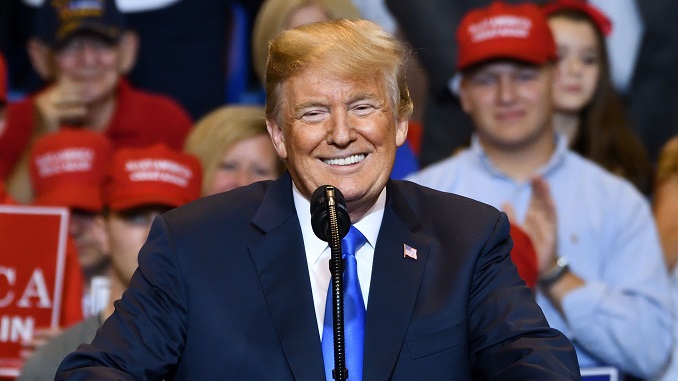
President Donald J. Trump saved a major policy proposal rollout for his trip to Arizona last week.
Earlier this month, President Donald J. Trump visited Tucson, Arizona, and announced the latest installment of his economic plan should voters return him to the White House in the upcoming November General Election.
Trump stated that his administration would “end all taxes on overtime.”
The former president went into further detail about this plank, saying, “Think of that. That gives people more of an incentive to work. It gives the companies a lot. It’s a lot easier to get the people. You know, I went to some economists, great ones, and I said, ‘What do you think?’ They said, ‘It would be unbelievable. You’ll get a whole new workforce by doing that.’ No taxes on overtime! The people who work overtime are among the hardest working citizens in our country, and for too long no one in Washington has been looking out for them.”
Trump added, “Those are the people. They really work. They’re police officers, nurses, factory workers, construction workers, truck drivers, and machine operators. It’s time for the working man and women to finally catch a break, and that’s what we’re doing because this is a good one. And I think it’s going to be great for the country. So that’s why we will be saying that if you’re an overtime worker when you’re past 40 hours a week, your overtime hours will be tax-free.”
After the announcement, the Trump campaign rolled out an endorsement of this proposal from the National Fraternal Order of Police. Patrick Yoes, its president, said, “This would be incredibly impactful for law enforcement officers and their families. SO many officers and their families depend on overtime pay just to get by, so eliminating taxes on this income will actually help these families get ahead. This is just one of the many reasons FOP members voted to endorse President Trump – he understands the needs of working families like ours.”
Former Illinois Governor Rod Blagojevich chimed in on his X account, writing, “Trump announced a great new policy yesterday. NO TAXES FOR OVERTIME! When I was growing up & my working parents scrimped & saved, ‘Time & a half over 40 & double time on Sundays’ meant a college education for me. Donald Trump – Champion of working people and the American Dream.”
This latest economic policy proposal follows others from Trump over the past year as the race for the White House has heated up across the country, including ‘no taxes on tips’ and ‘no taxes on Social Security for seniors.’
Daniel Stefanski is a reporter for AZ Free News. You can send him news tips using this link.
by Staff Reporter | Sep 17, 2024 | Economy, News
By Staff Reporter |
An exclusive poll for AZ Free News conducted by Data Orbital shows that among likely voters in the November 2024 General Election, President Donald Trump holds a narrow edge on Vice President and Democrat-appointed nominee Kamala Harris. Taken between 9/7/2024 – 9/9/2024, the poll shows Trump leading by a margin of 0.2% with 46.2% of those polled against Harris’ 46%, with a 4.26% margin of error.
Remarkably, the poll shows approximately 7.7% of Arizona voters remain undecided or refused to answer and are theoretically up for grabs in the highly competitive swing-state race.
Speaking with AZ Free News, George Khalaf, President of Data Orbital, explained, “Independent voters are always going to be very close, so they were. It was still neck and neck depending on the survey. The results sort of oscillate in terms of who’s in the lead.”
“That 7.7% undecided number, I would say, is going to be one of two things: 1.) Either individuals that are saying that they are likely to vote but don’t end up voting or 2.) People that really are truly undecided. But I would be shocked if the true undecided number is in the high single digits,” explained Khalaf.
“I would guess that right now, the true percentage of people that are undecided is maybe one or two percent, if that. This is a high-profile race and so most people have made up their minds. But I think a portion of people that are undecided likely will not end up making a decision on November 5th,” Khalaf stated. “And even if they come out and vote, they may just not vote in the presidential election or will write in somebody random.”
When polled on the most important issues facing Arizona, 30.4% of the likely votes said “Economy, Inflation, Cost of living,” 28.7% selected the Border and Immigration, and at a distant third selection, 18.3% said “Abortion/Pro-Choice/Women’s Rights.”
Conversely, Gallup polling from as recently as August found nationally that Immigration dominated as the most important issue at 19% of those polled, followed by the economy overall at 18%, poor government/leadership at 16%, and High Cost of Living/Inflation at 15%. Abortion barely moved the needle at just 4%.
Given that the poll’s results pre-date the Tuesday Sep. 10th Presidential Debate, they do not represent potential changes in perception that followed. However, Rasmussen Reports has offered a more comprehensive dataset with polling through Sep. 12th posted to X on Friday showing Trump ahead by six points, with another six percent undecided.
Pollster Nate Silver has consistently shown Trump to be favored to win the election both before and after the debate with Trump’s electoral college probability, which ignores the popular vote unlike general polling, at 61% based on the outcome of 40,000 election model simulations.
Nate Silver’s latest result is an increase from the 60.6% probability on Sep. 12th and is only a slight dip from the high point on Sep. 8th at 63.8%.
As of this report, Polymarket projection has President Donald Trump favored to win Arizona 61-40% and has Harris leading nationally by just one point. The projection has been fluctuating between the candidates by 1-3 points on a daily basis, with Trump leading by two points as recently as Sep. 11th and tied at 49% on the tenth.
As far as potential shifts in public opinion before the election, Khalaf told AZ Free News, “I don’t think we’re likely to see a large shift. I just think that obviously we all know the limitations of public opinion polling. There is a margin of error. And so I think the race is going to stay consistently in that range, which means that on election day, that’s why people are still saying it’s a toss -up, even though, again, I would say I would give Arizona a lean towards former President Trump, but I don’t expect a big shift. I don’t think that there’s much that could occur.”
Addressing the Sunday attempt on President Donald Trump’s life, he added, “I mean, look, we saw another assassination attempt, or at least that’s what they’re saying right now. They’re investigating an attempted assassination, and even then we’re not even hearing about it nearly as much as the first attempt. And so all that’s to say, there’s just so much information out there. There’s so much information that people are consuming. I’d be shocked if there was a major shift. I think all of the swing states: Arizona is no different.”
AZ Free News is your #1 source for Arizona news and politics. You can send us news tips using this link.
by Matthew Holloway | Sep 14, 2024 | Economy, News
By Matthew Holloway |
The Common Sense Institute of Arizona (CSI) released a report Wednesday which outlines the implications and economic impact of the City of Glendale’s far-reaching “Hotel and Event Center Minimum Wage Protection Act” (Prop 499). The act is set to be considered by voters on November 5.
The initiative, launched by the non-profit organization “Worker Power Political Action Committee,” has been challenged by the City of Glendale on the basis that it violates the State of Arizona’s “Single Subject Rule” limiting initiatives to act upon a single issue, The case is now headed to the State Supreme Court according to AZ Central.
The report from CSI Arizona details that the initiative, if it becomes law, would mandate that hotel and event center employers pay their staff a minimum of $20 per hour, and places narrow restrictions on the duties they may perform and the duration for which they may perform them. As Brunner explains, “For example, it prescribes how many square feet can be cleaned in a hotel before the employer is required to pay twice the room attendants’ regular rate of pay for each hour worked during that workday, and establishes new requirements on how Hotel and Accommodation firms treat certain revenues and records.”
The act would furthermore require the City of Glendale to create an entirely new enforcement division in order to enforce the mandate and hire staff to conduct investigations. It would also price non-union labor out of the market per the report.
The CSI found that the new law, if enacted, would, “reduce Gross Domestic Product (GDP) in Glendale by between $120 million and $1.9 billion.” Given that the city’s event and accommodation industries account for approximately 8.2% of Glendale’s entire economy, the blow to the city’s tax base could be severe.
“Depending on how the industry responds to the new policies, between 1,700 and 32,000 Glendale jobs could be impacted. Impacts will range from the elimination of existing jobs subject to the new rules, to reduced work hours, to the movement of jobs outside the city. How much of each and when will determine where things fall in this range.”
In a post to X, the CSI explained, “The Minimum Wage Act would impose significant costs on the city of Glendale, requiring the creation of a new Department of Labor Standards to enforce the Act’s provisions. CSI estimates the city would need to spend $995,000 to $1.9 million annually to manage these new requirements.”
Compellingly, the CSI report referecnces similar policies put in place around the country as “instructive examples,” of the likely ramifications of enacting the restrictive law.
“This year California instituted a $20 per hour minimum wage for fast food workers leading restaurant owners to reduce staff hours, lay off part-time staffers, and limit overtime pay. Also this year, Long Beach, CA passed a ballot initiative instituting a $23 per hour minimum wage for hotel workers. On the consideration of increasing hotel and airport workers’ minimum wage to $25 per hour, the President of the Valley Industry and Commerce Association said ‘increasing the hourly wage by $6 or $7 this year alone could cost an employer about $14,000 more per worker.’ For Arizona to pass a $20 minimum wage for hotel and event center workers in Glendale, it could cost employers up to $10,756 per affected worker -through a combination of either direct increased wage costs or efficiency losses as employers mitigate the impacts by reducing staff, cutting hours, or moving business activity. Much of this cost will likely be passed onto consumers in the form of higher prices and increased fees (as has been the case in California). This may further incentivize both customers and operators to seek alternatives outside the city.”
With Glendale and the city’s businesses banking heavily on the much ballyhooed Mattel Adventure Park at the VAI Resort set to open in late 2024, according to a park representative, and the growing impact of the Westgate Entertainment District and State Farm Arena on the local economy, the impacts of this measure could be devastating.
Matthew Holloway is a senior reporter for AZ Free News. Follow him on X for his latest stories, or email tips to Matthew@azfreenews.com.
by Staff Reporter | Sep 1, 2024 | Economy, Education, News
By Staff Reporter |
A progressive Democrat incumbent legislator is key to her party’s hopes of flipping both chambers in Arizona.
Mariana Sandoval is running for reelection to the Arizona House of Representatives in Legislative District 23. She was first elected in November 2022 and has served alongside Republican Michele Peña in the state House over the past two legislative sessions. In the House, Sandoval is a member of the Land, Agriculture & Rural Affairs Committee and the Ways & Means Committee.
On her campaign website, Sandoval proudly promotes endorsements from left-leaning organizations, including, Human Rights Campaign PAC, Save Our Schools Arizona, Living United for Change in Arizona, National Organization for Women Arizona Political Action Committee, Sierra Club, Arizona Education Association, Climate Cabinet, Moms Demand Action, and others.
Over her first term in office, Sandoval has proven that she does not share the values of many of the men and women who she represents. In 2023, she voted no on SB 1063, which would have “prohibit[ed] a city, town or other taxing jurisdiction from levying a transaction privilege tax, sales, use, franchise or other similar tax or fee on the sale of food and certain beverage items intended for home consumption.” After Republicans passed the bill out of both chambers, Democrat Governor Katie Hobbs vetoed it, writing, “From potential cuts to service – including public safety – to increased property taxes, it’s clear that this bill doesn’t actually eliminate costs for our residents.”
When Hobbs rejected the proposal, Arizona Senate President Warren Petersen blasted her decision in a statement. He said, Senate Republicans have been working toward introducing legislation necessary to provide financial relief to all Arizonans, especially low-income families who are feeling the tremendous burden of inflation. It’s very clear the governor has no interest in helping with that financial burden.”
Sandoval also opposed legislation that protected Arizona’s children. In February, she voted against HB 2586, which would have “add[ed] a new section of statute regulating the publishing and distribution of material harmful to minors on the internet.” Hobbs vetoed this bill, claiming that it went “against settled case law.” Other advocates for the proposal disagreed with Hobbs and her Democrat allies, including Arizona Women of Action. Amid the legislative process, the organization posted, “This nonpartisan bill needs SUPPORT. It would effectively protect AZ kids from accessing pornography. Age verification is a must.”
Terry Schilling, the president of the American Principles Project, also weighed in on the governor’s action. She said, “Up until now, protecting kids from online porn had been a cause with nearly unanimous, bipartisan support. Polls have shown the vast majority of American voters, across the political spectrum, back these laws. Both Democrat and Republican governors in a dozen states from Louisiana to Utah to Virginia have signed this legislation. And many more are on track to join this list shortly.”
Additionally, Sandoval opposed efforts to enhance safeguards for law-abiding Arizonans who have increasingly fallen prey to the rising tide of criminal activity across the state. This year, she voted against SCR 1021, which would “statutorily require an adult who is convicted of a class 2 felony for any child sex trafficking offense to be sentenced to natural life imprisonment.” The measure was passed by the Arizona Legislature and transmitted to the Secretary of State for inclusion on the November General Election ballot.
When the legislation was introduced, Senator Shawnna Bolick, the Republican sponsor of the effort, said, “We believe in holding traffickers accountable for their heinous crimes, and that’s why we’ve filed legislation for a ballot referral to put convicted child sex traffickers behind bars for life. Our message is clear: our children are not for sale, and we will not tolerate heinous crimes against them. Join us in this fight to protect our most precious resource – our children. Perpetrators, not here, not now, not never.”
According to the Arizona Independent Redistricting Commission, Legislative District 23 has a competitive vote spread of 16.9% between Democrats and Republicans over the past nine state elections. Out of those elections, Democrats have won all nine contests.
Sandoval will run in November’s General Election alongside Matias Rosales, who emerged from the July 30 Primary Election for the Democrat Party. She obtained 9,194 votes, and Rosales acquired 6,811 votes. James Holmes finished third in the primary, garnering 2,919 votes.
Both Sandoval and Rosales will face off against Peña. In November 2022, Peña had more votes than either of her Democrat opponents with 12,850, compared to 10,101 for Sandoval and 8,030 for Jesus Lugo Jr.
AZ Free News is your #1 source for Arizona news and politics. You can send us news tips using this link.
by Matthew Holloway | Aug 28, 2024 | Economy, Education, News
By Matthew Holloway |
The 2024 report from the Joint Legislative Budget Committee could potentially silence opponents of Arizona’s Empowerment Scholarship Account (ESA) Program once and for all. This week, Superintendent of Public Instruction Tom Horne called the myth that the ESA program was ever a threat to the budget: “utterly demolished.”
In a press release from the Arizona Department of Education, Horne explained that for Fiscal Year 2024, which concluded on June 30th, the Basic State Aid payments for education programs at district and charter schools and the controversial ESA program all finished well under budget with a net savings to the state of $4.3 million. The news comes just days after the Goldwater Institute debunked the narrative that the ESA program harmed students and blew up the state budget as previously reported by AZ Free News.
Horne said in the press release, “Having a surplus of more than $4 million is proof positive that the critics who have claimed the ESA program will bust the not only the state’s education budget but the entire budget itself were always wrong. It was always a myth, and that myth is utterly demolished.”
The report revealed that out of $6,309,352,100 appropriated toward education funding, even with the ESA, the state only spent $6,305,050,851.55 leaving behind a $4,301,248.45 surplus.
Horne, who was previously State Superintendent of Schools from 2003 to 2011 before being elected State Attorney General, continued:
“Budget figures are stubborn facts and they do not stand up to the political posturing that ESA critics have consistently and wrongly thrown at the program. The universal ESA scholarships are a vital part of making sure that parents are able to choose the schools that best fit the needs of their children. For example, we have families with three children. Two are doing fine in the neighborhood public school, but the needs of the third are not being met. ESAs enable the parents to find a school that meets the needs of the third child. How can anyone be so immersed in ideology that they would deny the parents that ability?”
He concluded, “Having choices such as charter schools, open enrollment for district schools and ESAs are a valuable tool for Arizona parents. As today’s announcement shows, these choices do not result in any part of the budget deficit. It resulted from overly optimistic projections of state revenues. ESAs are enabling parents to find the best schools to meet their children’s needs. No rational person should oppose that.”
The revelation from the JLBC report could severely undermine the political arguments of Democrats running against the state’s ESA program in November such as Democrat John McLean who is seeking to gain a State Senate seat in Arizona Legislative District 17. McLean is challenging Republican Vince Leach.
In a statement to AZ Free News in early August, Leach warned, “John McLean is going to have to defend the actions of the Democrat party both at the state level and the national level. He owns the damage to the state of Arizona by Governor Katie Hobbs, and also the radical policies that President Joe Biden and Vice President Kamala Harris are inflicting on our country. If voters elect McLean to office, that will help the Democrats take over the state legislature, which means that taxes will increase, school choice will disappear, and commonsense election laws will be reversed.”
Matthew Holloway is a senior reporter for AZ Free News. Follow him on X for his latest stories, or email tips to Matthew@azfreenews.com.
by Matthew Holloway | Aug 26, 2024 | Economy, News
By Matthew Holloway |
The U.S. Department of Labor revealed, as part of its preliminary annual benchmark revisions to national nonfarm payroll figures, that the department’s initial job creation numbers were overestimated by as much as 30%. Approximately 818,000 fewer jobs than the figure of 2.9 million touted by the Biden administration were actually created.
As reported by Forbes, the metrics taken from March 2023 to March 2024 estimated by the Deptartment of Labor at 2.9 million for the year, or 242,000 per month on average, were reduced to 174,000 per month or approximately 2.08 million.
Joint Economic Committee Vice Chairman Rep. David Schweikert (R-AZ) said in a statement, “This significant downward revision from BLS confirms what we’ve known since January 2021: that the U.S. economy is much weaker than President Biden and Vice President Harris have been selling.”
“This administration’s excessive spending, outrageous tax hikes, and burdensome regulations added over the last 3.5 years have made life much more difficult for American families than before the pandemic. Yet Biden and Harris have continued to peddle the narrative that the economy is robust because of ‘record-breaking’ job growth. Now, we know that the job gain estimates last year were notably overstated by more than 800,000 in yet another example of how badly the Biden-Harris administration has failed the American people.”
According to the announcement, the preliminary estimate of the upcoming annual benchmark revision is part of usual practice within the department and revisions are common. Another such revision took the Biden administration by surprise in 2022 when the Federal Reserve Bank of Philadelphia corrected the estimate for the Second Quarter that year from an estimated one million down to just 10,500 jobs per The Post Millennial.
Despite past experience with the fickle nature of federal jobs estimates however, in an election year, President Joe Biden has repeatedly boasted his administration’s job creation.
Just a day before the announcement, he posted to X, “Since Vice President Harris and I took office, our economy has created nearly 16 million jobs,” adding, “Average unemployment under our administration has been lower than during any administration in 50 years.” On April 5th, he wrote that the erroneous job report marked “another chapter in America’s comeback. With the report of 303,000 new jobs in March, we’ve passed the milestone of 15 million jobs created since I took office. That’s 15 million more people who have the dignity and respect that comes with a paycheck.”
Reporting from CNBC confirmed that the downward revision of -0.5 percent is the largest in fifteen years, the last occurring on the tail end of the 08’-09’ recession. Chief economist at LPL Financial Jeffrey Roach told the outlet, “The labor market appears weaker than originally reported. A deteriorating labor market will allow the Fed to highlight both sides of the dual mandate and investors should expect the Fed to prepare markets for a cut at the September meeting.”
The most heavily impacted sectors of the economy were professional and business services that saw a heavy revision down of 358,000 jobs followed by the badly struggling leisure and hospitality industry, which was revised down by 150,000 and has suffered severely under inflationary burdens and short-staffing. Manufacturing jobs took a heavy hit with a downward revision of 115,000 jobs along with trade, transportation, and utilities taking a hit to the tune of 104,000 jobs.
On April 4th, Biden specifically boasted about creating “Nearly 800,000 new manufacturing jobs.” The Bureau of Labor Statistics revision revealed this was overblown by at least an eighth.
Despite the massive, heavily, and repeatedly boasted overestimation, White House economist Jared Bernstein strained to maintain the Biden administration narrative in a statement writing, “This preliminary estimate doesn’t change the fact that the jobs recovery has been and remains historically strong, delivering solid job and wage gains, strong consumer spending, and record small business creation.”
Economists at Goldman Sachs told the outlet later that they theorize the Bureau of Labor Statistics, “may have overstated the revisions by as much as half a million,” CNBC wrote. The report added, “The firm said undocumented immigrants who now are not in the unemployment system but were listed initially as employed amounted for some of the discrepancy.”
Goldman Sachs economist Ronald Walker said that the revision is likely “erroneous” and “misleading,” according to Forbes.
Following the report Wednesday, President Donald Trump took to TruthSocial expressing outrage and suggesting the Biden-Harris administration inflated the job statistics for political benefit.
He wrote:
“MASSIVE SCANDAL! The Harris-Biden Administration has been caught fraudulently manipulating Job Statistics to hide the true extent of the Economic Ruin they have inflicted upon America. New Data from the Bureau of Labor Statistics shows that the Administration PADDED THE NUMBERS with an extra 818,000 Jobs that DO NOT EXIST, AND NEVER DID. The real Numbers are much worse than that and, if Comrade Kamala gets another four years, millions more Jobs will VANISH overnight, and Inflation will completely destroy our Country. YOUR LIFE SAVINGS WILL BE WIPED OUT. With a TRUMP VICTORY, we will once again have the Greatest Economy in History. MAGA2024!”
The final benchmark revision is set to be published by the Department of Labor in February 2025.
Matthew Holloway is a senior reporter for AZ Free News. Follow him on X for his latest stories, or email tips to Matthew@azfreenews.com.