by Elizabeth Troutman | Mar 25, 2024 | Economy, News
By Elizabeth Troutman |
The U.S. Air Force has plans that are expected to further devastate Tucson’s economy.
The Air Force plans to divest the entire fleet of A-10 aircraft within the next three to five years. Pilots and maintainers at Davis-Monthan will move onto the extraordinarily expensive F-35 aircraft due to the divestment, the Arizona Daily Independent reported.
The Davis-Monthan Air Force Base, where the A-10 “Warthog” ground-attack jets are stationed, hosts more than 10,000 airmen and civilian employees and contributes nearly $1 billion to the Tucson-area economy annually.
Fans of the A-10 will have one of their last opportunities to see the Warthog up close at the Luke Days 2024 airshow March 23-24.
The Air Force announced that after nearly 50 years at Davis-Monthan Air Force Base, the 355th Wing had begun divesting its fleet of A-10 Thunderbolt II aircraft in February of this year.
Some say the Air Force has sought divestment of the A-10 Thunderbolt II aircraft for years because it is an economical and effective aircraft and does not benefit defense contractors.
Arizona representatives sought to save the aircraft in May 2021 after a Biden administration budget plan called for the retirement of the Warthogs. Six Arizona Democrats — Sens. Mark Kelly and Kyrsten Sinema, and Reps. Ann Kirkpatrick, Ruben Gallego, Tom O’Halleran and Greg Stanton — and Republican Rep. Debbie Lesko vowed to oppose the A-10 retirement plans. They cited its unique role in close air support of ground troops and lack of any near-term replacement for that mission.
“Removing A-10s from the fleet when there is not another aircraft capable of performing this mission takes a vital tool away from our military and is the wrong step for our national security,” said Kelly, a former Navy combat pilot who sits on the Senate Armed Services Committee.
The A-10C Demonstration Team has performed for more than 40 years with dozens of pilots and teams at hundreds of air shows across multiple countries.
Pima County Board of Supervisors candidate John Backer served as an A-10 electrician in the 1980s.
“Having been blessed with first-hand experience of working on the airplane, I understand completely what a unique air frame the A-10 remains to this day,” he said. “Through the years, countless Marines and Army soldiers have shared their love, respect, and gratitude for the A-10 – a majority feel the A-10 directly saved their lives.”
Though the base is reportedly bringing in additional missions, Backer said the Warthogs will be hard to replace due to their Close Air Support capabilities and financial impact for Pima County.
Elizabeth Troutman is a reporter for AZ Free News. You can send her news tips using this link.
by Elizabeth Troutman | Mar 25, 2024 | Economy, News
By Elizabeth Troutman |
Inflation persists due to record levels of spending over the past three years, according to Rep. David Schweikert, R-Ariz., in a speech on the House floor Thursday night.
Schweikert said the total deficit spending for FY24 will be dramatically higher than both the Congressional Budget Office (CBO) and the Office of Management and Budget (OMB) initially projected if the national debt continues to increase at the current pace of over $99,000 per second.
Last May, Congressional fights over the next speaker overshadowed the greater concern, the national debt, Schweikert said.
“And think of this — in that time, we were fighting over like $16 billion,” he said. “We’re borrowing about $9 billion a day. So we’ve gone how many months, and we’ve never gotten around to actually working on the real problems because of the theatrics around here.”
As a result, the Scottsdale-Phoenix area resident said the Congressional Budget Office missed its FY24 deficit spending projection by $1 trillion.
Interest spending alone is projected to top $1 trillion this fiscal year, he said.
“When I came here a couple of months ago and said we could be heading for $1 trillion [in interest spending], I got mocked. I even saw my colleagues go, ‘Schweikert, you’ve got to stop making things up!’ Well, turns out I’m right,” he said.
“We will spend all day fighting over a few million here, which is important, and I am willing to cut these things, but we’re picking up pennies off the ground as the avalanche is crushing us,” he continued. “Because that same day we fought over those millions, we borrowed $9 billion a day when we are fighting over millions. Understand, $1 trillion has 12 zeros. Start to work your zeros and understand the scale.”
Addressing inflation, Schweikert said America is paying the price for spending money in ways that did not actually spike productivity. He said subsidizing things does not yield the most efficient and cheap way to produce them.
Schweikert advocated for a level of competition so the best, fastest product is rewarded.
“The last two months, [inflation] hasn’t been going down the way it’s supposed to,” he said. “So expect these interest rates I just showed you to continue. And if you live in my neighborhood, if you live in the Scottsdale-Phoenix area — wonderful area, absolutely incredibly beautiful this time of year. From January 2021 to two months ago, if you’re not making 23.6% more, you are poorer today than you were in January 2021.”
Making Americans less sick with new healthcare technology is one of the most powerful things we could do to lower the national debt, he said. Six weeks ago, the FDA approved the first cure to sickle cell anemia.
“Artificial intelligence is about to have a revolution in bringing cures to market dramatically faster,” Schweikert stated. “We’ve actually now had the first couple of AI drugs designed to make it through the FDA.”
Schweikert said policies can make it possible to bring new drugs to the market without costing $100 million.
“Do we think about things we could do in farm policy and nutrition policy in helping our brothers and sisters live better, healthier, more prosperous, [improve their] ability to join the labor force, maybe family formation, crushing income inequality,” he asked his fellow congress members.
Elizabeth Troutman is a reporter for AZ Free News. You can send her news tips using this link.
by Elizabeth Troutman | Mar 25, 2024 | Economy, News
By Elizabeth Troutman |
Arizona ranked fifth out of states adding the most mortgage debt between quarters three and four of 2023 according to a WalletHub survey.
WalletHub released a report Friday showing in what state homeowners are struggling the most in response to the upward trend of mortgage debt over the past few years.
The personal finance website compared the 50 states based on its proprietary data on mortgage debt from Q3 to Q4 2023.
Mortgage debt is by far the biggest category of debt for Americans, with the average household owing around $100,000. WalletHub found the total balance to be more than $12 trillion.
“Mortgage rates are the highest they’ve been in around a decade, and home prices have seen a meteoric rise in recent years as well,” WalletHub Editor John Kiernan said in a news release. “Even small increases in home prices can lead to thousands of dollars in extra mortgage interest costs for homeowners, so it’s important to choose wisely when deciding where and when to buy a house.”
The average mortgage balance in Arizona increased by 0.068% from Q3 to Q4 2023, and the average mortgage balance was more than a quarter of a million in Q4 2023.
The Grand Canyon state’s average monthly payment for mortgages in Q4 2023 was $1,751.
The states ahead of Arizona for adding the most mortgage debt included Maryland, Nevada, Hawaii, and Texas. The states with the smallest increases to mortgage debts were Wyoming, Delaware, and Vermont.
Elizabeth Troutman is a reporter for AZ Free News. You can send her news tips using this link.
by Daniel Stefanski | Mar 22, 2024 | Economy, News
By Daniel Stefanski |
The Grand Canyon State welcomed a grand manufacturing funding expansion this week.
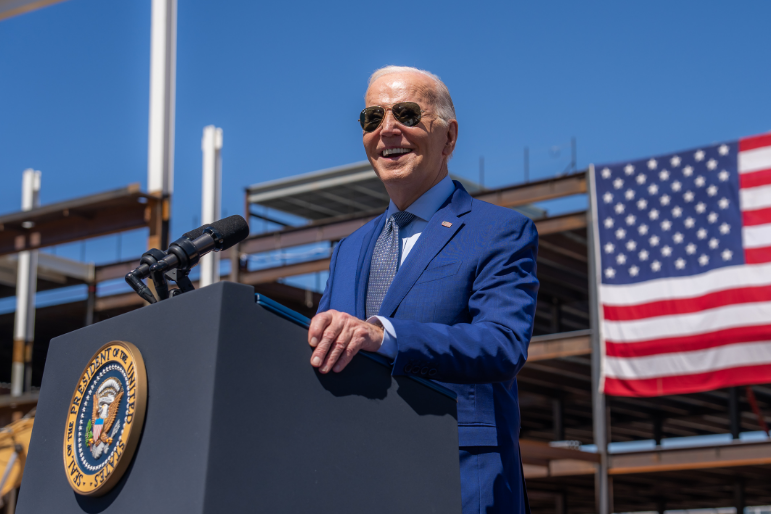
On Wednesday, President Joe Biden appeared in Chandler, Arizona, at the Intel Ocotillo location to “announce that the Department of Commerce has reached a preliminary agreement with Intel to provide up to $8.5 billion in direct funding along with $11 billion in loans under the CHIPS and Science Act.” According to a White House fact sheet, this investment would “support the construction and expansion of Intel facilities in Arizona, Ohio, New Mexico, and Oregon, creating nearly 30,000 jobs and supporting tens of thousands of indirect jobs.”
In a post on “X” after his speech, President Biden wrote, “Semiconductors are the tiny computer chips smaller than a fingertip that power our everyday lives. We invented them, but over time we moved manufacturing overseas. I came to office determined to bring their production home. That’s what our CHIPS Act does.”
Arizona Governor Katie Hobbs attended the event at Intel and spoke to attendees. After the announcement, Hobbs championed the increased funding for a vital sector within her state, saying, “I’m excited to announce that Intel will receive a historic investment from the CHIPS Act, made possible thanks to President Biden’s leadership. This critical investment will drive innovation, create jobs, and solidify Arizona’s position as a leader in semiconductor manufacturing.”
Hobbs added, “Our success story is only possible with our exceptional workforce. BuildItAZ, Future48 Workforce Accelerators, and semiconductor apprenticeships will help ensure Arizonans are ready to take advantage of these good paying jobs. Intel has been a leader in the Arizona business community for decades. Thank you to CEO Pat Gelsinger for continuing our partnership. Your vision and leadership are driving innovation, creating jobs, and strengthening Arizona’s position in the global semiconductor industry.”
Gina Raimondo, the Secretary of the Commerce Department, also took part in the gathering at Intel. She shared, “Today, we announced an $8.5 billion preliminary agreement with Intel that will help strengthen supply chains, revitalize American semiconductor manufacturing, and create nearly 30,000 jobs. It was great to join President Biden in Arizona to share the news.”
“Today is a defining moment for the U.S. and Intel as we work to power the next great chapter of American semiconductor innovation,” said Intel CEO Pat Gelsinger. “AI is supercharging the digital revolution and everything digital needs semiconductors. CHIPS Act support will help to ensure that Intel and the U.S. stay at the forefront of the AI era as we build a resilient and sustainable semiconductor supply chain to power our nation’s future.”
Daniel Stefanski is a reporter for AZ Free News. You can send him news tips using this link.
by Elizabeth Troutman | Mar 21, 2024 | Economy, News
By Elizabeth Troutman |
Arizona ranked as the nation’s 10th most federally dependent state in 2024, according to personal finance website WalletHub.
WalletHub compared the 50 states across three metrics: return on taxes paid to the federal government, federal funding as a share of state revenue, and share of federal jobs.
While Arizona’s overall rank was tenth, the Grand Canyon state ranked 15th for return on taxes paid to the federal government, fifth for federal funding as a share of state revenue, and 23rd for share of federal jobs.
President of the Arizona Free Enterprise Club Scot Mussi took issue with WalletHub’s methodology.
“WalletHub doesn’t do a great job outlining their methodology, but from what I can gather they are basing ‘dependency’ on federal payouts, regardless of the purpose of the funds,” Mussi said. “For example, states with more military bases are likely punished as being more ‘dependent’ on federal funds. So to rectify the dependency problem should we equally spread out military bases among all 50 states so that every state receives equal funding? That makes no sense.”
Mussi said he wonders if Arizona has a higher dependency score due to the number of retirees from states like Illinois and California.
“Because people choose to come to Arizona, does that mean we are a “dependency” state?” Mussi asked. “Again, not a great metric to measure dependency.”
Blue states were found to be less financially dependent than red states.
“Regardless of whether the distribution of federal funds is fair or not, living in one of the most federally dependent states can be beneficial for residents,” WalletHub Analyst Cassandra Happe said in a news release. “For every dollar residents of the top states pay in taxes, they get several dollars back in federal funding, which often leads to higher-quality infrastructure, education, public health and more.”
Alaska was found to be the most federally financially dependent state, followed by New Mexico, Kentucky, West Virginia, and Mississippi. New Jersey ranked as the least dependent.
“Alaska is the most federally dependent state, with over 57% of the state’s revenue coming from federal funding,” Happe said. “For every $1 that residents pay in taxes, the state receives $2.47 in federal funding. Plus, nearly 5% of Alaska’s workforce is employed by the federal government, one of the highest rates in the country.”
Vanderbilt professor Carolyn J. Heinrich said federal resources often support programs that increase societal benefits and reduce societal costs.
“For example, Title I funds in education are distributed according to the level of family economic disadvantage, recognizing that it is important to ensure that all children are healthy and well-educated,” she said. “State resources may be prioritized for uses that yield benefits primarily within the state, such as economic development incentives.”
Mussi said he does think there are examples of states benefiting from their congressmen bringing home federal money for special interest and pork projects.
“Senators from West Virginia have been notorious for this activity, and it should be opposed,” he said. “But metrics like state dependency don’t ever seem to accurately reflect this type of activity, so we usually never rely on them.”
Elizabeth Troutman is a reporter for AZ Free News. You can send her news tips using this link.
by Elizabeth Troutman | Mar 20, 2024 | Economy, News
By Elizabeth Troutman |
Reports show that the Biden administration plans to finalize its final tailpipe emissions rule for cars and trucks on Wednesday, a measure 61% of Arizonans oppose.
The final EPA rule covers both carbon dioxide and conventional pollutants for vehicle model years 2027 through 2032. This is part of the administration’s effort to ban new gas, diesel, and flex fuel vehicles from the U.S. market.
The possible rule could mean that nearly 70% of cars sold in 2032 would need to be electric vehicles, though this is not achievable with our current infrastructure and would make us more reliant on China, according to government relations firm AxAdvocacy.
Chet Thompson, American Fuel & Petrochemical Manufacturers (AFPM) president and CEO, said the EPA policy will feel like a ban for consumers.
“It will vastly restrict both their access to and ability to afford new gas cars, trucks, SUVs and traditional hybrids,” Thompson said. “And there are no offramps in the policy in the event our infrastructure isn’t ready or consumers simply don’t buy EVs at the rate EPA would like. This is exactly why 75% of registered voters solidly oppose any government efforts designed to ban gas, diesel and traditional hybrid cars.”
President Joe Biden has been clear since 2020 he intends to use his federal agencies and the state of California to eliminate sales of new gas cars.
“While multiple administration policies push us toward this end, the Environmental Protection Agency’s (EPA’s) passenger vehicle standards will do most of the damage on their own—requiring approximately 70% of new car sales to be electric in less than eight years,” he said. “This policy is bad for consumers, the economy and national security.”
“It will sacrifice our hard-won U.S. energy strength for even greater dependence on China and the EV battery and mineral supply chain China controls,” Thompson continued.
Only 16% of Arizonans support the rule, which would deprive Americans of the right to select the car best for them, their families, and their budgets.
Opposition for the rule is high in the key presidential and senate battleground states. Almost 90% of Michiganders oppose efforts to ban new gas cars and impose electric vehicle mandates.
In Wisconsin, 64% of residents oppose the measure, while 57% of Pennyslanvanians oppose, 61% of Nevadans oppose, and 66% of Ohioans oppose. Only 9% of Montana residents support the potential rule.
Elizabeth Troutman is a reporter for AZ Free News. You can send her news tips using this link.