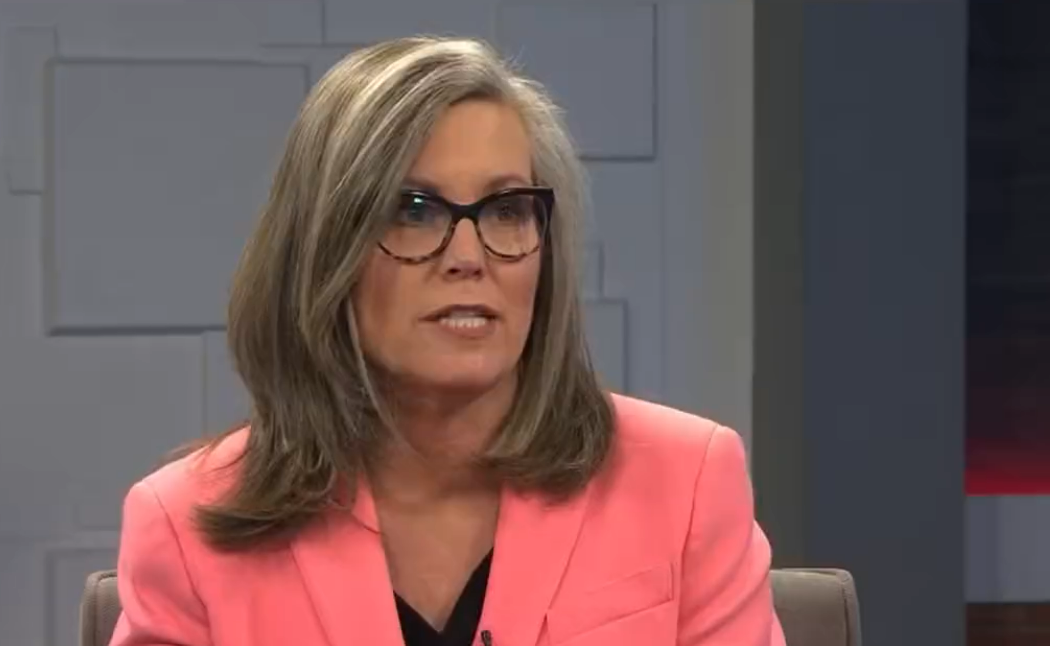
Arizona’s Republican state lawmakers are challenging Gov. Katie Hobbs to sign into law a government transparency bill amid the ongoing “pay-to-play” scandal involving the governor.
This past week, the Republican-led legislature sent SB 1186 to Hobbs’ desk. The legislation was inspired partly by ongoing legal challenges to the legality of the Arizona Medicaid program’s contract award system, and partly by ongoing allegations that Hobbs arranged for a unique rate increase to one of her top campaign donors.
Sunshine Residential Homes, a group home operator, donated more than $400,000 collectively to Hobbs’ gubernatorial campaign, Hobbs’ inaugural fund, and the Arizona Democratic Party.
Once Hobbs took office, the Arizona Department of Child Safety gave Sunshine Residential Homes a 30% rate increase, though no other group homes received rate increases and over a dozen contracts were terminated. This was reported initially by the Arizona Republic in 2024, along with another key detail indicating a close relationship between the governor and the company: Hobbs fine dining at the mansion of Sunshine Residential Homes CEO Simon Kottoor.
Hobbs’ inaugural fund — which reached nearly $2 million — was another funding source that was shrouded in secrecy. The inauguration event cost about $200,000, leaving the million-plus as a nonprofit source of funds to be spent at Hobbs’ discretion.
Attorney General Kris Mayes, a fellow Democrat, has maintained that her investigation into the alleged pay-to-play arrangement remains ongoing. Hobbs has yet to take Mayes up on her request for an interview.
The proposed legislation from Arizona’s Republican lawmakers would require companies that obtain state contracts or certain state grants to disclose anything of value provided in the previous five years to the governor, campaign-related entities, inaugural funds, and organizations making independent expenditures supporting or opposing the governor or their political opponents.
The legislation would also prohibit state agencies and employees from destroying notes created during the evaluation
The bill sponsor, State Sen. T.J. Shope (R-LD16), said financial disclosures should come before the state awards any contracts and grants, in order to ensure transparency and fairness in the process.
“Arizonans have watched one contracting controversy after another and are rightly asking whether political connections are influencing decisions involving billions of taxpayer dollars,” said Shope. “Governor Hobbs now has an opportunity to show Arizonans she supports transparency in government by signing this legislation.”
An advisory team was formed in the House to address this alleged pay-to-play scheme by Hobbs, and they also have their own investigation underway. The lawmakers hired outside counsel from out of state — Justin Smith with the Missouri-based James Otis Law Group — to conduct an independent investigation.
Smith led a battery and defamation lawsuit against E. Jean Carroll, an accuser of President Donald Trump.
That independent investigation initiated by lawmakers is ongoing. All findings from the outside counsel go to the advisory team and House leadership.
Maricopa County Attorney Rachel Mitchell and Auditor General Lindsey Perry are also coordinating on an investigation into the matter involving Hobbs and Sunshine Residential Homes. The House advisory team announced last year it would coordinate with Mitchell and Perry on their investigation.
AZ Free News is your #1 source for Arizona news and politics. You can send us news tips using this link.
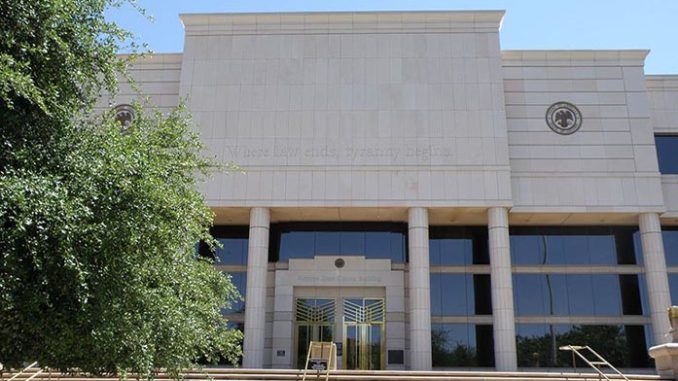
The Arizona Supreme Court has agreed to take on a case determining whether Arizona State University (ASU) can mandate diversity, equity, and inclusion (DEI) trainings for its employees.
Professor Owen Anderson sued the Arizona Board of Regents in 2024 after ASU required him to take a DEI training called “Inclusive Communities” (ASU referred to their version of DEI as “DEIB,” or “diversity, equity, inclusion, and belonging”).
ASU requires the Inclusive Communities training as a condition of employment upon hire and every two years.
The Goldwater Institute, a Phoenix-based public policy and litigation organization, filed on Anderson’s behalf. Goldwater Institute attorney Stacy Skankey said the case represented Arizonans’ right to hold government agencies accountable for violating the law.
Arizona law prohibits any mandatory trainings which impart “blame or judgment on the basis of race, ethnicity or sex.”
“No one should be forced to participate in divisive DEI training or endorse race-based ideology as a condition for holding a government job,” said Skankey. “That’s exactly why Arizona lawmakers banned mandatory trainings that teach discriminatory ideas about race, ethnicity, or sex. But a law without enforcement is no law at all.”
The Inclusive Communities training included materials which taught that white supremacy exists as a structural phenomenon, minority faculty don’t have authority or control due to structural inequalities like racism and sexism, white privilege and white fragility exist and impact communities, white people have a duty to combat their privilege, racism can be implicit even if not intended, and sexual identities yield power.
Transcript examples from the training materials were included in the Goldwater Institute’s filing within the Arizona Supreme Court.
Along with the training, ASU formerly required employees to pass an accompanying module quiz. This exam graded certain answers as correct which served to advance DEIB ideology; the Goldwater Institute argued this final test further proved the training served as an impermissible mandate for employees to accept blame or judgment on the basis of race, ethnicity, and sex.
Anderson said ASU’s mandate violated state law because the training assigned “race blame” based on skin color.
Anderson added that ASU’s training was rooted in a Marxist dichotomy reducing the world to oppressor versus oppressed, and that the training imparted impermissibly discriminatory teachings that conflicted with his religious and political beliefs. Anderson is a tenured faculty member who teaches philosophy and religious studies.
“Arizona State leaders broke the law when they forced me and every other employee to take part in an ideological training that taught that it’s okay to judge people on their race, ethnicity, religion, and sex. I simply refuse to do that,” said Anderson. “Ultimately, the question before the Arizona Supreme Court isn’t a left or right issue — it’s about whether a state employee has the right to hold their employer accountable when it violates the law.”
The Arizona Court of Appeals previously rejected Anderson’s lawsuit. The court ruled that the law doesn’t have a provision allowing individuals like Anderson to seek legal recourse.
AZ Free News is your #1 source for Arizona news and politics. You can send us news tips using this link.
The Arizona Department of Water Resources (ADWR) exceeded its authority under state law, the Maricopa County Superior Court ruled Monday.
The court determined in an under advisement ruling in this ongoing case that, again, ADWR lacked authority under state law to impose a new obligation on home developers to secure additional water supply.
The Home Builders Association of Central Arizona and Arizona Senate President Warren Petersen (R-LD14) have challenged this and other ADWR policies initiated at the behest of Gov. Katie Hobbs.
Maricopa County Superior Court Judge Scott Blaney said this additional requirement by ADWR went beyond what state law required. Per Blaney, the law only requires developers to show 100 years of continuous availability of water sufficient to satisfy water needs for the use proposed by the developer.
State law limited ADWR to two pathways: either developers could obtain a certificate of assured water supply from ADWR or they could obtain a commitment of service from a municipal provider such as a city, town, or private company with an ADWR assurance of water supply designation.
However, under a new rule pushed by the Hobbs administration, R12-15-710(H), ADWR limited developers to a third, new pathway for assured water supply designation. This pathway involved a newly created category of water availability ADWR called “New Alternative Water Supplies,” and required developers to secure an additional 25% of this new category beyond their proposed usage needs.
The ADWR changes under Hobbs resulted in what effectively became a housing moratorium. New building progress in the Valley ground to a halt.
Blaney ruled ADWR lacked the authority to create this third, new pathway. He declared that the plain language of the statute only requires a 100-year guarantee of water needs satisfaction.
“The Legislature created two paths to establish an assured water supply to develop a subdivision: obtain a certificate; or obtain a designation,” said Blaney. “Through the implementation of its moratorium and its nearly simultaneous promulgation of a rule that demands more water than the statute requires, ADWR has in effect attempted to rewrite the governing statute at the agency level.”
Blaney also rejected ADWR’s argument that this third pathway was a voluntary, alternative path out of several for developers. He sided with the developer’s assessment that ADWR had unlawfully restricted developers to a single pathway.
The court ruling on Monday blocked ADWR from enforcing the rule.
In April, the Maricopa County Superior Court struck down ADWR’s housing moratorium articulated in several rules pertaining to unmet water demand and depth-to-water limits.
Similar to this most recent ruling, Blaney found that ADWR sought to break necessary limitations on administrative agency powers and had unlawfully implemented two agency rules without following the Administrative Procedures Act.
AZ Free Newsreported last month that the ADWR-spurred housing moratorium may put taxpayers on the hook for more than $1 billion, due to ongoing and potential future builder compensation claims.
ADWR plans to appeal pending the final ruling.
When Hobbs took office, she formed a Water Policy Council to overhaul the state’s approach to groundwater management. Two committees were formed, one of which addressed assured water supply.
AZ Free News is your #1 source for Arizona news and politics. You can send us news tips using this link.
A local church filed suit against the city of Phoenix for its new ordinance requiring permits to feed and provide medical care to the homeless in public parks.
The city ordinance, “Phoenix Medical Treatment and Food Distribution in Parks,” impacts any individual or organization with a charitable or humanitarian purpose from distributing food or medical care to the general public, not just the homeless — though it is those seeking to provide resources to the homeless that are most impacted by the policy.
The city emphasized the prohibition on the sale, distribution, or exchange of syringes or needles, needle exchange programs, and distribution of needle/intramuscular naloxone in public communications discussing the new ordinance.
The ordinance exempts those distributing food or medical care for non-charitable purposes, such as food distributed at events not open to the general public, like birthday parties, or medical aid rendered to address a sudden medical event. Water and electrolyte beverage distribution was also exempted from the permitting process.
The council passed the ordinance last month, and it took effect last wek week. Starting Friday, the city provides a limited number of permits: two per month, per park made available on a tri-annual basis. The two permits combine both food and medical, not two food and two medical permits.
Those seeking permits must submit the names, food handler certificates, and medical certifications for all providing food and/or medical care, along with proof of a $2 million liability insurance policy.
Lance Brace, a Phoenix real estate agent, and his nonprofit St. Herman’s Table filed the lawsuit challenging the ordinance through Provident Law in the Arizona District Court this week.
St. Herman’s Table provides a meal, water, Bibles, and small hygiene products to the homeless at Cave Creek Park at Cactus once a week. The nonprofit is part of the Exaltation of the Holy Cross Orthodox Church.
Brace argued that the ordinance violates the First Amendment and the Arizona Free Exercise of Religion Act, claiming that it extends favorable treatment to secular activities, like wedding and birthday parties, by not holding them to the same permitting requirements as religious organizations engaging in charitable endeavors.
Advocates for the city ordinance say the homeless have made the public parks unsafe for children and families.
In its presentation of the ordinance during a formal council meeting last month, the city included photos taken by city staff and submitted by residents as examples of the pervasive problems occurring in park systems due to unfettered services rendered to the homeless: mass crowding, littering, drug usage, drug paraphernalia, and contamination with biological hazards.
As an example of the safety hazards presented by charitable organization presence without government oversight, officials referenced several recent city cleanup efforts that yielded the collection of hundreds of needles at South Mountain Park and Preserve, John F. & Mary P. Long Homestead Park, and Margaret T. Hance Park.
Critics of the city ordinance argued that the charitable services shouldn’t be limited by a permitting process due to the outsized needs of the homeless community.
AZ Free News is your #1 source for Arizona news and politics. You can send us news tips using this link.
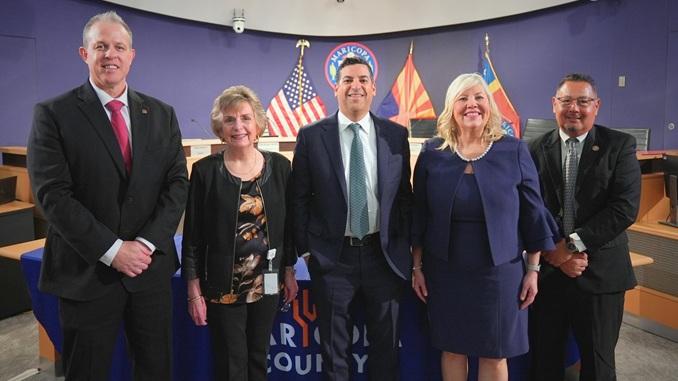
Several Maricopa County staffers are now in the middle of an elections authority dispute between the recorder’s office and the Maricopa County Board of Supervisors.
Several employees with the recorder’s office have been placed under investigation for the alleged theft of a piece of election equipment.
Several employees were contacted by an officer with the Pinal County Sheriff’s Office over the weekend as part of a criminal investigation initiated by special counsel appointed by Maricopa County Attorney Rachel Mitchell, following a complaint from the Maricopa County Board of Supervisors (BOS).
Mitchell’s office said MCAO has no involvement in the investigation.
An allegation was made to Maricopa County Attorney @Rachel1Mitchell, who had a conflict of interest, and she appointed a Special Counsel. MCAO is not involved in the investigation and has no further comment. https://t.co/HA2GYOxkDR
— Maricopa County Attorney's Office (@marcoattorney) June 8, 2026
BOS leaders Kate Brophy McGee and Debbie Lesko, chair and vice chair, said the criminal investigation was not some new development but the result of an incident that occurred months ago in March.
Per McGee and Lesko, Chief Information Officer Bryan Colby and one other, unnamed recorder’s office employee briefly removed a pre-tabulation ballot scanner from the Maricopa County Election and Tabulation Center (MCTEC) during the Tempe Jurisdictional Election. The two employees removed the scanner from MCTEC property for approximately 50 minutes before returning it.
The board also accused Colby of potentially jeopardizing the chain of custody by removing “a handful” of provisional ballots from MCTEC. However, the board said all ballots and envelopes were accounted for the day following the incident.
Maricopa County Recorder Justin Heap contends the scanner belonged to his office, since recorder funds paid for it.
Following the brief removal of the scanner, the county decommissioned and replaced the equipment for $70,000.
Brophy McGee and Lesko issued their press release explaining the criminal investigation into Heap’s employees after Heap filed an emergency motion with the Arizona Superior Court over the weekend.
Heap petitioned the court to take stronger action against the board by stopping further actions like the deputy contacts with his staff that occurred over the weekend — which Heap characterized as retaliation — and for an enforcement action to require the board to adhere to the court’s previous ruling.
🚨 BREAKING: LEGAL UPDATE Yesterday, I filed an emergency motion with the Court after armed sheriff's deputies appeared at the homes of three Recorder's Office employees and informed them they were under criminal investigation.
— Maricopa County Recorder Justin Heap (@azjustinheap) June 8, 2026
Last month, the Arizona Superior Court ordered the board to restore election authority and resources to Heap’s office. The board, which maintains it has “plenary authority” over elections administration, rejected this ruling and plans to appeal.
Last week, Heap asked the court to hold the board in contempt.
And now this week, Heap has accused the board of doing the very thing they have accused him of doing: criminalizing election workers.
“For weeks, the board has attempted to convince the public that I somehow intend to seek criminal penalties against election workers for performing their duties,” said Heap. “That claim is a lie, and they know it. Yet, while making those false accusations, the board was quietly pursuing criminal investigations and penalties against election workers employed by the recorder’s office.”
Heap said “meaningful cooperation” with the board of supervisors has been “impossible,” as evidenced by this latest development.
“While the Board publicly talks about collaboration, claims it wants to work together, and falsely accuses others of creating conflict, behind the scenes it bullies employees, interferes with the recorder’s operations, and now seeks to subject election workers to criminal investigations for attempting to lawfully do their job using equipment purchased and owned by the recorder’s Office,” said Heap.
AZ Free News is your #1 source for Arizona news and politics. You can send us news tips using this link.