by Matthew Holloway | Jul 18, 2025 | News
By Mathew Holloway |
Municipal Affairs Liaison at the Goldwater Institute William Beard sat for an interview with AZ Free News to expand on an op-ed published Saturday, “Regional Transit In Tucson: Bigger Tax Bill, Worse Results?”
Beard warned in his column that as we approach 20 years of the 2006 vintage Regional Transportation Authority (RTA), only 18 of the 35 projects promised to the taxpayers of Pima County have been completed.
He wrote, “The mismanagement is staggering. Tucson’s unfinished Regional Transportation Authority (RTA) projects are estimated to be $400–$600 million short. At the current pace—roughly $50 million in spending per year—completing the work would take at least eight more years. There’s one big problem, however: the sales tax that funds the RTA is set to expire in 2026, and time is running out. Tucson officials have responded by throwing up their hands and admitting defeat, postponing four projects for inclusion in a future ‘RTA Next’ plan.”
Beard directly attributes the RTA’s financial woes and lack of productivity to a series of economic factors, exacerbated by the City of Tucson’s project mismanagement, delays, and unwillingness to shoulder the added cost burden. He explained, “Every infrastructure plan faces risks, and Pima County’s strategy was no exception. The 2008 recession slowed tax collections, and inflation has since driven construction costs well beyond the 10% buffer allowed by law. Tucson, however, made matters worse by repeatedly altering project scopes to appease neighborhood groups, further delaying timelines and driving up costs. Each time, Tucson failed to take responsibility by allocating more supplemental resources. Instead, city leaders appeared to hope the problem would simply go away.”
He added, “Tucson’s leaders clearly misunderstand the purpose of the RTA, viewing it more as a construction manager responsible for overruns than a basic funding mechanism distributing tax dollars. Each city was responsible for designing and building its own projects. Any change in scope—additional lanes, neighborhood preferences, unforeseen costs—was theirs to fund, not the RTA’s.“
Speaking with AZ Free News, Beard elaborated:
“I’m from Tucson. I grew up there, so this is a little personal for me. But there’s a history of kicking the can down the road by the community writ large, leadership, etc. A ‘Why deal with it today when we can postpone to tomorrow’ attitude. And it’s only when things truly reach a critical point that something happens politically.
“The powers that be down there would prefer to kind of maintain the status quo. They don’t want their boat rocked. They don’t want anybody coming in and potentially undermining their political power, so let’s maintain things as they are.
“To the point of the article, the problem fundamentally is two things. One, was it a failure to plan or a plan to fail? And number two, remember when voters vote on these long-term things, you always end up with a situation where the compromises politically that were made in order to get the thing past the voters that were approved in the beginning, political leadership that are elected further on into the cycle, they don’t believe that they are obligated to follow the wishes of whatever compromises were made in the first place.”
As for the political fallout, Beard predicted that an attempt from Tucson Mayor Regina Romero to extricate the city from the RTA, as she threatened in 2022, might not “end well for her politically speaking.”
He noted, “The problem is she is basically telling all of the voters across Pima County, not just the other communities, but the voters throughout Pima County, including her own voters, ‘eff you’. And I don’t think, given what happened with (Proposition) 414 a few months ago in the city of Tucson, I don’t think that will end well for her politically speaking.”
City voters soundly rejected Prop 414 or the “Safe & Vibrant City” proposition, which would have enacted a half-cent sales tax increase for the next 10 years to fund various city projects. City Manager Tim Thomure told AZCentral that the Proposition’s rejections sent city planners “back to the drawing board [to] sharpen our pencils and work it out so that we live within the budget that will be available to us.”
Beard continued saying that Romero, “is, of the opinion, and there are other people, including Supervisor Hines on the Board of Supervisors, of the opinion that the City can basically go its own way and make its own sales tax. They’re forgetting, of course, that if that happens, roughly… a third of the total revenue that would come to the region would disappear because it would revert back to the state legislature to determine whether or not those funds get distributed based on the regional planning that southern Arizona currently enjoys.”
He added that Tucson’s deviation from the RTA planning adopted in 2006 could leave the city open to legal consequences. He observed, “I’m not an attorney, so I don’t give legal advice, but I spent 30 years in the contracting world and I’ve read enough of the documents, the intergovernmental agreements, the procedures, policy procedures of the RTA that was adopted in 2006, all of them keep referring to voter language, you know, the amount of money that was set aside by the voters that could go to these projects.
“Under state law, you can vary that up to 10 % overrun, because it’s the vagaries of construction, that happens. But anything above and beyond that, you’ve got to go back to the voters in order to get their approval to make that kind of scope change. Again, I’m not an attorney, but I can read what’s in the language and it’s pretty clear.”
According to Beard, the RTA board did send its new legal counsel a question with the hope of getting an answer by the end of July at their next formal board meeting, asking: “What is the legal obligation of the RTA board to complete all of the projects if the revenue has not come in to satisfy all of the needs that the voters … determined 20 years ago?”
He concluded: “To be blunt, the city of Tucson’s got nobody to blame but themselves. You can point fingers at the RTA all you want to. You can point fingers to the leadership. The reality is in the numbers; the math is the math. And for all of these projects the City of Tucson kept postponing, it only dramatically increased the amount of money they would have to bring to the table, even assuming the RTA never had a revenue shortfall.
“Because the City of Tucson kept postponing these projects, the costs were going through the roof and there was no way legally for the RTA to step forward and say, oh yeah, we’ll cover those extra costs. That’s not possible.”
Matthew Holloway is a senior reporter for AZ Free News. Follow him on X for his latest stories, or email tips to Matthew@azfreenews.com.
by Matthew Holloway | Jul 18, 2025 | News
By Matthew Holloway |
Robert Warshaw, the court-appointed monitor over the Maricopa County Sheriff’s Office (MCSO), found himself challenged by Republican state and county-elected officials and over 100 attendees at a community forum with Sheriff Jerry Sheridan on Wednesday night.
GOP leaders, including Maricopa County Board of Supervisors Chairman Thomas Galvin, Supervisor Debbie Lesko, gubernatorial candidate Karrin Taylor Robson, and Maricopa County Republican Committee First Vice Chair Shelby Busch, joined the meeting with a large group of supporters of the Sheriff’s Office. The group demanded an accounting from Warshaw for the $311 million in taxpayer dollars spent over the past 11 years on the court-mandated monitoring in the racial profiling case Melendres v. Arpaio.
Supervisor Galvin shared a series of posts to X, laying out the case presented by Lesko and himself. He wrote, “Last night Supervisor @DebbieLesko gave eloquent speech at Maricopa County’s west valley meeting on federal oversight of MCSO[:] *$350 million in costs since 2007[,] *Compliance goalposts keep moving[,] *Monitor paid $2.9M last year[,] *4 sheriffs have served since lawsuit filed[.]”
“Maricopa County pays for these meetings, with taxpayer dollars, and thanks to all who showed up to participate in the public process. High turnout at any public meeting is always a good thing!”
Supervisor Mark Stewart shared video of Galvin’s remarks, initially posted by Maricopa County Attorney Rachel Mitchell, suggesting a concerted effort by the Board of Supervisors and County Attorney’s Office to pushback against the Melendres ruling.
Stewart wrote, “The time to end this decade long oversight. The men and women of the @mcsoaz Sheriffs office deserve recognition as a top tier law enforcement organization. The taxpayers expect their hard earned tax dollars to be invested in their safety. Thank you @Rachel1Mitchell for speaking out and to Chairman @ThomasGalvin for leading this effort.”
During his remarks Galvin quipped, “Mr. Warshaw, you’re a tough man to find! In fact, this is the first time we’ve met.”
Mitchell described the scene in a post writing, “@ThomasGalvin speaking truth to the federal monitor—oversight of our elected sheriff has cost Maricopa taxpayers hundreds of millions of dollars.”
Brandon Hiller, Chief of Staff to the Maricopa County Attorney, shared an image of Warshaw resting his head on his hand during the proceedings, which reportedly became raucous at times. He wrote, “The federal monitor was not pleased with all the support for @JerrySheridan24 and @mcsoaz. Time to end the court orders. 350 million dollars later… 30 million to the federal monitor alone…”
According to KJZZ, the overall cost to the Maricopa County taxpayers to meet the ruling’s 360 requirements for the agency, related to traffic stops and internal affairs, is projected to reach $350 million this year. Warshaw told the audience that the reforms ordered by Judge Snow are not complete yet.
“This agency has made a lot of progress. A lot of progress. We’ll get to the money in a second,” Warshaw told the forum. “Is this thing going to go on forever? No, no, no.”
The monitor told attendees that an independent firm recently did a traffic-stop study of the Sheriff’s Office and found that the bias alleged in Melandres has continued and that oversight will only end after the Sheriff’s Office complies. Warshaw said that the MCSO is still facing a major backlog of internal misconduct investigations, required to be resolved within 180 days with many exceeding that timeline. Warshaw’s most recent report indicated that the department is in “full and effective compliance” with 92% of the 360 requirements in Judge Snow’s order while the misconduct investigation backlog “remains one of the biggest hurdles affecting MCSO’s ability to reach overall completion.”
Lesko was unconvinced however, and said, “I ask the judge, the federal monitor, (and) all the stakeholders to please end this madness.”
Many critics cited the cost of the federal monitoring as their chief concern. Court records show that of the $311 million cost of the lawsuit to date, $31 million has covered the monitoring fees. Warshaw defended the cost, stating that he has 13 full-time staffers monitoring the department.
Galvin was incredulous, referring to the monitoring effort’s 2025 year to date cost of $2.9 million. “We have to spend $2.9 million—you have to spend $2.9 million on Mr. Warshaw. You have to pay for this meeting tonight,” Galvin said. “Debbie and I cut the check, but you, the taxpayers, are paying for this meeting.”
Matthew Holloway is a senior reporter for AZ Free News. Follow him on X for his latest stories, or email tips to Matthew@azfreenews.com.
by Matthew Holloway | Jul 16, 2025 | News
By Matthew Holloway |
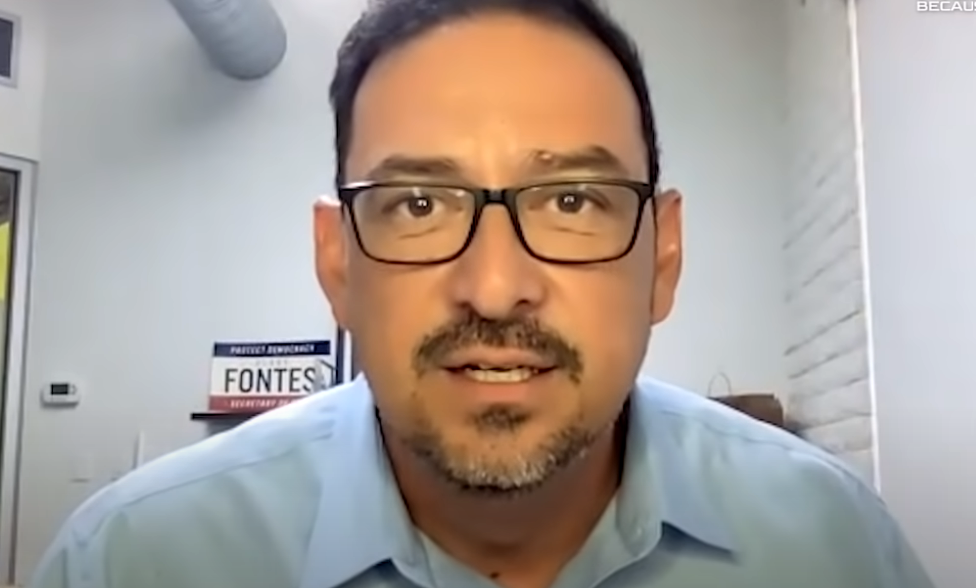
Arizona State Senator Jake Hoffman (R-LD15) suggested Secretary of State Adrian Fontes’ handling of a “foreign cyberattack” looks like a “massive cover-up” in a fiery exchange on X, posted Tuesday.
Further allegations from Hoffman that “Adrian Fontes is lying” followed Turning Point Action COO Tyler Bowyer’s post about the reported hacking of the Secretary of State’s Candidate Portal. Hoffman added that the FBI and Department of Homeland Security are now involved in the matter.
In his initial post Bowyer wrote, “BREAKING NEWS: I was just was told by an inside source at the legislature that it appears the Arizona Secretary of State’s portal was hacked, believed to be impacting the Candidate portal, but possibly much more.”
The Secretary of State responded with a reference to his office’s July 1st press release writing, “Your ‘inside source’ finally read the press release we issued on July 1? Breaking news indeed.”
In the press release in question, Fontes’ office stated:
“The Secretary of State’s Office detected and successfully responded to a malicious adversary that targeted the Arizona Secretary of State’s website. These attempts were investigated, our security controls tuned for similar attack patterns, and applicable threat intelligence was shared with our cybersecurity partners. The Arizona statewide voter registration database was not targeted and is unaffected by this event. The integrity of all Secretary of State systems has been maintained and the office remains in a heightened security posture as we continue to monitor for new and evolving threats.”
In a statement Fontes said, “Our office identified patterns of activity consistent with what others are now publicly acknowledging, and we took decisive action to strengthen our defenses early on. I’m proud to say that critical systems—like Arizona’s voter registration database—remained secure and protected throughout. We will continue to lead with urgency and vigilance, because defending democracy doesn’t come with a pause button.”
In a response posted Tuesday night, Hoffman blasted Fontes writing, “July 1st press release looks like a MASSIVE cover up[.] FBI & DHS (at least!) now involved[.] A private briefing was held TODAY and legislators have confirmed that a ‘foreign cyberattack’ on AZ’s election system occurred[.] The public is totally in the dark[.] Adrian Fontes is lying!”
In a follow-up post he wrote, “AZ ELECTION CYBER ATTACK COVER-UP Legislators report a briefing last week for GOP members downplaying severity of hack[.] NOW: Reports of a briefing today for DEM legislators only telling the full story[.] FBI & DHS are confirmed to be involved[.] Why is Adrian Fontes lying?”
AZ Free News has reached out to Senator Hoffman seeking elaboration on the “private briefing” held Tuesday and the involvement of the FBI and Department of Homeland Security that “confirmed” a “foreign cyberattack’ on AZ’s election system.”
As of this report no response has been received.
Matthew Holloway is a senior reporter for AZ Free News. Follow him on X for his latest stories, or email tips to Matthew@azfreenews.com.
by Matthew Holloway | Jul 16, 2025 | Economy, News
By Matthew Holloway |
Arizona Republican Congressman Abraham Hamadeh (R-AZ08) issued a call this week for Jerome Powell, Chairman of the Federal Reserve, to resign. Hamadeh cited a series of failures from Powell in an official Congressional letter sent on Sunday.
“My call for Chairman Powell’s resignation does not come lightly nor without good cause,” stated Congressman Hamadeh. “Considering the recent revelations by Office of Management and Budget Director Russell Vought about Chairman Powell’s gross mismanagement of the Federal Reserve’s headquarters renovation project, and his apparent lack of candor before the Senate Banking Committee, neither does my call come too soon.”
In a post to X Monday, Hamadeh further stated, “Jerome Powell has lost the confidence and ability to effectively Chair the Federal Reserve.”
Senators pressed Powell hard on the ongoing $2.5 billion renovation of the Fed’s headquarters during the Chairman’s semiannual monetary policy hearing before Congress in June. Sen. Tim Scott (R-SC) critcized Powell for the renovations, referring to them as “luxury upgrades that feel more like they belong in the Palace of Versailles.”
James Blair, a White House deputy chief of staff, announced in a post to X, “The Federal Reserve’s Inspector General is considering opening an investigation into the massive cost overruns for their $2.5B+ HQ renovation project.”
Blair was appointed to the National Capital Planning Commission which holds oversight over the project last week.
In his letter calling for Powell to step down, Congressman Hamadeh echoed the words of Director Vought, who questioned the “ostentatious” overhaul of the Federal Reserve Campus and also cited the Chairman’s “failure to accurately assess the effects of tariffs” and “refusal to lower interest rates for the good of the nation in a timely manner,” as causes. He added, “This renovation is $700 million over budget at a time when your political game playing is wreaking havoc with Americans’ budgets. In fact, it is your failure at the Fed that has caused home ownership to be cost prohibitive for too many young families, denying them access to one of the most important facets of the American Dream.”
Hamadeh continued by highlighting Powell’s failed predications on the Trump administration’s tariff system.
He wrote, “Aside from the burden you have placed on taxpayers, who must foot the bill for your frivolous fabrications, you have failed to properly assess the impact of President Donald Trump’s tariff policy. Contrary to your predictions, increasing tariff collections are helping improve government finances with the U.S. Treasury Department posting a $27 billion budget surplus in June 2025.”
Hamadeh acknowledged that “White House economic adviser Kevin Hassett has said that President Trump has the authority to fire Chairman Powell for cause,” but added that “it shouldn’t have to come to that.”
He concluded, “Chairman Powell needs to accept the fact that his political game playing has led to harmful failures and step down for the good of the country.”
Matthew Holloway is a senior reporter for AZ Free News. Follow him on X for his latest stories, or email tips to Matthew@azfreenews.com.
by Matthew Holloway | Jul 13, 2025 | News
By Matthew Holloway |
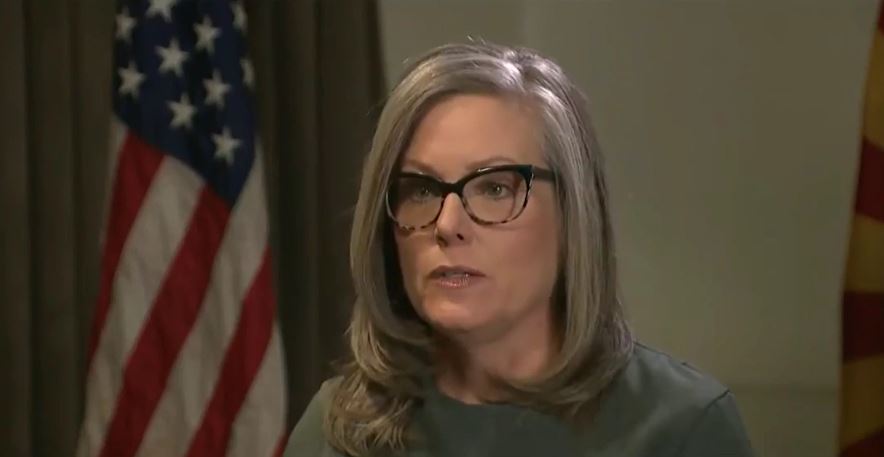
Arizona’s Democrat Governor Katie Hobbs is facing a new round of severe criticism and wide condemnation. On July 9th, reports surfaced that Hobbs nominated her Democrat ally and failed District 17 legislative candidate Dana Allmond for a role in the Department of Veterans’ Services. Hobbs then pulled back the nomination and appointed Allmond to a newly created post with a $170,000 annual salary and a $114,000 annual contract for her assistant, Marcus Trombetta.
Arizona Senator Jake Hoffman (R-LD15) released a scathing statement posted to X on Wednesday writing, “Katie Hobbs nominated fellow Dem politician, Dana Allmond, for a cushy gov’t job. Then Katie DEMOTED her. Then Katie invented a job that’s never existed before for her. Then Katie paid her & her asst. nearly $600,000 of YOUR money!
“FULL STATEMENT: Katie Hobbs’ jaw-dropping nearly $600,000 handout of taxpayer money to a former Democrat politician and her assistant for newly invented jobs reeks of corruption.
“It’s sickening that Hobbs continues to treat Arizona’s government like her personal friends-and-family slush fund, doling out lavish six-figure salaries to political cronies.
“With Hobbs it’s clear, when she’s not entangled in pay-to-play schemes, she’s plundering Arizonans’ hard-earned dollars as if they’re her own personal piggy bank.”
Hoffman’s statement aligns well with reporting from the Arizona Capitol Times, which was confirmed by the Department of Economic Security. Per the Times, after her replacement as nominee for head of the Department of Veterans’ Services with John F. Scott II in April, Hobbs reportedly created the role of “senior executive consultant” for Allmond and promptly renewed her state contract.
Hobbs’ press aide Christian Slater told the outlet that Allmond is part of the DES “senior engagement team” in her new role and will be tasked with helping Arizona veterans access DES services. The move follows a 5% reduction in force at the Department of Economic Security, owing to the Governor’s failure to adjust the budget for reduced federal grants.
According to the Times, the terminated staffers at DES received their 2 ½ weeks’ notice just days after Allmond’s new contract became effective.
In a statement, Slater dismissed any connection and attempted to shift blame to the federal budget cuts driven by the Trump administration, ignoring that Hobbs and Democrat legislators had ample opportunity to work with GOP leaders to account for the difference.
“The workforce reduction at DES was an unfortunate consequence of the Trump administration’s reckless cuts that endanger DES’s work to combat fraud and efficiently deliver the critical services Arizonans rely on,” Slater claimed.
As previously reported by AZ Free News, Republican legislative leaders have questioned the apparent duplication of duties between the new DES “senior executive consultant,” and the Department of Veterans’ Services existing responsibilities.
Earlier in the year, Sen. Hoffman challenged DES Director Michael Wisehart before the Committee on Director Nominations. Per the Times, Wisehart didn’t refute that the role duplicates the responsibilities but answered that Allmond would help connect veterans with needed services, noting that DES also has programs that work with veterans.
A blistering article issued by the Arizona Free Enterprise Club, dating back to March 2024, has also shown that the new role for Allmond is only the most recent in a series of controversial new jobs created by Governor Hobbs. According to the article, at that time, Hobbs had created forty new roles including: six people working in the Office of Resiliency, four new employees in the Office of Tribal Relations, and three new in-house attorneys.
Matthew Holloway is a senior reporter for AZ Free News. Follow him on X for his latest stories, or email tips to Matthew@azfreenews.com.