by Matthew Holloway | Sep 27, 2025 | News
By Matthew Holloway |
The sniper attack on a U.S. Immigration and Customs Enforcement (ICE) facility in Dallas has sparked a wave of reactions from Arizona politicians, reflecting a deeply divided political landscape.
In the attack, a 29-year-old gunman named Joshua Jahn killed one ICE detainee and critically wounded two others before ending his own life. The shooting was described by authorities as a targeted attack, with “anti-ICE” messages found inscribed on ammunition at the scene.
At the federal level, Arizona’s congressional delegation has been vocal, though not uniformly so. Congressmen Andy Biggs (R-AZ-05) and Abe Hamadeh (R-AZ08) were among the first to respond. Biggs condemned the violence and offered prayer for the affected families, writing, “Violence against our courageous law enforcement officials is completely unacceptable. I am praying for our @ICEgov agents and their families while we await more details.”
Hamadeh posted to X, highlighting the emerging evidence of the crime being motivated by anti-ICE sentiment, writing, “Anti-ICE messages carved on the bullet casings. Another militant left-wing shooter inspired by the media and the left’s constant demonization of our law enforcement officers. These brave men and women are tasked with enforcing our immigration laws and protecting our homeland, and for that, these radicals have put a target on their backs.”
Congressman Eli Crane (R-AZ02) shared posts from the Department of Homeland Security and President Donald Trump throughout the morning and wrote succinctly, “This violence must stop.”
In a Thursday post sharing a video from Benny Johnson, he added, “I stand with ICE. Their critical efforts are only necessary because of the border crisis forced upon everyday Americans by Joe Biden and whoever was really calling the shots while he was dozing off in the White House.”
Democrat Rep. Greg Stanton (D-AZ04) addressed the attack as well, calling it “Shocking, senseless news out of Dallas this morning.” He posted, “Violence of any kind has no place in America and tears our communities apart. As details continue to emerge about the shooting, we grieve with the families who lost loved ones and pray for the wounded.”
At the state level, the Republican Party of Arizona issued a statement regarding the shooting within the broader context of rising attacks on ICE agents.
“The rise in attacks on our ICE agents is no accident,” the party wrote on X. “In Dallas, a shooter opened fire on an ICE office with ‘ANTI-ICE’ bullets. Here in Arizona, we’ve seen protests escalate into violent clashes with law enforcement during ICE operations. When lawless mobs target the men and women keeping our communities safe, it’s time to draw the line. Arizona stands with ICE and every officer on the frontlines. Enough is enough — attacks on law enforcement will not be tolerated.”
Homeland Security Secretary Kristi Noem called the attack a “wake-up call.” She wrote in a statement:
“For months, we’ve been warning politicians and the media to tone down their rhetoric about ICE law enforcement before someone was killed. These horrendous killings must serve as a wake-up call to the far-left that their rhetoric about ICE has consequences. Comparing ICE Day-in and day-out to the Nazi Gestapo, the Secret Police, and slave patrols has consequences. The men and women of ICE are fathers and mothers, sons and daughters. They get up every morning to try and make our communities safer. Like everyone else, we just want to go home to our families at night. The violence and dehumanization of these men and women who are simply enforcing the law must stop. We are praying for the victims and their families.”
In Arizona, where border security is a profound and omnipresent issue, the incident resonates deeply given the prominent role of ICE throughout the state. Past protests and counter-protests related to ICE activities, some of which have turned violent, are fresh in the minds of many Arizonans and the threat of further violence looms large.
Matthew Holloway is a senior reporter for AZ Free News. Follow him on X for his latest stories, or email tips to Matthew@azfreenews.com.
by Matthew Holloway | Sep 26, 2025 | Education, News
By Matthew Holloway |
After overcoming months of stonewalling, the Goldwater Institute has issued a report revealing that school district superintendents in Arizona are awarded some of the most lucrative public service contracts in the state.
The report, by Goldwater’s Director of Legal Strategy for Education Policy Christopher Thomas, uncovered perks including “car allowances,” performance bonuses, duplicate private retirement packages (“funding private retirement accounts on top of their already generous state pension benefits”), and “generous personal and vacation leave banks” that can be “cashed out.”
“For taxpayers, the secrecy should set off alarms,” Thomas said in an article for Goldwater. “Superintendents are not just any employee—they are the CEOs of their districts, the highest-paid public servants in many counties. They are also the only officials directly accountable to the elected school board. The superintendent’s job is important, and high salaries may be justified. But the current system of secrecy and delay erodes public trust.”
In a post to X, the Goldwater noted that the superintendents enjoy, “Duplicate retirement packages. Monthly car allowances large enough to lease high-end sports cars. Performance bonuses,” and added, “These are just some of the benefits that AZ school superintendents receive that make them among the state’s highest paid public employees…”
In the text of the report entitled, “The Hidden Ways Arizona School Superintendents Are Paid,” Thomas analyzed contracts from 41 of the largest school districts in Arizona, extracted over four months despite “district stonewalling,” and “a tangle of complex contract provisions that school boards, and the superintendents themselves, deliberately design to mask the full measure of compensation from taxpayers.“
Perhaps the most egregious example highlighted in the report is the compensation package for the embattled Superintendent of the Tolleson Union High School District, Jeremy Calles.
Although the district ranks only 16th in size statewide—and continues to face corruption allegations while posting student proficiency rates below both state and peer averages (21% in math and 26% in English)—Superintendent Calles receives an annual compensation package of $491,360, exceeding that of every other surveyed superintendent by more than $100,000.
Calles’ full earnings include a base salary of $361,584, already the highest in Arizona by $111,000, per Goldwater, plus $72,316 in performance pay, substantial retirement contributions beyond his state pension, a car allowance, and the ability to bank up to 120 unused personal days for a potential $166,184 cashout upon his departure from office.
The Tolleson Union High School District is hardly unique in this respect, according to the report. Monthly stipends or “car allowances” are in place at districts ranging from $500 per month at Marana USD and Littleton ESD to as much as $1,250 per month in Amphitheater USD and Sahuarita USD. Some districts even offer these as annual lump sums, such as Tucson USD, which offers a cool $20,000 annually, or Laveen ESD, which comes in just shy at $19,475 per year.
Concluding his report for the Goldwater Institute, Thomas summarized both the extravagant compensation packages and the seemingly deliberate lack of taxpayer transparency into them. “Superintendents have important jobs. In each district, they are the one employee the school board hires, supervises, and may ultimately terminate,” he said. “The superintendent is responsible for student achievement, implementing board policy, recommending staff hires, and overseeing school district finances. They understandably command the highest salary in the school district. However, there should be greater transparency in just how much they are paid. Their contracts may be among the most important public documents held by school districts. Because of this, these contracts should be readily available to the public.”
Thomas further recommended corrective action, adding, “In addition, school districts should publish total compensation analyses for their superintendents, listing the value of all the perks that are included in their contracts. It is likely that most school board members do not fully understand how their superintendent is paid, nor all the sources of compensation the superintendent receives. Surprisingly, many have never even seen the superintendent’s contract, and some have been denied access when they’ve requested it.”
Matthew Holloway is a senior reporter for AZ Free News. Follow him on X for his latest stories, or email tips to Matthew@azfreenews.com.
by Matthew Holloway | Sep 26, 2025 | News
By Matthew Holloway |
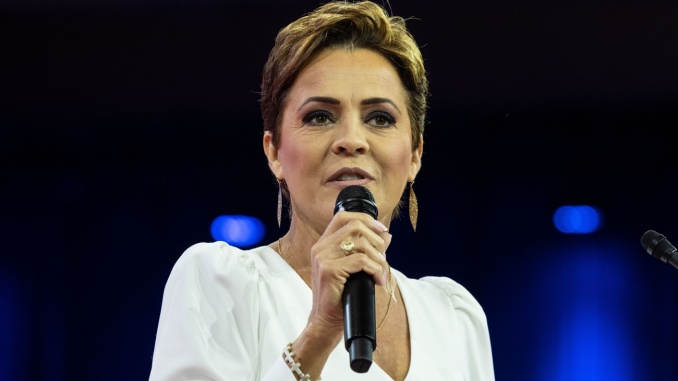
The full deposition of Kari Lake, acting CEO of the U.S. Agency for Global Media (USAGM), was unsealed and filed publicly on Monday in the U.S. District Court for the District of Columbia. In the September 9th questioning from plaintiffs’ lawyers in lawsuits challenging layoffs at Voice of America (VOA) and its parent agency, Lake dismantled the narratives woven by the terminated staffers in outlets like the Washington Post and NPR.
Lake has been accused of “gutting” VOA through alleged illegal firings and union-busting. The headlines painted a scene of “fearful journalists” and “dismantling” America’s global voice, framing the cuts as a political purge in defiance of court orders. However, Lake’s sworn testimony tells a different story.
In the 549-page transcript, Lake coolly describes a deliberate, team-driven effort to comply with President Trump’s March 14, 2025, Executive Order “Continuing the Reduction of the Federal Bureaucracy,” which mandated slashing agencies like USAGM to their “statutory minimum” within seven days, as previously reported by AZ Free News.
“I effectuated — I got busy working to effectuate the President’s executive order,” Lake stated plainly during the deposition, responding to questions about her rapid response to the EO. Far from the “unaware” operative depicted in the Post’s coverage—which claimed she learned of the order “the day of” and blindsided staff—Lake described proactive preparations based on “rumblings” and immediate collaboration with career officials.
“We made the decision to determine what (the) statutory minimum was, and in the process of doing that, we worked with the senior leadership at the agency to come up with what our plan would be. We placed everybody on paid leave and worked with senior leadership, career leadership, and they came up with the plan.”
This new information decisively counters the union-led narrative of a “union-busting attack on workers’ First Amendment rights,” as put forth by the American Federation of Government Employees (AFGE) and amplified by Politico. Lake emphasized that reductions in force (RIFs) affecting hundreds were “the same process that went into the first one,” guided by non-partisan experts, such as Victor Morales, a 36-year agency veteran.
“This was an agency decision based on everything that’s led up to [it],” she added, rejecting any indications of personal retaliation. These firings also included a subsequent round after an August 28 executive order excluded the USAGM from the Federal Labor-Management Relations Program.
The deposition also highlighted Lake’s repeated warnings about foreign infiltration plaguing USAGM, which were emphasized during her congressional testimony with Congressman Abe Hamadeh in June. “This place is rotten. It’s rotten to the core,” she told the House Committee on Foreign Affairs. “President Trump has asked me to go in and help clean it up, and he’s also issued an executive order to reduce this agency down to its mandate, to what is mandated, statutorily required. That’s exactly what I’m doing. I don’t care if they attack me.”
Media critics have dismissed her findings as fearmongering to justify cuts, but under oath, Lake was firm, identifying “massive national security violations, including spies and terrorist sympathizers and/or supporters infiltrating the agency, eye-popping self-dealing involving contracts, grants, and high-value settlement agreements…”
Pressed on her posts to social media stating that “the CCP has infiltrated VOA and you are paying for it,” Lake confirmed her statement without hesitation, saying simply, “Yes.” When asked about Chinese Communist Party (CCP) meetings with VOA managers to shape coverage, she replied, “In the past, they have.”
These revelations appear to fly in the face of NPR’s portrayal of Lake’s reforms as baseless paranoia endangering journalists abroad, with reporters “fearful” over visa revocations amid supposed “lax security” excuses.
Instead, Lake clearly laid out the overhaul as a mission to restore integrity: “I think it’s important to effectuate the President’s executive order and make sure that what we’re putting out is honest, truthful reporting.”
She highlighted fiscal wins, like canceling an “obscenely expensive 15-year lease that burdened the taxpayers,” and anticipated operating “above the originally proposed statutory minimum” while adhering to the law.
The lawsuits, Widakuswara et al. v. Lake and Abramowitz et al. v. Lake, both stem from the firing of VOA staff and former VOA Director Michael Abramowitz, whom Lake attempted to reassign before a judge intervened to block it. But Lake invoked executive privilege on White House chats and stressed the EO’s clarity: “In the executive order, it says right here in Section 2(a), ‘such entities shall reduce the performance of their statutory functions and associated personnel to the minimum presence and function required by law.'”
Along that same line of reasoning, Solicitor General of the United States D. John Sauer announced in late August that the Department of Justice is prepared to defend the removal of Abramowitz from his position writing, “Under Article II, inferior executive officers must be removable at will by the President or by a department head acting on the President’s behalf.”
As Lake navigates the legal hurdles raised before her, her deposition emerges as a counter to the media narrative. While outlets like the Washington Post describe “contentious court battles” and “radical cuts,” Lake’s testimony underscores a lawful cleanup of a bloated, fatally infiltrated bureaucracy. She summarized the situation best, saying, “The President put out an executive order calling for the reduction to the statutory minimum,” and “it was the decision of the team, the senior leadership team, that we needed to follow the President’s executive order.”
Matthew Holloway is a senior reporter for AZ Free News. Follow him on X for his latest stories, or email tips to Matthew@azfreenews.com.
by Matthew Holloway | Sep 25, 2025 | News
By Matthew Holloway |
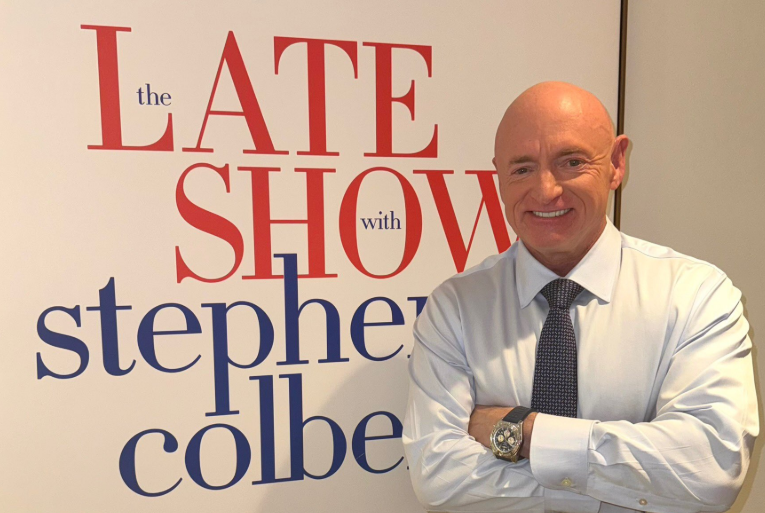
Arizona Rep. Juan Ciscomani (R-AZ06) sharply admonished Sen. Mark Kelly on social media Tuesday after the Tucson Democrat announced his Monday night appearance on The Late Show with Stephen Colbert. Some critics online are accusing Kelly of angling for a 2028 White House run while neglecting his Senate duties, echoing similar concerns about Senator Ruben Gallego’s Iowa town hall this summer.
In a post to X, Kelly wrote, “Always a privilege to be on the @ColbertLateShow! Tune in tonight on CBS to see my conversation with @StephenAtHome.”
This move followed Colbert’s trivializing of the suspension of Jimmy Kimmel by ABC after that host made offensive remarks following the assassination of Charlie Kirk, and amidst a tense congressional standoff that could lead to a government shutdown.
Sharing Sen. Kelly’s post to X, Ciscomani openly admonished him, writing, “Or, how about actually doing some *real* work, Senator? Avoiding a disastrous government shutdown is in the hands of Senate Democrats. Late-night TV interviews aren’t going to help make sure our border agents get paid, or keep the Grand Canyon open.”
He added, “This guy is AZ’s Senior Senator,” before following up with a reminder of Kelly’s duty to Arizona with a stern command: “Do. Your. Job.”
Nick Field of PoliticsPA pointed to Democrats feeling out a 2028 presidential run by “guesting” on Colbert throughout the week, writing, “Three potential 2028 Democratic candidates are guesting on Colbert this week: Mark Kelly on Tuesday, Gavin Newsom on Wednesday and Chris Murphy on Thursday.”
During the interview with Colbert, Kelly used about half of his time in the spotlight joining the host in bashing President Trump, telling Colbert he wishes that a Republican would “grow a spine and do something publicly,” about “the President and how he conducts himself.” He even attempted to lay the blame for the likely upcoming shutdown at the President’s feet.
“Let me make this perfectly clear to everybody. This is a fight over the cost of your health care,” Kelly claimed. “That’s all this is about. The president says no. He says he would prefer a government shutdown.”
The conversation with Colbert quickly turned to the assassination of Charlie Kirk, framed in Sen. Kelly’s experiences surrounding the attempted assassination of his wife, former Democrat Rep. Gabrielle Giffords, in 2011.
Matthew Holloway is a senior reporter for AZ Free News. Follow him on X for his latest stories, or email tips to Matthew@azfreenews.com.
by Matthew Holloway | Sep 23, 2025 | News
By Matthew Holloway |
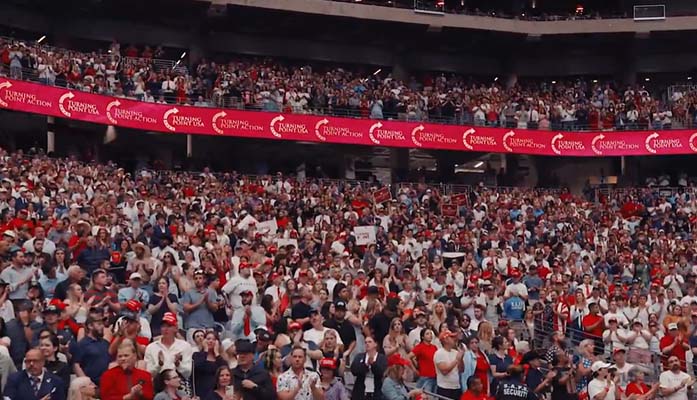
Arizona Republican and conservative leaders gathered at State Farm Stadium in Glendale on Sunday for the Charlie Kirk Memorial, describing a unified scene filled with worship music and a spirit of revival.
In a radio appearance with James T. Harris of the Conservative Circus on 550 KFYI, Congressman Abe Hamadeh (R-AZ08) set the scene, telling the host, “James, the energy and the atmosphere was incredible. You know, Charlie was this 31-year-old man. His life was taken so short. Yet, you see so many people coming in, and there’s a sense of revival there, right? I mean the whole service was perfectly executed by Turning Point, especially given the quick turn around. I mean my God, they filled State Farm Stadium plus Desert Financial Credit Union Arena or Desert Diamond Area, rather, just across the street. So, you have almost 100,000 or over 100,000 people celebrat[ing] the life of Charlie Kirk. And it wasn’t just a political rally, James. I mean there was a prayer, there was worship music. I mean…the energy was different than any other rally I’ve been to.”
In an interview with Piers Morgan on Monday, Acting CEO of the U.S. Agency for Global Media Kari Lake said the feeling at the event was, “Definitely unity.”
She explained, “We were there to remember a friend, a great patriot, a great American, a great Christian, and it was extraordinary. I mean, the whole event started with hours of worship music by the biggest, you know, performers in Christian music…Getting there… was… it was almost impossible. I mean, every road going in was filled with standstill traffic, and people were walking from miles away.”
Lake added, “This was a group of Americans who love this country, a patriotic group, many of whom were Christians, all of whom love Charlie Kirk for the strong message he shared, for the peaceful way that he spread the word of our Constitution and our freedoms. And even the politicians that were there were talking about that. We’ve got to start coming together as a country, and that doesn’t mean we give up what we believe in, but we can no longer tolerate the crime, the violence that is coming at us, and we’ve sat down and taken it for a long time. Now we’re standing up, and we refuse to take it.”
Congressman Juan Ciscomani (R-AZ06) shared images to X from the event and wrote, “Charlie lived by prioritizing his faith — and he did so without hesitation while inspiring many. This allowed our youth the courage to lead with their faith and have a political position based on who you are as a person and what you believe in your heart. It’s a very important message. Today’s service is a reflection of who Charlie was — centered on his beliefs with strong conservative values.”
During the memorial, Congressman Eli Crane (R-AZ02) shared a personal anecdote about his friendship with Kirk, writing, “Darkness will never be able to overcome light. There may be moments where it appears that all is lost. This story we live in will have many more dark moments, and I can promise you this, light will ultimately overcome it all.”
He added, “I’m grateful to have been able to call Charlie a friend. He inspired me and so many others. He showed us that places like academia weren’t lost but void of light. He became that light and started a movement that will eclipse in his death what he built in life. Though we will miss our friend and true patriot. We will never forget him, and we will carry on the work that fueled him. To be bold, speak truth, and point others to Christ.”
Arizona Senate President Warren Petersen shared photos from the memorial, commenting, “With tens of thousands ready to remember, honor, and celebrate the life of Charlie Kirk. Never seen anything like this.”
State Senator T.J. Shope (R-LD16) shared them as well and wrote, “Truly amazing sights coming out of State Farm Stadium today! We’re watching at home like millions of others but am glad @votewarren and thousands of others are in the building to pay respects to the great @charliekirk11!”
Matthew Holloway is a senior reporter for AZ Free News. Follow him on X for his latest stories, or email tips to Matthew@azfreenews.com.