by Daniel Stefanski | Apr 30, 2024 | News
By Daniel Stefanski |
Arizona homeowners were unable to acquire enhanced protections for their properties thanks to a veto from the state’s Democrat governor.
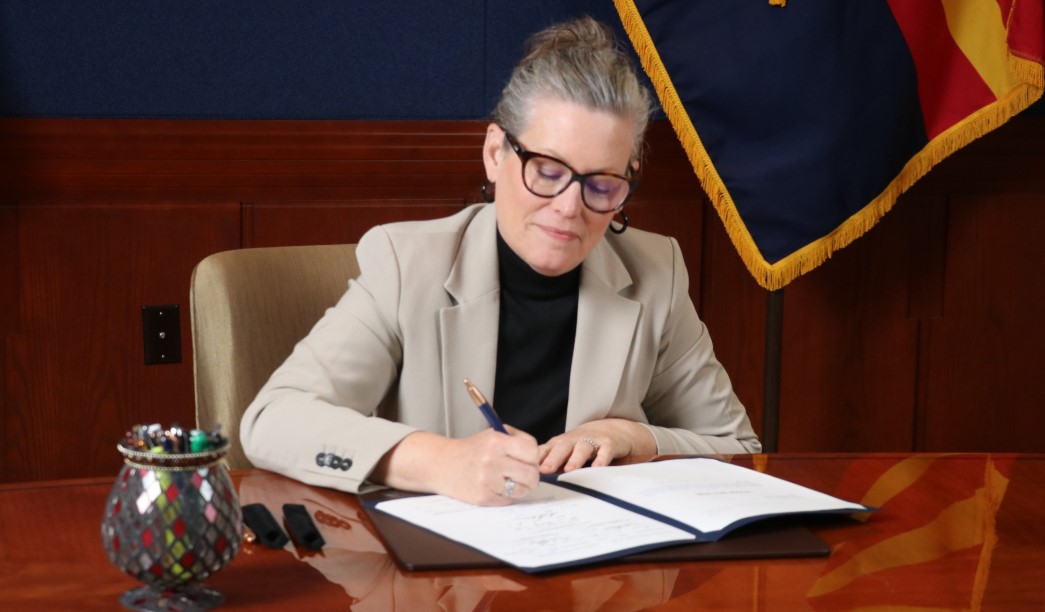
Earlier this week, Governor Katie Hobbs vetoed SB 1129, which would have “allow[ed] a property owner or the property owner’s authorized agent to request, from law enforcement, the immediate removal of a person who is unlawfully occupying a residential dwelling, outline[d] conditions that determine if a person is unlawfully occupying a residential dwelling, [and] deem[ed] that a person who fails or refuses to surrender possession of the property as directed by a law enforcement offer is committing trespass” – according to the purpose from the Arizona Senate.
In her veto letter to Senate President Warren Petersen, Hobbs explained that the proposed “fails to leverage existing legal mechanisms, respect the due process rights of lawful tenants, and minimize unintended consequences, such as for victims of domestic violence.”
Senator Wendy Rogers, the bill’s sponsor, reacted to the governor’s decision on her legislation, writing, “Criminals are scheming to take over homes that aren’t theirs, posing a threat to the safety of homeowners and infringing on their private property rights. Although we have trespassing laws, it’s often difficult to prove a person is unlawfully occupying a home and can result in a lengthy legal battle. Homeowners testified in committee hearings about their property being severely damaged, the subsequent astronomical costs from these criminals, and consequently, they felt incredibly violated. We should not further victimize homeowners with a time-consuming, cumbersome, and costly removal process.”
Rogers also addressed the governor’s reasoning in her letter, saying, “In her veto letter, Katie Hobbs claims this bill fails to protect the rights of lawful tenants and minimize unintended consequences for victims of domestic violence. Did she read the bill? It addresses illegal occupants, not lawful tenants. That’s precisely the point. This bill has absolutely NOTHING to do with landlord-tenant law and has exemptions for family members and anyone with an agreement to cohabitate.”
The governor’s veto attracted the attention of one of her colleagues from across the country and the political aisle – Florida Governor Ron DeSantis, who said, “The Governor of Arizona just vetoed a bill that we signed here in Florida so that these squatters could be ejected. What kind of a message does that send? You’re saying you can squat in somebody’s house and basically they got to go through a six month process.” DeSantis added, “We’re putting an end to the squatters scam in Florida. While other states are siding with the squatters, we are protecting property owners and punishing criminals looking to game the system.”
Senator Justine Wadsack, a cosponsor of the bill, also weighed in on the action from the Ninth Floor of the Arizona State Executive Tower. She said, “”As a Realtor, I’ve personally encountered a squatter occupying a home I was showing to a client. It was a terrifying threat to my safety, the safety of my clients, as well as to the homeowners. When I called the police, I was told there’s not much they could do. Nobody should ever be allowed to live in and occupy another person’s home without their permission, yet I continue to have constituents reach out to me with these types of stories. I’m proud of the swift and unified response Republican lawmakers made to fight this issue, it’s a shame Governor Katie Hobbs has vetoed yet another piece of commonsense bipartisan legislation.”
Senators Farnsworth, Kavanagh, Kern, Shope, and Representative Gillette – all Republicans – were cosponsors of the legislation.
Daniel Stefanski is a reporter for AZ Free News. You can send him news tips using this link.
by Daniel Stefanski | Mar 12, 2024 | News
By Daniel Stefanski |
A veterans-related bill is making its way through the Arizona Legislature, but failing to pick up the bipartisan support that may be needed for Governor Katie Hobbs’ signature.
Earlier this month, the Arizona State Senate approved SB 1308, which “prescribes requirements and procedures that individuals assisting with veterans’ benefits matters before the Arizona Department of Veterans’ Services (ADVS) or the U.S. Department of Veterans Affairs (U.S. VA) must fulfill prior to receiving compensation for such services” – according to the purpose from the chamber.
All Republicans voted in favor of the bill, while 12 Democrats joined in opposition to its passage from the chamber. Two Democrats did not vote.
After the vote, the Arizona State Senate Republicans “X” account wrote, “Senate Democrats voted ‘NO’ on a bill protecting veterans from being financially taken advantage of when seeking advice on their benefits.”
SB 1308 was sponsored by Senator Wendy Rogers and co-sponsored by Senators Anthony Kern and Justine Wadsack.
Rogers cheered on the green light for her legislation, stating, “My SB 1308 passed the Arizona Senate offering us military veterans more options for help seeking disability claims with the Department of Veterans Affairs.”
One of the provisions of the legislation would “prohibit a person from receiving compensation for advising, consulting or assisting an individual regarding a veterans’ benefits matter before ADVS or the U.S. VA; or referring an individual to another person to advise, consult or assist the individual with a veterans’ benefits matter.”
The bill does allow for “a person to receive compensation for advising, consulting or assisting an individual with a veterans’ benefits matter if the person, prior to providing any services, prepares an agreement to be signed by all parties that contains the following: a) the terms of the agreement, including the payment amount for the services being provided; and b) a disclosure written in 12-point font, in a readily noticeable and easily identifiable place, stating that the business is not sponsored, endorsed by or affiliated with ADVS or the U.S. VA or other federally chartered veterans’ service organization, and that specified organizations may be able to provide the veteran with the same services free of charge.”
On the Arizona Legislature’s Request to Speak system, a representative from Arizona Veterans signed in as neutral on the bill.
Derek Debus, a Military, Veterans, and Firearms Attorney, posted his displeasure with Senate Republicans over the passage of this bill on his “X” account, writing that SB 1308 “incentivizes and legitimizes unaccredited claims sharks and fraud mills from getting rich defrauding our veterans and taxpayers, [and] does not fix a single problem with Veterans’ access to legal representation by creates a whole host of problems and barriers.”
The bill now heads to the Arizona House of Representatives for consideration.
Daniel Stefanski is a reporter for AZ Free News. You can send him news tips using this link.
by Corinne Murdock | Mar 6, 2024 | News
By Corinne Murdock |
On Monday, GOP leaders for both legislative chambers’ elections committees announced additional election transparency measures in an agreement with the Phoenix-based ballot production and distribution company, Runbeck Election Services (RES).
State Rep. Alexander Kolodin (R-LD03), vice chair of the House Elections Committee, and State Sen. Wendy Rogers (R-LD07), chair of the Senate Elections Committee, shared in a press release that RES entered into a memorandum of understanding (MOU) guaranteeing an observation program, software audits, an election workflow report from RES, and access to 2022 election data.
Kolodin further revealed in the press release that RES also agreed to cage the ballot sorters, contingent on legislative appropriation. The MOU dates back to last Wednesday.
“This agreement represents a significant advancement in our ongoing efforts to ensure the security and integrity of Arizona’s elections,” said Kolodin. “I appreciate the cooperation of Runbeck’s new ownership and their willingness to provide greater transparency — the foundation of public trust and confidence.”
By “new ownership,” Kolodin was likely referring to the company whose president and CEO is Mihai Toma, brother to House Speaker and congressional candidate Ben Toma (R-LD08). Last August, RES sold a majority stake in the company to Lincoln Shields, a subsidiary of Black Mountain Investment Company (BMIC), whose president and CEO is Mihai Toma.
RES said in a statement that the speaker has no stake in RES and was unaware of the purchase until shortly prior to its occurrence. The speaker pledged to divest his financial interest in BMIC, reported to be over $100,000, around the time of the sale.
The RES CEO is Jeff Ellington, appointed to the position in 2021 after serving for about a decade in various executive capacities. Under Ellington, RES reported significant growth in its ballot mailing operations: from 3.5 million in 2016 to 16 million in 2020. According to the company, at least 45 percent of registered voters in the nation “touch[ed]” one of their products in 2020.
Under the MOU, RES agreed to allow up to three observers each from the state’s Republican and Democratic parties onsite during the primary and general election days to watch in-bound mail packet sorting activity via the loading dock and the camera feeds viewing the loading dock, sorting areas, and ballot storage room entrances; a House-led audit of signature verification and ballot duplication software licensed to Maricopa County, which will be completed this year and made public; a RES report published prior to the upcoming August primary outlining its scope of work and election workflow with Maricopa County and other state election agencies, complete with chain of custody documents, as well as RES documents completed and returned to Maricopa County; and onsite access to up to two legislative observers to view RES’ general election night loading dock video footage from 2022.
Corinne Murdock is a reporter for AZ Free News. Follow her latest on Twitter, or email tips to corinne@azfreenews.com.
by Daniel Stefanski | Feb 14, 2024 | News
By Daniel Stefanski |
A bipartisan effort to pass election reforms in Arizona succeeded last week.
After many failed times of attempting to approve election reform measures in Arizona under a divided government since the start of 2023, the Republican-led legislature and Democrat Governor Katie Hobbs came to an agreement on a crucial package. Late last week, the state house and senate passed HB 2785, and then the governor signed the legislation.
According to an overview provided by the Arizona House of Representatives, the bill is “an emergency measure that modifies certain procedures and deadlines related to the conduct of elections.” The significant provisions of the legislation, per the press release from the Arizona House, are as follows:
- Robust legally binding signature verification standards in law for first time in Arizona.
- Puts political parties on an equal playing field when curing ballots.
- Promotes greater use of ID when voting early.
- Ensures that Arizona’s overseas military will be able to vote, and Arizona’s electors will be delivered on time.
With the bipartisan agreement, Arizona’s primary election date will be moved up to July 30.
“Politics is the art of the possible, and when Republicans stick together, we can achieve the impossible, like getting Katie Hobbs to sign real election reforms into law,” said Representative Alexander Kolodin, sponsor of HB 2785. “Arizona’s voters can rest assured that the 2024 election will be more secure, free, and fair than those that have gone before.”
The Senate Elections Committee Chair, Senator Wendy Rogers, added, “”This legislation is a major win for Arizona voters and important in restoring voter confidence in election Integrity. After months of painstaking discussions among lawmakers, election experts, administrators, county officials, and the executive branch, I’m proud we were able to craft a commonsense solution that all 15 Arizona counties support. It will ensure our service members abroad will have their votes counted on election day, and moreover, it will enable us to accurately determine the winner sooner rather than later.”
Governor Hobbs also struck a triumphant tone in her statement when she signed the bill, saying, “With this bill, we are making sure every eligible Arizonan can have their voice heard at the ballot box. We protected voters’ rights, we kept the partisan priorities out, and we demonstrated to the country that democracy in our state is strong. Thank you to Republicans and Democrats in the legislature who put partisan politics aside to deliver this important victory for the people of Arizona.”
Arizona Secretary of State Adrian Fontes, also a Democrat, chimed in with his support of the package. Fontes said, “I am pleased to see Arizona’s bipartisan effort to pass House Bill 2785, keeping on-time ballot delivery for military and overseas voters and securing the state’s electoral votes for the 2024 presidential election. This legislation received overwhelming support across party lines and demonstrates Arizona’s commitment to fair and secure elections.”
The bill passed the state house with a 56-2 vote (with two vacant seats), and the senate with a 24-2 vote (with four members not voting).
Ironically, the consensus on these election reforms between legislative Republicans and statewide Democrats comes as both parties prepare to wage a legal fight in the courts over the Elections Procedures Manual that was produced by Secretary Fontes and greenlighted by Governor Hobbs and Attorney General Kris Mayes.
Daniel Stefanski is a reporter for AZ Free News. You can send him news tips using this link.
by Corinne Murdock | Feb 7, 2024 | News
By Corinne Murdock |
In a race against Thursday’s deadline to prevent a potential conflict between state law and the federal election calendar deadline, Republican lawmakers have advanced a proposed set of bills while Democrats have balked. It’s unlikely the bills will become law, however, as Gov. Katie Hobbs quickly rejected them as “dead on arrival.”
Republican lawmakers from both the House and Senate announced their proposed solution, two bills, on Monday afternoon; by Tuesday morning, a joint committee had advanced the bills.
In a press release, the lawmakers said that the pair of bills, SB1733 and HB2785, would provide counties with an additional 19 days in the primary election calendar and an extra 17 days in the general election calendar to comply with federal deadlines.
State Sen. Wendy Rogers (R-LD07), chair of the Senate Elections Committee, expressed hope that Hobbs would sign the legislation if passed, claiming that a refusal would cause election turmoil and voter disenfranchisement. However, Hobbs dismissed the proposal almost immediately after its release.
“This commonsense solution promises to strengthen voter confidence, is backed by all Arizona county recorders, and allows our men and women who are serving in our armed forces overseas the opportunity to cast a ballot in our elections,” said Rogers.
HB2785 sponsor State Rep. Alexander Kolodin (R-LD03) remarked that it was “highly unlikely” the feared calendar conflict would come to fruition, and that the solution was “more complicated” than some other, unnamed solutions.
“There were many simpler ways to solve this problem, some of which do not require legislative solutions,” said Kolodin. “Nevertheless, we negotiated in good faith and agreed to accept this more complicated solution in exchange for signature verification and several other commonsense reforms.”
The solution aligns with recent requests by election officials, including that of Maricopa County Supervisor Bill Gates over the weekend.
On Tuesday, both SB1733 and HB2785 passed quickly and narrowly out of a special joint meeting with the Senate Committee on Elections and the House Elections Committee. Democrats uniformly opposed the bills, while all Republicans voted for them.
Arizona House Democrats described the bills as “a Christmas tree of unrelated and controversial policy provisions” that they and, likely, Hobbs would oppose.
Arizona Senate Democrats claimed that the alleged excess provisions in the proposed legislation would disenfranchise voters and hinder ballot access.
In a joint statement issued over the weekend, Hobbs and Secretary of State Adrian Fontes clarified that the governor wouldn’t approve any bill that carried “harmful unrelated legislation.”
The contested provisions include the imposition of the state’s first signature verification standards, as well as the expansion of signature curing hours to the weekend before and after an election for those elections including federal offices.
The proposed legislation would also create a category of verified early ballots exempt from review for voters who show ID when turning in their mailed early ballot in person.
The Arizona Association of Counties gave their support for both bills during Tuesday’s committee hearing.
Corinne Murdock is a reporter for AZ Free News. Follow her latest on Twitter, or email tips to corinne@azfreenews.com.