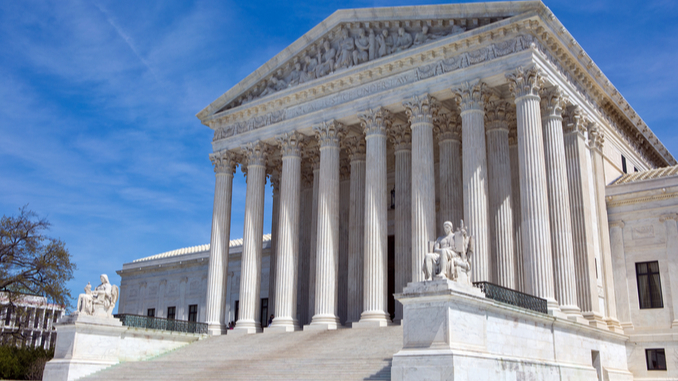
This week, the Department of Justice (DOJ) asked the Supreme Court to uphold Arizona’s proof-of-citizenship requirements for voting.
The DOJ filed a brief in Republican National Committee, et al. v. Mi Familia Vota, et al. (case Nos. 25-1017, 25-1019, and 25-1022).
The case will determine whether the National Voter Registration Act (NVRA) prohibits states from: removing noncitizens from voter rolls within 90 days of an election, requiring individuals to provide documentary proof of citizenship when registering to vote in federal elections using the state registration form, and denying individuals the ability to vote by mail if they don’t provide documentary proof of citizenship.
These questions emerged from House Bills 2243 and 2492; both passed in 2022. Together, these bills require the secretary of state and county recorders to regularly review voter rolls, mandate registrants using the state registration form provide proof of citizenship, and prohibit vote by mail for federal-only voters.
The Ninth Circuit Court of Appeals ruled that the NVRA does preempt that legislation, impacting any similar citizenship proof measures taken by other states concerning their voting laws.
The federal court ruled the provisions in the Arizona laws amounted to unlawful voter suppression and were therefore unconstitutional. The court determined that voters must be allowed to vote federal ballots at least, even when they fail to provide proof of citizenship.
The respondents in the present litigation — Mi Familia Vota, Voto Latino, Arizona Asian American Native Hawaiian and Pacific Islander for Equity Coalition, Democratic National Committee, and the Arizona Democratic Party — want to preempt Arizona and other states from imposing proof-of-citizenship limitations on voting.
Jesus Osete, principal deputy assistant attorney general for civil rights, said in the DOJ announcement that the NVRA doesn’t prohibit states from removing noncitizens from voter rolls.
In its filing, the DOJ argued the lower court’s ruling conflicted with the NVRA since it would effectively render state forms into mere replicas of the federal form. States would lack the flexibility afforded by the NVRA, said the DOJ.
The DOJ filing argued that proof-of-citizenship requirements were harmonious with NVRA requirements to increase the number of eligible citizens registered to vote and ensure the maintenance of accurate and current voter rolls.
“When noncitizens with no right to shape American government vote in American elections, the ballot box no longer speaks for the People, because its tally no longer reflects their voice,” argued the DOJ.
Senate President Warren Petersen (R-LD14) said he was “thrilled” by the Trump administration’s intervention.
“Only U.S. citizens should vote in our elections,” said Petersen. “Excited for SCOTUS to take up this important case.”
Thrilled the Trump DOJ is backing Arizona’s proof-of-citizenship requirements! Only U.S. citizens should vote in our elections. Excited for SCOTUS to take up this important case. https://t.co/xWBiciTxjV
The Supreme Court has already overruled the Ninth Circuit Court of Appeals on one of the issues in 2024. The Supreme Court allowed Arizona to enforce its proof-of-citizenship requirement for state voter registration forms, but refused to allow enforcement of the requirement for those registering with federal forms.
That follows the precedent set in 2013, when the Supreme Court ruled that the NVRA prohibited Arizona from requiring proof of citizenship of those voters registering to vote with the federal voter registration form.
AZ Free News is your #1 source for Arizona news and politics. You can send us news tips using this link.
Over the past three years, Arizona Attorney General Kris Mayes has been executing a political agenda.
She has refused to defend state laws—while going out of her way to attack common-sense federal policies—simply on the grounds that she personally disagrees.
She’s failed to uphold our values. She’s destroyed common sense. And she has pursued an extreme political agenda to appease her party leadership—all the while undermining President Trump’s efforts to make America great again.
Principled, hard-working Arizonans have paid the price for her politically motivated dereliction of duty.
I’m running for Attorney General because Arizona desperately needs a top law enforcement officer who will uphold our laws and fairly represent Arizona families.
As Senate President, I’ve taken part in over 110 lawsuits to ensure Arizona’s laws and interests are defended when the Attorney General wouldn’t act. We have led an unprecedented campaign to protect Arizonans, and our action has provided unparalleled experience.
I’ve defended Arizona’s sex offender registration laws. The case in question, Doe v. Sheridan, argues whether our state can mandate convicted sex offenders to keep law enforcement informed, including reporting online identifiers used on social media and other platforms, so officers can investigate crimes and prevent future harms. The Arizona Legislature stepped up and successfully defended the sex offender registration laws in court after the Arizona attorney general failed to carry out her responsibility to do so.
I’ve defended the integrity of girls’ sports. As Senate President, I’ve led the defense of Arizona’s Save Women’s Sports Act in federal court against special interests seeking to allow boys to play in girls’ sports. We’ve taken this case all the way to the Supreme Court, and we’re waiting on a major ruling from the nation’s high court on similar cases that could affect Arizona’s law.
I’ve defended laws dealing with the First Amendment. One of those cases was Chiles v. Salazar, where the Arizona Legislature joined a challenge to Colorado’s conversion therapy ban. Another was in NRA v. Vullo, where we challenged whether the State of New York could threaten banks with adverse regulatory actions if they provided services to the National Rifle Association.
I’ve defended laws related to the Second Amendment. One of those cases was Smith & Wesson v. Mexico, defending American firearms manufacturers from being held liable from frivolous lawsuits from foreign entities. Another was Miller v. Bonta, challenging California’s ban on the manufacture, distribution, importation, and possession of various firearms.
I’ve defended laws related to the Eighth Amendment. Under my leadership, the Arizona Senate filed briefs to allow cities to disband homelessness encampments, winning at the Supreme Court.
I’ve defended the state’s right to carry out justice regarding capital punishment.
I’ve defended election integrity. We intervened to defend Arizona’s ability to make sure only citizens are voting in our elections.
I’ve defended our state against radical environmentalists. In Petersen v. EPA, we sued the Biden-led EPA to overturn unattainable environmental standards that punished job creators, and detrimentally impacted America’s power grid. We joined a lawsuit to block a California rule forcing trucking drivers to use less efficient battery-powered vehicles, which would have further increased the costs of everyday items.
I’ve defended our state against unconstitutional executive overreach. We challenged then-President Biden’s executive order forcing federal contractors and their employees to receive the COVID-19 vaccine.
And I’ve defended our state against rampant government encroachment on our lands.
Thanks to my involvement in these—and dozens of other legal efforts—I’ve been called Arizona’s de facto Attorney General, stepping in where our liberal Attorney General has shamefully abdicated her role. Our engagement in these matters has allowed me to serve our great citizens and provide leadership where none existed. It’s time for Arizona to once again have an Attorney General committed to serving all the people—not just partisan special interests.
Arizona Gov. Katie Hobbs vetoed the Republican-backed state budget proposal Tuesday, calling the plan “unbalanced and reckless,” while Republican gubernatorial candidate Andy Biggs sharply criticized the decision and accused Hobbs of blocking tax relief efforts.
In a statement issued by the Governor’s Office, Hobbs said the GOP proposal would “default on our debt obligations, endanger vulnerable children, slash critical public safety funding, and pay for tax breaks to billionaires, data centers, and special interests by kicking Arizonans off their healthcare and taking food off their tables.”
The Republican proposal, passed by the Legislature largely along party lines, included tax cuts tied to federal tax conformity measures, reductions to agency spending, and changes to several state programs. The proposal would have implemented major portions of federal tax cuts adopted in last year’s federal legislation and reduced spending across most state agencies.
Legislative Republicans said the proposal spent roughly $800 million less than Hobbs’ January budget proposal.
The veto follows weeks of tension between Hobbs and Republican legislative leadership over budget negotiations and education funding. On April 13, Hobbs announced she would veto nearly all legislation sent to her desk until Republican lawmakers produced a budget proposal and returned to negotiations.
Following Hobbs’ veto on Tuesday, Congressman Andy Biggs’ (R-AZ05) gubernatorial campaign circulated a statement accusing the governor of repeatedly rejecting tax relief measures.
“The Veto Queen is at it again,” a graphic released by the campaign stated. “Katie Hobbs has now vetoed over $1 billion in tax relief for Arizona workers, families, and small businesses for the 3rd time in 5 months as our state’s affordability crisis deepens.”
Biggs also said he had previously worked on multiple state budgets during his tenure as president of the Arizona Senate.
“As a former State Senate President, I’ve written multiple state budgets and worked with different governors to put forward structurally sound and responsible budgets that protect public safety and allow Arizonans to keep more of their money,” Biggs stated.
“It takes patience, leadership, and a commitment to good-faith work between the governor and the Legislature. Katie Hobbs has shown she has none of those attributes, which is why she keeps falling back on simply vetoing bills and budgets. Arizonans deserve a leader with a vision, not vetoes. In November, we’ll make that change.”
Arizona House Speaker Steve Montenegro (R-LD29) also criticized Hobbs following the veto, accusing the governor of pursuing higher spending priorities.
“Once again Gov. Hobbs creates fiscal chaos for Arizona as she fights for her California-style budget,” Montenegro wrote in a post on X. “This budget focuses on what matters most to Arizona families, higher take-home pay, lower costs.”
Once again Gov. Hobbs creates fiscal Chaos for Arizona as she fights for her California-style budget.
"This budget focuses on what matters most to Arizona families, higher take-home pay, lower costs,"
"What we will not do is allow this governor to raise taxes and spend more for… https://t.co/yBqpVhnsDK
“What we will not do is allow this governor to raise taxes and spend more for her programs on the backs of every family in Arizona,” Montenegro added.
Despite the veto, Hobbs’ office indicated negotiations could resume. According to KJZZ, the governor’s office said Hobbs had reached out to legislative leadership seeking additional budget meetings this week.
The Legislature adjourned after passing the proposal, with lawmakers expected to return in June unless leadership calls them back sooner. However, Arizona Senate President Warren Petersen (R-LD14) pushed back on claims that Republican lawmakers were taking an extended break following passage of the budget proposal.
This is false, the Senate will be back on Monday and many members, myself included will be there every day this week. The governor placed a moratorium on bills and we delivered a budget. There is no floor work to do. https://t.co/AmsU23qk8Y
Responding to a social media post by journalist Craig Harris stating that “The GOP-controlled Arizona Legislature is taking a one-month paid vacation,” Petersen wrote on X, “This is false, the Senate will be back on Monday and many members, myself included will be there every day this week.”
“The governor placed a moratorium on bills and we delivered a budget. There is no floor work to do,” Petersen added.
Arizona Senate Republicans announced on Monday that they passed a $17.9 billion budget for fiscal year 2027 that includes $1.45 billion in tax relief over four years and spends approximately $800 million less than Governor Katie Hobbs’ proposal.
The budget, approved by the Legislature and sent to Hobbs, is based on updated April revenue projections that showed a $200 million decrease in available resources.
According to Senate Republicans, the plan includes a series of tax changes intended to provide cost-of-living relief, including eliminating state taxes on tips and overtime pay, increasing the standard deduction, allowing full deductions for child-care expenses, increasing the dependent tax credit by $25, and creating a $6,000 deduction for seniors age 60 and older with retirement or pension income.
🚨FOR IMMEDIATE RELEASE: Senate Republicans Pass Historic $1.45 Billion Tax Relief Budget- Delivering Permanent Affordability for Families, Workers and Seniors While Protecting Core Services
The proposal also includes conformity with federal tax policy changes associated with Donald Trump’s tax cuts, which the Senate said would ensure Arizona taxpayers do not need to refile their 2025 state tax returns.
“This is a serious, disciplined budget that puts Arizona families first,” Senate President Warren Petersen (R-LD14) said in a statement. “We cut taxes, protect essential services, and base every decision on real April revenue projections — not wishful thinking.”
He added, “In divided government, we faced the math, eliminated waste through targeted reforms, and delivered real results without raising taxes or growing government.”
The budget maintains current funding levels for K-12 education and public safety, preserves the voter-protected K-12 State Land Trust, and limits overall spending growth to 1.9 percent.
To address the projected shortfall, Senate Republicans said the plan includes policy changes aimed at reducing spending, including enhanced eligibility verification in public assistance programs such as the Arizona Health Care Cost Containment System (AHCCCS) and the Supplemental Nutrition Assistance Program (SNAP), a 5% reduction in agency operating budgets excluding public safety and child welfare agencies, and the repeal of certain tax credits and subsidies, including solar incentives.
The budget does not reduce base pay for Arizona Department of Public Safety troopers or firefighters and does not modify existing data center incentives previously signed into law.
The plan also includes $4.75 million in emergency funding for the Department of Public Safety, which Senate Republicans said the agency had requested and that the governor had previously vetoed as a standalone bill.
The Arizona Senate Republican Caucus said the budget reflects the constraints of divided government and relies on no new taxes or fees.
“This budget reflects the reality of divided government,” Petersen said. “While Democrats were on the floor today saying we need to raise taxes, we are instead delivering historic tax relief without burdening taxpayers. Your business and your wallet are on the ballot this fall. Vote wisely.”
The proposal now awaits Hobbs’ action.
House Speaker Steve Montenegro (R-LD29), Petersen, and other legislative Republican leaders are scheduled to hold a press conference on Tuesday at 1 p.m., according to a media advisory, to highlight the budget and urge Hobbs to sign the legislation.
Arizona House Republicans announced passage of a state budget proposal this week, saying it delivers significant tax relief while reducing overall spending compared to Governor Katie Hobbs’ plan.
In a press release, House GOP leaders said the budget includes what they described as one of the largest tax cuts in Arizona history while maintaining funding for core government services.
The proposal has advanced through a series of budget-related bills in the House and Senate, including House Bill 4140, which implements key components of the fiscal year 2026–2027 budget.
According to the release, the proposal is designed to provide cost-of-living relief for families, seniors, workers, and small businesses and would spend approximately $800 million less than Hobbs’ budget.
Republican lawmakers said the plan maintains a balanced budget while prioritizing affordability, drawing a contrast with Hobbs’s budget plan.
“Arizona Republicans are delivering one of the largest tax cuts in state history, and our proposal has the votes to pass both chambers,” Arizona Senate President Warren Petersen (R-LD14) said in a statement.
“For months, Governor Hobbs told us full conformity to federal tax relief, including tax cuts for tipped workers, hourly employees, seniors, and small business owners, was impossible. It’s not,” he continued. “Under President Trump, Washington delivered relief for working Americans, and Arizona Republicans are making sure our taxpayers receive those same Trump tax cuts here at home. Republicans balanced the budget with honest numbers, protected core priorities, and provided real relief for families still struggling with higher costs. Arizona is leading the nation as the only state we are aware of advancing the full Trump tax cuts into law. Despite the Governor’s stunts, Republicans stayed at work and got the job done for our citizens.”
The budget proposal comes amid an ongoing policy dispute between the Republican-controlled legislature and the governor over taxes and spending priorities. Earlier in the session, Republican leaders advanced tax proposals they described as among the largest in state history, while Hobbs outlined a separate approach focused on targeted relief and new revenue mechanisms.
Arizona House Speaker Steve Montenegro (R-LD29) said in a statement, “House and Senate Republicans put forward a serious budget built on facts, not wishful thinking.”
He added, “It delivers major tax relief, eases cost pressures on Arizona families, fully funds core state services, and spends far less than the Governor’s proposal. It does not rely on gimmicks, inflated projections, or money that may never show up to balance the budget. In divided government, responsible leadership means facing the math, making hard choices, and protecting taxpayers. Republicans have done that, putting a workable budget on the table and giving Arizona a clear path to finish the session responsibly. The proposal is ready to move, and so is the Legislature. It is time to pass the bills and deliver for Arizona.”
In a post on X, Montenegro and Petersen said the proposal delivers tax relief, reduces spending, and fully funds core state services.
Arizona Republicans are delivering a serious, balanced budget for our state that spends about $800 million less than Governor Hobbs’ plan.
This plan cuts taxes, lowers costs for families, and fully funds the core services Arizonans rely on, all while staying within a responsible… pic.twitter.com/cRxSfV4nJ6
— Arizona House Republicans (@AZHouseGOP) April 27, 2026
Additional details on specific tax provisions and final budget allocations are expected to be addressed as the proposal moves through the legislative process and negotiations continue with the governor’s office.