by Matthew Holloway | Apr 20, 2025 | News
By Matthew Holloway |
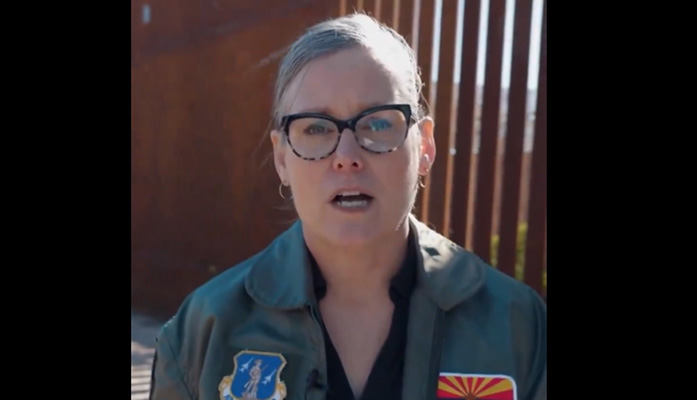
In a stark contrast to her efforts to rebrand herself as tough on the border, Governor Katie Hobbs has vetoed the Arizona Immigration Cooperation and Enforcement (ICE) Act, SB 1164. The bill would have required that every police department and sheriff’s office in the state comply with detainer orders from Immigration and Customs Enforcement.
Amidst her ongoing deliberate obstruction of the legislative process, labeled as a “moratorium” on signing new bills, Hobbs vetoed an additional 32 bills as well.
In Hobbs’ veto letter, she addressed Senate President Warren Petersen, seeming to attempt a conciliatory tone and saying in part, “You and I both disagreed with the previous administration’s immigration policies, and we may both disagree with the next administration’s immigration policies. I have worked productively with the federal government to secure our border, stopping fentanyl at our ports of entry through the Task Force SAFE, disrupting cartel operations with Operation Desert Guardian, and working across all levels of government to keep communities safe with the Border Coordination Office.”
She claimed, “I will continue to work with the federal government on true border security, but we should not force state and local officials to take marching orders from Washington.”
The Republican State Governor’s Association’s Rapid Response Director Kollin Crompton released a statement in response to Hobbs’ veto saying, “Katie Hobbs’ veto is no surprise — her record on the border is pitiful. Hobbs tried to fool Arizonans into thinking she was a border hawk, but this shameful veto shows she is unserious about addressing the border and protecting Arizonans from the violence and drugs coming into the state. She waited until 7:00 pm on Friday of a holiday weekend to try to hide from her open borders record. Arizonans are sick of Katie Hobbs’ window dressing — they deserve a governor who will actually work to secure the border and keep them and their families safe.”
As reported by AZ Free News in November of last year, Hobbs stated during her disjointed kick off of Task Force SAFE, “We will not be participating in misguided efforts that harm our communities. And I’ve been incredibly clear about that.”
Petersen described the bill as a measure to make Arizona a “partner and not an obstacle,” to the federal government’s efforts to enforce immigration law.
“It deals with this first wave of deportation that the Trump administration is focused on, which is removing the most dangerous criminals from our streets,” Petersen explained.
Matthew Holloway is a senior reporter for AZ Free News. Follow him on X for his latest stories, or email tips to Matthew@azfreenews.com.
by Jonathan Eberle | Apr 15, 2025 | News
By Jonathan Eberle |
Last week, Arizona lawmakers passed SB 1164, also known as the “AZ ICE Act.” The bill, sponsored by Senate President Warren Petersen (R-LD14), seeks to strengthen cooperation between local and federal authorities on immigration enforcement. It now awaits consideration by Governor Katie Hobbs.
The legislation, which passed the Arizona House along party lines with full Republican support, prohibits state and local government entities from enacting policies that restrict cooperation with federal immigration authorities. It also establishes a process for enforcing compliance: if a city or county is suspected of violating the law, a complaint may be filed with the Arizona Attorney General, triggering an investigation under Arizona Revised Statutes §41-194.01—commonly referred to as a “1487 investigation.” Jurisdictions found in violation could have state-shared revenues withheld until they comply.
“I applaud my colleagues… for supporting this vital action to help safeguard our communities from dangerous criminal illegal aliens,” said Petersen. “It’s time for the Governor to put politics aside… and protect innocent men, women, and children.”
The AZ ICE Act prohibits state and local government agencies from blocking cooperation with federal immigration enforcement; authorizes the Arizona Attorney General to investigate and penalize non-compliant jurisdictions; requires county sheriffs and the Arizona Department of Corrections to honor immigration detainer requests; and it allows law enforcement agencies to enter into 287(g) agreements with the federal government, deputizing local officers to perform certain federal immigration enforcement duties.
The AZ ICE Act mirrors efforts in other states to support federal immigration enforcement amid ongoing national debates about border security and states’ roles in immigration policy. Proponents argue such measures are necessary to prevent the release of undocumented immigrants with criminal records and to ensure local cooperation with U.S. Immigration and Customs Enforcement (ICE).
The bill now heads to Governor Hobbs’ desk. If signed, the AZ ICE Act would take effect later this year. As the immigration debate continues, Arizona remains a key player in shaping the conversation on border policy, enforcement, and public safety.
Jonathan Eberle is a reporter for AZ Free News. You can send him news tips using this link.
by Staff Reporter | Apr 13, 2025 | News
By Staff Reporter |
The Trump administration will no longer continue its legal challenge to Arizona’s documentary proof of citizenship (DPOC) laws.
The Department of Justice (DOJ) filed a brief on Tuesday motioning to drop the case.
Assistant Attorney General Harmeet Dhillon filed the brief the very day after she was sworn into her position within the Civil Rights Division, alongside the controversial Interim Attorney for the United States Attorney’s Office for the District of Arizona, Timothy Courchaine.
Senate President Warren Petersen called the development “a major win for election integrity and the rule of law” in a statement Wednesday. Petersen previously submitted a letter to the DOJ requesting they drop the case.
“The @azsenategop and @azhousegop will continue to defend this law against the special interest groups challenging it,” said Petersen.
Petersen submitted his request letter to Attorney General Pam Bondi in mid-February.
The case, Mi Familia Vota v. Fontes, is before the Ninth Circuit Court of Appeals.
Arizona’s DPOC laws required automatic rejection of Arizona state form registration submissions lacking DPOC, prohibited individuals who hadn’t provided DPOC from voting for a president or returning a ballot by mail, and added mandatory fields to the state registration form for a registrant’s birthplace and a checkbox confirmation of the applicant’s U.S. citizenship.
Last August, the Ninth Circuit Court of Appeals ruled Arizona would have to accept state voter registration forms without DPOC.
Tuesday’s motion by the DOJ was the latest in the Trump administration’s efforts to cease legal action against states’ election laws.
Last month, the DOJ dropped multiple election-related lawsuits in Texas, Georgia, and Louisiana initiated under the Biden administration. Those lawsuits opposed voting maps and election integrity initiatives, respectively.
President Donald Trump and his administration have also taken steps to require proof of citizenship in elections, prompting resistance from the state’s top Democratic leaders.
Arizona Secretary of State Adrian Fontes, alongside Attorney General Kris Mayes, filed a lawsuit against the Trump administration over President Donald Trump’s recent executive order requiring DPOC to register to vote in federal elections as well as requiring all ballots to be received by Election Day.
Last week, Mayes and Fontes held a joint press conference announcing their lawsuit and accusing Trump of “unconstitutional intrusion” on states’ rights and congressional authority regarding elections. The pair want Trump to go through — not around — Congress for any election law changes.
“If President Trump wanted to make laws then he should have run for congress where the U.S. Constitution says that work is done,” said Fontes. “If the President wants to reshape our elections, he must propose realistic bipartisan legislation in Congress instead of forcing states into unfunded mandates through unlawful executive orders.”
“Clearly, Trump only supports state’s rights when it suits him,” said Mayes.
Last month in another case pertaining to DPOC, the Arizona Court of Appeals ruled against the Elections Procedure Manual (EPM) produced by Secretary of State Adrian Fontes. Fontes’ EPM would have allowed voters who failed to submit or couldn’t achieve verification of their DPOC.
AZ Free News is your #1 source for Arizona news and politics. You can send us news tips using this link.
by Jonathan Eberle | Apr 12, 2025 | News
By Jonathan Eberle |
Arizona Senate President Warren Petersen has joined a coalition of states and energy companies in filing a federal lawsuit aimed at reducing regulatory barriers to deploying small modular nuclear reactors (SMRs), a next-generation nuclear energy technology touted for its safety, efficiency, and potential role in transitioning to clean energy.
Filed in a U.S. District Court late Monday, the lawsuit challenges a longstanding Nuclear Regulatory Commission (NRC) rule that subjects SMRs to the same licensing standards as large-scale nuclear reactors. Arizona joins Florida, Texas, Louisiana, Utah, and three nuclear energy firms in asking the court to set aside the rule.
“Arizona’s utility companies want to pursue SMRs, but their hands are tied with red tape,” Petersen said in a statement. “It could take decades and an unreasonable amount of money to establish plants under the current rule.”
The plaintiffs argue that the NRC’s approach contradicts the original intent of Congress, which in the 1950s envisioned a more flexible regulatory framework for smaller reactors. They contend the uniform standards are outdated and unnecessarily hinder the adoption of SMRs, which can be factory-built and installed on-site, even in rural areas.
Small modular reactors are advanced nuclear energy systems that produce significantly less power than traditional reactors—typically under 300 megawatts—but offer key advantages. They can be constructed more quickly, pose fewer safety risks, and emit nearly zero greenhouse gases. Because of their modular design, SMRs can be scaled to meet specific energy demands and are considered ideal for hard-to-reach communities or states looking to diversify their energy portfolios.
Proponents say SMRs could be a critical tool in meeting emissions targets while maintaining grid reliability and reducing dependency on fossil fuels.
The push to modernize nuclear regulation has gained traction as several states and energy companies look to expand nuclear energy options. Advocates of the lawsuit argue that reforming the licensing process could unlock billions in clean energy investment and accelerate the path toward energy independence.
Arizona’s involvement in the case reflects a broader interest among state leaders in expanding energy choices amid rising demand. Petersen’s office noted that the lawsuit aligns with broader national efforts to reduce reliance on foreign energy. For now, Arizona joins a growing list of states pushing for a regulatory framework they say better reflects technological innovation and evolving energy needs.
Jonathan Eberle is a reporter for AZ Free News. You can send him news tips using this link.
by Matthew Holloway | Mar 22, 2025 | Education, News
By Matthew Holloway |
Arizona Superintendent of Public Instruction Tom Horne released a statement this week regarding the Primavera Online charter school, Arizona’s largest charter school operator. Primavera is facing revocation of its charter from the Arizona State Board for Charter Schools due to low academic results.
Responding to calls for him to intervene, Horne, who holds a seat on the board, stated, “I have no power or influence over that.” In his statement responding to calls to stop the revocation from Attorney Jesse Binnall, who represents Primavera, Congressman Andy Biggs (R-AZ), and Arizona Senate President Warren Petersen, Horne explained that the role of regulating charter schools is divided in Arizona between the Arizona Department of Education and the Board for Charter Schools.
Horne stated, “The legislature chose to divide jurisdiction regarding charter schools between the Arizona Department of Education and the Charter Board. The current issue is within the jurisdiction of the Charter Board. I have no power or influence over that. If I were to try to influence it, the Charter Board would resent the trespass on their turf, and it would do more harm than good. There is likely to be an appeal to an administrative law judge, and the school needs to marshal its evidence to present to the administrative law judge. If I am asked for any data or other information that the department has, I will of course immediately provide it regardless of which side requests it.”
Speaking at a press conference in front of the Capitol, Binnall, who formerly worked on President Donald Trump’s legal team, compared the potential closure of Primavera to lawfare designed to stifle school choice. He said, “The voters of this country have spoken loud and clear … that President Trump’s agenda, which includes school choice, is highly favored by the voters. Instead of getting on board with this policy, you have some people that are trying to use various versions of lawfare … in order to get in the way of school choice.”
“We have to be confident that these people who serve … the people of Arizona are going to do the right thing for the children of Arizona,” he continued. “The right thing for the children of Arizona … is to help organizations like Primavera be more successful, not try to take away school choice.”
Primavera holds a designation as an alternative school owing to its focus on providing an education to at-risk students. In a board meeting on March 4th, Primavera Online founder and CEO Damian Creamer said that the school was incorrectly designated while he was on leave caring for his ailing wife and was graded as if it were a traditional school. Officials from Primavera argued that the school would’ve received a passing “C” grade if it had been properly designated.
Matthew Holloway is a senior reporter for AZ Free News. Follow him on X for his latest stories, or email tips to Matthew@azfreenews.com.