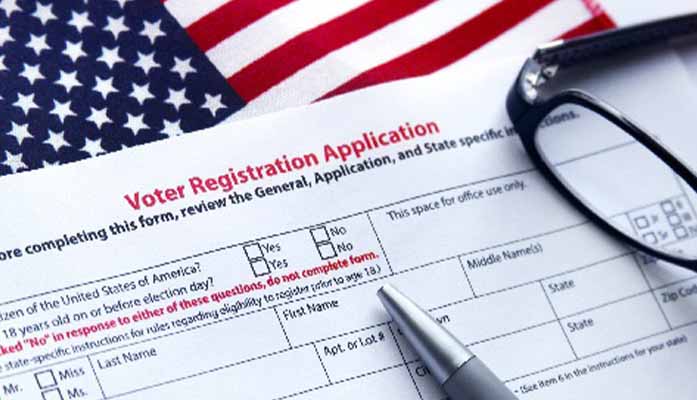
The Trump administration will no longer continue its legal challenge to Arizona’s documentary proof of citizenship (DPOC) laws.
The Department of Justice (DOJ) filed a brief on Tuesday motioning to drop the case.
Assistant Attorney General Harmeet Dhillon filed the brief the very day after she was sworn into her position within the Civil Rights Division, alongside the controversial Interim Attorney for the United States Attorney’s Office for the District of Arizona, Timothy Courchaine.
Senate President Warren Petersen called the development “a major win for election integrity and the rule of law” in a statement Wednesday. Petersen previously submitted a letter to the DOJ requesting they drop the case.
“The @azsenategop and @azhousegop will continue to defend this law against the special interest groups challenging it,” said Petersen.
🚨BREAKING: A MAJOR WIN FOR ELECTION INTEGRITY AND THE RULE OF LAW!!!
The DOJ, under @realdonaldtrump, just filed a brief announcing they are REVERSING the Biden challenge and are no longer seeking to overturn Arizona’s documentary proof of citizenship laws!!
Petersen submitted his request letter to Attorney General Pam Bondi in mid-February.
The case, Mi Familia Vota v. Fontes, is before the Ninth Circuit Court of Appeals.
Arizona’s DPOC laws required automatic rejection of Arizona state form registration submissions lacking DPOC, prohibited individuals who hadn’t provided DPOC from voting for a president or returning a ballot by mail, and added mandatory fields to the state registration form for a registrant’s birthplace and a checkbox confirmation of the applicant’s U.S. citizenship.
Last August, the Ninth Circuit Court of Appeals ruled Arizona would have to accept state voter registration forms without DPOC.
Tuesday’s motion by the DOJ was the latest in the Trump administration’s efforts to cease legal action against states’ election laws.
Last month, the DOJ dropped multiple election-related lawsuits in Texas, Georgia, and Louisiana initiated under the Biden administration. Those lawsuits opposed voting maps and election integrity initiatives, respectively.
President Donald Trump and his administration have also taken steps to require proof of citizenship in elections, prompting resistance from the state’s top Democratic leaders.
Arizona Secretary of State Adrian Fontes, alongside Attorney General Kris Mayes, filed a lawsuit against the Trump administration over President Donald Trump’s recent executive order requiring DPOC to register to vote in federal elections as well as requiring all ballots to be received by Election Day.
Last week, Mayes and Fontes held a joint press conference announcing their lawsuit and accusing Trump of “unconstitutional intrusion” on states’ rights and congressional authority regarding elections. The pair want Trump to go through — not around — Congress for any election law changes.
“If President Trump wanted to make laws then he should have run for congress where the U.S. Constitution says that work is done,” said Fontes. “If the President wants to reshape our elections, he must propose realistic bipartisan legislation in Congress instead of forcing states into unfunded mandates through unlawful executive orders.”
“Clearly, Trump only supports state’s rights when it suits him,” said Mayes.
Last month in another case pertaining to DPOC, the Arizona Court of Appeals ruled against the Elections Procedure Manual (EPM) produced by Secretary of State Adrian Fontes. Fontes’ EPM would have allowed voters who failed to submit or couldn’t achieve verification of their DPOC.
AZ Free News is your #1 source for Arizona news and politics. You can send us news tips using this link.
In 2022, the Arizona Free Enterprise Club crafted the blueprint to stop illegals from voting in our elections, authoring landmark legislation that was signed into law, becoming the first state in the nation requiring proof of citizenship to register to vote with HB2492. Now, states around the country are taking notice and adopting our model, and just last week President Trump signed an Executive Order to do it nationally. Arizona was just the tip of the spear, and the dominoes are finally beginning to fall.
As of this week, two states require proof of citizenship to register to vote. Arizona was the first with HB2492. Earlier this year, Wyoming became the second. And now, the Texas Senate is considering a bill that is nearly identical to the Arizona Model, which would make them the third.
Arizona has long been at the forefront of this issue. In 2004, Arizona voters overwhelmingly approved Prop 200 to require proof of citizenship to vote. After nearly a decade of litigation, the U.S. Supreme Court allowed us to only implement the requirement on our own voter registration form but prevented us from requiring it on the federal form. The result over the decade following the decision was the complete proliferation of the “Federal Only Voting” list, amounting to tens of thousands of potential noncitizens registering and voting in our elections…
The Arizona State Legislature is reviewing several election-related bills aimed at tightening voter registration rules, increasing transparency in election mailings, and preventing potential voter fraud.
Sponsored by Rep. John Gillette (LD-30), the three bills—HB 2004, HB 2006, and HB 2007—focus on restricting voter registration mailings, requiring disclosures on election-related mailings, banning payment incentives for voter registration, and limiting third-party election mailers. Supporters argue these measures will protect election integrity.
This bill prohibits Arizona county recorders from sending voter registration cards to mailing addresses outside the state, with exceptions for military personnel and overseas voters covered under federal law as well as Arizona residents without in-state postal service access.
Supporters argue this bill prevents potential voter fraud by ensuring only Arizona residents receive registration materials at valid in-state addresses. HB 2004 passed the House Floor (33-27-1) and is now under Senate consideration.
HB 2006: Requiring Disclosures on Election Mailings
Under this bill, any nongovernmental entity that mails or delivers election-related documents—such as voter registration applications or early ballot requests—must include the phrase “not from a government agency” on the envelope. The requirement applies to third-party voter registration groups, political organizations, and nonprofit advocacy groups.
Proponents argue this measure prevents voter confusion and ensures recipients can differentiate between official government communications and third-party outreach. HB 2006 passed the House Floor (37-19-4) and is advancing to the Senate.
HB 2007: Prohibiting Payment for Voter Registration Quotas
This bill bans individuals or organizations from paying or receiving compensation based on the number of voter registration forms collected, completed, or submitted.
Currently, government agencies, political parties, and private organizations conducting voter registration drives receive state and federal voter registration forms at no cost. However, this bill would ensure that voter registration efforts are not incentivized by financial compensation, which supporters say prevents fraudulent or rushed registrations. HB 2007 passed the House Floor (34-23-3) and is now under Senate review.
The Arizona Senate is expected to debate these bills in the coming weeks. As lawmakers debate these measures, Arizona voters will be watching closely to see how the changes may impact future elections.
Jonathan Eberle is a reporter for AZ Free News. You can send him news tips using this link.
A contentious legal battle over Arizona’s voter identification laws has once again found itself under the scrutiny of the U.S. Court of Appeals for the Ninth Circuit. Arizona Senate President Warren Petersen has vowed to bring the case back before the U.S. Supreme Court after the Ninth Circuit issued a ruling that undermines a decision previously made by the nation’s highest court.
The case centers on a 2022 law passed by the Republican-controlled Arizona Legislature, which requires proof of citizenship for individuals to vote in state and federal elections. This law is designed to prevent non-citizens from casting ballots and aims at ensuring the integrity of Arizona’s elections after a long-standing debate over voter fraud and concerns about election security. The law, however, has faced resistance from various groups, including activists arguing that such requirements disproportionately disenfranchise certain voter groups.
Petersen, who has been a staunch advocate for the law, expressed frustration after the Ninth Circuit panel’s decision last week. “It’s a new year, but we have the same, old Ninth Circuit Court of Appeals, playing familiar games of judicial activism,” said Petersen in response to the ruling. “This radicalism undermines confidence in our judicial system, and it has negative consequences for the fabric of our Republic. Legislative Republicans are already working to return to the Supreme Court in defense of Arizona election integrity, and we intend to win.”
The issue came to a head last August when a three-judge panel from the Ninth Circuit vacated an emergency stay decision that had been issued by another Ninth Circuit panel. This earlier ruling allowed Arizona to enforce the proof of citizenship requirement when voters registered for federal elections, such as those for the U.S. Presidency and Congress.
The Ninth Circuit’s latest decision represents an ongoing point of contention, as it effectively permits voters to register using the state form without submitting proof of citizenship. This ruling creates a situation where voters can register without confirming their citizenship status, a move that proponents of the Arizona law argue goes against state sovereignty and undermines federal election integrity.
After the Ninth Circuit’s initial ruling, Petersen took the matter to the U.S. Supreme Court, seeking an emergency stay to ensure Arizona’s proof-of-citizenship requirement was upheld. The Supreme Court ruled in favor of Arizona, affirming that the state had the right to reject registration forms that did not provide evidence of citizenship. This ruling marked a significant victory for Arizona Republicans who had been pushing for stronger election integrity laws.
Jonathan Eberle is a reporter for AZ Free News. You can send him news tips using this link.
Senate President Warren Petersen announced on Monday morning that he received the list of 218,000 voters registered without proof of citizenship.
These 218,000 voters (an increase from the initial estimate of nearly 100,000) had obtained their driver’s licenses prior to the 1996 requirement to apply with proof of citizenship, went on to get a duplicate license, and then registered to vote for the first time or re-registered to vote after 2004. For over 20 years, they were caught up in a compatibility error between the Arizona Department of Transportation (ADOT) and the state’s voter registration system.
Later in the day, Fontes announced that voters can check whether they’re one of the affected voters through my.arizona.vote.
The Arizona Supreme Court ruled in September that these voters caught up in the compatibility error would be allowed to vote the full ballot. America First Legal sued Fontes last month to obtain access to that list of voters.
“This morning I authorized receipt of those names,” said Petersen. “We will do everything we can to make sure our elections are run with integrity.”
Judge ruled AZSOS must release 218k names that he had refused to disclose. This morning I authorized receipt of those names. We will do everything we can to make sure our elections are run with integrity. Special thanks to @merissahamilton@America1stLegal@JenWEsq!
After Petersen announced receipt of the list, Fontes held a press conference discussing the impact of the court-ordered release.
“Let me be very clear about that: every single person on that list has sworn under penalty of perjury that they are a U.S. citizen and eligible to vote,” said Fontes. “They’ve done the exact same thing that every other citizen of the United States of America has done. But because here in Arizona we have that extra thing that needs to be done, that extra documented proof of citizenship — that is not required anywhere else in the country — we find ourselves in this quagmire.”
Fontes assured voters that they had the right to not be harassed at their homes or have others demand identification from them. Fontes said that any harassing of the 218,000 voters would be subject to prosecution.
“If anyone does do this sort of thing, please contact our office or your local law enforcement agency. Voter harassment and intimidation is a violation of the law,” said Fontes.
Fontes said that his office would be contacting the county recorders about voters on the list within the next few days and week. The secretary of state said that their office would work “later this year” to collect the appropriate documentary proof of citizenship.
Fontes discouraged the 218,000 voters on the list from contacting their local election officers presently, due to the busy nature of the ongoing election.
“You are under no obligation whatsoever to provide documented proof of citizenship if you’re on this list,” said Fontes.
Fontes said he is “not happy” with the court order, and blamed the focus on the 218,000 voters on the “lies and conspiracies” by individuals concerned with election integrity, which he characterized as “folks who mean this democracy harm.”
AZ Free News is your #1 source for Arizona news and politics. You can send us news tips using this link.