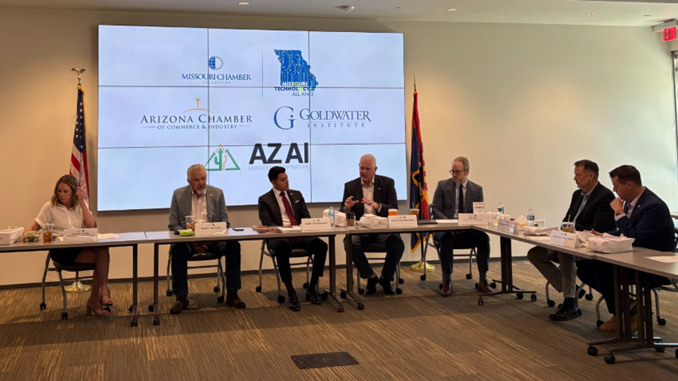
The Arizona Chamber of Commerce & Industry and the Goldwater Institute hosted a delegation of Missouri policymakers in Phoenix to discuss economic competitiveness, innovation, and pro-growth policy, according to a joint release.
The meeting focused on Arizona’s approach to building a competitive environment for emerging industries and long-term economic growth.
The discussion followed the Chamber’s recent launch of its AZ AI Leadership Initiative, which aims to strengthen Arizona’s position in emerging technologies and the broader digital economy.
Arizona has seen rapid expansion in AI and data center infrastructure, driven by growing demand for computing power and cloud services. Major investments from companies such as Taiwan Semiconductor Manufacturing Company (TSMC), which is constructing advanced semiconductor fabrication facilities in Phoenix, along with large-scale data center developments by Google and Meta Platforms in Mesa, and Amazon Web Services in Goodyear, have helped position the state as an emerging hub for both semiconductor production and AI-related computing capacity.
Participants included legislative leaders, policy experts, and representatives from the Arizona Commerce Authority, who shared insights into the state’s policy framework and economic development strategies.
A big part of the conversation: how states are thinking about AI and the broader digital economy.
“Arizona’s growth didn’t happen by accident,” said Courtney Coolidge, executive vice president of the Arizona Chamber of Commerce & Industry. “It reflects deliberate policy choices that prioritize certainty, competitiveness, and a regulatory environment where businesses can invest, innovate, and scale.”
Arizona lawmakers participating in the meeting included House Speaker Steve Montenegro (R-LD29), Majority Leader Michael Carbone (R-LD25), Rep. Jeff Weninger (R-LD13), Rep. Justin Wilmeth (R-LD2), chair of the House Artificial Intelligence and Innovation Committee, Senate President Pro Tempore T.J. Shope (R-LD16), and Senate Majority Whip Frank Carroll (R-LD28).
“Arizona has made a conscious decision to lead on innovation rather than wait for other states to set the pace,” Montenegro said. “That kind of alignment and forward-looking policy environment allows industries to grow and scale here.”
Lawmakers and policy leaders highlighted sectors including advanced manufacturing, semiconductors, aerospace, autonomous systems, and emerging technologies as areas where Arizona has seen sustained growth.
“Arizona’s success in attracting major investment is tied directly to our focus on advanced manufacturing, infrastructure, and supply chain strength,” Carbone said.
Weninger pointed to Arizona’s regulatory and tax structure as a factor in business investment.
“Companies are looking for certainty,” Weninger said. “Arizona’s predictable regulatory environment and competitive tax structure give businesses the confidence to invest and expand.”
Participants also discussed the role of infrastructure, water policy, and land use in supporting statewide growth. “We’ve been intentional about making sure economic development isn’t concentrated in one region,” Shope said.
Carroll said Arizona’s approach to economic development has positioned the state for continued expansion, particularly in emerging industries.
Wilmeth emphasized the importance of flexibility in regulating new technologies. “We’ve taken a thoughtful approach to emerging technologies by avoiding premature regulation,” he said.
Victor Riches, president and CEO of the Goldwater Institute, said policy certainty and deregulation remain key factors in supporting innovation.
“As emerging technologies continue to reshape industries, policy certainty and deregulation matter more than ever,” Riches said. “Arizona needs to ensure an environment where innovation can move forward.”
The Missouri delegation included state senators and policy advisors, including Sen. Travis Fitzwater, Sen. Maggie Nurrenbern, Sen. Karla May, Sen. Barbara Anne Washington, Sen. Jamie Burger, policy advisor to Gov. Mike Kehoe, Johnathan Shifflett, and representatives from the Missouri Chamber of Commerce, Karen Buschmann, and Jared Hankinson.
The meeting explored how elements of Arizona’s economic policy framework could be adapted in other states and how interstate collaboration could support broader economic growth.
Arizonans enacted a major incentive for local governments to address homelessness.
Voters approved Proposition 312, which requires local governments to compensate its property and business owners for damages caused by the homeless. Governor Katie Hobbs certified the proposition on Monday alongside all other election results.
Proposition 312 would secure compensations through a refund on property tax payments up to an amount matching costs incurred by local government’s “failure to enforce laws and ordinances prohibiting illegal camping, loitering, obstructing public thoroughfares, panhandling, public urination or defecation, public consumption of alcoholic beverages, and possession or use of illegal substances.”
Should the cost of damages exceed the property tax bill, the proposition gives the owner the right to apply for a refund from their next property tax payment(s) in perpetuity until that initial balance is paid.
“Property owners would be eligible annually for refunds until the taxing entity begins enforcing the relevant public nuisance laws,” stated the ballot summary.
Policy experts anticipate the Arizona proposition to inspire other cities to adopt a similar policy.
The Goldwater Institute, which crafted Proposition 312, said in a statement on Monday that the measure provided another tool in addressing the homeless crisis facing Phoenix and major cities in other states. Victor Riches, Goldwater Institute’s senior communications manager, said in an opinion piece for The Wall Street Journal that the proposition should serve as sufficient motivation for local elected officials to act with more urgency.
“Proposition 312 should be a wake-up call for elected officials forcing law-abiding businesses and residents to pay the price for a crisis they didn’t create,” said Riches. “The message to politicians couldn’t be clearer: Do your job. Enough is enough.”
Riches identified Phoenix and its infamous downtown area unofficially cordoned off for the homeless (“The Zone”) as a prime example of the “government malfeasance” that allowed the adverse effects of homelessness on properties and businesses in the area.
“Property values plummeted in the Zone. Small businesses suffered. People lost their livelihoods as dozens of business owners had no choice but to close up shop,” said Riches. “And even as the city spent over $180 million to address the crisis (only a fraction of which is publicly accounted for), the number of homeless people in Phoenix rose 92% between 2018 and 2023.”
Nearly 59 percent of voters (1.8 million votes) approved Proposition 312. The legislative vehicle for the proposition, HCR 2023, passed in both chambers with bipartisan support earlier this year.
Major leftist organizations said in their arguments against Proposition 312 that the cities and counties shouldn’t face financial punishment for the acts of the homeless, and reduced tax revenue would hinder funding for community assistance geared toward homelessness.
Among those to oppose Proposition 312 were Civic Engagement Beyond Voting, Lutheran Social Services of the Southwest, Opportunity Arizona, Fuerte Arts Movement, Living United for Change in Arizona, and the ACLU of Arizona.
The Common Sense Institute Arizona (CSI) found in a report released last month that the proposition would likely improve property values.
AZ Free News is your #1 source for Arizona news and politics. You can send us news tips using this link.
A ballot measure to protect Arizonans from the rise of unabated homelessness in communities was overwhelmingly passed by voters in the General Election.
Earlier this month, Proposition 312 received almost 60% of the vote, cruising to a smooth victory on Election Night. The measure, which was referred to the ballot from the Arizona Legislature, stipulates that “property owners may apply for a tax refund for expenses incurred due to a governing authority’s failure to enforce certain public nuisance laws on or near the owner’s real property.”
The legislative vehicle for the measure, HCR 2023, was sponsored by House Speaker Ben Toma. It passed both chambers in the Arizona Legislature with bipartisan support and was transmitted to the Secretary of State’s Office in March of this year.
In a statement after the successful passage of the bill out of his chamber, Senate President Warren Petersen said, “There are instances where local governments routinely and repeatedly fail their citizens by not enforcing laws. An example of this would be the City of Phoenix’s handling of the former homeless encampment known as ‘The Zone.’ This area was not only a public safety and public health disaster for those who camped there, but it was also a detriment to the livelihoods of small business owners who set up their shops in the area.”
Petersen added, “Money talks, and as a way to encourage municipalities to enforce the law, Speaker Toma and I teamed up to sponsor HCR 2023/SCR 1006. This measure is a ballot referral that would protect law-abiding citizens. If approved by voters, property owners would be allowed to request a refund for expenses incurred to mitigate the problem, up to the amount of their property tax liability. The funds would be deducted from the local government’s state shared revenue.”
Speaker Toma also had said, “Business owners and residents alike are having their property stolen, vandalized, or terrorized and are desperate for help. That’s why I sponsored HCR2023, to hold our local governments accountable to our community members and to help provide some relief for property owners who have suffered damages because of a city’s purposeful failure to provide the public health and safety services we all pay for.”
The Arizona Chamber of Commerce and Industry, which was instrumental in promoting the proposition, issued a statement following the General Election win, writing, “Arizona voters have sent a clear message: Government, do your job. They do not want our state to become the next San Francisco or Los Angeles. Prop 312 is a win for property owners, businesses, and everyday Arizonans who too often shoulder the costs of unaddressed homelessness.”
“Arizona voters have sent a clear message: Government, do your job. They do not want our state to become the next San Francisco or Los Angeles. Prop 312 is a win for property owners, businesses, and everyday Arizonans who too often shoulder the costs of unaddressed homelessness. pic.twitter.com/IPLhHq5UAf
The Goldwater Institute, which also pushed for Prop 312’s passage, also took a well-deserved victory lap after the positive result. The organization’s President and CEO, Victor Riches, stated, “The voters sent a clear message this election cycle: they demand their tax dollars be used to enforce the law and address rampant homelessness. Now that Prop 312 is law, business and property owners will not be left holding the bag when municipalities refuse to do their job.”
Daniel Stefanski is a reporter for AZ Free News. You can send him news tips using this link.
On Wednesday, Arizona became the first state to allow patients to access individualized treatments otherwise blocked by the FDA. The bill was dubbed the “Right to Try for Individualized Treatments,” an expansion of original Right to Try law allowing patients with life-threatening illnesses to undergo clinical trials of the treatments of their choosing.
Governor Doug Ducey signed the bill, SB1163, into law. The Phoenix-based Goldwater Institute, a conservative and libertarian public policy think tank, pioneered the original Right to Try law. That law also began in Arizona. It eventually received approval from Congress under former President Donald Trump.
Goldwater Institute President and CEO Victor Riches said that the new law ensured protections for a fundamental right: the right to save one’s own life.
“The right to try to save one’s own life is one of the most precious rights of all,” said Riches. “America doesn’t have to wait for the FDA to reform itself in order to put patients first. States can and should act now to protect all Americans’ fundamental right to try to save their own life.”
Goldwater Institute Executive Vice President Christina Sandefur said that the law provided new hope for Arizonans. Sandefur called the law “Right to Try 2.0.”
As AZ Free News reported, the bill was inspired by the Riley family in Phoenix. Two of their three daughters, Keira and Olivia, were born with metachromatic leukodystrophy: a sudden, fatal disease that attacks nerves in the brain and spinal cord. Due to FDA restrictions, the Rileys had to seek treatment outside of the country. They were forced to raise tens of thousands of dollars at the height of the pandemic in 2020 in order to relocate to Italy for the five months they needed to access treatment for Keira. The experimental gene therapy was their last hope to save her life.
Olivia couldn’t qualify for the treatment because she was already symptomatic. As of this report, she was transferred to hospice. The average life expectancy for metachromatic leukodystrophy patients is six years.
Kendra Riley, the girls’ mother, spoke with conservative radio host James T. Harris about the bill’s enactment. Riley said that the next step would be to have the rest of the nation pass similar laws.
“You think if your child has one chance in the entire world to live a normal life, we should be able to have access to it in America,” said Riley. “The medicine is there but bureaucracy and insurance shouldn’t be holding it back. Everyone should have the right to a chance at a normal life. I truly hope this helps everyone.”
As they were rallying support for the bill, Sandefur characterized current law as immoral.
“It is unconscionable that an American patient has to travel to another country to Europe in order to be able to get access to a treatment that could save their lives,” said Sandefur.
Corinne Murdock is a reporter for AZ Free News. Follow her latest on Twitter, or email tips to corinne@azfreenews.com.
Division One of the Arizona Court of Appeals will soon determine whether the city of Scottsdale violated the state’s gift clause law by awarding one swim team public pool discounted access at the expense of another – for over 10 years. Court of appeals judges Jennifer Perkins, Cynthia Bailey, and Maria Elena Cruz heard the case, Neptune v. Scottsdale, on Wednesday.
As reported previously, swim coach Joe Zemaitis had attempted for 13 years to gain access to Scottsdale’s public pools for his team, Swim Neptune. The city continually rebuffed Zemaitis’s attempts, instead granting access at discounted rates to another team, the Scottsdale Aquatic Club.
In a press release, Zemaitis explained that their efforts over the years were met with bureaucratic inconsistencies.
“Since 2007, we’ve been aggressively pursuing space in the Scottsdale pools,” said Zemaitis. “They seem to reinterpret the rules and rewrite the rules every time we are eligible under the criteria, they change them again to try to freeze us and our residents out, and it’s simply not
fair.”
Initially, Zemaitis apprised the Goldwater Institute of the situation. Their legal team roped in the American Freedom Network (AFN) – the institute’s network of pro-bono attorneys. AFN counsel sent the city of Scottsdale a letter to allow swim teams to bid on the pool space. This prompted the city to open up the pool space for a request for proposal (RFP): a formal solicitation bid.
However, the city of Scottsdale cancelled the RFP after it was apparent that the Scottsdale Aquatic Club would lose the bid. That was the final straw for Zemaitis. This past February, the Goldwater Institute filed suit against the city.
In a statement, the Goldwater Institute asserted that the city of Scottsdale had created a monopoly – giving gifts of discounted rates and pool access to the Scottsdale Aquatic Club in violation of the state’s gift clause – then violated their own procurement code in their handling of
the RFP.
“This monopoly violates Arizona’s Gift Clause, which prohibits government from giving gifts to private entities. That’s exactly what the city of Scottsdale is doing here,” asserted the Goldwater Institute. “The deal was also done in violation of the city’s own procurement code. Scottsdale’s unlawful actions against Swim Neptune Foundation are preventing the swim club’s Scottsdale families from using facilities that they’re already paying for with their taxes.”
During Wednesday’s hearing, the city’s attorney, Eric Anderson, challenged that no city actions constituted a gift clause violation. Anderson argued that cancellation of the RFP contract and the lane fees weren’t gift clause violations.
“What is the claim here? What is Neptune asking this court to do? Are they asking for an injunction, a mandamus?” questioned Anderson.
Anderson argued further that the issues of procurement and gift clause abuses are separate.
Even so, Anderson claimed that the city hadn’t violated any procurement processes. He said that the acting procurement director merely noticed that the process had an error – that the committee should’ve scored the procurement bids entirely and not partially.
The panel of judges appeared confused by Anderson’s arguments. They wondered at the apparent conflicting language between the city’s method for scoring and the RFP (request for proposal).
Judge Perkins stopped Anderson multiple times to note that the court wasn’t so much concerned about the why behind the RFP cancellation, but the fact that it occurred at all.
“Isn’t Neptune saying this cancellation of the RFP worked to give a special advantage to a private interest, and that is why the city cancelled the RFP because if it hadn’t cancelled the RFP then the winning bidder would’ve been the non-preferred entity […] You know, this looks hinky,” said Perkins. “You had a relationship with one entity, you thought that entity was going to win the bid, when it turned out that – at least in the back and forth that we see according to the record – that the math was wrong, and when the math was correct and somebody else was going to get the bid, then we cut off the process. That the big picture is the articulated violation. The question of how we calculate consideration and everything tells us whether or not they’re correct about the violation. That’s not what is the violation.”
As a rebuttal, Riches clarified that the gift clause violation at hand is the city’s subsidization of one private entity. He called for declaratory relief, and a mandamus on the city.
He emphasized the fact that Swim Neptune was the mathematical winner of the city’s procurement evaluation – not Scottsdale Aquatic Club. This would’ve been cause to award Swim Neptune the bid, yet Scottsdale didn’t. Instead, they threw out the RFP.
Riches warned that this case would prove to be the basis for other cases around the state concerning government’s preferential treatment and relationships with private entities.
“If the city of Scottsdale can do this with public resources – [then] they can do this throughout the state,” asserted Riches.
After the hearing, Riches told AZ Free News in a statement that they were pleased with the court’s handling of the case.
“The Gift Clause prohibits the use of public resources by private parties unless certain protections are met. Here, the City of Scottsdale set up a public procurement process for a valued public asset – public swimming lanes – but then arbitrarily tossed the results when it did not like the outcome. That is unlawful and costs Scottsdale citizens $284,000 every year,” explained Riches. “We were glad to see the court of appeals grapple intelligently with these serious questions, and we are hopeful the court will stop the city’s taxpayer abuse in this case, and discourage future abuse going forward.”
The judges indicated that they would publish their ruling soon.
Corinne Murdock is a reporter for AZ Free News. Follow her latest on Twitter, or email tips to corinne@azfreenews.com.