by Ethan Faverino | Feb 27, 2026 | Economy, News
By Ethan Faverino |
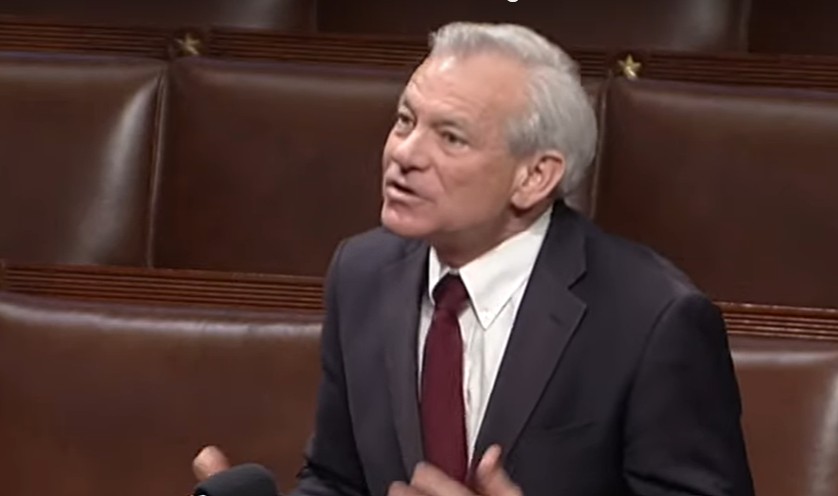
In response to the U.S. Supreme Court’s February decision in Learning Resources, Inc. v. Trump, which held that the International Emergency Powers Act (IEEPA) does not authorize the President to impose tariffs, Joint Economic Committee (JEC) Chairman David Schweikert (AZ-01) issued a statement encouraging a shift toward a more stable and growth-oriented tax framework.
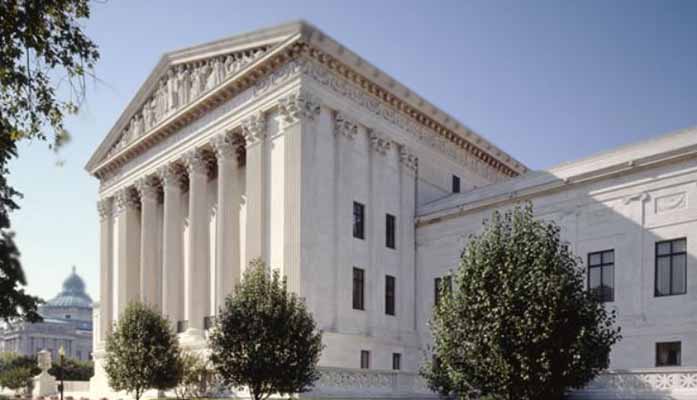
In a 6-3 ruling, the Supreme Court invalidated sweeping tariffs imposed under IEEPA, concluding that the statute does not grant the executive branch authority to levy import duties. The Court reaffirmed that Congress holds constitutional authority over tariffs and taxation, rejecting arguments that IEEPA’s provisions governing economic measures during national emergencies extend to imposing duties.
Chairman Schweikert emphasized the broader implications for America’s tax system amid rising federal spending. “As our nation’s spending continues to grow, we must be honest about the math,” he stated. “To sustain essential programs and protect our fiscal health, we need a tax system that produces stable, predictable receipts without stifling growth. Today’s ruling underscores the uncertainty in our current tax framework, uncertainty that limits investment, hiring, and innovation.”
Schweikert advocated for transitioning to a border-adjusted, destination-based cash flow tax (DBCFT) as a superior alternative to tariffs for promoting domestic production and economic competitiveness. “To bring greater stability and competitiveness to our economy, and address tax arbitrage arising from other countries’ tax policies, I believe the U.S. should move toward a border-adjusted, destination-based cash flow tax. In line with the goals of tariffs, a DBCFT supports U.S.-based production and American workers. But tariffs distort markets and reduce overall output. A destination-based cash flow tax achieves these same objectives through a more economically rational, growth-oriented framework.”
He highlighted key advantages of the DBCFT, including immediate deductions for business investments to encourage reinvestment and growth, taxation based on where goods are consumed rather than where they are produced, and border adjustments that tax imports while exempting exports.
This approach, Schweikert noted, discourages offshoring, provides businesses with predictability for long-term planning, and helps ensure stable tax revenues to support increasing federal expenditures.
“I will be holding a hearing on this important topic in the coming weeks,” he added. “America’s long-term prosperity hinges on our ability to keep U.S. companies competitive both at home and globally. A destination-based cash flow tax strengthens that foundation.”
Ethan Faverino is a reporter for AZ Free News. You can send him news tips using this link.
by Staff Reporter | Feb 21, 2026 | News
By Staff Reporter |
Arizona state lawmakers requested the U.S. Supreme Court to take up an appeal on the state’s proof of citizenship for voter registration.
Last February, the Ninth Circuit Court of Appeals struck down two laws which established proof of citizenship requirements. That court declared Arizona’s laws attempting to add more requirements on voter registrations were preempted by the simpler registration requirements of federal voting rights laws under the National Voter Registration Act (NVRA) and were therefore invalid.
Those laws, passed in 2022 under then-Gov. Doug Ducey, restricted mail-in voting for registrants lacking citizenship verification in addition to requiring recorders to check federal citizenship databases and applicants to provide documentary proof of citizenship and residence. These pieces of legislation emerged following the Supreme Court’s 2013 decision against an Arizona law requiring proof of citizenship when registering to vote in federal elections.
Several years later, in 2018, the state entered into a consent decree requiring county recorders to search Arizona Department of Transportation (ADOT) records for state registration forms lacking proof of citizenship. Those applications without verifiable citizenship proof through ADOT would only be allowed to cast ballots in the federal election, otherwise known as “federal-only voters.”
A number of progressive activist organizations joined in a lawsuit to challenge these laws: Mi Familia Vota, Voto Latino, Living United for Change in Arizona, League of United Latin American Citizens, Arizona Students Association, ADRC Action, Arizona Coalition for Change, Poder Latinx, Chicanos Por La Causa and their affiliated action fund, Democratic National Committee, Arizona Democratic Party, Arizona Asian American Native Hawaiian and Pacific Islander for Equity Coalition, Promise Arizona, and the Southwest Voter Registration Education Project.
The Inter-Tribal Council of Arizona, San Carlos Apache Tribe, Tohono O’odham Nation, and Gila River Indian Community also were among the challengers to proof of citizenship laws, citing concerns with challenges tribal members face to obtain proof of residency. Several tribal members were named independently in the lawsuit: Keanu Stevens, Alanna Siqueiros, and LaDonna Jacket.
The leaders of the Republican-led Arizona legislature filed their petition with the Supreme Court this week.
Sen. President Warren Petersen (R-LD4) issued a press release announcing the Supreme Court petition in which he accused the Ninth Circuit judges of having “rewrote” federal law and ignored Supreme Court precedent.
“For more than two decades, Arizona has required proof of citizenship to register to vote, because only American citizens should decide American elections,” said Petersen. “This case is about whether states still have the power to enforce commonsense safeguards to ensure only eligible voters participate in our elections. Arizona is standing up not just for our state, but for every state’s constitutional authority to secure its own elections.”
The filing argues that the Ninth Circuit ruling against Arizona law stretches federal voting law far beyond its allowable interpretation.
“This case, which comes to the Court on a non-expedited basis and underpinned by a comprehensive evidentiary record, offers an ideal vehicle for clarifying the NVRA’s preemptive scope, affirming that federal consent decrees cannot perpetually paralyze state legislative bodies, and vindicating the presumption of legislative good faith,” read the filing.
AZ Free News is your #1 source for Arizona news and politics. You can send us news tips using this link.
by Matthew Holloway | Jan 14, 2026 | News
By Matthew Holloway |
Arizona Senate President Warren Petersen (R–LD14) said he believes the U.S. Supreme Court is likely to uphold state laws that protect girls’ and women’s sports, following oral arguments in a closely watched case on whether biological males may compete in female athletic competitions.
Petersen attended oral arguments in West Virginia v. B.P.J. in Washington, D.C., where the Court heard challenges to state-level laws restricting participation in girls’ sports based on biological sex.
“It was an incredible experience to be in the Supreme Court with the justices in the room hearing their arguments,” Petersen said in an interview with AZ Free News following the hearing. “If I’m reading the room, I think we win this six to three.”
Petersen explained that much of the questioning from the Justices centered on the definition of sex under the law, rather than transgender status itself. “What it’s really boiling down to is the definition of sex,” he said. “They’ve conceded that it’s about sex. They’re not even arguing that it’s about transgender status.”
He described a moment during questioning in which Justice Alito pressed attorneys defending the challenge to the laws on how to define the term “woman,” calling the exchange revealing.
Petersen and House Speaker Steve Montenegro (R-LD29) joined the case through an amicus brief in September 2025 after Arizona Democrat Attorney General Kris Mayes declined to defend the Save Women’s Sports Act. Under Arizona statute, that authority shifted to legislative leadership.
“Unfortunately, you have an attorney general who’s not willing to defend our laws,” Petersen said. “But fortunately, the statute gives the Senate President and the Speaker standing. We were able to intervene and defend the law, and we’ve taken it all the way here.”
Petersen characterized the law as “common sense” and said lawmakers felt compelled to see it defended at the highest level.
“This is the same Women’s Sports Act to protect our girls and make sure they have these opportunities,” he said. “This law needed to be defended.”
Beyond athletics, Petersen said the case raises broader questions about state authority and federal overreach. “If they get this wrong, it would be devastating,” he said. “It would mean that your daughters, your granddaughters, your sisters—their chances to compete in sports and be champions—those dreams are shot.”
Petersen noted that while most states have enacted protections for girls’ sports, a Supreme Court ruling striking those laws down nationwide would leave states with no recourse. “At least if they leave it to the states, there would be some safe harbors,” he said. “If they ruled against everybody, there would be nowhere girls could go.”
Critics of the laws argue that they discriminate against transgender individuals. Petersen rejected that framing, saying the laws preserve opportunities while maintaining fairness.
“They still have opportunities,” he said. “They can be part of a co-ed team; they can play with people of the same biological sex or even create their own leagues. What they can’t do is play in biological girls’ sports.”
He added that the issue is necessary and unavoidable, pointing to female athletes who have lost titles and opportunities under policies that allow biological males to compete in girls’ categories.
If the Supreme Court upholds the laws, Petersen said no new legislation would be required in Arizona. “We already have the law,” he said. “We just want the law that we passed to be upheld.”
If the Court issues a narrow or adverse ruling, Petersen said lawmakers may be forced to explore alternative legislative approaches, though he cautioned that a sweeping loss could take years—or longer—to undo.
“That’s why it’s so critical they get it right,” he said. “If they get it wrong, it’s no different than Roe v. Wade. It could be decades, if ever, until it gets fixed.”
The Court is expected to issue its ruling as late as June this year, according to Petersen.
Matthew Holloway is a senior reporter for AZ Free News. Follow him on X for his latest stories, or email tips to Matthew@azfreenews.com.
by Staff Reporter | Dec 11, 2025 | Education, News
By Staff Reporter |
The Arizona Board of Education (ASBE) removed language relating to diversity, equity, and inclusion (DEI) from state teaching standards and English language learning courses.
This follows a delay in their decision on the matter several months ago.
State Superintendent of Public Instruction Tom Horne published a press release approving ASBE’s decision to go forward with removing DEI language from Arizona education.
Arizona’s federal funding for 2026 amounts to about $870 million; should Arizona schools not purge DEI, that federal funding may be refused, per the Trump administration.
Horne said the DEI divestment not only counted as compliance with President Donald Trump’s executive order conditioning federal funding on the absence of DEI, but as a philosophical good for students.
“All people should be judged based on their character and ability, not their race or ethnicity. DEI language and programs promote the exact opposite, and they have no place in the classroom,” said Horne. “These terms do not belong in teaching standards, which are meant to direct educators on the most effective ways to teach students’ core academics. Every instructional minute is precious, and DEI efforts distract from that essential mission.”
Multiple federal courts issued nationwide preliminary injunctions against the DEI ban earlier this year. However, the proceedings of those cases were impacted by the Supreme Court ruling in June through Trump v. CASA that declared these and other nationwide injunctions improperly exceed the authority of federal courts. The Supreme Court determined that lower courts must offer specific relief to the involved parties, and generally can’t issue nationwide injunctions to non-plaintiffs.
Following this decision by ASBE, a dedicated working group launching in February will draft materials purging DEI from the Arizona Professional Teaching Standards and Structured English Immersion (SEI) Endorsement Course Frameworks.
These materials will define DEI-related language in order to determine which language to remove or revise.
All 15 counties will have representation in this working group. There will be special considerations to include teacher representatives from General Education, Special Education, and the various teacher subgroups such as English Language Learning, Gifted, and Talented programs.
Stakeholder input will be collected from the three public universities, county education superintendents, school administrators, Arizona Rural Education Association, Arizona Educators Association, and current Structured English Immersion course providers.
ASBE is scheduled to consider these materials next September.
While the state’s top education authority supports these modifications, other stakeholder groups oppose them.
The Arizona Education Association (AEA) submitted a letter to ASBE urging rejection of the proposed changes. AEA leadership claimed over 22,000 educators statewide signed onto the letter in their press release. That’s roughly one-third of the teacher workforce in the state. However, the letter clarified that AEA counted mere membership with their organization as equivalent to all members signing on to their letter.
AEA President Marisol Garcia said without DEI Arizona education would cause a “race to the bottom” — vulnerable to constant changes and little of the continuity required for imparting a strong education — as well as a purging of history.
The other major teachers unions at the national level — the American Federation of Teachers and National Education Association, as well as the civil rights organization, the National Association for the Advancement of Colored People — sued the Trump administration to stop the DEI ban.
AZ Free News is your #1 source for Arizona news and politics. You can send us news tips using this link.
by AZ Free Enterprise Club | Oct 25, 2025 | Opinion
By the Arizona Free Enterprise Club |
In 2022, the Arizona legislature passed—and then-Governor Ducey signed into law—a landmark election integrity bill: HB 2492. Authored by the Arizona Free Enterprise Club, the law bolsters safeguards to our election process by requiring proof of citizenship to register to vote, ensuring that only U.S. citizens are voting in our elections.
It’s commonsense legislation that is popular with the public and a blueprint for other states looking to adopt nearly identical bills. And why wouldn’t it be? U.S. citizens cannot go into France, Australia, or any other country throughout the world and vote in their elections, so why should citizens from other countries be allowed to vote in our elections?
Yet immediately after HB 2492 was passed, a consortium of liberal organizations and the Biden Justice department sued to stop the law from going into effect. Now, after multiple trips to the Ninth Circuit Court of Appeals, one of which included a bizarre ruling that required an emergency appeal to the U.S. Supreme Court to let Arizona enforce our proof of citizenship requirements for the 2024 election (which we won), the entire law will now be going to the nation’s highest court.
We are confident that the Supreme Court will uphold the law in its entirety, but one issue about the litigation has been simmering beneath the surface: Arizona Attorney General Kris Mayes…
>>> CONTINUE READING >>>