by Ethan Faverino | May 6, 2026 | News
By Ethan Faverino |
The U.S. House of Representatives unanimously approved an amendment presented by Congressman Eli Crane (R-AZ-02) to accelerate recovery efforts in the Kaibab National Forest following the devastating White Sage Fire.
The amendment, included in the 2026 Farm Bill, grants the U.S. Forest Service critical emergency contracting flexibilities to bypass unnecessary bureaucratic delays and speed up restoration work in the fire-affected areas.
Modeled after the North Rim Restoration Act of 2025, the measure targets nearly 60,000 acres impacted by the wildfire in Northern Arizona.
“Page, Fredonia, the Kaibab Band of Paiute Indians, and other impacted communities were dealt a setback due to the devastating White Sage Fire,” stated Rep. Crane. “In response, I’m honored to have introduced and passed an amendment to help pave the way to a full and timely recovery.”
Key provisions of Rep. Crane’s Amendment (Sec. 8409 – Kaibab National Forest Restoration):
- Authorizes the use of emergency acquisition flexibility under federal regulations to contract for forest management restoration activities, rebuilding, planning, design of structures, ground improvements, and other recovery efforts.
- Removes the need for a Presidential emergency or disaster declaration, allowing immediate action to support local communities.
- Requires robust transparency through detailed reports to Congress every 180 days on expenditures, expected costs, cost overruns, contractor performance, potential conflicts of interest, waste/fraud/abuse, and project timelines.
- Includes a 12-month extension option if new wildfires impact ongoing recovery, subject to congressional approval.
- Sunsets the authority five years after enactment or upon completion of recovery efforts, whichever comes first.
In addition to his own amendment, Rep Crane signed on as the sole cosponsor of an amendment led by Rep. Anna Paulina Luna (R-FL) to eliminate provisions that shielded pesticide companies from accountability while preserving critical public health protections. The measure restores Americans’ right to hold these companies accountable in court when their products cause harm.
He also cosponsored an amendment introduced by Rep. Paul Gosar (R-AZ-09) to reform evidence standards for compensating ranchers for livestock losses caused by Mexican wolves.
“I’m also grateful for the leadership of Representatives Gosar and Luna, who successfully passed provisions that assist our ranchers and help protect our food supply,” added Crane. “These results advance critical priorities for rural Arizonans, and I’m thankful for the positive outcomes.”
The amendments now move forward as part of the broader Farm Bill package.
Ethan Faverino is a reporter for AZ Free News. You can send him news tips using this link.
by Staff Reporter | Apr 3, 2026 | News
By Staff Reporter |
A federal appeals court rejected Republican lawmakers’ effort to undo a million-acre monument near the Grand Canyon.
The Ninth Circuit Court of Appeals upheld former President Joe Biden’s designation of the monument. Biden issued a proclamation establishing the monument on land surrounding the Grand Canyon National Park. The former president justified its creation as a means of conservation and deference to Native American tribe history.
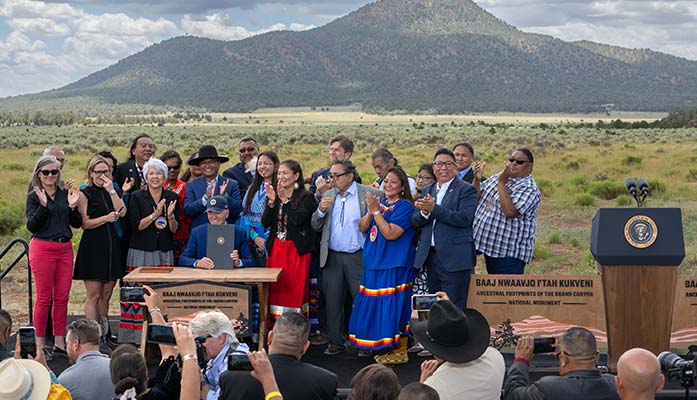
The acreage is now referred to as the Baaj Nwaavjo I’tah Kukveni Ancestral Footprints of the Grand Canyon National Monument.
The monument name comes from two of the Native American tribes who lived in the region: the Havasupai (Baaj Nwaavjo, meaning “where Indigenous peoples roam,” and I’tah Kukveni meaning “our ancestral foot prints”).
The designation further shielded the acreage from mining operations, first prohibited in 2012 under a Department of Interior (DOI) ban lasting until at least 2032.
The Bureau of Land Management (BLM) and U.S. Forest Service jointly manage the monument.
The initial announcement prompted lawmakers to call Biden’s proclamation a “dictator-style land grab” and “government overreach” that had the potential to impact national security.
Arizona legislative leaders, State Treasurer Kimberly Yee, Mohave County, and the towns of Colorado City and Fredonia sued to reverse the designation in 2024.
The three local governments argued the monument would hurt the potential of future tax revenues, pending the DOI ban lapsing after 2032. Colorado City also argued the water supply coming from an aquifer under the monument could be infringed if federal actors decided to restrict it.
Arizona lawmakers and the state treasurer argued the monument designation limited their ability to sell, lease, set royalty rates, and set values for the land. They also argued the designation forced them to divert resources to address the effects of the monument.
As to the ban on uranium mining, all against the designation claimed economic harm would occur due to the potential for higher energy prices in the future.
The Ninth Circuit Court of Appeals rejected all of those arguments in a ruling issued on Wednesday. The judges found their claims to be speculative.
Apart from the physical land management provided by BLM, the Baaj Nwaavjo I’tah Kukveni Ancestral Footprints of the Grand Canyon National Monument is overseen by a Monument Advisory Committee (MAC).
The MAC, established in the fall of 2024, has 15 members:
- Luke Thompson, Arizona Game and Fishing Department representative;
- Jason Chavez, Gov. Katie Hobbs’ tribal affairs director;
- Patrice Horstman, Coconino County Board of Supervisors member;
- Angelita Bulletts, BLM district manager and Paiute tribal member;
- Bennett Wakayuta, Hualapai tribal member;
- Lena Fowler, Coconino County Board of Supervisors member and Navajo tribal member;
- Forrest Radarian, a high school science teacher representing outdoor recreations;
- Amanda Podmore, a conservationist with Grand Canyon Trust;
- James “Jim” Unmacht, executive director of Arizona Sportsmen for Wildlife Conservation;
- Kathryn Leonard, state historic preservation officer with Arizona State Parks and Trails;
- Clare Aslan, associate professor and director of Northern Arizona University’s school of earth and sustainability;
- Sherre Finicum, a rancher;
- Clarinda Vail, mayor of the town of Tusayan; and
- Members of the public Dale Barlow and Lydia Breunig.
Their terms are set to expire in 2027 or 2028. It doesn’t appear that the MAC has conducted any meetings.
AZ Free News is your #1 source for Arizona news and politics. You can send us news tips using this link.
by Matthew Holloway | Mar 18, 2026 | News
By Matthew Holloway |
The U.S. Forest Service has finalized a long-contested land exchange with Resolution Copper tied to the proposed mining project near Superior, Arizona.
Resolution Copper announced that the exchange with the federal government has been finalized following years of environmental review, legal challenges, and consultation. The exchange transfers more than 2,400 acres of land in the Tonto National Forest to Resolution Copper, while the company conveys more than 5,400 acres of land across Arizona to federal agencies for conservation and public use.
The land exchange was authorized by Congress in the 2014 National Defense Authorization Act and has been subject to ongoing litigation and regulatory review in the years since.
The announcement follows a March 13 decision in the U.S. Court of Appeals for the Ninth Circuit, which declined to block the exchange, and the U.S. Supreme Court’s 2025 decision not to issue an emergency stay requested by Apache Stronghold, a nonprofit effort of the San Carlos Apache tribe and mine opponents.
The parcel transferred to Resolution Copper includes Oak Flat, an area within the Tonto National Forest that sits above a large underground copper deposit. The project has been identified as one of the largest undeveloped copper resources in North America, with estimates of more than 40 billion pounds of copper.
Resolution Copper, a joint venture owned by Rio Tinto and BHP, has stated that the project could eventually supply a significant share of U.S. copper demand and support domestic supply chains for energy and infrastructure.
The Forest Service completed a Final Environmental Impact Statement (FEIS) for the project in 2025 following more than a decade of study and consultation.
Despite the completion of the land exchange, the project remains subject to additional federal, state, and local permitting requirements before mining operations can begin.
The land transfer has been the focus of sustained opposition from the San Carlos Apache Tribe and other groups, who argue that Oak Flat—known as Chi’chil Biłdagoteel—is a site of religious and cultural significance.
The Resolution Copper project has drawn national attention due to its potential economic impact and its role in domestic mineral production, as well as ongoing legal and political disputes surrounding the land exchange.
In February, Resolution Copper announced a $285,000 donation to the United Food Bank amid rising food assistance demand in Arizona.
Matthew Holloway is a senior reporter for AZ Free News. Follow him on X for his latest stories, or email tips to Matthew@azfreenews.com.
by Matthew Holloway | Jun 21, 2025 | Economy, News
By Matthew Holloway |
The Resolution Copper project, a joint venture of BHP and Rio Tinto, issued a statement Tuesday welcoming the republication of the Final Environmental Impact Statement (FEIS) by the U.S. Forest Service (USFS) for its proposed underground mine 60 miles east of Phoenix near Superior, AZ.
The proposed development of the largest untapped copper deposit in the world relies on a major land-swap between the Rio Tinto, BHP, federal and state governments to proceed.
Initially the FEIS for the project was released by the Forest Service in 2021, but was later withdrawn by the agency to provide additional time for the USFS to study the objections of tribal governments and the overall community.
The proposed mine is controversial and would ultimately transform the Oak Flat parcel southwest of Superior, currently forest service land, into a 1.8-mile-wide crater between 800 and 1,115 feet deep, in exchange for 6,005 acres of land to be transferred by BHP and Rio Tinto local, state and federal governments and agencies.
“As part of the land exchange, Resolution Copper has committed to initiatives that support cultural preservation, recreation, education, employment, economic development, and nature through long-term partnerships with Native American Tribes and local communities. This includes significant funding in a long-term Native American Trust Fund and Emory Oak restoration,” Resolution Copper stated. “Other commitments focus on conservation and monitoring of seeps and springs; restoration and preservation of creeks, rivers, and watersheds; and habitat enhancement for biodiversity.”
Vicky Peacey, General Manager of Resolution Copper said, “Through this process, we have deepened our relationships with local communities and Native American Tribes, including our senior leaders spending time with Tribal leaders to listen and build mutual understanding. We welcome the opportunity to continue these conversations as we move into the next phase of permitting. Working together, mining can co-exist with cultural heritage, recreation, and nature, while delivering new economic opportunities in rural Arizona.”
“This project has undergone one of the most comprehensive environmental and social reviews in U.S. history,” she added. “The republication of the FEIS reflects the thorough work by the USFS, local communities, and Native American Tribes and the seriousness with which all stakeholders have approached this process. We remain committed to earning trust through transparency, engagement, and responsible development as we move forward.” In PR posts to social media, Resolution Copper boasts the prospects of adding $1.2 Billion to Arizona’s economy and thousands of jobs in Superior and Magma, AZ, totaling $270 million in annual salaries.
In a statement posted to X, U.S. Secretary of Agriculture Brooke Rollins expressed the Trump administration’s support for the proposal early in the week, noting that the republication of the withdrawn FEIS is “an important step in advancing President Trump’s goal of emergency and mineral independence by boosting domestic mineral production.” Rollins added, “The Resolution Copper project is a prime example of how we can harness America’s abundant resources to fuel growth in rural America, reduce our dependence on foreign imports, strengthen our supply chains, and enhance our national security.”
The U.S. Department of Agriculture detailed in a Tuesday release that the land transfer cannot occur until August 19, 2025, or 60 days after the Federal Register notice is published per a ruling from a U.S. District Court on June 9th. It added that, if approved, the mine is projected to generate $149 million in annual payroll, with approximately 1,500 jobs, providing between $80 and $120 million a year in estimated state and local tax revenue as well as $200 million a year to the federal government. The final environmental impact statement is expected to be posted to the Federal Register, along with the draft decision record from the USFS on June 20th.
The public has 45 days to make any objections to the decision and the USFS must respond and address any objections within 90 days, meaning the project could see final approval as soon as November 2nd.
Matthew Holloway is a senior reporter for AZ Free News. Follow him on X for his latest stories, or email tips to Matthew@azfreenews.com.
by Matthew Holloway | Feb 21, 2025 | News
By Matthew Holloway |
In a bipartisan effort between Republican Congressman Eli Crane (AZ) and Democrat Congressman Mike Levin (CA), the “Hire Veterans Act” was reintroduced to the U.S. House of Representatives. If enacted, the bill would employ U.S. military veterans in vacant, critical roles within the U.S. Forest Service, National Park Service, and Bureau of Land Management.
According to Crane, all three of the federal land management agencies have been suffering from serious staffing shortages that have negatively impacted their operational effectiveness. In particular, both Congressmen cited the U.S. Forest Service facing an ongoing struggle to recruit and train staff in multiple critical roles with what they referred to as “a noticeable gap in the experience and skill sets of candidates, affecting their capacity to address increasing wildfire threats.”
“As a 13-year veteran of the U.S. Navy, I’m all too familiar with the obstacles servicemen and women face when transitioning to civilian life. I’m also well-aware of the challenges our federal land management agencies currently face, particularly in filling vacancies for firefighters, park rangers, and foresters,” said Crane in a press release.
As reported by the New York Times, 3,400 employees from the U.S. Forest Service were terminated by the Trump Administration on Thursday, amounting to approximately 10% of the service’s workforce. Many of the newer employees would have been hired under the Diversity, Equity, and Inclusion regimen of the Biden Administration.
“With this bill, Congress has the opportunity to both streamline the employment process for veterans AND better ensure that our natural resources are protected for future generations. I’m grateful to be able to introduce this legislation that serves our veterans while furthering the responsible stewardship of U.S. land,” Crane added.
“Our veterans sacrifice so much for our nation. We have an obligation to ensure that veterans returning to civilian life can get jobs and support their families,” said Rep. Levin. “I’m glad to be partnering with Rep. Crane on our bipartisan bill to expand opportunities for veterans and help connect them to jobs in federal land management agencies. I look forward to working with my colleagues to advance this important legislation.”
According to a press release from the U.S. Department of Agriculture (USDA), which manages the Forest Service, U.S. Secretary of Agriculture Brooke Rollins issued a memorandum to rescind all Diversity, Equity, Inclusion, and Accessibility (DEIA) programs and celebrations. Instead, the USDA will reprioritize unity, equality, meritocracy, and color-blind policies.
Rollins said in her opening remarks at the USDA, “We will neither commemorate nor celebrate our immutable characteristics, neither among ourselves nor among Americans at large. We will instead celebrate the things that make us American: merit, faith, and liberty first among them. All Americans deserve equal dignity, and at this Department they will receive it. On this precipice of the 250th anniversary of our Revolution, we will rededicate ourselves to ‘the proposition that all men are created equal.’”
Matthew Holloway is a senior reporter for AZ Free News. Follow him on X for his latest stories, or email tips to Matthew@azfreenews.com.
Page 1 of 11