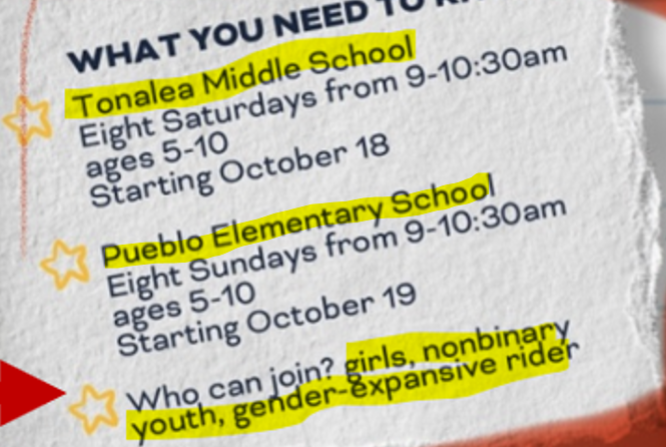
As enrollment dips and two schools are considered for repurposing, Scottsdale Unified School District (SUSD) is promoting a biking event for “girls, nonbinary youth, and gender-expansive” children in family-facing communications.
In an October 9th post to X, parental rights organization Scottsdale Unites for Educational Integrity (SUEI) wrote: “Parents confirmed @ScottsdaleUSD is using their district-wide communication system to promote an event for ‘nonbinary youth’ and ‘gender expansive’ children. Girls in Gear (and apparently boys, too) claims that these lessons are Social Emotional Learning. Email: GovBRD@SUSD.org.”
🚨SUSD is planning a "girls" event for "nonbinary youth" and "gender expansive" children.
— Scottsdale Unites for Educational Integrity (@ScottsdaleUnite) October 9, 2025
The “Girls in Gear” program, which focuses on cycling skills and social-emotional learning, includes participants who identify outside traditional gender norms, according to a district email sent to families. A post on X by SUEI shared the event flyer, which lists the inclusive criteria.
According to the Girls in Gear website, the event “is open to any rider who identifies as a girl. If a rider identifies as a girl, then the rider is welcome to participate in Girls in Gear.”
In a reply to the SUEI post, Arizona Women of Action drew attention to the contradiction that SUSD is continuing to focus on gender ideology despite reduced enrollment, school closures under discussion, and at-risk federal funding.
Arizona Women of Action wrote in its reply:
“1. Identifying as a gender that is not innate (boy or girl) is often the first step of the ‘trans’ path. By Scottsdale Unified recognizing these identities (non-binary, gender expansive) the district can contribute to a child’s ‘trans’ path. Change in pronouns and presentation are next, irreversible puberty blockers and hormones follow.
2. This is no longer a girls’ event if non binary or gender expansive youth can participate.
3. SUSD is closing schools. This kind of choice could be a contributing factor to low enrollment.
4. Isn’t there an EO about this? Yes. And schools can lose federal funding.”
The organization also called up on followers to call “the U.S. Department of Education’s Office for Civil Rights (OCR) at 1-800-421-3481 to report non-compliance.”
1. Identifying as a gender that is not innate (boy or girl) is often the first step of the "trans" path. By Scottsdale Unified recognizing these identities (non-binary, gender expansive) the district can contribute to a child's "trans" path. Change in pronouns and presentation… pic.twitter.com/iL7yUKiRPR
District reporting in February revealed that under SUSD Superintendent Dr. Scott Menzel, enrollment has consistently dropped. As of February 2025, enrollment stood at 19,367, a decrease of 390 students from 2024, down 355 from the previous year. Over the past seven years, enrollment has dropped precipitously by 13%, from 22,608.
In response to the enrollment trends, the SUSD governing board voted 3-2 on October 7th to advance a proposal to repurpose Echo Canyon K-8 School and Pima Elementary School for the 2026-27 school year, according to AZ Family. Menzel addressed the looming closures with families in a September message and cited under-enrollment at both schools.
The promotion of the program also comes amid federal policies addressing gender-related content in schools. President Trump’s Executive Order 14190, issued January 29, 2025, directs the withholding of federal funds from K-12 programs that promote gender ideology or other specified materials, and reestablishes the 1776 Commission for patriotic education. Additionally, a Department of Health and Human Services directive on August 26, 2025, requires states to certify that sex education programs do not reference transgender youth or gender ideology to receive funding, affecting 46 states and territories, including Arizona. Several Democratic-led states have filed lawsuits challenging the directive. Despite pending legal action, the Executive Order and HHS Directive both remain in effect at present.
SUSD has previously addressed transgender-related policies, including student transition plans and LGBTQ curriculum, and run afoul of the Arizona Department of Education and parents alike. In prior incidents, the district faced questions over notifications to parents and the use of school spaces for related activities, such as a “sexuality-safe-space” at Mohave Middle School, as reported by the Arizona Daily Independent.
Last month, a BrainPOP lesson on LGBTQ topics prompted review under state DEI restrictions, with Superintendent of Public Instruction Tom Horne citing potential violations.
Other community responses in the thread include comments from users expressing concern over the event’s inclusivity and district priorities.
Parents confirmed @ScottsdaleUSD is using their district-wide communication system to promote an event for "nonbinary youth" and "gender expansive" children. Girls in Gear (and apparently boys, too) claims that these lessons are Social Emotional Learning.
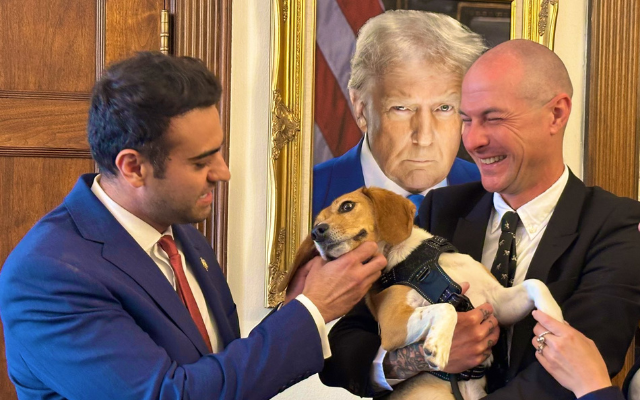
Congressman Hamadeh announced he is directing a group of House Republicans to demand that Fiscal Year 2026 spending bills include explicit language prohibiting federal funding for transgender experiments on animals.
“When Americans send their hard-earned money to Washington, they expect it to be used wisely to secure our borders, to defend our nation, and to provide essential services that protect our citizens. What they do not expect is for their tax dollars to bankroll the latest ideological fads of the radical left,” said Hamadeh.
“No one should be forced to subsidize radical gender ideology, let alone grotesque experiments that inflict suffering on animals in the name of ‘gender transition science.’ This is not medical research; it’s political theater disguised as science,” he added.
The initiative addresses growing concerns over federal funding being used to support immoral and unnecessary experiments involving animals such as monkeys, mice, and rabbits.
These experiments reportedly involve mutilating animals and administering cross-sex hormones to advance theories aligned with radical gender ideology.
“What possible scientific benefit can come from mutilating a rabbit or drugging a monkey with cross-sex hormones? None,” stated Congressman Hamadeh. “These experiments are not about medical advancement; they are about normalizing the transgender agenda.”
Hamadeh’s call to action highlights a broader issue: the capture of America’s research institutions by ideology. Agencies like the National Institute of Health (NIH) have diverted taxpayer dollars to projects that prioritize cultural agendas over scientific integrity.
The Congressman pointed to the Biden administration’s aggressive promotion of gender ideology across education, healthcare, and federal research as a driving force behind these experiments. “Billions of taxpayer dollars have been funneled into projects that redefine biology, undermine parental rights, and confuse children,” he said.
The push to defund these experiments is framed as part of a larger fight to protect American values and restore common sense to government spending.
Hamadeh concluded with a message to all members of Congress, saying, “The American people deserve better. Our children deserve better. And the animals who have no voice at all deserve better. That’s why I will keep leading this charge, because the line must be drawn here, and it must be drawn now. This isn’t politics – it’s common sense.”
Ethan Faverino is a reporter for AZ Free News. You can send him news tips using this link.
After publishing this Substack, I came across this video of a young woman’s “detransition” story. I also learned that Texas Christian University canceled an event featuring Chloe Cole, another “detransitioner” who travels the nation sharing her testimony. The fight to protect the next generation from the evils of “transgenderism” is far from over.
This quote is from the young woman who lived as a “male” for eight years but now regrets having a double mastectomy, full hysterectomy, and genital reconstruction surgery:
“I’m so angry…and so sad. It’s like a virus, or something, that infected me. And it happened so quickly…I can’t have kids. I’ll never lose my virginity. It’s like I’m left to just accept the scraps of the life that I could have had…I don’t know how to be okay with that. I hate when people [say], ‘Everything happens for a reason.’ No, this didn’t happen for a reason. It’s just a tragedy. Call it what it is.”
In the video, you can see what appears to be mutilation scars on her left forearm. Skin grafts are typically taken from this area to construct “a penis, urethra, scrotum, and the obliteration of the vaginal cavity with closure,” an operation known as phalloplasty (or “bottom surgery”). While it is possible to correct genital deformities, the damage to her body is irreversible, and the trajectory of her future is permanently altered. She can recover some femininity, but her womanhood is gone forever.
This is the expected end of social “transitioning,” cross-dressing, and using alternative names and pronouns—all of which can be concealed by false interpretations of student privacy laws. Also, when K-12 district representatives and employees implement DEI policies, host rainbow celebrations, and defend “gender identity,” they are advocating for all of the above. No one is born in the wrong body, and anyone who supports sterilizing and castrating minors should not be trusted around children.
I always bring the “transgender” agenda back to government education because it’s an area where many parents are still asleep at the wheel. Public schools (and increasingly some private schools) are the battlefield as board members, administrators, teachers, and counselors position themselves as the enemy of parental rights. Thankfully, parents are winning in the courts, and thousands of children will never undergo “transgender” medical malpractice. Still, parents must remain vigilant in the ongoing war to assert moral authority over their children.
It’s also important to bring attention to another group that’s not doing enough to tackle the “transgender” problem. Sadly, many Christians are aiding and abetting the spread of LGBTQ ideologies and practices. Keep in mind that “Christian” is a relative term associated with thousands of denominations and cults, and can be interpreted to mean a “good person.”
On February 25, 2025, Pew Research published survey results showing that “57% [up from 54% in 2014] of U.S. Christians say homosexuality should be accepted by society; 55% [up from 44% in 2014] say same-sex marriage should be legal.” The report also reveals 29% of Christians believe greater acceptance of “transgender” individuals is “a change for the better.” The latter is a baseline number, as researchers did not ask this question in previous case studies.
Oddly enough, Barna’s 2025 study shows Millennials and Gen Z have increased their church attendance. The report says, “The typical Gen Z churchgoer now attends 1.9 weekends per month, while Millennial churchgoers average 1.8 times—a steady upward shift since the lows seen during the pandemic. These are easily the highest rates of church attendance among young Christians since they first hit Barna’s tracking.”
Before we celebrate, let’s consider that in 2004, 51% of American pastors held a biblical worldview. By 2022, just 37% of pastors had sustained a biblical worldview, while 62% held syncretistic beliefs (that is, blending Christianity with other religions). In 2023, only 36% of pastors were “very effective” in helping Christians grow their faith over time. A mere 10% were “very effective” in “growing new converts into mature Christians,” while 12% encouraged believers to share their faith, and a measly 6% reached out to non-Christians.
These are sobering statistics, and, according to Barna, the increase among Gen Z still equates to attending church “less than half the time” of older generations. So, while young people are seeking truth, many will join ministries led by compromised leaders. Gen Z’s faith might grow over time, but they won’t share it outside the church, and what they learn may not have a lasting effect. In short, the American Church produces converts without conviction and consumers without consecration, who master religious transactions without transformation.
My fellow believers, none of this is a sign of “revival.”
I have lost count of how many times we canceled Netflix, rebooked Disney vacations, and chose Walmart over Target. Jumping on a trend is not good enough. We can’t be so preoccupied with our regularly scheduled programming that we fail to address the spirit of the age that’s consuming present generations.
Are we too holy to associate with LGBTQ people because their sin looks different than ours? Are we so loving that we can’t confront sin at all? Have we settled for inviting the lost to hear watered-down preaching because we’re too biblically illiterate to usher them into the Kingdom directly? If we’re honest, most Christians wouldn’t know how to minister to that broken woman in the video. We would say, “Jesus loves you,” and hand her a flyer for the next church event.
I agreed when the woman said destroying her body didn’t happen for a reason, and she called it a tragedy. The expression, “Everything happens for a reason,” is typically what believers (and nonbelievers) say when they lack the capacity to produce genuine empathy. It’s on par with “God works in mysterious ways,” a favorite among those who cannot discern the difference between coincidence and divine appointment. Neither of these phrases is found in Scripture.
The truth is, everything does not happen for a reason. Some things—and I would argue, living in a fallen world, that most things—happen as a consequence. Our beliefs influence our actions, and actions dictate outcomes. We can only help the next generation by imitating the Berean Christians (Acts 17:11), speaking the truth in love (Eph. 4:15), and investing time in young people beyond religious activities. Some sinners will never darken the doorway of your church, but they shouldn’t have to wait until Sunday to hear the gospel.
I challenge Christians to befriend an LGBTQ person, learn their story, and, when their heart is ready, preach the full gospel to them. Don’t stop at “Jesus loves you” and a church invitation. Tell them why He was crucified. Explain that He is not only our Friend—He is also our Judge. He extends mercy to those who repent and wrath to those who reject Him. Jesus came as a lamb, but He will return as a lion. Faith in His work on the cross is the only way to life, both now and for eternity.
Never separate love from truth.
Tiffany Benson is the Founder of Restore Parental Rights in Education. Her commentaries on education, politics, and Christian faith can be viewed at Parentspayattention.com and Bigviewsmallwindow.com. Follow her on socials @realtiffanyb.
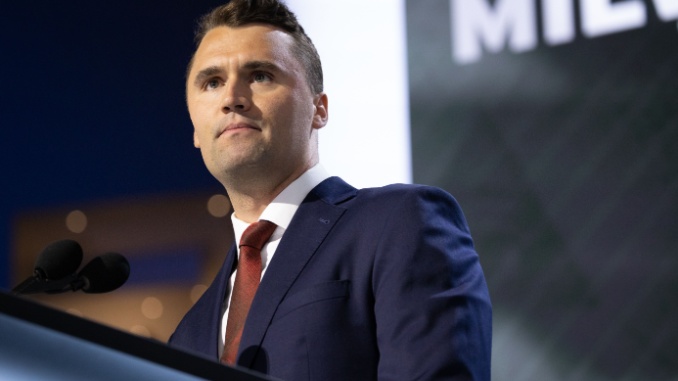
The tragic assassination of Charlie Kirk is not only the loss of a cultural leader, but also a chilling reminder of what happens when we confuse speech with violence. Kirk was a tireless champion of free expression, and his death underscores the urgent need to examine how the suppression of dialogue can set the stage for real violence.
In his own words, Kirk once warned: “When people stop talking, really bad stuff starts… when you stop having a human connection with someone you disagree with, it becomes a lot easier to want to commit violence against that group. What we as a culture have to get back to is being able to have reasonable disagreement where violence is not an option.” His words now read as both a prophecy and a plea for the culture of dialogue we so desperately need.
Suppressing Speech Is Not The Answer
Psychology teaches us that suppressing thoughts doesn’t eliminate them — it simply pushes them underground. Clinicians see this dynamic in individuals who repress emotions until they reemerge as passive aggression or even have destructive outbursts. The same pattern plays out in society: When people are told their perspectives are unspeakable, frustration grows, mistrust deepens, and the risk of acting out increases. Ironically, attempts to enforce “safe spaces” by silencing dissent often make communities more volatile. True safety comes from open dialogue, where conflict can be addressed directly rather than festering in silence.
The Danger Of “Social Justice Warrior” Rhetoric
When individuals adopt the mindset of “social justice warriors,” the very word “war” can take on a literal dimension. Combined with rhetoric that labels opponents as “Nazis,” “fascists,” or even as “threats to existence” for questioning prevailing ideologies, we create a psychological framework where violence feels like moral self-defense. Social psychologists call this groupthink — a process in which consensus becomes so rigid that dissenters can be irrationally cast as evil. Ingredients of groupthink include a belief in the moral superiority of the group, direct pressure on dissenters, strong outgroup stereotypes, and collective rationalization — all of which were present here. In such an atmosphere, attacking a speaker can feel like a righteous duty. Tragically, Kirk’s willingness to question aspects of trans ideology and other sacred cows of certain political groups placed him squarely in the crosshairs of this warped moral reasoning.
Words Are Not Violence
Words can sting, but they are not the same as physical harm. Equating speech with violence not only inflates anxiety but also undermines resilience. It conditions people to believe that discomfort is intolerable and that retaliation — even violent retaliation—is justified. By contrast, protecting free speech fosters self-efficacy — the belief in one’s ability to navigate challenges constructively. It strengthens authentic connection, reduces the loneliness that comes from self-censorship, and creates opportunities for genuine problem-solving.
Charlie Kirk’s assassination must be seen for what it is: a catastrophic failure to uphold the principle that dialogue is the antidote to violence, not its cause. As Kirk himself urged, the future of our culture depends on whether we can “have reasonable disagreement where violence is not an option.”
To honor his legacy, we must recommit to that vision — resisting the falsehood that words are violence — and embracing the truth that dialogue, even when difficult, is the path to peace. This is the very theme I explore in my book Can I Say That? Why Free Speech Matters and How to Use It Fearlessly, which offers psychological tools for protecting free speech and building the resilience that open dialogue requires. The book includes examples such as Andy Ngo and Riley Gaines, who have suffered violence for their speech — and tragically, Charlie Kirk is now added to that list in the worst possible way. I urge you to channel your grief into action — do not be silenced but use your voice and stand together. It’s exactly what Charlie would have wanted.
Dr. Chloe Carmichael is contributor to the Daily Caller News Foundation, a clinical psychologist, USA Today bestselling author of “Nervous Energy,” and a visiting fellow at Independent Women. Her upcoming book “Can I Say That? Why Free Speech Matters and How to Use It Fearlessly” (Skyhorse, Nov. 2025) explores the mental health benefits of open dialogue and the costs of self-censorship.
The steady decline of academic success and moral integrity is an undeniable reality in many Arizona school districts. K-12 libraries are plagued with sexually graphic novels. Science textbooks tout evolutionary theory and climate change nonsense. ELA assignments contain race-baiting themes and false social justice narratives. LGBTQ+ clubs are in full force, while private spaces still pose a safety risk to female students.
Do Christian/conservative teachers have any responsibility to restore order in our public schools? Aren’t they on the frontlines of steering young minds and upholding ethical standards in the classroom? Why don’t we see more exposure of subpar curricula and corrupt policies that fail to protect educators’ constitutional rights at work?
Will this school year be any different, or will Arizona teachers maintain the status quo?
Jessica Tapia’s Story
California educator and parental rights advocate Jessica Tapia
Jessica Tapia is an alumna and former employee of Jurupa Unified School District (JUSD). She graduated from Jurupa Valley High School, secured a full-time position in the district, and eventually landed her dream job as a high school P.E. teacher.
Tapia loved her career and her students, but she loved God foremost. And her faith would soon be tested.
Six years into her career, some JUSD students decided to research Tapia and discovered Christian/conservative posts on her social media page. The juveniles reported their findings to district officials, who conducted an internal investigation. Tapia was placed on administrative leave and admonished to hide her online profile. As a condition of employment, she would also have to agree to use students’ preferred names and pronouns, even without parental consent.
If Tapia complied with JUSD’s policies—including allowing boys to access girls’ locker rooms—she would keep her compensation package and enjoy acceptance among her peers. Otherwise, she faced serious and permanent consequences. Thankfully, Tapia not only believed in the unchanging truth that God created male and female, she was also willing to defend her faith and freedom of speech on school grounds.
Tapia was fired from her dream job, and the woke mob demanded her head on a platter. In a moment of truth, Tapia lost nearly everything she worked hard to achieve, and her reputation was now tarnished. JUSD reprimanded her for unprofessional conduct and accused her of publishing “racist, offensive, and disrespectful” content. No doubt, the most painful experiences came in the form of separating from her students and watching colleagues turn their backs.
This would be a sad story if it ended here.
Tapia knew her rights and filed a lawsuit against JUSD. Turns out, firing a teacher who refused to lie to students and families is not only morally reprehensible, but it’s also illegal. After a long battle with many ups and downs, stretching and testing her faith, Tapia finally won! JUSD settled with Tapia for $285,000 and another $75,000 for her attorney fees. She’s now one of America’s leading advocates for teachers and parental rights in education.
When JUSD violated Tapia’s First Amendment rights, she pushed back. When dangerous transgender policies contradicted her faith—and put female students at risk—Tapia refused to comply. When following orders suddenly meant hiding vital information from parents, she said no. Tapia didn’t cower in fear, take a bribe, or ignore the situation altogether. Instead, she chose to do the hard thing. The right thing.
What’s Your Story?
School board members are elected officials who swear an oath to uphold the United States Constitution. Protecting teachers is their responsibility when it comes to drafting and voting on district policies. Administrators should not manipulate or control this process. Furthermore, school districts don’t have the legal right or moral authority to give ultimatums or blackmail employees into submission. It’s time teachers say, “Enough is enough.”
Transgender ideology is a dangerous lie and a mental illness that shouldn’t be imposed on anyone. Still, K-12 educators often conceal their Christian beliefs to avoid backlash and discrimination. These are the “don’t rock the boat” types. It’s also possible that some teachers are simply unaware or unbothered by high-profile issues on campus. These are the “ostrich” types. For the sake of moral clarity, consider the following real-life scenarios that also degrade our public education system.
We currently have teachers who, for whatever reason, purposely pass unprepared students on to the next grade level. Rebellious teachers hide inappropriate books in their classrooms and read filth to children behind parents’ backs. An increasing number are perpetrating or ignoring signs of sexual, physical, mental, and emotional abuse. Public schools are overflowing with activists disguised as teachers whose sole mission is to advance union agendas.
I say, enough is enough.
Of course, there are a host of problems that educators shouldn’t be blamed for, including:
overspending, mismanagement, and corruption at the district level.
excessive classroom sizes.
laxed or nonexistent disciplinary policies.
the expectation of training fellow teachers without compensation.
submitting to self-important, intimidating administrators (many of whom don’t even like children).
These hardships don’t go unnoticed by parents, community members, and board members who share educators’ concerns. Nevertheless, Tapia’s story is a prototype, a demonstration of boldness that highlights every teacher’s responsibility to always respond with moral integrity and conviction.
It’s simple: Set and keep professional boundaries. Respect students and safeguard their innocence. Be straightforward with parents and never lie to save face. Refuse to be intimidated or comply with unconstitutional policies. Don’t quit in the heat of the battle. Know your rights. If you experience legitimate discrimination on school grounds, consult legal counsel and file a complaint.
Teachers shouldn’t be discouraged when criticisms are ignored and questions go unanswered. Those with the most power are typically the least compelled to solve problems that don’t immediately affect them. Oftentimes, negative publicity is the only way to disrupt the status quo. To be sure, nothing will change if good teachers keep playing nice, remaining silent, or walking away. There’s no outrunning the madness in government schools—you must find the backbone to confront the madness head-on.
Tapia’s testimony aligns with a theme we see throughout the Bible: God rewards obedience and courage; He hates rebellion and cowardice. Tapia’s story is a provocation for teachers to blow the whistle and stand on truth regardless of the consequences. Even if you’re not particularly religious, your First Amendment rights don’t end where bad district policies begin.
This school year can be different than years past. It just takes one good teacher to find their voice and lead the way.