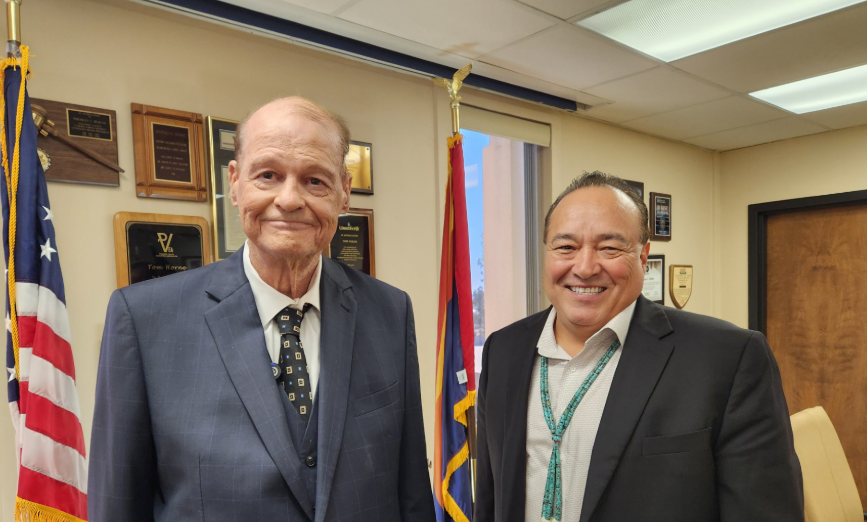
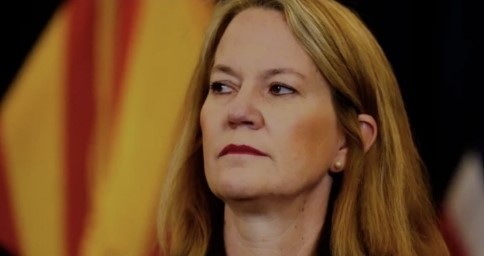
Native American students across Arizona are achieving significant improvements in reading and math proficiency, driven by targeted school improvement strategies, according to State Superintendent Tom Horne.
Notably, three schools in the Chinle Unified School District are now surpassing state averages in both math and English, making a transformative shift in educational outcomes. They saw an increase from 20% proficiency in 2023 to 34% districtwide.
“When I took office in January 2023, I was informed that the average proficiency rate for Native American students was five percent,” said Superintendent Horne in a press conference. “This was very upsetting to me, as it would affect the students’ employment prospects and quality of life. I said that we would change everything we were doing in that respect and give total focus to increasing proficiency rates among Native American students. I met with tribal leaders who were shocked to learn about the five percent number and agreed with me that action had to be taken.”
Through collaboration between the Offices of Indian Education and School Improvement, schools have received extensive support, such as teacher training, on-site visits, and leadership guidance, to help them and their students succeed.
Horne added, “With outstanding leadership from leaders of Native American districts, and our help, the proficiency rates of Native American students have soared.”
Other districts in the state have also reported extraordinary progress. Ganado Unified School District saw a 159% growth in students testing proficient in math and English, while Red Mesa Unified School District achieved a growth of 149%.
Baboquivari Unified School District recorded a 197% increase, Kayenta Unified School District a 122% jump, Sacaton Elementary District a 124% increase, and Tuba City Unified School District a 113% improvement.
Chinle Unified School District Superintendent Quincy Natay credited the success to a collective effort. “We are extremely proud of the progress our students and teachers have made,” Natay said. “These gains are a direct result of our governing board’s support of our vision and strategic plan, dedication of our educators, the support of our parents and communities, and the hard work of our students. We remain committed to building on this momentum and ensuring that all our students, across every grade level, have the opportunities and education to improve their quality of life.”
Ethan Faverino is a reporter for AZ Free News. You can send him news tips using this link.
Arizona Superintendent of Public Instruction Tom Horne is urging the Phoenix Union High School District to reverse its decision to reject armed officers on campus following a violent knife fight between two female students at Carl Hayden High School.
The altercation, reported by the Phoenix Police Department, occurred just after 9 a.m last Monday. Officers responded to reports of a physical fight during which one student struck another with the handle of a closed-blade pocketknife.
The student with the pocketknife was referred to the Juvenile Court Center and faces one count of aggravated assault. The injured student received treatment for minor injuries, and the incident remains under investigation. Horne emphasized the critical need for armed officers, stating, “The safety of students, teachers, and staff members at schools is not negotiable, and a knife fight on the Carl Hayden campus Monday shows the dangers are increasing. This needs to stop immediately. The Phoenix Union governing board needs to reverse a terrible decision they made earlier this year when they rejected requests from the leadership of both Carl Hayden and Betty Fairfax high schools for armed officers on campus.”
“Yesterday, Phoenix Police reported that two female Carl Hayden students were in a knife fight that resulted in injuries,” Horne added. “This proves the need for armed officers and demonstrates the utter lack of concern by the members of the Phoenix Union government board who rejected the request for officers that had been endorsed by the two schools and district administration. It was an outrageous dereliction of responsibility, and the board needs to reconsider this matter immediately.”
The incident at Carl Hayden High School is part of a broader pattern of safety concerns within the Phoenix Union High School District. Earlier this year, a tragic stabbing at Maryvale High School resulted in the death of a 16-year-old student, prompting scrutiny of campus security protocols.
Phoenix Union Governing Board member Jeremiah Cota requested reconsideration of the board’s earlier vote back in August 2025, but again, the Phoenix Union board voted to deny state-funded officers. Cota tweeted, “There will be NO school resource officers agenda item at the Phoenix Union next board meeting. The Board President has refused my calls for improving school safety once again. Shameful for this district to put anti-law enforcement politics before student and staff safety.”
There will be NO school resource officers agenda item at the @PhoenixUnion next board meeting.
The Board President has refused my calls for improving school safety once again.
Shameful for this district to put anti law enforcement politics before student and staff safety. pic.twitter.com/AgBddrV0Vc
Arizona is one of the nation’s leading states in offering families education choice—and families are loving it.
Three out of four parents support the state’s Empowerment Scholarship Accounts program, which enables families to choose the learning environments that work best for their children. Parents can use these funds to pay for private school tuition, tutoring, textbooks, homeschool curricula, online courses, special needs therapy, and more.
The typical student in this program receives about $7,500 per year, less than half the $15,300 per pupil at Arizona’s district schools.
But Democrat Attorney General Kris Mayes wants to put a stop to even that.
Yet again, Mayes is waging lawfare against the more than 90,000 students using the state’s education choice program.
Earlier this year, Mayes ordered the Arizona Department of Education to adopt an extra-statutory regulation—one she invented from thin air—that undermined the ability of the department to approve education savings account expense requests in a timely manner. Now, she’s using exaggerated concerns over misspending to achieve the same end: throwing sand in the program’s gears.
Late last month, Mayes sent a letter to Arizona Superintendent of Public Instruction Tom Horne ordering him to cease automatically approving account purchases under $2,000, a practice Mayes argued “has led to ESA [Empowerment Scholarship Account] holders purchasing prohibited items […] with taxpayer funds.”
Horne, a former attorney general, responded that Mayes’s issue lies not with him but with the state Legislature, which modified the program’s statute last year to require the education department to adopt “risk-based auditing procedures” for the program. The revision was signed into law by Gov. Katie Hobbs, a Democrat.
The risk-based auditing provision seems like a boring, in-the-weeds detail. But such details can make or break a program like the Empowerment Scholarship Accounts—and Mayes knows it.
Before the Legislature revised the statute, the Arizona Department of Education was manually approving every single account purchase or reimbursement request. This “review every penny” approach was causing massive backlogs and delays.
There were nearly 11,000 transactions in Quarter 3 of this year alone. It’s impossible for the department’s small staff to review each transaction in a timely manner. Instead, families were forced to wait over two months to purchase things like books or curricular materials.
But families can’t wait months just to buy a textbook or pay their child’s tutor or school. Those who couldn’t wait had to pay out of pocket—and it took nearly five months to be reimbursed.
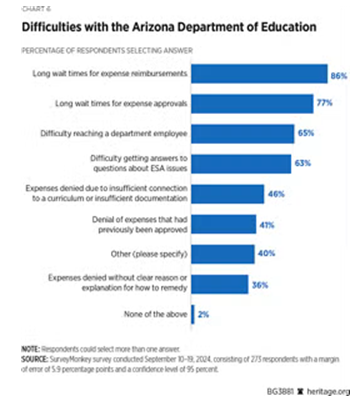
The delays caused families considerable frustration. A survey of families using the accounts found that two-thirds were dissatisfied with how the program was being administered, and about 8 in 10 were frustrated by long wait times for expense approvals and reimbursements.
It wasn’t supposed to be this way. ClassWallet, the vendor that operates the program, promised in its 2023 contract with the state “to automate the approval of platform transactions and reduce the [department’s] reliance on manual reviews of platform purchases,” claiming that the artificial intelligence it was developing “provides the State a path to a zero-approval queue, minimizing staffing and costs.”
Unfortunately, ClassWallet has thus far failed to deliver on that promise. And while artificial intelligence might one day allow parents to instantly access their funds while reducing fraud to zero, it’s not there yet.
In the meantime, the department needed a practical solution that simultaneously maximized user-friendliness while minimizing fraud.
That’s where risk-based auditing comes in. In response to parental frustration with the manual review process, the legislature modified the statute, ordering the Arizona Department of Education to adopt a risk-based auditing approach.
To comply with legislative intent, the department decided to automatically approve spending requests below $2,000, then audit accounts on the back end.
The new approach has been a stunning success. Parents can get most items immediately, and wait times for purchase requests above $2,000 dropped from two months to just three or four days. And the risk-based auditing system produced a high degree of financial accountability.
Unfortunately, though, the media seized upon the tiny percentage of ESA holders who are taking advantage of the looser rules. Sensationalist “journalists” with a long history of factually challenged attacks on school choice programs breathlessly reported that account holders purchased a variety of ineligible expenses, including diamond rings and necklaces, flights and hotel stays, and even lingerie.
What they neglected to report was the scale of the misspending.
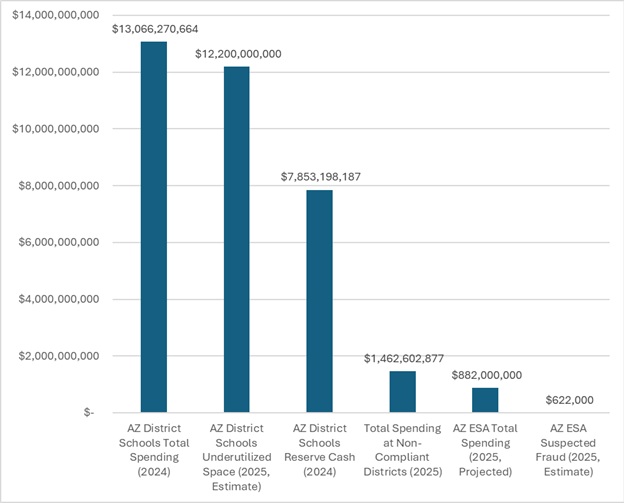
Last month, the Arizona Department of Education revealed that its internal audit of two years’ worth of ESA spending had turned up $622,000 in ESA funds that are “possible fraud or misuse.” That’s less than 0.05% of total ESA spending from 0.4% of account holders.
More than that, anyone engaged in misspending will be forced to pay the money back and could face prosecution. The department reports that it is “in the process of collecting more than $600,000” in improper spending, and it’s already suspended 400 accounts. Some have been referred some to the attorney general for further investigation and prosecution.
One would think that the attorney general would be impressed by this high level of accountability. But instead, she’s demanding that the Education Department abandon risk-based auditing in favor of the failed manual-review process that produced months-long wait times.
Clearly, accountability is not the goal here. Arizona’s attorney general is using misspending as a pretext. If accountability were her real concern, she’d be raising alarms about all the waste, fraud, and abuse in the district school system—such as the $12 billion worth of unused and underutilized buildings that Arizona school districts are sitting on, or the record $7.8 billion they’re holding in cash reserves.
Mayes says she is concerned with stopping the 0.4% of account holders committing fraud. But her demands would make the program unworkable for the over 99% of families who are just trying to do right by their children.
Punishing fraud is necessary. Every government program has some amount of fraud and abuse, and public officials have a duty to implement rules that keep fraud to a bare minimum. But undermining a program’s effectiveness does not serve the public interest, especially when that program is helping kids get access to a better education and a brighter future.
The attorney general’s demands are unreasonable and pretextual. Acceding to her demands would not fix the state’s education choice program—it would break it. Horne was right to tell the attorney general to go pound sand.
Jason Bedrick is a Research Fellow at The Heritage Foundation’s Center for Education Policy.
With the tragic murder of a Maryvale High School student and the brutal attack against the Annunciation Catholic School in Minneapolis, MN, still fresh in public memory, State Superintendent of Public Instruction Tom Horne submitted a legislative budget request for $180 million to continue and expand state funding to put more armed officers on campuses throughout Arizona.
Existing funding for school safety, by initial appropriation and carryover, totals $128 million. Federal funding also provides an additional $20 million. According to the Arizona Department of Education, both are scheduled to expire in 2026. To address this, Horne has reportedly submitted the request for $180 million, which, if approved, “would ensure the current level of funding will continue and the added $32 million will allow for expanding the program for more officers and training.”
In a statement released Thursday, Horne said, “Over the past several weeks, our nation has witnessed terrible school tragedies. This problem is not going away, and we need to address it aggressively. Therefore, I am now making a budget request of the legislature to appropriate at least $180 million to make sure we have no gap in providing funding for armed officers on campuses. This request adds dollars to hire and train officers for more schools statewide to protect students, educators, and classified staff.”
Horne referred back to the successful intervention of a heroic Tucson Police Officer William Bonanno, who thwarted an attempted attack on Legacy Traditional School-East Tucson in January.
“The value of having armed officers on campuses is beyond dispute. One of the best examples occurred earlier this year when a heroic Tucson police officer arrested an armed intruder on a school campus during class hours.
“This criminal was armed with a gun and a knife and told the officer he was there to kill children and make them famous. The officer was on that campus because of funding through the department’s School Safety Program. In fact, he had been hired less than a month earlier using supplemental dollars my department made available. This program works and deserves more funding so it can be expanded. Every parent should want an officer on their child’s campus.”
The School Safety Program helped save the lives of innocent children yesterday. Thank you to the School Resource Officer for helping to avert tragedy. I will fight to have an SRO on every campus to keep students safe. https://t.co/QmystFhVBX
Maricopa County Schools Superintendent Shelli Boggs issued a concurring statement saying, “I will continue to advocate for school safety programs. This is about ensuring that every student, in every school, in every neighborhood, has the peace of mind that comes from knowing they are safe.”
Maricopa County Sheriff Jerry Sheridan offered his support as well, stating, “As Sheriff of Maricopa County, I strongly support Superintendent Horne’s efforts to fully fund our school safety program to ensure all schools have these resources to protect our kids. There is no greater responsibility for society than to do everything possible to keep children safe, especially in a place of learning and growing. To that end, we currently have dozens of MCSO deputies participating in this program, and additional funding will allow us to expand our services.”
Responding to a letter issued by Arizona Democrat Attorney General Kris Mayes, Arizona Superintendent of Public Instruction Tom Horne issued a statement that Mayes is “misleading the public with claims she has leveled at the management of the Empowerment Scholarship Account (ESA) program.” In an 8-page letter with 12 pages of testimony from the Arizona Department of Education’s John Ward in the case of Velia Aguirre v. State of Arizona, Mayes outlined an investigation from her office, making allegations regarding the Department of Education’s use of a risk-based audit approach, which echoes a similar exchange between Horne and Governor Katie Hobbs in December 2024.
Mayes directly critiqued Horne and the ADE writing in part:
“Your failure to appropriately monitor ESA spending has created an untenable situation. Again, I do not want to disrupt the process for ESA holders who are following the law, but this cannot continue. Accordingly, you must act immediately to develop and implement appropriately rigorous purchase review standards and risk-based audit procedures so that ESA families may access their funds in a timely manner and public funds are not spent illegally. The Department’s purchase review and audit standards should employ appropriate controls to safeguard public funds. These controls, and any automatic payment thresholds, should consider the level of risk associated with different categories of expenses, vendors, methods of payment, and individual ESA holders.”
Mayes went on to cite a 12 News report that “the Department has automatically approved [$]1.2 million ESA purchases since the automatic approval policy took effect in December 2024.”
As Matt Beienburg wrote in an op-ed for AZ Free News, the Arizona Capitol Times issued a retraction of its initial report that “Education department under fire for approving $124M in improper ESA [education savings account] purchases,” clarifying with a formal correction that “an inaccurate dollar amount,” was reported. However, no similar retraction has been issued by 12 News as of this report.
"Facts don't lie, even if the media does."
Here are two MAJOR lies 12News "reported" in its bogus ESA attack 👇
❌ Dollar amounts were exaggerated up to 100 times!
Beienburg notes that blatantly inappropriate purchases such as iPhones, televisions, and other non-educational items “haven’t been approved, as the State Board of Education’s ESA Handbook—ratified by members appointed by both former Gov. Doug Ducey and Gov. Katie Hobbs—makes clear. The document expressly states that while families’ ESA purchases under $2,000 are promptly reimbursed by the state, these items ‘are not deemed ‘approved’ by the Department, until they are audited OR the timeframe to audit the orders has passed [2 fiscal years].’ Just like their tax returns filed with the IRS, these families’ ESA purchases are processed up front and subject to enforcement afterwards.”
For immediate release: August 29, 2025 Horne calls out AG Mayes for misleading attack on ESA program AG sent letter to Superintendent today Link: : https://t.co/ul3JSKLudp Contact: Communications@azed.gov pic.twitter.com/xGEPdsrHqB
— Arizona Department of Education (@azedschools) August 29, 2025
In a lengthy statement, Horne addressed the allegations raised by Mayes and accused the AG of making false statements:
“In your letter today, and in a recent television interview, you misled the public by stating that improper ESA purchases had been approved, without any reference to the fact that under risk-based auditing dictated by the legislature the money has been recovered or is in the process of being recovered. We have collected or are in the process of collecting more than $600,000 that was paid out for improper purchases. You also criticize risk-based auditing. Risk-based auditing is a very common and appropriate practice used by auditors, and the ESA Director has more than 16 years’ experience as an auditor. The risk-based approach involves not approving purchases prior to review, but paying amounts under $2,000 subject to later review, which is how we were able to collect or be in the process of collecting more than $600,000.”
He went on to chide Mayes writing, “You state that this is not partisan. That is disproved by all the false statements you made on the television interview.”
Horne continued, “Your argument is not with me but with the legislature. The legislature recently passed ARS section 15–2403B. It provides in part: ‘The department, in consultation with the office of the auditor general, shall develop risk-based auditing procedures for audits conducted pursuing to this subsection.’
“The statute was passed because the department is operating with the same number of people to check purchases as had been given by the legislature when the program was 1/7th as large. The most recent House budget included an appropriation for more people to check purchases, but it had to drop that provision when the governor said that if it did not do so, she would veto the entire budget. The limit on personnel had meant delays for reimbursement or more than two months, which was an unbearable burden for parents who had already paid the money and needed reimbursement. This explains why the legislature wanted to add more staff to serve parents.
“Again, you misled the public in your interview by stating that these improper items have been approved. They were not approved, and as to all the items you mentioned, the accounts have already been frozen. This is as egregious as ignoring the recovery of over $600,000, not to mention your failure to state that this procedure was dictated to us by the legislature and the ESA parent committee that you referred to set the limit at $2,000 pursuant to the legislative command to adopt risk-based auditing. It has been made clear to ESA users in multiple communications that payments of under $2,000 do not imply approval, which can be obtained only after the risk-based auditing dictated by the legislature.
“You referred to a July 21 meeting of the legislative audit committee. Within four days we consulted with the auditor general. Some have erroneously interpreted the word ‘consultation’ to mean that the auditor general has the right to dictate terms to us. That is incorrect. The normal English language use of the word consultation is that we have a discussion, which we have done, and then proceed. However, we have agreed to have further consultations with the auditor general and will do so.
“We will provide at a later date further responses to your long-winded letter of seven pages single space. We are responding now to the main points so you will have no further excuse to mislead the public.”