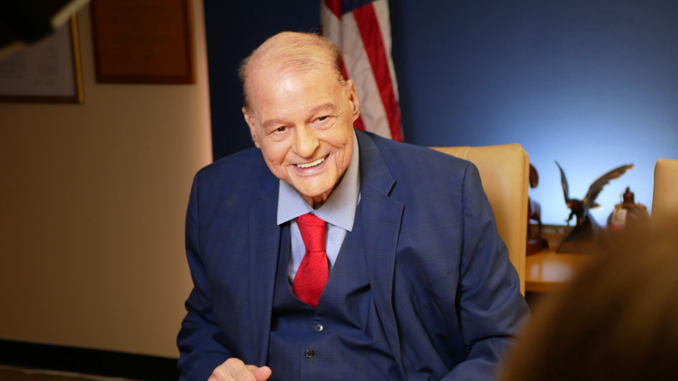
Arizona Superintendent of Schools Tom Horne expressed concern publicly that Peoria Unified School District (PUSD) leadership is failing in its response to student sexual abuse.
The head of Arizona schools said he was concerned with a lack of transparency within PUSD.
Horne also indicated worry over the recent leadership changes at PUSD amid investigations that follow sexual abuse charges against two Centennial High School teachers, Haley Beck and Angela Burlaka.
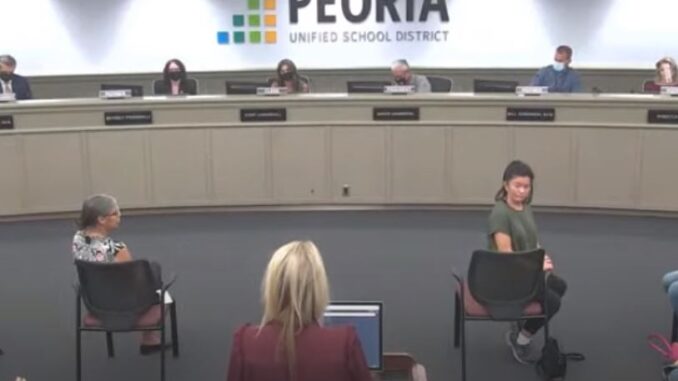
Three of the five governing board members voted to remove Heather Rooks from the presidency in a special meeting last week for asking the Maricopa County Attorney’s Office (MCAO) to join an internal investigation of alleged mandatory reporting failures concerning Beck.
The board had voted against bringing the MCAO on in an earlier meeting. Rooks and board member Janelle Bowles voted against replacing Rooks with board member Jeff Tobey.
Arizona law mandates school personnel report to law enforcement, the Department of Child Safety, and the State Board of Education when they have reason to believe that a minor has experienced intentional abuse, neglect, or physical injury.
Unlike the PUSD governing board, the state’s schools chief issued open support for Rooks.
“Horne agrees with Rooks that full reporting is legally required,” stated an Arizona Department of Education press release. “Also, reports are to be made immediately, and reporting to a supervisor or administrator is not sufficient. Failure to comply is a Class I misdemeanor for child abuse or neglect and a Class 6 felony for not reporting a reportable offense.”
Following her ouster from the presidency, Rooks offered details on the alleged mandated reporting failures in an interview with “The Conservative Circus.” Rooks shared an allegation that Centennial High School’s principal sat on reports which accused Beck of grooming and other inappropriate behaviors with a male student.
Rooks voiced feelings of shame for the board’s behavior in a statement issued after last week’s special meeting. Rooks said she had a responsibility to secure an investigation into alleged mandated reporting failures.
— Heather Rooks The Peoria Mom (@ThePeoriaMom) May 7, 2026
Horne stressed in a press release that Arizona has “zero tolerance” for failing on mandated reporting.
“I am deeply concerned about the events occurring on the Peoria district board. It is absolutely crucial that every school be transparent with the public about what happens in schools,” said Horne. “There should be zero tolerance for people who don’t live up to their duty to report misconduct. In recent months, the State Board of Education, where I am a voting member, has disciplined educators for that kind of failure.”
Beyond the problems at PUSD, Horne said he’s observed a rising trend of school employees maltreating children.
“There seems to be a terrible trend of school employees being accused of egregious breaches of conduct, including sexual activities with children. This is completely unacceptable and schools must do everything possible to ensure the safety of children,” said Horne. “The exploitation of a child by anyone, but especially an educator or other school employee, is an unfathomable breach of trust and cannot be tolerated.”
Horne included a reminder in his press release that the State Board of Education retains jurisdiction over disciplinary matters concerning educators and school personnel, while hiring decisions remain under the purview of local districts or charters.
Anyone with information about grooming or sexual abuse of students within PUSD are encouraged to contact Peoria Police Department investigators at their tip line: 623-773-8132.
AZ Free News is your #1 source for Arizona news and politics. You can send us news tips using this link.
Arizona Superintendent of Public Instruction Tom Horne is pleading with the state legislature to approve an additional $40 million for school safety.
Horne said in a Monday press release that those proposed millions are just the minimum that hardly reflects the outsized need on Arizona’s campuses for security.
Superintendent Horne said the latest deadline for school safety grant requests yielded a demand of over 800 counselors or social workers and over 700 officers. He said the funding needed to fulfill the cost of these requests would amount to nearly $187 million.
Under Horne’s administration, the number of armed officers under the School Safety Program (SSP) grew from just over 100 to nearly 500—nearly five times the size in just three years. SSP determines the distribution of resources through competitive, state-funded grants lasting three-year cycles.
Horne said that the best model for the SSP is to have officers present to work alongside the certified mental health counselors. There are nearly 600 counselors and social workers that work alongside the nearly 500 armed officers at over 1,100 locations statewide.
There are over 1,500 district public schools and over 500 public charter schools in the state. Over 1 million students attend these schools, and nearly 60,700 educators that teach in them.
The average SSO salary according to the fiscal year 2027 FAQ runs at about $157,000.
“If the funding isn’t there to provide for them, and then a tragedy happens in one of those schools, that would be a terrible occurrence,” said Horne. “Any school that asks for a police officer should be able to get one to defend the students, to defend the staff and the teachers.”
Superintendent Horne cited the recent near-tragedy that occurred in Oklahoma earlier this month. An unarmed high school principal, Kirk Moore, confronted and stopped an adult former student, Victor Lee Hawkins, who was attempting to shoot up the school. Moore survived the encounter with a gunshot wound to the leg; no fatalities occurred.
He also cited the 2012 tragedy out of New England, where another principal made a similar attempt to stop a gunman and lost her life in the infamous Sandy Hook Elementary School shooting. An elementary school principal, Dawn Hochsprung, was shot and killed by gunman Adam Lanza as she confronted him.
Both cases, Horne says, justified his argument that every Arizona school requires an armed officer to prevent injuries or deaths.
“My biggest nightmare is that an armed maniac gets onto a school campus and kills people. Just a few weeks ago, a heroic principal in Oklahoma subdued an armed gunman at a school and was wounded in the process. While we praise his actions, having unarmed teachers be the first line of defense is not acceptable,” said Horne.
Horne said that current law will ensure those 500 armed officers remain funded, but that no new funding will mean no additional officers and, further, will mean a loss of funding for the nearly 600 counselors and social workers.
AZ Free News is your #1 source for Arizona news and politics. You can send us news tips using this link.
Arizona Superintendent of Public Instruction Tom Horne announced earlier this week that two northern Arizona schools have been named National Title 1 Distinguished Schools in recognition of their significant gains in student academic achievement.
Valentine Elementary School, located in the small northwest Arizona community of Valentine, and Window Rock High School, situated on the Navajo Reservation, earned the prestigious national honor. The schools were selected for demonstrating exceptional progress in boosting their students’ academic performance.
“I am very proud of the work these students and educators have done to earn this honor. Each year, the Arizona Department of Education recognizes schools that demonstrate exceptional achievement and success in the Distinguished Schools program,” stated Superintendent Horne. “In addition to the students, congratulations must go to all the district leaders, teachers, administrators, and staff for this remarkable accomplishment. It reflects these schools’ commitment to maximizing instructional time and ensuring that every instructional minute counts.”
The National Title 1 Distinguished Schools award is part of the National ESEA Distinguished Schools Program, a project of the National Association of the Elementary and Secondary Education Act (ESEA) Program Administrators.
The program publicly recognizes qualifying federally funded Title 1 schools for positive educational advances and outstanding academic achievement.
Each state may honor up to two schools per year. Schools selected for the award must meet strict criteria, including a poverty rate of at least 35% (or the state’s average poverty rate if below that threshold), high academic achievement or growth, and meeting or exceeding state-determined accountability standards.
Valentine Elementary and Window Rock High School join a select group of schools nationwide that have earned this distinction. As National Title 1 Distinguished Schools, they will receive a commemorative award package, including entry to the National ESEA Conference, a dedicated section on the ESEA Network website, and special recognition during the conference.
Select sessions at the conference will feature “Stories of Success” from Distinguished Schools, highlighting their effective strategies for improving student outcomes. Arizona’s Distinguished Schools finalists will also be recognized on the Arizona Department of Education’s Distinguished Schools website and at the state ESEA Conference.
“I congratulate these schools on their mission to provide a high-quality education that fosters academic achievement and character development, which is very important, while cultivating strong partnerships with families in the community,” said Horne. “It demonstrates the passion, the dedication, and excellence taking place in your classrooms every day.”
Ethan Faverino is a reporter for AZ Free News. You can send him news tips using this link.
The Arizona superintendent of schools is urging Gov. Katie Hobbs to lift a financial burden for schools.
Hobbs has yet to decide on a bill, SB 1142, allowing Arizona schools to participate in a new federal school tax credit opportunity. Superintendent Tom Horne says the governor needs to sign the bill, or else Arizona schools will lose out on critical funding.
The pending legislation wouldn’t come at a cost to the state, and it could potentially provide up to $6 billion more to public, charter, and private schools.
“Any school could establish such a scholarship organization to accept contributions and bring more money to the classroom,” said Horne. “It does not cost the state any money and would increase funding for education.”
Horne mentioned that another prominent Democratic governor has backed this federal program.
“This bill benefits students in public district schools, charters, and every other school setting,” said Horne. “[Gov. Hobbs] should join fellow Democrat Governor Jared Polis of Colorado in supporting this program.”
Unlike Hobbs, the Colorado governor has expressed support for school choice. One other Democratic governor, Josh Stein of North Carolina, has opted into the program.
The Democratic governors of Kansas, Kentucky, North Carolina, and Wisconsin all vetoed opting into the program.
State Sen. Shawnna Bolick (R-LD2) sponsored the bill. It passed both chambers without support from any Democratic lawmakers, and was sent to Gov. Hobbs on Wednesday.
Arizona House Democratic lawmakers said they opposed SB 1142 because it doesn’t establish enough oversight of the distribution of funds. Some characterized it as a wrongful diversion of public funds from public schools, insisting it would ultimately impact the state general fund. However, this program derives its funds from a federal tax credit.
Last year, Congress included the federal school tax credit program within the FY2025 reconciliation act (the “One Big Beautiful Bill Act”). The program launches January 1, 2027.
The federal legislation allows taxpayers to donate up to $1,700 annually to state-recognized Scholarship Granting Organizations (SGOs) that issue grants to cover eligible school expenses for certain students like books, supplies, tutoring, special needs services, computers, internet access, tuition, fees, room and board, uniforms, and transportation.
With that donation potential, Arizona schools could see up to $6 billion in extra funding. (The Arizona Department of Revenue reported over 3.5 million individual income tax returns in 2023).
Only students whose family income falls below 300 percent of their area median income would qualify for SGO grants.
The federal legislation requires SGOs to be 501(c)(3) nonprofits, provide scholarships to 10 or more students who don’t attend the same school, spend at least 90 percent of revenue on qualifying scholarships, and prioritize scholarships first for students who have received scholarships in previous years and then for siblings of such students.
Should Gov. Hobbs approve Arizona’s participation in the program, the Arizona Department of Revenue would administer the federal SGO credit and approve SGOs.
ADOR would submit a list of certified SGOs to the Secretary of the Treasury annually and post the list on the ADOR website.
AZ Free News is your #1 source for Arizona news and politics. You can send us news tips using this link.
Arizona’s school choice program allows participants to use funds to pay for college, per a reminder from the state’s top elected education official.
Tom Horne, Arizona Superintendent of Public Instruction, promoted this usage of Empowerment Scholarship Account (ESA) program funds in an interview with The Center Square last week.
Horne said this option was more than just a benefit to families. The superintendent made the case that higher education directly correlated to strengthening Arizona’s economy.
“We want kids to go to college,” said Horne. “The percentage of college-educated students in a state has something to do with the success of its economy.”
This is not a new allowance. Arizona law has allowed this use of school choice funds since universalization occurred in 2022 under the former governor, Doug Ducey. Arizona was the first state to open school choice to all students.
Over 102,800 students have enrolled in the ESA program for the 2025-2026 school year, as of last week.
Horne is touting the benefits of the ESA program amid attacks from various special interests.
The Arizona Department of Education (AZED) is under pressure from a major media outlet, 12News, and anti-school choice organizations over misspending rates within the program.
12News reported that 20 percent of ESA expenditures were improper purchases. AZED reported the misspending rate amounted to less than two percent.
12News argued both figures can be true depending on the context, but Horne argued that was not the case. He said the actual amount of fraudulent purchases out of all misspending was 0.3 percent.
“The people who’ve made these criticisms fundamentally did not understand. To start with, [12News] said there was 20 percent fraud,” said Horne in a KTAR interview last month. “The 20 percent figure was the percentage of purchases under $2,000 to see if they were okay or not. But only 20 percent of that 20 percent were improper. That’s four percent. And the other thing to know is, they’re not all fraud. A lot of times it’s innocent mistakes.”
While Horne continues to defend and promote the merits of the ESA program in its present form, both supporters and detractors of the program argue changes need to be made.
Horne’s primary election challenger, Treasurer Kimberly Yee, announced last month that reforms were needed to reduce improper spending, starting with a switch in the reimbursement vendor.
Regardless of the outcome of this election, either Horne or Yee may face new challenges from school choice opponents.
The benefit to pay for higher education through the school choice program, and universalization as a whole, may be limited later this year pending the outcome of a ballot initiative seeking to place an income cap on eligibility.
Under the initiative, only families earning less than $150,000 a year would qualify to enter the ESA program. That income ceiling would be adjusted annually.
Under that income cap, approximately 15 percent of current ESA students would be removed from the program.
The initiative would also further restrict the list of allowable purchases. All tutors, schools, and service providers would be required to fall under State Board of Education oversight, and pay a fee and register annually with AZED to receive ESA funds.
It would also eliminate the current ability for families to rollover funds. All unspent funds would be recouped and returned to the state. That would, effectively, end ESA students’ ability to set aside funds over the years to pay toward college.
The Arizona Education Association and Save Our Schools Arizona are behind the ballot initiative, “Protect Education Act,” filed last month (this version superseded a previous version, the “Protect Education, Accountability Now Act”).
The initiative requires nearly 256,000 signatures to make the ballot.
AZ Free News is your #1 source for Arizona news and politics. You can send us news tips using this link.