by Corinne Murdock | Mar 12, 2023 | Education, News
By Corinne Murdock |
Parents can now call a hotline to report inappropriate lessons at their schools, under a new initiative launched by the Arizona Department of Education (ADE) on Tuesday.
Superintendent Tom Horne discussed the hotline during a Wednesday interview on “The Mike Broomhead Show.” The superintendent said that teachers suspected of abusing their position may face disciplinary conduct and proposed that violations impact a school’s letter grade per the state’s A-F Accountability System.
“Teachers should be teaching the academic standards to their students and not abusing a captive audience by pushing their own ideology,” said Horne. “If they know that their kids have been taught those things, we want them to let us know so we can investigate it and try to do something about it.”
In a press release, ADE clarified that inappropriate public school lessons included those that focus on race or ethnicity, rather than individuals and merit; promoting gender ideology; social-emotional learning (SEL); or inappropriate sexual content. The department linked to our report documenting the over 200 educators who signed onto a statement proclaiming that they would teach outlawed materials like Critical Race Theory (CRT) – even if banned.
Anti-school choice activists and critics of Horne encouraged parents to flood the hotline, dubbed the “Empower Hotline.” Save Our Schools Arizona issued a call to action to drown out real reports from parents seeking help.
“[Please] report how amazing it is that teachers are doing so much for our kids despite the lack of resources provided to them,” stated SOSAZ.
The Empower Hotline rollout included a link to a page on the ADE site explaining Critical Race Theory (CRT) and Social-Emotional Learning (SEL).
ADE claimed that CRT is being taught in many public schools, and rejected the claim that it’s a college-level curriculum. ADE published a list of key words and phrases associated with CRT: oppressors or oppressed, whiteness, white privilege, white supremacy, white complicity, white equilibrium, and white fragility.
“The claim that CRT or its principles and elements is not part of any school curriculum in Arizona is false. It is being taught to children,” stated the ADE.
ADE also characterized SEL as a gateway for CRT. The department also claimed that SEL took away precious instructional time by focusing on emotions and feelings.
“Student test scores have been declining since before the pandemic, and resources – especially the non-renewable resource of time – need to be spent to fully educate students in core subjects,” stated ADE. “Teachers are professionals. They know their students and are already trained to be alert for signs of emotional and behavioral problems. This doesn’t require a full-blown curriculum that detracts from teaching academics.”
Horne warned in a statement that CRT can be taught under different titles, such as “power diversity” or “deep equity.”
Arizona Education Association (AEA) President Marisol Garcia called the hotline a “recipe for disaster.”
“Inviting the harassment of educators, without due process at their local level, with the ability of these ‘accusations’ to be FOIA’d?” asked Garcia.
Those seeking to file a report may call the hotline at (602) 771-3500 from 8:30 am to 4:40 pm, or submit an email to empower@azed.gov.
Corinne Murdock is a reporter for AZ Free News. Follow her latest on Twitter, or email tips to corinne@azfreenews.com.
by AZ Free Enterprise Club | Feb 25, 2023 | Opinion
By the Arizona Free Enterprise Club |
Racist policies have no business in Arizona. And in 2010, our state’s voters made that clear when they passed Proposition 107. This amendment to Arizona’s Constitution banned affirmative action programs in the state that were administered by statewide or local units of government, including state agencies, cities, counties, and school districts. But as we’ve become all too familiar with here in the U.S. and the state of Arizona, politicians and bureaucrats have figured out ways to skirt the language in our constitution. That’s led to where we are today.
Under the guise of words that sound harmless enough like “diversity,” “equity,” and “inclusion” (DEI), Critical Race Theory (CRT) and similar programs largely flew under the radar and have been used to indoctrinate our students. Floods of parents eventually caught on, making it their mission to stop the invasion of CRT and DEI in our school districts. And while the newly elected Superintendent of Public Instruction, Tom Horne, has already taken steps to stop such indoctrination in our schools, there’s more work to be done.
>>> CONTINUE READING >>>
by Corinne Murdock | Feb 15, 2023 | Education, News
By Corinne Murdock |
Public schools who refuse to have armed officers on campus won’t receive grant money for school safety.
In a press release last Wednesday announcing the latest round of $80 million in funding from the School Safety Grant Program, Arizona Department of Education (ADE) Superintendent Tom Horne told schools to prioritize having armed law enforcement. Otherwise, the superintendent said that ADE wouldn’t recommend the school for funding to the State Board of Education.
“Every school should have a law enforcement officer to protect students and staff, and this should be accomplished on an urgent basis,” said Horne. “Delay in implementing this goal could leave schools more vulnerable to a tragic catastrophe. Schools that currently have no armed presence yet submit grants applications that do not request an officer will not receive a recommendation from this Department to the State Board of Education.”
Under former Superintendent Kathy Hoffman, funding from the grant program could be applied to school resource officers or counselors. One of Hoffman’s main priorities during her first term and re-election campaign was to shrink the disparity between the number of students and counselors.
Hoffman stated that her administration slashed the student-to-counselor ratio by 20 percent. However, Horne’s administration noted that school violence has increased in recent years.
The ADE cited an increase in reported incidents of school threats, real and fake weapons found on campus, and “disturbing” social media posts inferring school violence. ADE also reported numerous receiving phone calls from Phoenix-area high school teachers about fights that, in at least one instance, risked a female teacher’s safety.
Horne noted in the ADE press release that this push for schools to have armed officers wasn’t in order to exclude other school safety measures that the program funds, such as counselors. He recalled his support for counselors as far back as 1978 during his services as a school board member, when he voted against eliminating counselors from their district.
“Schools still ought to have counselors but providing a safe school atmosphere that requires an armed presence is the first priority,” said Horne.
Horne later told ABC 15 that there wasn’t any reason why schools should refuse police protection on campuses.
“I can’t understand how anybody doesn’t understand how important it is that we be sure we don’t have any massacres in Arizona,” said Horne. “The first priority has to be the safety of the students and we don’t want a situation where 20 or 30 students are killed because no one was there to defend them.”
In a tweet, ADE posed a hypothetical, asking what a school would do if an armed “maniac” invaded a school that only had counselors and no armed officers.
Several days after ADE announced its decision on school safety grants, a 13-year-old Cottonwood-Oak Creek School District student making a “kill list” was arrested; school officials determined that the student posed a credible threat.
State Rep. Jennifer Pawlik (D-LD13) called Horne’s decision “disappointing.” Pawlik also criticized the decision to make the announcement during National School Counselors Week.
The ACLU of Arizona asserted that school safety couldn’t be achieved with police presence on campus.
In addition to this funding, ADE is working with former Phoenix Police Department leaders to provide additional safety resources and procedures to schools.
Opposition to armed officers on campus often comes from concerns over a racial divide. Tensions heightened in one school district last year over discussions of funding school resource officers (SROs), about one month after the Uvalde school shooting. Chandler Unified School District (CUSD) Board Member Lindsay Love said that she and too many others, including children and parents, felt uncomfortable with having more police officers on campus.
Corinne Murdock is a reporter for AZ Free News. Follow her latest on Twitter, or email tips to corinne@azfreenews.com.
by Daniel Stefanski | Feb 14, 2023 | Education, News
By Daniel Stefanski |
It’s been just over a month since new Arizona Superintendent of Public Instruction, Tom Horne, was sworn into office, and his hire to run the Empowerment Scholarship Account (ESA) Program has been delivering significant results for Arizona families.
Christine Accurso, the new ESA Executive Director, has been a longtime pro-life and school choice advocate in the East Valley. Her family has benefited from the ESA program for years – well before the Arizona Legislature expanded its scope in 2022. After the bill was signed into law by former-Governor Doug Ducey, Accurso singlehandedly led a grassroots army of moms and dads from around Arizona to defeat a campaign meant to refer ESA expansion to the ballot and delay the implementation of school choice and freedom for tens of thousands of children in our state.
Since coming on with the Arizona Department of Education, Accurso has been hard at work to save the expanded ESA program a second time, bringing staffing up to the levels intended by the legislature, handling the huge backlog of funding and reimbursement requests, vetting and approving new applications for the program, and ensuring that parents are receiving timely and relevant information from her office.
To that end, Accurso has been extremely diligent in sending out weekly emails to account holders, explaining what her program is working on, clarifying any previous misconceptions about ESAs, and giving updates on the number of students benefiting from school choice in Arizona. Her first email, sent January 3 (which was her inaugural day leading the program), alerted parents and guardians that there were 45,170 students receiving an ESA. In her email this week, that number was up to 46,971 – and Accurso briefed readers that the program is “receiving a minimum of 150 new applications a day.”
Accurso’s latest email also gave an update on her processing que, which is very helpful for account holders to realize the reasons behind some delays in payment processing or approval of desired resources for students. The Marketplace has a backlog of 4,578; Direct Pay of 4,032; Reimbursements of 24,409; and pre-paid debit cards of 63,125 – and there are 4,000 orders coming in each day to be processed. These numbers are significantly down from the original backlog Accurso inherited from the previous administration (and shared in her January 13 email), which was 171,575 orders.
The ESA Executive Director has also been planning and executing the formation of a parent advisory committee – an action she forecasted in her January 13 email to account holders. Accurso announced in her January 25 email that the application process for this committee was open – with 15 to 30 members selected to serve in a volunteer capacity. There were 140 applications received by the ESA Program for this committee, per Accurso’s February 8 email, and she informed interested readers that “we will be finalizing the candidates and communicating with them soon.”
The February 8 email to account holders was lengthy, which Accurso apologized for, but it was filled with necessary information. Accurso explained that she had “spent her first month as the executive director adjusting our office’s approach to everything in the ESA program to align with the state law.” She clarified the law and requirements for an “individual vs facility/business offering tutoring or teaching services,” and she gave an update on “accessing your ESA funds.” She gave a lot of information on the four ways account holders could access their ESA funds, including some new directives on using the pre-paid debit card. Accurso warned that her office “does plan to cancel the use of debit cards for all accounts that have not submitted the appropriate receipts by the (required) deadline or have purchased unallowable items with the card (For example: Chevron, Chick-Fil-A, Taco Bell and Dillard’s).”
Accurso realizes that one of the deadliest attacks toward ESA programs is the lack of oversight by those entrusted to distribute and steward the funds, and the propensity of some account holders to misuse funds that have been earmarked for specific educational purposes – whether intentionally or unintentionally. This is why she appears to be laser focused on bringing the Arizona ESA program into conformity with the law and the original intent of the legislature. Her weekly updates will continue to provide much-needed guiderails for parents and guardians as the program moves forward under the watchful eyes of Superintendent Horne.
Daniel Stefanski is a reporter for AZ Free News. You can send him news tips using this link.
by Daniel Stefanski | Feb 9, 2023 | Education, News
By Daniel Stefanski |
Democrats may have taken over most of the major statewide offices in Arizona in January 2023, but there’s one newly elected Republican officer who’s re-emerged on the scene and is ready to keep his promises to voters.
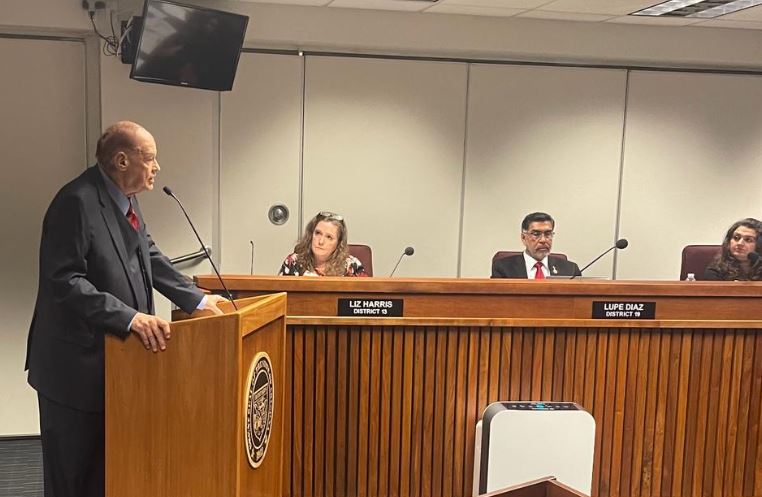
Tom Horne, Arizona’s Superintendent of Public Instruction, previously served in the office from 2003 to 2011, returning this year after defeating incumbent Kathy Hoffman by 9,100 votes. Last week, Horne gave a State of Education speech before the Arizona House Education Committee.
In Superintendent Horne’s presentation of the Strategic Initiatives for the State of Education, which was reviewed by AZ Free News, he laid out the future for his agency and the mission of his office. Superintendent Horne wants to “help and improve failing schools,” reinstate “test to graduate” policies, “teach curriculum bell to bell,” “regain structure in classrooms,” and “empower parents.”
Soon after the address to the committee, the Arizona Department of Education’s Twitter account posted, “Our administration has an ambitious agenda to fix our schools. We’ll prioritize education over distractions, create education improvement teams to support our schools, and bring back discipline to our classrooms so our teachers and students feel comfortable in their classrooms.” The account also thanked the Education Committee for inviting Superintendent Horne to present, stating, “The situation is grim with 2/3 of students below achievement levels. Our schools must teach our kids how to learn and not how to feel.”
When asked by AZ Free News about his thoughts on the address before the legislative committee, Superintendent Horne replied, “The Legislature appeared receptive to the Department’s mission of service to the schools and supportive of our priority to raise educational outcomes.”
Furthermore, when AZ Free News inquired about how he expects to work with legislators to accomplish his goals for this year – and throughout the duration of his term in office, Superintendent Horne said, “We all want schools where students can excel and feel safe.”
Not everyone was receptive toward Superintendent Horne’s presentation. Rep. Nancy Gutierrez, a member of the House Education Committee, tweeted, “I was quite concerned while listening that Social Emotional Learning was portrayed as CRT, that the focus will be on suspending and expelling students and that we will be relying on biased testing to determine success. This is not the best way to move forward.”
Superintendent Horne’s administration has already achieved significant accomplishments in its first month – especially with the Empowerment Scholarship Account (ESA) Program under the leadership of Christine Accurso, the Executive Director. As of February 1, the Arizona ESA program had 46,545 children enrolled. The program also averages approximately 900 phone calls and 140 new applications per day, per Accurso’s last report to parents. Accurso has moved quickly to bring staffing levels up to the Arizona Legislature’s expectations and to ensure that the program is following the legislators’ intent in every area.
Daniel Stefanski is a reporter for AZ Free News. You can send him news tips using this link.