by Staff Reporter | Sep 11, 2024 | Education, News
By Staff Reporter |
A Scottsdale-area mom is hoping that her success and positions on a local school district governing board will convince voters to elect her to the Arizona State Senate.
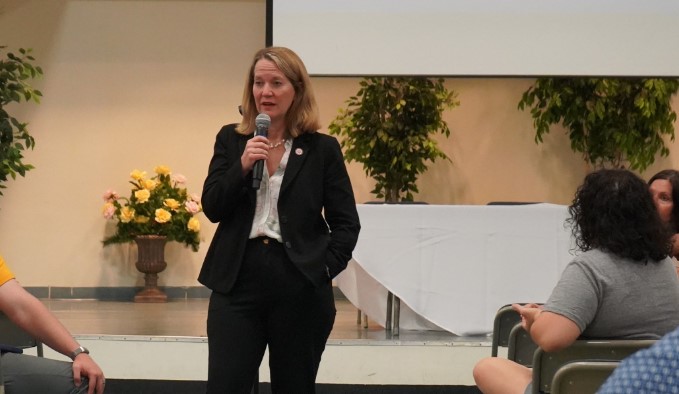
Carine Werner is currently running to represent Arizona Legislative District 4 in the state senate. She is an immigrant and small business owner, looking “to address the problems we face and help us protect the community we love together.”
Currently, Werner serves on the Scottsdale Unified School District Governing Board, where she has gained valuable experience for a potential move to the state Senate. In 2022, Werner gave an interview to the Scottsdale Progress Newspaper to outline her motivations for running for the position she would later assume, and to preview her action items and priorities for office.
She told the paper that she was running for the board because, “having experienced the past few tumultuous years with children in Scottsdale schools, I know the frustration and pain our students, families, and community experienced. I bring common-sense leadership, an enduring passion for securing our children’s future, respect for parents and teachers, and a skill for building consensus without compromising values.”
Werner then presented six promises to voters and parents of children within the Scottsdale Unified School District. The first was that she would “address parents’ rejection of SUSD.” She made this commitment because “A recent exit survey reveals that parents are concerned about failing academics, politically-charged classrooms, the promotion of ideological and anti-American rhetoric, and that they lack faith in the SUSD administration and the board.”
The Scottsdale mom added, “When I’m on the board, parental input will guide decisions made. I plan to partner with parents to curate the best educational experience for our children.”
The second promise was that she would “reverse enrollment decline and loss of funding.” Werner made this commitment because, “We cannot market our way out of this problem, nor should taxpayers’ foot the bill. We must restore academic excellence, close the achievement gap, and create a culture students will thrive in.”
The third promise was that she would “pay teachers first.” She made this commitment because “Although enrollment is down, SUSD increased administrative staff overhead. The Arizona legislature approved an additional $1 billion in year-over-year education spending, bringing the total K-12 spending for this year to $8.45 billion. In addition, federal funding and property taxes brings that total to $14.88 billion. Governor Ducey called on school board members to ensure these funds are directed to teachers. I commit to using my vote to prioritize those funds for teachers’ salaries and funding our classrooms first.”
The fourth promise was that she would “improve academic performance. Werner made this commitment because “With less than 37% of SUSD 10th graders proficient in math and ELA, a strategy to improve academic scores must be clearly stated, aggressive, and measurable. Yet, SUSD’s strategic development plan treats academics as an afterthought. We must get back to focusing on the basics. My commitment is to ensure that achievement programs will improve student proficiency and mastery of academic standards.”
The fifth promise was that she would “improve student safety.” She made this commitment because, “We must ensure the safety of our schools through support of our valued School Resource Officers, partnerships with the Scottsdale Police Department, and continuous review and improvement of our safety procedures.”
Werner also noted that, “The Arizona Legislature has approved $50 million in ongoing funding for school safety, supporting school resource officer salaries, and $20 million for the school safety interoperability program, which provides funding to county sheriffs for real-time communication solutions between schools and public safety agencies in the event of an emergency.”
The final promise was that she would “remove politics from the classroom.” Werner made this commitment because, “We must develop students’ interests, not identities. Politics and ideological rhetoric should have no place in our classrooms. I will work to remove the divisive curriculum that has been swept into our schools, restoring our education of revered American principles and ensure every student has the opportunity to thrive.”
It was this promise from Werner that led to the most controversy over her efforts to keep her commitments to constituents. Last year, Werner was unafraid to stand with Arizona Superintendent of Public Instruction Tom Horne when he addressed educational curriculum that may have been in violation of state law. Her appearance led to accusations against her from the president of the Scottsdale Unified School District Governing Board, Julie Cieniawski, claiming that Werner and another member of the board “showcased their inability to honor policy [duties and obligations] and the principles of democracy at an ‘emergency press conference,’ held by the State Superintendent of Instruction, to further complain about the outcome of the collective board decision.”
Cieniawski shared her opinion that “their public commentary contained inaccuracies, disparaged a minority population, and asserted erroneous judgments regarding the benefits SUSD students receive from a comprehensive and multi-faceted education.”
Yet, others saw this episode differently and appreciated Werner’s stand for the children and constituents of her school district. In an op-ed for the Scottsdale Progress, a retired public-school teacher, Susan Winder, defended Werner and called Cieniawski’s earlier piece “divisive, misleading, and frankly, embarrassing for our great city.”
Winder wrote, “Here’s my beef: Cieniawski has attempted to silence her fellow board members – the ones voters elected to represent them. And, while Carney and Werner attacked the content of the curriculum, Cieniawski has stooped to a new low by making personal attacks on Carney and Werner. As an SUSD stakeholder, I do not want the minority board members to be silenced by the majority members. I am grateful that we now have board members who care about the quality of curriculum SUSD offers to our students, as well as the legality of the lessons… and that they are willing to speak up.”
The promises and subsequent actions on the governing board from Werner earned her the support of several women who appeared in a campaign ad on her behalf this summer for her run for the state legislature. In that ad, the women announce their support for Werner, in large part, because of her trustworthiness to keep her commitments to her constituents.
The women say, “I’m not political. I don’t go to rallies. I don’t usually donate to candidates. But this election isn’t about politics to me. This election is about protecting our family and our community. I know Carine Werner. She’s a mom, a school board member, and most importantly she’s a fighter. She stands up for what’s right and not what is politically easy. Politicians say one thing and do another, which is why I trust Carine Werner. She’s not a politician. She’s a mom like me. Carine will fight for our families and help make our neighborhoods safe. It’s time to change who we send to the state Senate. Vote Carine Werner for state Senate. I trust Carine to stand up for us.”
The Republican candidate isn’t done making promises she intends to keep in office. She’s made more commitments to the voters in her new district should they send her to the state Senate. On her campaign website, the first of those promises is that she will fight to “increase teacher pay and reduce wasteful spending.” The second is that she will work to “empower parents.” The third is that she will strive to “empower and fund law enforcement.” The fourth is that she will vote to “secure the border.” The fifth is that she will attempt to “address homelessness with compassion and accountability.” The sixth is that she will work to “champion low-tax, business friendly environment.” The seventh is that Werner promises to advocate for policies that “generate job growth.” And finally, she vows to support efforts to “improve cost of living.”
Legislative District 4 is one of the most competitive in the state. According to the Arizona Independent Redistricting Commission, it has a 3.4% vote spread over the past nine statewide elections within its boundaries, with Republicans winning five of those contests.
Werner emerged from the Republican primary election in July and is facing off against incumbent Democrat state senator Christine Marsh for the right to represent Arizona Legislative District 4.
AZ Free News is your #1 source for Arizona news and politics. You can send us news tips using this link.
by Matthew Holloway | Sep 7, 2024 | Education, News
By Matthew Holoway |
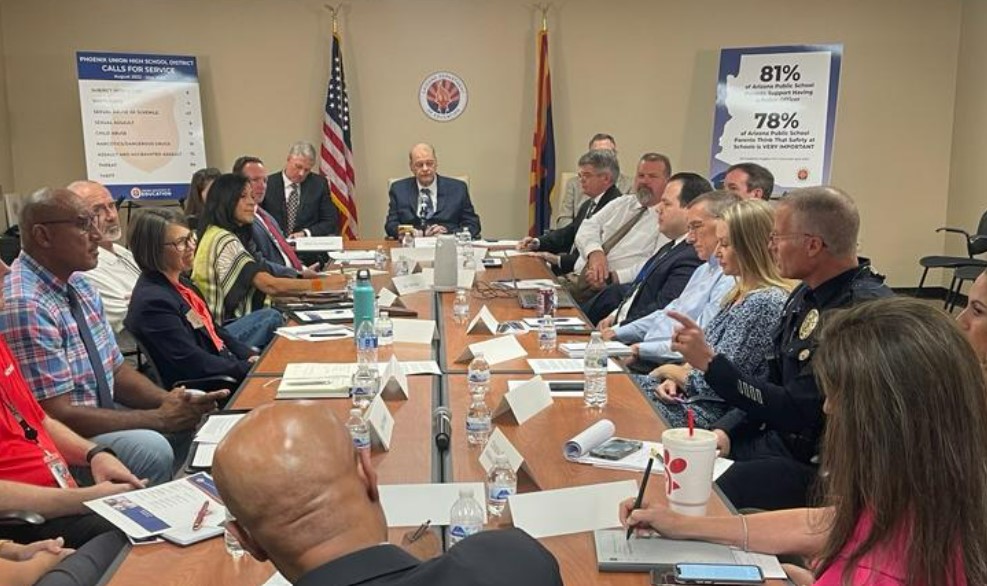
The State of Arizona is deploying School Resource Officers (SROs) into additional schools through 2026. The firm Off Duty Management will be facilitating the deployment of armed, uniformed police officers into multiple schools across six counties as part of Superintendent Tom Horne’s agreement with the company.
According to a press release from the Arizona Department of Education, Horne announced the state’s partnership with Off Duty Management last October to facilitate the deployment of armed, trained and uniformed officers despite the shortage of police officers in many Arizona communities.
Off Duty Management is a firm founded by former law enforcement officers with a particular market in supporting law enforcement operations. It employs current officers during their off-duty time through it’s proprietary OfficerTRAK® software and mobile app enabling the officers to schedule opportunities to work as SROs at various participating schools.
Horne told reporters, “The safety of school campuses is a priority for my administration. If some armed maniac should try to invade a school, the most effective response is to have well-trained armed law enforcement officers to protect everyone on campus. Our partnership with Off Duty Management is a vital part of ensuring safety. It is proving to be a successful, effective public-private partnership and the first of its kind in the nation.”
Arizona Department of Education’s Director of School Safety Mike Kurtenbach explained, “This agreement with Off Duty Management is a complement to the School Resource Officer program and illustrates how police officers who work as school safety officers also are trusted role models for students, which brings a sense of safety to the school campus.”
He added, “With this innovation, an officer can be provided to a school even if the community where that school is located has a shortage of its own officers. Cross-jurisdictional sharing of resources makes perfect sense to use this strategy to protect children and others in schools.”
He observed that the arrangement places over 700 officers, trained and eligible under the law, to serve at the disposal of Arizona schools. Sixty districts or charters in Maricopa County and dozens more across five other counties are participating.
Speaking with AZ family, Horne said, “We didn’t say no to anybody because my nightmare is that some maniac would go into a school and kill 20 kids.” He noted that the actions of two SROs were critical to halting the rampage of a 14-year-old who attacked and killed two students and two teachers at Apalachee High School in Georgia. Horne told reporters the tragedy could have been much worse. “It saved a lot of lives,” he said.
In a post to X following the school shooting, Horne wrote, “My heart goes out to the people of Georgia today. And to those who continue to resist School Resource Officers in Arizona, please watch the news. These tragedies are recurrent nightmares demanding we prioritize safety in our schools.”
He explained that at present, “There are 228 SSOs that are full-time, then we have what are called school safety officers that are part-time,” and cited the expansion will vastly increase that number. He told the outlet that all schools requesting an SRO should get one.
Matthew Holloway is a senior reporter for AZ Free News. Follow him on X for his latest stories, or email tips to Matthew@azfreenews.com.
by Daniel Stefanski | Jul 29, 2024 | Education, News
By Daniel Stefanski |
A powerful Arizona organization is attempting to coax the state’s once-invincible champion for school choice into fighting back against one of its most fierce opponents.
Last week, John Thorpe, a Staff Attorney with the Goldwater Institute, sent a letter to Arizona Superintendent of Public Instruction Tom Horne, over his office’s continued capitulation to Attorney General Kris Mayes over the interpretation of certain laws pertaining to the Empowerment Scholarship Account (ESA) program.
The letter from the Goldwater Institute sought “to bring some clarity to the issues of (1) whether the use of ESA funds for ‘supplementary expenses’ requires an explicitly documented ‘nexus’ to a curriculum approved by the Department of Education, and (2) whether ESA funds are subject to the AG’s authority under [state statutes].”
This communication addressed an earlier email from Arizona Department of Education ESA Executive Director, John Ward, to parents within the program, informing them about a letter he had received from Mayes’ Solicitor General. According to Ward, that letter “stated that some ESA program practices are inconsistent with State law and result in payment of ESA funds without authorization of law, [and that] the Solicitor General’s Office has directed the ESA program to address the issues it identified.”
The Attorney General’s Office cited two Arizona statutes to bolster its argument that “the Arizona Department of Education has approved certain supplemental items and textbooks without requiring curricula, which may result in ‘illegal payment of public monies.’” Ward told parents that “ADE has no choice but to comply with the Solicitor General’s determination,” forcing families to “submit a curriculum with all supplemental materials requested or purchased” – something that he even noted was a practice “in place since before the current ADE administration.”
Horne’s acceptance of Mayes’ interpretation of the law was surprising to many members of the public, being that his office has been at odds with the Attorney General’s Office on almost every issue related to this program. Previously, Horne issued several statements expressing his unabashed opposition to the Democrat Attorney General’s persistent attacks on the ESA program and vowing to match her office step for step in defense of parents.
In Thorpe’s letter, he argues that “the law does not condition families’ rights to buy supplemental materials on an explicitly documented ‘curriculum nexus,’” and that “Arizona families’ ESA dollars are not ‘public monies.’”
Thorpe concluded his letter to the state’s schools chief, writing, “The AG’s power to investigate misuse of public monies does not give her the authority to prevent your office from allowing Arizona families to use their ESA funds for statutorily permitted uses. Nor does the law require you, or those families, to justify every textbook or ‘supplementary expenditure’ with a Department-approved curriculum nexus or documentation from a private school.”
On the same day of the Goldwater letter, Ward sent another email to ESA families in response to questions of his department “to provide additional guidance on what is required to use Empowerment Scholarships to purchase supplemental materials” – perhaps signaling that Horne and the Arizona Department of Education would not be backing down from its surrender to Mayes. Ward stated that “ADE would like to provide you with an updated template of Parent-Prepared Curriculum that you can use to submit with your requests for supplemental materials.”
One of the state’s most ardent and effective advocates of the ESA program, Christine Accurso, linked to the Goldwater letter on her social media platform, adding her own commentary about how parents should react to the decision from the Arizona Department of Education on these supplemental materials for their ESA accounts. She said, “ESA parents should have absolutely no fear with submitting orders (for direct purchase or for reimbursement) that includes items that are obvious supplemental educational materials. If an order gets rejected, then email asking them to approve it. If you get an email or communication about your order that says it is the ‘department’s final administrative decision’ then you can go to the State Board of Education and file an appeal. However, you must have proof that the department has given its ‘final administrative decision’ before submitting an appeal to the SBE.”
The Goldwater Institute’s public foray into this controversial action from the Republican Superintendent’s Office follows a letter that was previously sent to Horne from Arizona House Speaker Ben Toma, a fellow Republican. In his letter, Toma wrote, “I understand that you may have no choice but to cooperate with the Attorney General’s politically-motivated investigation. However, ADE is best situated to determine how to implement its policies in a way that fulfills legislative intent but does not burden parents with unnecessary bureaucratic requirements.”
Toma added, “As you implement your Department’s policies, I urge you to scrutinize Attorney General Mayes’ unsolicited legal advice expressed in her July 1, 2024, letter, consider how her interpretation of Arizona statutes would impact parents throughout the state, and reject her interpretation of the law that would lead to absurd results.”
In a blog post for the Goldwater Institute, Matt Beienburg referenced Toma’s letter, stating, “As noted by Arizona Speaker of the House Ben Toma, the unprecedented intrusion and second-guessing by the AG’s office into ADE’s administration of the ESA program is just the office’s latest attempt to advance a novel legal theory in order to hijack the legislative deliberations and decisions of state lawmakers. Indeed, just days before firing off its attack against ADE for its application of state statute, the AG’s office was forced to concede and drop its efforts to override the provisions of the recent bipartisan state budget agreement. The AG’s demands against the ESA program should similarly be rejected by the state department of education, the state board of education, and the judicial system of Arizona.”
A few days removed from the Goldwater Institute letter, the Arizona Department of Education sent another email to ESA parents, informing them of a virtual meeting with Horne, Ward, and others from the department to “provide account holders with an opportunity to have their questions answered regarding the new curricula requirements for supplemental materials.” However, families will not be able to ask their questions live and unfiltered. Instead, as per the electronic notice, “the format for the virtual meeting will be the Department of Education reading and answering questions that have been submitted to it by ESA Holders.”
Daniel Stefanski is a reporter for AZ Free News. You can send him news tips using this link.
by Staff Reporter | Jul 24, 2024 | Education, News
By Staff Reporter |
State Superintendent of Public Instruction Tom Horne is advising Arizona’s school districts and charter schools to consult legal counsel regarding implementation of the controversial Title IX changes.
The changes to Title IX center on the redefining of the term “sex” to include “gender identity.” In effect, schools would be required to permit access to gendered programs, activities, or spaces on the basis of gender identity rather than biological sex, such as sports teams, locker rooms, and bathrooms. The U.S. Department of Education (ED) released the final Title IX rules outlining this change in April.
In ED’s justification for expanding the concept of “sex” to include “gender identity,” the agency declared that basing exclusion on biological sex amounted to sex discrimination.
“For more than 50 years, Title IX has promised an equal opportunity to learn and thrive in our nation’s schools free from sex discrimination,” said U.S. Secretary of Education Miguel Cardona. “These final regulations build on the legacy of Title IX by clarifying that all our nation’s students can access schools that are safe, welcoming, and respect their rights.”
These new rules take effect on Aug. 1.
In a press release on Monday, Horne announced that he’d advised legal counsel to educational institutions through letters disseminated to all districts and charters. Horne emphasized that, though all schools had the choice to implement the updated Title IX regulations, there were pending legal challenges that may result in students suffering damages.
“This is your choice, but you may wish to delay implementing the new regulations until the legal situation is clarified. If the regulations are implemented and then later overruled by the courts, students may suffer damages in the meantime,” said Horne. “This is not legal advice. The Arizona Attorney General may disagree […] We are a local control state, and it will be up to districts and charters to determine how to proceed in this situation. You need to consult with your lawyer. I am only providing information I think might be useful.”
Indeed, a federal court in Louisiana ruled against the new regulations last month. The judge determined that the new federal rules amounted to federal overreach, calling ED’s rulemaking “arbitrary and capricious,” and signaling concern for the rules’ threat to protected constitutional speech.
Some districts have already opposed the changes.
Dysart Unified School District’s governing board voted to reject the new Title IX rules earlier this month. The district declared that ED’s changes to Title IX were contradictory to the existing, plain language of the rules.
Horne noted in Monday’s press release that the new Title IX rules could “significantly injure public education” by prompting parents to flee the system.
“In the past I’ve been asked by districts, as a policy matter, about their consideration of rules, permitting biological boys who have male genitalia being allowed in girls’ bathrooms, locker rooms, and showers,” said Horne. “My response was that there should be unisex bathrooms available, and if there was no room for them, the faculty bathroom should be used for that purpose. That would preserve the dignity of biological boys who identify as girls. But if they were allowed in girls’ facilities, I thought parents might well remove the girls from the school and send them to another district, Charter School, or private school. So, this rule could significantly injure public education.”
26 states have put forth legal challenges to the Title IX changes, with some awarded injunctions: Alabama, Alaska, Arkansas, Florida, Georgia, Idaho, Indiana, Iowa, Kansas, Kentucky, Louisiana, Mississippi, Missouri, Montana, Nebraska, North Dakota, Ohio, Oklahoma, South Carolina, South Dakota, Tennessee, Texas, Utah, Virginia, West Virginia, and Wyoming.
AZ Free News is your #1 source for Arizona news and politics. You can send us news tips using this link.
by Daniel Stefanski | Jul 15, 2024 | Education, News
By Daniel Stefanski |
Another political battle may be brewing over Arizona’s historic school choice program.
Earlier this week, Arizona House Speaker Ben Toma sent a letter to Tom Horne, the state’s Superintendent of Public Instruction (ADE), over his department’s controversial decision to acquiesce to Attorney General Kris Mayes’ demands to increase regulation of the Empowerment Scholarship Account (ESA) program.
In his letter, Toma wrote, “I understand that you may have no choice but to cooperate with the Attorney General’s politically-motivated investigation. However, ADE is best situated to determine how to implement its policies in a way that fulfills legislative intent but does not burden parents with unnecessary bureaucratic requirements.”
Toma added, “As you implement your Department’s policies, I urge you to scrutinize Attorney General Mayes’ unsolicited legal advice expressed in her July 1, 2024, letter, consider how her interpretation of Arizona statutes would impact parents throughout the state, and reject her interpretation of the law that would lead to absurd results.”
The Republican Speaker’s communication addressed an email from ADE ESA Executive Director, John Ward, to parents within the program, informing them about a letter he had received from Mayes’ Solicitor General. According to Ward, that letter “stated that some ESA program practices are inconsistent with State law and result in payment of ESA funds without authorization of law, [and that] the Solicitor General’s Office has directed the ESA program to address the issues it identified.”
The Attorney General’s Office cited two Arizona statutes to bolster its argument that “the Arizona Department of Education has approved certain supplemental items and textbooks without requiring curricula, which may result in ‘illegal payment of public monies.’” Ward told parents that “ADE has no choice but to comply with the Solicitor General’s determination,” forcing families to “submit a curriculum with all supplemental materials requested or purchased” – something that he even noted was a practice “in place since before the current ADE administration.”
Horne’s acceptance of Mayes’ interpretation of the law was surprising to many onlookers, being that his office has been at odds with the Attorney General’s Office on almost every issue related to this program. Previously, Horne issued a number of statements that expressed his ardent opposition to the Democrat Attorney General’s persistent attacks on the ESA program and vowing to match her office step for step in defense of parents.
One of the foremost experts and defenders of the ESA program, Christine Accurso, addressed this action by Horne’s office, writing, “I joined the ESA program as a parent in 2014 and in all of the years we participated, I never had to submit curriculum that listed pencils and paper (for example) as something I can use ESA funds for. This new regulation is not what the legislature intended. If you go back and listen to the many years of committee hearings you will clearly hear the lawmakers desired to give parents access to tax dollars to provide an excellent education for their child, putting them on equal footing financially (while providing a 10% savings) to what the state funds in the public schools. I don’t know of a school district in Arizona, let alone America, who has curriculum for such obvious supplemental educational materials, as noted above.”
Accurso’s sentiments were reciprocated by Speaker Toma, who in his letter to Horne, stated, “it appears that the Attorney General’s Office is advancing an argument that documentation is required for most ESA-related expenses. The legislative record does not support such an overtly restrictive view or burdensome administration of the ESA program.”
Speaker Toma concluded his letter by expressing his appreciation for Horne’s “willingness to discuss these implementation issues with legislators who – like parents – are understandably concerned about the Attorney General’s letter.”
Daniel Stefanski is a reporter for AZ Free News. You can send him news tips using this link.