by Daniel Stefanski | Jan 17, 2025 | Education, News
By Daniel Stefanski |
As another legislative session begins in Arizona, Republicans and Democrats are again bringing the all-important issue of school choice to the forefront of the public debate.
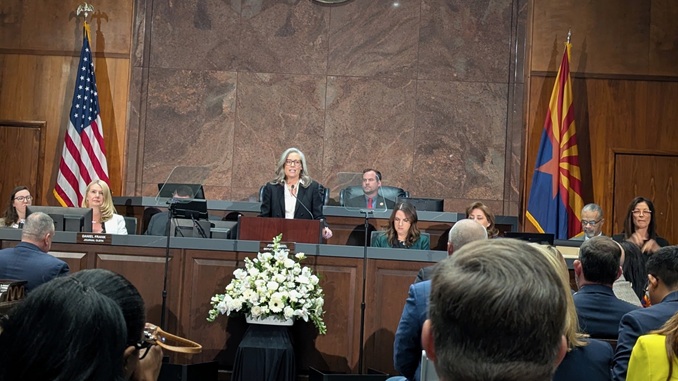
On Monday, Governor Katie Hobbs ushered in the start of the 57th Regular Session of the Arizona Legislature with her State of the State address, where she took time to criticize the Empowerment Scholarship Accounts (ESA) program. In her speech, Hobbs said, “The current program is unchecked, flawed, and rife with exploitation. Three years ago, it went far beyond its original purpose, which was to support kids with special needs and military families. Today, it has ballooned into a billion-dollar boondoggle increasingly scamming Arizonans. Other entitlements funded by taxpayers have strict oversight and income requirements. Yet the ESA program has the privilege of virtually no safeguards.”
Hobbs proposed changes to the ESA program for a “balanced solution that supports families and finally brings real and effective guardrails to ESAs.” Her solution was to “institute responsible income caps, ensure taxpayers know where their money is going, and create real accountability for taxpayer dollars.”
The governor’s remarks were met with immediate criticism from Republicans and others who support the expanded ESA program. Superintendent of Public Instruction Tom Horne said, “Under my leadership, the department has done a full-court press against waste and fraud. I hired both a program auditor and an investigator, which had not been done before. I require that every expenditure be for a valid educational purpose and have been attacked for doing that. The Governor needs to pay more attention to what is going on. She gets an ‘F’.”
Senate President Pro Tempore T.J. Shope added, “We will also protect parental choice, so that every child in the state has the ability to succeed in the classroom, no matter their zip code or financial status.”
Common Sense Institute Arizona wrote, “In her State of the State address, Governor Hobbs asked lawmakers to compare Arizona’s ESA program to other government entitlement programs with respect to accountability and transparency. Luckily, we already did! And it turns out that improper payment rates in the Arizona ESA program are a fraction of those in other government programs like Medicaid, Unemployment Insurance, and SNAP.”
Jason Bedrick said, “The voters made their will clear by re-electing those who supported ESAs and expanding their legislative majority. The legislature should reject Gov. Hobbs’ attempts to undermine ESA families.”
On the flip side, Governor Hobbs’ comments received support from her allies, who have long attempted to shrink, regulate, or eliminate the historic ESA expansion program in Arizona. Save Our Schools Arizona Executive Director Beth Lewis responded, “It is time to end the rampant waste, fraud, and abuse in the universal ESA voucher program. We commend Governor Hobbs for championing public education and pushing for much-needed voucher reform. We sincerely hope legislators like Senate President Petersen who name ‘fiscal responsibility’ their top priority will bring long-overdue guardrails to this irresponsible program, which now costs taxpayers nearly $1 billion annually.”
Hobbs and legislative Republicans will continue to bicker about the future of school choice in Arizona, but not much – if anything – will be done this year (and likely the next) to regulate ESAs per the governor’s insatiable desire. Over the past two years, Arizona Senate President Warren Petersen successfully fended off ferocious political attacks that targeted ESAs and other school choice opportunities for Arizonans. He will again be counted upon, along with his Republican colleagues in the Arizona House and Senate, to protect one of the top states in the country for school choice.
Daniel Stefanski is a reporter for AZ Free News. You can send him news tips using this link.
by Matthew Holloway | Dec 26, 2024 | Education, News
By Matthew Holloway |
Earlier this month, Gov. Katie Hobbs sent a letter to Superintendent of Public Instruction Tom Horne, rebuking him for the implementation of a risk-based auditing approach to approving Empowerment Scholarship Account (ESA) program reimbursements. A few days later, Horne responded by suggesting that Hobbs “should start reading what she signs.”
In a statement, Horne reminded the Democrat governor that the process the Arizona Department of Education (ADE) is now employing is explicitly called for under a bill she signed into law herself. He notes further that Hobbs is also directly responsible for creating the situation that necessitated the change when she signed a bill permitting private school tuition to be paid under reimbursement rather than the previous third-party vendor.
The move has come as a backlog of reimbursement requests for the ESA program has exceeded 85,000. The Department of Education, unable to utilize third party provider Class Wallet, which was previously the procedure, will now automatically approve the requests up to $2,000 and then audit them after the fact.
In the initial letter to Horne, Hobbs pointed to recent indictments and allegations of fraud and abuse of the ESA program and claimed that the implementation of the risk-based auditing approach “is a complete dereliction of the ADE’s responsibility to ensure the appropriate use of public funds.”
Horne replied in a statement saying:
“The method we are instituting, known as risk-based auditing, is specifically provided for in the budget statute that the Governor signed last session. Maybe she should start reading what she signs.
Equally startling, is that she herself created the problem we are trying to solve by signing a bill to permit private school tuition to be paid under the reimbursement method, rather than going through our vendor, Class Wallet, which was previously required. This played a major role in increasing the delays and reimbursements from 30 days a year ago to over 100 days now.
The Governor played a major role in creating a problem that we now must solve by using a method provided for in a Bill that she signed.
Part of the problem appears to be that staff in the Governor’s office are slow learners.”
In a press release, Horne referred to Arizona Law under A.R.S. 15-2403 (B), which explicitly permits this method stating, “The department, in consultation with the office of the auditor general, shall develop risk-based auditing procedures for audits conducted pursuant to this subsection.”
The Superintendent also stressed the accountability of the program saying, “The ESA program is among the most accountable programs in the State. It’s responsible for demonstrating accountability through reporting that is required by statute, rules, and ad hoc requests from seven government agencies and bodies, including: Governor’s Office; Legislative Leadership; Joint Legislative Budget Committee; Attorney General’s Office (multiple units); Auditor General’s Office (multiple divisions); State Board of Education and the State Ombudsman.”
As previously reported by AZ Free News, Hobbs was recently fact-checked by Citizens For Free Enterprise, who publicly criticized her for attacking the ESA program. The group stated, “FACT CHECK: Arizona’s universal school choice program is a model of accountability, transparency, and security, according to CSI Institute Arizona. The over 83,000 Arizona families using ESAs just want the best for their children – and Katie Hobbs should stop attacking them.”
Matthew Holloway is a senior reporter for AZ Free News. Follow him on X for his latest stories, or email tips to Matthew@azfreenews.com.
by Daniel Stefanski | Dec 17, 2024 | Education, News
By Daniel Stefanski |
Amid an increased flurry of attacks on Arizona’s school choice opportunities, a prominent organization is countering with the facts.
Citizens For Free Enterprise responded to another derogatory statement about Arizona’s historic Empowerment Scholarship Account (ESA) azprogram from the state’s Democrat Governor, Katie Hobbs. Earlier this week, Hobbs posted, “ESAs are rife with waste, fraud and abuse, and this will only make it worse. This empowers bad actors who are spending taxpayer dollars on ski passes, luxury car driving lessons, and grand pianos. We need accountability and transparency for this almost billion dollar program.”
Hobbs was reacting to a recent news story about the Arizona Department of Education’s new policy to automatically approve a vast majority of outstanding reimbursement requests from parents in the program, which was announced by Republican Superintendent of Public Instruction, Tom Horne, at a Board of Education meeting.
The response from Citizens For Free Enterprise stated, “FACT CHECK: Arizona’s universal school choice program is a model of accountability, transparency, and security, according to CSI Institute Arizona. The over 83,000 Arizona families using ESAs just want the best for their children – and Katie Hobbs should stop attacking them.”
Others weighed in on the governor’s attack ahead of the 57th State Legislature, starting in January. State Representative Travis Grantham said, “I wish Democrats cared this much about government waste across the board. Why do they only care about it when it’s privatized and / or it gives the citizenry more choices?”
Fellow legislator Austin Smith added, “Not only was Katie Hobbs education agenda rejected; she lost seats in the house and senate. Bold move Cotton, let’s see if it pays off.”
Not everyone was opposed to Hobbs’ statement. Democrat State Representative Oscar De Los Santos replied, “From forging documents to scam taxpayers to abusing funds for luxury items, the private school voucher program is filled with waste, fraud, and abuse. Every Arizonan should be outraged. The DOGE committees should take a look at this disaster.”
Matthew Ladner, a school choice advocate, weighed in on De Los Santos’ statements, saying, “The waste, fraud and abuse in the ESA program is a small fraction of programs you support. If you’d like to eliminate all the programs with ESA level or higher abuse you will make Ron Paul a very happy man!”
In addition to its statement, Citizens For Free Enterprise shared a document of facts from the Common Sense Institute Arizona (CSI) to counter the myth that “ESA’s are subject to rampant fraud and abuse.” On that document, CSI highlighted that there was more than $2 billion of “Medicaid billing fraud in Arizona revealed by a single investigation into pandemic-era relaxed program standards,” and that “Arizona’s share of estimated pandemic-era fraudulent U.S. Unemployment Insurance payments” was $2.3 billion. On the flip side, according to CSI, “the sum-total of all specific, public allegations of ESA fraud …identified to-date, since universal eligibility expansion” was just around $650,000 – a far cry from the fraud in other state programs and handouts.
CSI concluded that “there are specific statutory requirements governing the use of ESA monies – including guidelines on permissible expenditures and a requirement that ADE conduct random and regular audits to ensure compliance. Within that framework, the program has been able to run well, especially compared to similar programs.”
While officials and organizations may have again successfully pushed back on Demcorats’ renewed, false detractions of the ESA program, Horne’s handling of this significant portion of the department he was entrusted to oversee continues to present major headaches for Republicans and school choice proponents. Since Horne’s first ESA Director, Christine Accurso, left the office last summer, he has been faced with a rising number of reimbursement requests and other issues that he has struggled to address with his team. Horne also capitulated to Democrat Attorney General Kris Mayes earlier this year, when she challenged him about the lack of “curriculum” attached to certain requests, adding additional regulations for parents to comply with the attorney general’s threats. Horne’s backsliding here came after he had repeatedly stood up to Mayes and Hobbs’ saber-rattling against the school choice program.
Additionally, Horne recently blamed a number of external factors, including Arizona state legislators, for the skyrocketing number of unfulfilled reimbursement requests. In a November press conference, Horne noted a fix to the ESA program that allowed parents to bypass ClassWallet to obtain reimbursements, stating, “Somebody went to the Legislature last year and got them to pass a bill saying they could do it by reimbursement… We’ve asked the Legislature, in the future, ‘Please ask us before you pass something so we can tell you what the consequences will be.’”
While the program has continued to grow over the past two years, Arizona Education Department officials have failed to satisfactorily explain why the processes put in place by Accurso before her departure were unable to suffice for smooth management and processing of reimbursements and other factors of ESA program oversight and delivery going forward. Accurso was able to save the program from massive and glaring issues created by Horne’s Democrat predecessor, adding staff to her team and reducing the backlogs to almost nothing, while accounting for an exponential increase in students and families realizing the benefits of ESAs.
Daniel Stefanski is a reporter for AZ Free News. You can send him news tips using this link.
by Staff Reporter | Dec 11, 2024 | Education, News
By Staff Reporter |
The Maricopa Superior Court dismissed a challenge to a school district’s dual language program, citing lack of standing.
The plaintiff, Patricia Pellett, is a Scottsdale Unified School District parent, and not part of the district she challenged, Creighton Elementary School District (CESD). Arizona Department of Education (ADE) Superintendent Tom Horne’s wife, Carmen Chenal Horne, represented Pellett in the case.
Back in August, Horne said that it was irrelevant that Pellett didn’t have a child in CESD schools.
“Under a provision in the initiative that said that a student of any parent in the state could bring an action against any school district in the state that violates this initiative,” said Horne.
The challenge to CESD arose from Horne’s crusade against dual language programs. Horne’s aim is to have all schools teach only through immersion programs. Dual language models teach students subjects in languages other than English for part of their education, whereas immersion has students taught their subject matter entirely in English.
State law enacted through a voter initiative (Proposition 203 passed in 2000) requires that public schools teach the English language through English-spoken courses and English language classrooms, unless parents are eligible to provide prior written informed consent for bilingual education techniques or those educational methodologies permitted by law.
“[A]ll children in Arizona public schools shall be taught English by being taught in English and all children shall be placed in English language classrooms,” states the law.
Eligible circumstances include parents with children who already know English, older children, and children with special needs.
The Arizona State Board of Education has determined that parental waivers for immersion aren’t required, a finding affirmed by Attorney General Kris Mayes last year. Mayes published that opinion in response to a request on legal clarity from state representatives as to whether the language models used by seven school districts — Glendale Elementary, Kyrene Elementary, Phoenix Elementary, Mesa Public Schools, Laveen Elementary, Creighton Elementary, and Mexicayotl Academy — warranted corrective action by ADE.
Horne dismissed Mayes’ opinion as “ideologically driven” and not based in law.
Horne turned to Pellett to challenge schools’ dual language programs after Maricopa County Superior Court ordered Horne to pay over $120,000 in legal fees earlier this year.
The judge, Katherine Cooper, ruled that state law didn’t authorize Horne to ask the courts to rule on school district compliance with Proposition 203. Cooper ruled that only the State Board of Education possessed authority over dual language programs, citing the board’s responsibility for developing and approving immersion models. Cooper further declared that Horne had no justiciable claim, either, and ruled that parents and guardians had the power to file lawsuits to enforce the proposition.
“The school districts, like all public and charter schools, are required to follow a model as approved by the State Board,” ruled Cooper.
Horne’s response was to accuse the ruling as avoidant of the merits of the case. He reiterated that the voter-approved initiative (Proposition 203) required children to be taught in English.
With Horne’s continued challenges to the existence of dual language programs and advocacy for immersion programs, the Arizona School Boards Association says it will advocate for greater reliance on 50-50 models.
AZ Free News is your #1 source for Arizona news and politics. You can send us news tips using this link.
by Matthew Holloway | Dec 11, 2024 | Education, News
By Matthew Holloway |
Arizona’s charter schools are about to receive a fresh infusion of taxpayer dollars in a federal grant from the United States Department of Education. The grant is expected to fund the establishment of two dozen new charter schools and bolster another 23 already in operation.
As reported by The Center Square, the state of Arizona has received approximately 24% of the $143 million awarded across the nation by the Expanding Opportunities Through Quality Charter Schools Program, a total of about $34.8 million. The outlet noted that although the funding originates from fiscal 2024 it will be distributed in annual disbursements through 2029.
In a press release from the Arizona Department of Education (ADE), Superintendent of Public Instruction Tom Horne said, “I am extremely pleased that we have received this federal grant that will create 24 new high-quality charter schools and help another 23 existing schools with models and practices that result in academic growth. I want to commend the department staff who competed for this funding. Their work has resulted in the state receiving the largest recipient of this grant, per capita, in the country.”
Horne added, “Arizona is the leader in the country on school choice and charters are a major component of that. These dollars will serve a vital purpose in making sure that an estimated 10,000 students in traditionally underserved areas will have a chance to select a high-quality charter school. Every student in every part of our state, urban or rural, rich or poor, deserves this opportunity and I am very pleased to be a part of this effort.”
Speaking with AZ Capitol Times, Horne explained Arizona’s long-term history of fostering charter schools saying, “The charter schools in Arizona go back to the 1990s.” Then, he noted that as a state legislator, he championed charter schools and their purpose. “Even a good district school may not necessarily meet the needs of all the students,” Horne told the outlet. “And so the parents should have the ability to find a school that does meet those needs.”
In the release, ADE stated that it has already begun work on the upcoming project “which aims to increase the number of high-quality charter schools focusing on educationally disadvantaged students.” It added that such students are identified by their economic disadvantage, disability status, as non-English speakers, and as “other demographic groups.”
The statement outlined the grant’s purpose stating:
“The grant also seeks to close achievement gaps in academic scores, provide technical assistance to educators to improve teaching and learning and encourage dual or concurrent enrollment in college level courses. The expectation is that students will experience at least one year of academic growth on state tests for math, reading and language arts with a long-term measurement of cumulative three-year growth.”
At present, approximately 560 charter schools are in operation throughout Arizona serving about 231,000 students. The Center Square report cited the Arizona Charter Schools Association. Under Arizona law, all charter schools are open enrollment and as a result enjoy wide adoption. The outlet reported that the California Department of Education, Colorado League of Charter Schools, New York State Education Department, Utah Association of Public Charter Schools, and Rhode Island Department of Education also received 2024 grant funding as well.
Matthew Holloway is a senior reporter for AZ Free News. Follow him on X for his latest stories, or email tips to Matthew@azfreenews.com.