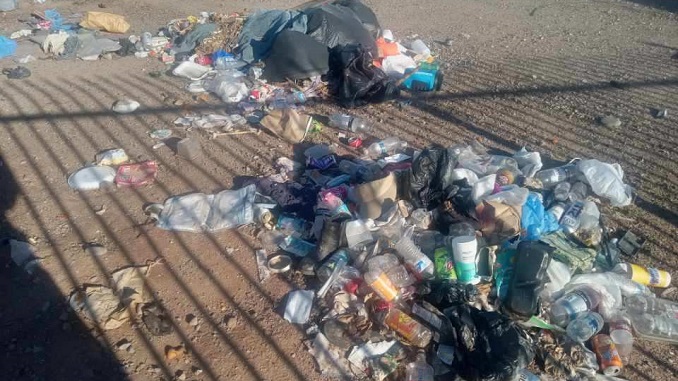
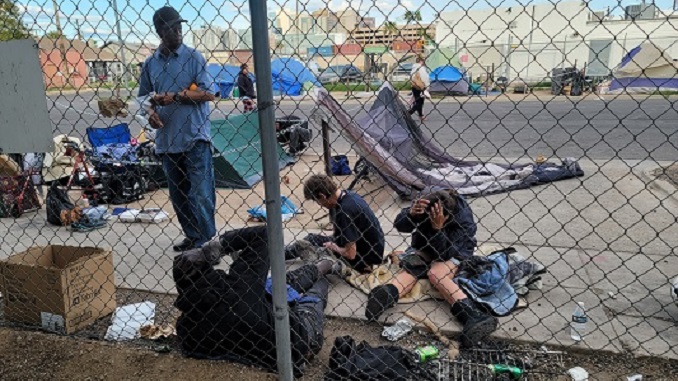
In addition to being found at fault for the notorious homeless encampment in downtown Phoenix known as “The Zone,” the city of Phoenix must also pay over $221,000 in attorney’s fees and costs.
Maricopa County Superior Court Judge Scott Blaney issued the order for attorney’s fees on Monday. This latest order followed his September ruling which determined that city of Phoenix officials had not only failed to abate the public nuisance known as The Zone but had maintained it.
“The City of Phoenix shall maintain its public property in the Zone in a condition free of: (a) tents and other makeshift structures in the public rights of way; (b) biohazardous materials including human feces and urine, drug paraphernalia, and other trash; (c) individuals committing offenses against the public order. The Court will employ a reasonableness standard to future allegations of violation of (b) and/or (c). The Court does not intend this order to create a private cause of action for every non-pervasive violation of subsection (b) and/or (c). Further, the Court will require evidence of a substantive, good faith attempt to address any future violations of this order with the City before seeking court involvement.”
As reported previously, the city cleaned up The Zone several days in advance of the court-ordered deadline. This resulted in an over 82 percent success rate in admittance of the area’s homeless into shelters. The city also installed signs prohibiting encampments and other criminal activities around the area that formerly housed The Zone.
Blaney’s September ruling found the city to be at complete fault for The Zone. Blaney declared that the city had displayed an utter disregard for law-abiding citizens and tolerated crime by the homeless.
“The City’s refusal to meaningfully enforce statutes and ordinances in the Zone has created a classic siren song to certain individuals that are enticed at their peril by the Zone’s drugs, sex, and lack of societal rules.”
Additionally, Blaney found that the city intentionally stopped or materially reduced enforcement of laws in The Zone, as well as transported the homeless using taxpayer-funded “courtesy rides” from police officers and community organizations.
All in all, Blaney found unequivocally the city to blame for the increase in violent and organized crimes such as assaults and murders, drug usage and sales, public defecation and urination, rape and prostitution, and property damage and theft. City officials admitted to decriminalizing these behaviors.
A home for sale in the middle of the ‘zone’. The zone is in Phoenix Arizona and extends for several blocks. Everyone talks about the rights of the homeless. We need to balance that with the rights of all others. Homeowners and business owners also have rights and deserve better pic.twitter.com/n0VjLRJ6W5
Despite what city officials have indicated, it is unknown how many of the homeless population in Phoenix are homeless by choice. City representatives admitted that determinations of involuntary homelessness have been based on self reporting, not investigatory efforts into that individual’s case. They also admitted to being stumped by “service resistant” homeless: those who refused services like shelter because they didn’t want to adhere to any rules imposed, such as leaving behind contrabands like drugs or weapons. About 20 percent of homeless were “service resistant” according to a survey.
Despite the mass encampment cleanup, some community members have noted that homelessness persists in the area.
I just drive thru there today. Even tho they cleared the tents, it’s still hundreds of homeless in the zone area. If you are in the Phoenix area and want to help out, dm me. If you want to donate, the cashapp link is at the bottom of the flyer. Give thanks by giving back 🤲🏾📈 pic.twitter.com/GKLJpRC3dW
The city of Phoenix reported having an 82 percent success rate with admitting The Zone’s homeless into shelters after a court order to clean up the infamous downtown homeless encampment.
The majority success rate came just ahead of the court-ordered deadline last week, Nov. 4. Of the 716 homeless in The Zone, 590 consented to entering a shelter according to Rachel Milne, director of the Office of Homeless Solutions. That’s a success rate of over 82 percent.
Milne also said that they managed to reconnect some of those sheltered homeless with their families, or got them established with treatment programs. Milne says that shelter only serves as the beginning of securing permanent housing for the homeless.
“We need to make sure those 590 individuals that did move on to an indoor location now have the support systems and the proper services to help them in their homelessness,” said Milne.
That concern relates to the recidivism rates of The Zone’s residents, something noted by the Maricopa County Superior Court when it ordered the city to clear The Zone.
In his ruling, Judge Scott Blaney criticized city officials equating 70 percent of individuals accepting services as a permanent movement from the streets. Blaney ruled the data as potentially misleading, noting that the city wasn’t able to disclose how many of those individuals accepted a “free hotel room for the night” before returning to The Zone the next day.
As part of their compliance with the court order, the city established clear signage prohibiting encampments and other related criminal activity around the area that formerly housed The Zone.
🧵INBOX: Welcome to The Zone, the epicenter of the homeless crisis that @CityofPhoenixAZ refuses to solve. This man is one of many that will likely live and die on these streets under the city's current approach to homelessness. I investigated & uncovered shocking details… pic.twitter.com/snb8QkvjsA
AZ Free News published a series of reports on the nature of The Zone: rampant crime and lawlessness: murders and assaults, drug use and dealings, prostitution, gang violence, theft and property destruction, bordered all around by knee-deep and blocks-long biohazards.
One of the lawyers that sued the city over its handling of The Zone, Ilan Wurman, marveled at the success rate the city of Phoenix experienced when forced to meet a court deadline to help the homeless.
“We did it. Because of our lawsuit, the City has cleared the Zone,” said Wurman. “And look at the huge number of folks who ACCEPTED SHELTER. Just incredible.”
We did it. Because of our lawsuit, the City has cleared the Zone. And look at the huge number of folks who ACCEPTED SHELTER. Just incredible.
Arizona’s Republican legislative leaders are wading into another legal fight.
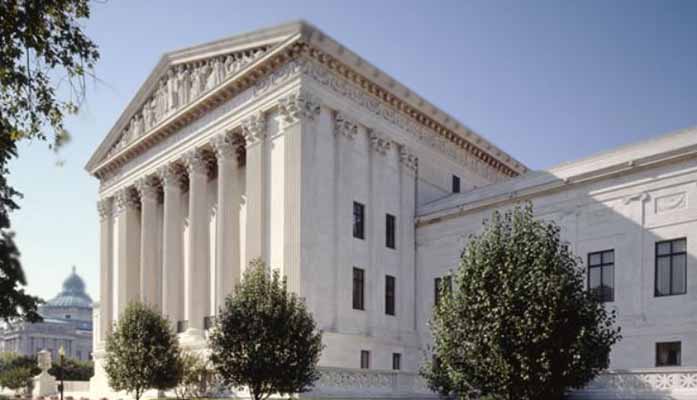
Earlier this week, Senate President Warren Petersen and House Speaker Ben Toma filed an amicus brief at the U.S. Supreme Court in City of Grants Pass v. Gloria Johnson and John Logan. According to the legislators, the case involves “three homeless individuals in Grants Pass (who) filed this lawsuit to try to stop local and state governments from combating the public safety threats, the public health dangers, and the inhumane conditions associated with these homeless encampments.”
The city has received unfavorable opinions from the federal courts at both the district and appeals (Ninth Circuit) levels, leading to the appeal to the nation’s high court.
In their brief, Petersen and Toma assert that “the Legislature also has a pressing interest in homelessness because it confronts the realities of America’s homelessness crisis every day, including only a few blocks from the state capitol complex. Phoenix, Arizona, is home to one of the nation’s largest homeless encampments, commonly known as ‘The Zone.’ With hundreds of homeless residents, The Zone is a place of intense poverty, frequent crime (including multiple homicides), social instability, and poor living standards.”
The lawmakers opined that “the Ninth Circuit decided it was better at making policy than elected state legislatures and city councils.” They argued that the opinion from the Ninth Circuit “injects the federal courts into a policymaking area reserved for state and local lawmakers, entrenches a plainly incorrect and deeply damaging construction of the Eighth Amendment, and improperly interferes with state and local policymaking on the critically important issue of homelessness.”
President Petersen issued a statement in conjunction with his announcement, saying, “We’re talking about a humanitarian crisis that continues to spiral out of control in our state, thanks to bad court rulings, judicial overreach, and a litany of vetoes by the Governor. Lives and livelihoods are lost every single day that we continue to allow homeless encampments to grow in our communities. We must have clarity from the U.S. Supreme Court in order to holistically address the systemic issues contributing to homelessness, as well as the dire public safety and public health consequences created by allowing these encampments to remain. Once again, the Attorney General is absent, but the Speaker and I are committed to engaging for the betterment of Arizona.”
Senator John Kavanagh added, “Many of the street homeless population are seriously mentally ill, drug addicted or both. It is unconscionable that these vulnerable people are being allowed to live in squalid circumstances on the street where they may abuse drugs and become crime victims. This situation is a result of federal court rulings that some say prohibit the police from enforcing street camping bans even when shelter can be provided to the homeless person. It is imperative that the Supreme Court clarify lower court rulings, so that if homeless persons are offered shelter and refuse, they can be removed from the street by the police.”
One of Arizona’s newest legislators also weighed in on the issue and filing of the brief. Senator Shawnna Bolick said, “Homelessness is one of the top issues impacting Legislative District 2, putting law enforcement and private property owners into the direct fray due to the lack of leadership at Phoenix City Hall. My constituents want safe neighborhoods, not ones littered with used needles and drug paraphernalia often left overnight for their kids to encounter on the way to the bus stop to get to school. There are quite a few civil society groups stepping up, but it’s not enough. I hope the USSC does the right thing. Government exists for public safety, and Arizona’s Governor along with the Phoenix Mayor are failing their citizens.”
The General Counsel for the Arizona House Republicans, Linley Wilson, pointed to a recent post from California Governor Gavin Newsom about the issue of federal courts inserting caselaw into “local efforts to clear street encampments,” stating, “This humanitarian crisis is not a partisan issue. The 9th Circuit’s opinions harm the homeless and the Legislature’s ability to craft effective policies.”
This humanitarian crisis is not a partisan issue. The 9th Circuit’s opinions harm the homeless and the Legislature’s ability to craft effective policies. Read the amicus brief filed today by @RepBenToma and @votewarren in SCOTUS👇🏼https://t.co/7VCv5B3MOMhttps://t.co/QyfE8C8gkd
The Maricopa County Superior Court ruled on Wednesday that the city of Phoenix violated the law by enabling the existence of the infamous mass homeless encampment downtown known as “The Zone.”
Judge Scott Blaney declared in his ruling that the city displayed utter disregard for law-abiding citizens, instead issuing preferential treatment to the homeless by tolerating lawbreaking.
“[I]n their zeal to assist homeless individuals occupying the Zone, City personnel appear to be utterly indifferent to the plight of the City’s constituent property owners, their families, and small business owners that are attempting to make a living,” said Blaney. “The City’s refusal to meaningfully enforce statutes and ordinances in the Zone has created a classic siren song to certain individuals that are enticed at their peril by the Zone’s drugs, sex, and lack of societal rules.”
Blaney ordered the city to clear The Zone by Nov. 4, and keep the area clear of encampments and biohazards associated with the homeless (public defecation, drug paraphernalia, trash) thereafter. Blaney directed counsel for all parties to reconvene on Nov. 30 to review the city’s compliance with his order.
Blaney ruled that the city “intentionally” stopped or materially reduced the enforcement of criminal, health, and quality-of-life laws in The Zone; transported homeless individuals into The Zone with taxpayer-funded “courtesy rides” from police officers and community partners like Community Bridges; and generally allowed and even encouraged the occupation of The Zone.
As such, Blaney said the city was to blame for the increase in violent crime, organized crime, public drug use, biohazards, property crimes, prostitution, public indecency, fire hazards, blocked rights of way, environmental deterioration, and businesses’ decline.
The judge noted that prior to 2018, homelessness was limited, encampments weren’t present in the area, and residents considered the area safe. The ruling traced The Zone’s origins to early 2019, when current Mayor Kate Gallego assumed office.
A major argument presented by the city for their neglect of The Zone was a lack of shelter beds. Blaney declared the city failed to provide credible evidence of this claim; he also pointed out that there’s an unknown number of homeless individuals who are homeless by choice. City representatives admitted at trial that they determine whether an individual is “involuntarily homeless” based on self-reporting, not an investigation into that individual’s case. Some, as Blaney said, could well have the means to secure shelter through government benefits or a disability pension.
City representatives also admitted in testimony that it was their strategy to not prosecute individuals within The Zone for any crimes committed. The representatives relied on euphemistic language to describe their decriminalization approach, expressing that they “would prefer” those individuals to not “become justice involved.”
Blaney determined that the city’s approach essentially legalized all crime for any individual within The Zone.
“[I]f a homeless individual is confronted for an alleged crime, the city’s strategy is to pursue services for the individual instead of a conviction,” said Blaney.
As reported by AZ Free News and told to the residents who sued the city, police officers were advised that “the Zone is off-limits to enforcement.” Blaney also noted that the city appeared to reverse this policy of keeping police out of The Zone following his preliminary injunction earlier this year.
Blaney also detailed police’s delayed response to emergency calls, resulting in non-actions like asking a homeless individual to leave private property but refusing to remove those offenders from public easements or sidewalks adjacent to the property, even if that individual was intoxicated or high on drugs.
The mass encampments grew from an impasse of “service resistant” homeless that apparently stumped the city with their preference to life on the streets. These “service resistant,” reportedly didn’t want to follow the rules of the shelters by giving up their contraband of drugs and weapons, their pets, their partners, or the many possessions they’d accumulated that wouldn’t fit in the shelter space. According to a 2022 survey of the homeless conducted by the city, nearly 20 percent expressed this sentiment.
It’s likely the “service resistant” recognized that they could have the best of both worlds: three meals a day and a steady supply of other resources, like heat relief or hygiene packs provided by the city at no cost with no questions asked, and the ability to live “rule-free” and partake in all the drugs, alcohol, and prostitution they desired without fear of punishment from law enforcement.
“Although unthinkable for the general public, there are many individuals in the Zone that choose to live in a tent on the sidewalks or in the street, with three meals each day provided by the Human Services Campus and the ability to engage in antisocial behavior and drug use,” observed Blaney.
The city defended their inaction over the impasse. Their witness, Sheila Harris, attempted to convince Blaney of her plan to implement “permanent supportive housing” or “housing first,” in which homeless individuals are given the housing and then all other problems, like drug addiction, are dealt with afterward. Harris was credited as the main expert behind the city’s current approach in solving homelessness.
Blaney rejected Harris’ proposal. He sided with the perspective that the enforcement of laws resulted in more law and order, not less.
Blaney said that Harris’ “unusually soft” and “more expensive” approach wouldn’t come close to solving the causes behind homelessness or the myriad of dangers they’ve created, namely mental health and drug issues. Rather, Blaney pointed out that the increased enforcement of laws and interventions have proven to incentivize the homeless to either return to live with friends or family, move into transitional housing, or move to other cities with “more permissive laws” and no camping bans.
“According to Dr. Harris, the City of Phoenix’s plan, which she helped create, uses less enforcement and instead looks to an individual’s wants and needs,” said Blaney. “Although the Court agrees that all individuals, homeless or not, deserve to be treated with dignity, the Court does not believe that Dr. Harris’ unusually soft approach to addressing the dangerous and chaotic conditions in the Zone would be effective.”
Blaney also expressed doubt in the city’s estimation that 70 percent of individuals accepted services which translated into a permanent movement from the streets. The judge said that number was potentially misleading, noting that the city wasn’t able to disclose how many of those individuals accepted a “free hotel room for the night” before returning to The Zone the next day.
Unlike the homeless, the city would enforce laws on regular citizens, Blaney noted. The judge pointed out the irony of the city’s arbitrary enforcement of right-of-way law in its handling of a local business who took the opportunity presented by some gas line work to install sculptures in a spot where the homeless had been encamped. Yet, the city took no issue with the homeless encampment in the same spot also in violation of right-of-way law.
Corinne Murdock is a reporter for AZ Free News. Follow her latest on Twitter, or email tips to corinne@azfreenews.com.
A freshman Arizona Republican Representative scored a victory in his efforts to uphold the interests of hard-working taxpayers.
Last week, Representative Matt Gress issued a press release, announcing that “the Arizona Department of Housing won’t be enforcing a controversial – and very likely illegal – provision in its contract with the City of Scottsdale.”
✅FOR IMMEDIATE RELEASE✅ State Representative @MatthewGress Announces Victory in Ongoing Fight Against Scottsdale’s Taxpayer-Funded Homeless Hotel Plan
“This is a victory for the safety and well-being of Scottsdale’s residents, many who staunchly oppose their tax dollars being… pic.twitter.com/Hn37QdHJ7h
Gress’s release explained that the “contract provision would have authorized the City to use the state funds to house homeless people from ‘the zone’ in downtown Phoenix and foreign nationals who otherwise would have been expelled under Title 42 in a hotel close to Pima and Indian Bend Roads.” The release added that “the City was previously awarded a $940,000 grant from the Department of Housing to carry out the terms of the contract,” and that “the Department has now admitted to Representative Gress that, despite the terms of the Contract, it does not intend to enforce the ‘Zone’ or the ‘Title 42’ provisions of its Contract with the City.”
In a statement accompanying his release, Gress said, “This is a victory for the safety and well-being of Scottsdale’s residents, many who staunchly oppose their tax dollars being spent to house homeless from other cities and foreign nationals who should have been deported under Title 42. I maintain serious concerns regarding the city’s intentions to utilize area hotels for this purpose and intend to pursue this matter further. Soon I will announce details of a public subcommittee hearing where I plan to delve more deeply into the problematic approach of converting hotels to housing for homeless.”
This is an important step in the right direction. We need real treatment options for unhoused individuals, not temporary shelters converted from hotel rooms.
I’ll be exploring this topic in an upcoming subcommittee hearing.
On August 3, Representative Gress transmitted a letter to Arizona Department of Housing Director Joan Serviss, expressing his concerns about “significant and unsettled questions (regarding) the validity and enforceability of the Contract” between the City of Scottsdale and the Department. Gress asserted that “nothing in state law or S.B. 1720 (what the Department derived its authority to execute the Contract under), however, authorizes the Department or the City to use state monies to provide housing for foreign nationals who entered the country after Title 42 was lifted in early May.”
The Representative warned that “if the Department enforces this unlawful provision, or if the City attempts to require the hotel to house individuals from the Zone or aliens who have been released under the federal government’s unconstitutional parole program, the City and the Department will be vulnerable to a lawsuit by a taxpayer to recover the illegal payment of public monies.”
Director Serviss responded to Gress on August 18, informing the legislator that “while we stand by the validity of the Contract, we have confirmed with the City that the shelter beds and services provided pursuant to the Contract have not and will not serve those individuals impacted by the Zone and Title 42.”
The issue of temporarily housing foreign nationals in cities around Arizona is not new to the state. In 2021, former Republican Attorney General Mark Brnovich sent a letter to the Secretary of the U.S. Department of Homeland Security and the Acting Director of the U.S. Immigrations and Customs Enforcement, “expressing grave concerns that an ICE contractor has apparently subcontracted with the current owners of a hotel…in Scottsdale to operate a 1,200-person ICE detention facility.” Brnovich noted his disappointment with the federal government over its neglect to confer with his office before executing this contract, highlighting the “important public safety issues involved in locating any detention center in a community setting.”
Daniel Stefanski is a reporter for AZ Free News. You can send him news tips using this link.