A Tempe school employee was arrested last weekend for alleged voyeurism involving security footage of minors for sexual gratification.
Antony Nikai Cruz, 28, is accused of downloading surveillance footage of girls ages 13 to 15 years old changing in a makeshift locker room amid renovations at Corona del Sol High School.
Cruz is facing one felony count of voyeurism for sexual gratification; his bond was set at $100,000.
Cruz was not a teacher, according to Tempe Union High School District (TUHSD) officials. While the district didn’t disclose what Cruz’s employment entailed in interviews with the media, TUHSD governing board records reflect that Cruz’s latest employment title was a surveillance officer for the district office, and that he has been with the district since at least the 2022-2023 school year.
Other board records reflect that Cruz provided more than security services for the district.
Records reflect that Cruz coached freshman wrestling at Marcos de Niza High School in 2024.
Records also reflect that Cruz worked as a safety and security officer at various times at Marcos de Niza High School, Mountain Pointe High School, Corona del Sol High School, and Desert Vista High School.
Governing board records further reflect the following for Cruz’s employment history with TUHSD:
July 1, 2024: worked extra duty at Corona del Sol High School
July 26, 2024: worked extra duty to provide security for an event at Corona del Sol High School
September 9, 2024: worked extra duty to provide security for an event at Desert Vista High School
November 4, 2024: worked extra duty to coach freshman wrestling at Marcos de Niza High School
May 1, 2025: worked extra duty at Marcos de Niza High School
May 21, 2025: worked extra duty at Desert Vista High School
June 24, 2026: employment changed from 1.0 safety and security officer at Marcos de Niza High School to 1.0 surveillance officer at the district office, effective July 1, 2026
July 1, 2026: worked extra duty as a safety and security officer at Mountain Pointe High School
The district placed Cruz on administrative leave the day prior to his arrest. He has since been terminated.
According to court records, Cruz was discovered to have downloaded the makeshift locker room footage during a security supervisor audit of security system activity late last week. Court records claim Cruz downloaded the footage in July.
That audit reportedly revealed that the camera download history indicated security footage had been exported to external drives, and the security system’s cloud storage history indicated access by an IP address believed to belong to Cruz’s household.
That TUHSD security supervisor contacted the Tempe Police Department about his findings. Police arrested Cruz at his home in south Phoenix on Saturday.
TUHSD issued a statement assuring the public that they believe the security footage was isolated to one camera on campus. TUHSD has also clarified that the existence of security cameras in the makeshift locker room was not standard, stating that the district doesn’t have cameras in classrooms, regular locker rooms, or other designated changing areas.
The investigation into Cruz is ongoing.
AZ Free News is your #1 source for Arizona news and politics. You can send us news tips using this link.
Just two years after voters approved a $161 million bond in 2023, the Kyrene Elementary School District has unveiled a deeply unpopular, albeit long overdue, austerity plan to shutter nine of its 25 schools. Final decisions on which campuses will close remain in flux until December.
This should alarm not only Kyrene residents but also taxpayers in neighboring East Valley districts such as Chandler, Gilbert, and Mesa, which have likewise postponed needed consolidations despite data showing the urgency for school districts to “rightsize” to avoid future financial shocks.
Kyrene’s predicament shows what happens when district leaders, aided by special-interest boosters, ignore demographic realities and lean too heavily on bonds and overrides to prop up aging, half-empty facilities. Beyond the loss of schools and public trust, Kyrene’s crisis is a cautionary case study in how long districts can keep kicking the can on closures and restructuring before the math catches up.
For decades Kyrene ESD has fiercely defended its autonomy, resisting consolidation with Tempe Elementary School District, most notably in 2008, when Tempe voters approved a merger that Kyrene voters rejected by a 2-to-1 margin. The district has also resisted unifying with Tempe Union High School District, which serves most Tempe and Kyrene graduates. The result: three separate, duplicative bureaucracies servicing the same boundary zones of attendance.
That independence once seemed justified. By the 1980s and 1990s, Kyrene’s fortunes soared with population growth and rising property values following Phoenix’s annexation of Ahwatukee. A building boom beginning in the 1970s relieved Kyrene’s historic reliance on drawing students from outside its boundaries. That same appetite in housing translated to Kyrene’s expansion of schools, fueled by voter-approved bonds and overrides. Like many East Valley districts, Kyrene’s bond and override measures have passed easily, and typically without organized opposition.
Those glory days are long gone. Enrollment has fallen from 20,000 students in 2001 to roughly 12,000 today. That represents a 40 percent drop while the district continues operating 26 schools, a daunting figure considering it only serves grades K-8. Demographers project another 1,000-student decline within five years, equating to roughly $7 million less in state funding. Eight Kyrene campuses are less than half full, and three others are barely above that mark, culminating in the present restructuring effort.
Although Kyrene does have an override measure on the ballot for 2025, it remains to be seen if the drastic restructuring plan will have any impact on voter sentiment in the area for future bond requests. Given that Kyrene has spent millions from the recent bond request on schools now marked for closure, governing board members would be hard-pressed to make their case to residents for additional funding. Taxpayers who were told in 2023 by Superintendent Laura Toenjes that the bond would be “one more example of Kyrene’s commitment to fiscal responsibility” are right to demand answers about the gap between two decades of declining enrollment and the district’s continued inaction.
Kyrene is hardly alone. Large systems such as Chandler Unified remain locked in a perpetual bond-and-override cycle, masking structural enrollment declines with new debt and vague promises of an enrollment recovery effort that grows less plausible each year.
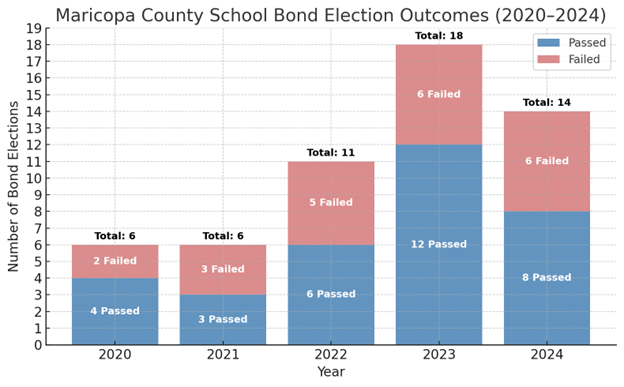
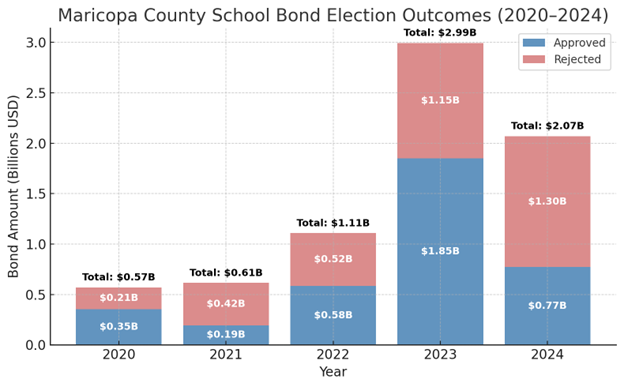
As seen in the chart below between 2020 and 2024, bond requests across Maricopa County have ballooned as pandemic stimulus dollars expired and districts turned back to property-tax financing. The pace of school bond elections far exceeds municipal ones, and the total amounts sought have surged as seen in the 2nd chart below. Inflation alone doesn’t explain the escalation, though it is often erroneously cited as the root cause of this growth.
The lesson isn’t that districts should never seek voter support, but that leaders must confront an uncomfortable truth: demand for traditional district schools is shrinking. Some causes, like rising housing costs and lower birth rates, are beyond their control. Others, like families choosing charters or ESAs, are the direct result of competition and consumer preference. Pretending otherwise guarantees more sudden, painful closures down the road, along with wasted opportunities adding up to hundreds of millions in taxpayer funds.
Kyrene’s crisis is neither the first nor the last domino of overbuilt school districts. Every district that keeps chasing bonds to prop up half-empty schools is writing the same ending. The can has been kicked far enough. It’s time to stop borrowing from tomorrow to preserve yesterday’s mistakes.
Arman Sidhu is a lifelong Arizona resident and educator who has served as a teacher and principal in both traditional public and charter schools. He is a doctoral student in education at Arizona State University’s Mary Lou Fulton Teachers College. His opinions are entirely his own.
24-year-old Daniel Ashpes of the Tempe Union High School District was arrested for threats against Donald Trump Jr. and Turning Point USA founder, CEO Charlie Kirk.
The Tempe Police Department announced Ashpes’s arrest on Tuesday; he was taken into custody on Thursday, Oct. 17. Ashpes messaged threats directed at Trump Jr. and Kirk through a mass messaging system while they were in town for a political rally last week.
“Daniel Ashpes was taken into custody by Tempe police on Thursday, after detectives were notified of threatening messages sent in response to an automated mass-messaging system asking for an RSVP to the Turning Point rally at a Tempe hotel,” said the department on Facebook. “TPD’s Threat Mitigation Unit launched an immediate investigation and developed probable cause for Ashpes’ arrest that same day. In an interview with detectives, Ashpes admitted to sending the messages.”
The Tempe Police Department is announcing the arrest of 24-year-old Daniel Ashpes for multiple counts of online threats made toward Donald Trump Jr., and Charlie Kirk who were in Tempe for a political rally last week. pic.twitter.com/KKxn6eoxKy
Ashpes is facing the following misdemeanor charges: three counts of threatening to cause physical injury to another person and one count of using a phone to threaten or intimidate. Penalties for these charges range up to six months in jail and a fine of up to $2,500.
Ashpes is not an Arizona native. According to his since-deleted Facebook profile, Ashpes was from Irvine, California, where he attended Arnold O. Beckman High School in Tustin, California. His profile mentioned that he also lived for a time in Portland, Oregon.
All of Ashpes’s other social media profiles — including Instagram, YouTube, LinkedIn — were deleted, limiting access to an online footprint that may have provided further insight to Ashpes’s political beliefs.
Ashpes attended Northern Arizona University and was a student teacher at Flagstaff Unified School District.
Ashpes taught social studies at Desert Vista High School; he was hired in July.
On Wednesday, Desert Vista informed parents that Ashpes was placed on administrative leave over his arrest.
“We are writing to inform you that Mr. Daniel Ashpes, a social studies teacher at DV, has been placed on administrative leave while authorities conduct an investigation,” stated the school. “Yesterday, at 1:33 PM, we notified Mr. Ashpes’ students and their families of the situation, prior to any media reports. As this is an ongoing matter, our priority was to first inform those directly impacted before communicating with the wider Desert Vista community. While we are unable to provide details at this time, we are aware that the Tempe Police Department has filed charges related to alleged online threats. Please note that the Tempe Union High School District (TUHSD) does not tolerate or condone any form of threats or harassment by employees or students.”
Donald Trump Jr.’s father, Donald Trump, has survived two assassination attempts this year: one in July and one in September.
In the July assassination attempt, 20-year-old Thomas Matthew Crooks shot a near-fatal bullet that grazed Trump’s ear at a Pennsylvania rally. The gunfire killed one, 50-year-old Pennsylvania firefighter and father Corey Comperatore, and injured seven others: 57-year-old David Dutch and 74-year-old James Copenhaver were shot and critically injured but recovered; the nephew of Congressman Ronny Jackson was grazed in the neck by a bullet but recovered; and four Pittsburgh Police officers were injured minorly by debris from objects hit by the gunfire.
The second assassination attempt occurred in September. The would-be assassin, 58-year-old Ryan Wesley Routh, never made it to the point where he fired off any shots at Trump. Routh had set up an AK-47 rifle, backpack, and Go-Pro camera along the fencing adjacent to the Trump International Golf Club course. Routh was spotted by the Secret Service about 400-500 yards from Trump while he was playing golf. The Secret Service then fired several rounds at Routh and caused him to flee.
AZ Free News is your #1 source for Arizona news and politics. You can send us news tips using this link.