Arizona House Minority Whip Stacey Travers (D-LD12) is pledging to renew her effort to require clergy to report suspected ongoing or future child abuse disclosed through confidential religious communications. Her legislation failed to advance this year, while the Arizona Supreme Court recently issued a ruling defining the scope of the state’s clergy reporting exemption.
Travers introduced HB 2039 in December. The bill would have amended Arizona’s clergy reporting exemption to require members of the clergy, Christian Science practitioners, and priests to report when there is reasonable suspicion that abuse is ongoing, will continue, or may threaten other minors.
House Judiciary Committee Chairman Quang Nguyen (R-LD1) has opposed Travers’ proposals and has said he will not give the measure a hearing while he remains chairman. Nguyen, who is Catholic, said that Travers would have to wait until 2029, when he is no longer a legislator, for the bill to receive a hearing.
“I’m going to be very frank about this,” he said, “this bill has absolutely zero to do with reporting crimes because duty to report already exists in the state of Arizona, just not in the confessional booth,” Nguyen previously told LifeSiteNews. “That is all.… This is a way to go out and destroy our Church. Nothing more, nothing less.”
Congressman and GOP gubernatorial nominee Andy Biggs described the bill at the time as “a terrible attack on Catholics in Arizona by, of course, a Democrat. This bill should never see the light of day.”
A terrible attack on Catholics in Arizona by, of course, a Democrat. This bill should never see the light of day.
Current Arizona law requires specified mandatory reporters who reasonably believe a minor has been abused or neglected to report that information. Clergy may currently withhold a confession or confidential communication when they determine that maintaining confidentiality is “reasonable and necessary within the concepts of the religion.” The exemption applies to the confidential communication itself and does not cover a clergy member’s independent observations of a minor.
HB 2039 would have narrowed that exemption. Under the proposed language, clergy could withhold information concerning abuse that had already occurred unless there was reasonable suspicion that the abuse remained ongoing, would continue, or could threaten other minors. It also would have amended Arizona’s civil clergy-penitent privilege to permit examination of a priest or clergyman concerning a confession when the clergy member determined it involved ongoing abuse.
Under the state’s existing reporting statute, failure to make a required report is generally a class 1 misdemeanor. Failure to report a statutorily defined “reportable offense,” which includes several sexual offenses involving minors, is a class 6 felony.
HB 2039 was assigned to the House Judiciary and Rules committees and received its second reading in January. It did not advance before the Legislature adjourned.
Travers said that she distinguishes between protected religious confession and circumstances in which someone discloses continuing abuse.
“There is a special case when you’re confessing to somebody in your religious organization,” Travers said, describing a confession involving a search for “absolution and contrition.”
She described an admission of ongoing child abuse made with the expectation that clergy will not report it as a “conditional” confession and said she intends to continue pursuing legislation addressing those circumstances.
Nguyen also blocked a similar proposal by Travers in 2023. At the time, Travers said the legislation grew out of the case involving Paul Adams, a Bisbee man, after he disclosed abuse to leaders of the Church of Jesus Christ of Latter-day Saints (LDS).
That case eventually reached the Arizona Supreme Court.
According to the court, Adams disclosed sexual abuse to Bishop John Herrod around 2011 and later repeated the disclosure during a meeting involving his wife. Herrod subsequently informed Bishop Robert Mauzy, who convened a church disciplinary council. Adams again disclosed the abuse during that proceeding and was excommunicated.
The abuse came to the attention of federal authorities in 2017 after the Department of Homeland Security discovered a video online. Adams and his wife were subsequently indicted. Adams died by suicide in jail before trial, while his wife pleaded guilty and was sentenced to prison, according to the Supreme Court’s opinion.
Three of the children later sued the church and several church officials, alleging in part that they failed to comply with Arizona’s reporting law.
The Arizona Supreme Court ruled that the First Amendment generally prevents courts and juries from deciding whether clergy correctly applied religious doctrine when determining that withholding a report was reasonable and necessary under their religion, absent fraud or collusion for a secular purpose.
The court also held that religious institutions are entitled to substantial deference in defining what constitutes a “confession,” a “confidential communication,” and who qualifies as clergy. The justices vacated a Court of Appeals decision and affirmed summary judgment for the church defendants.
The court emphasized that its decision concerned interpretation of Arizona law and federal constitutional protections rather than the factual merits of the children’s abuse allegations.
A separate unanimous Arizona Supreme Court ruling issued Aug. 12 further defined the limits of clergy privilege.
In Rodriguez-Ramirez v. State of Arizona, the court held that a communication between a Phoenix pastor accused of sexually abusing his co-pastor’s teenage niece and the co-pastor did not qualify as a protected “confession” under Arizona’s criminal clergy-penitent privilege.
The justices defined a confession as a confidential admission of a crime, sin, or fault to clergy for the purpose of seeking spiritual absolution, consolation, or guidance. Because the communication in that case did not meet the court’s standard, the justices affirmed the superior court’s decision allowing a secretly recorded conversation to be used in the criminal case.
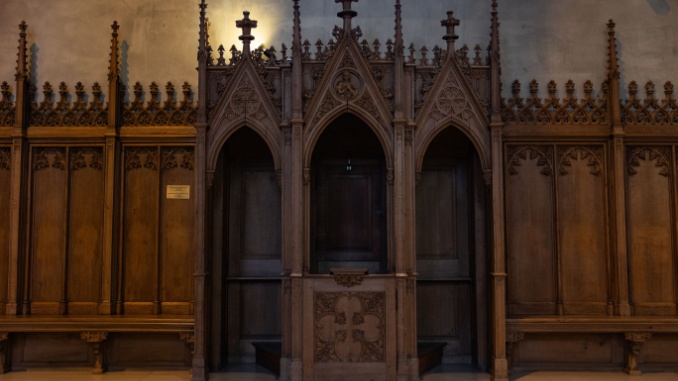
The dispute over Travers’ proposal has particular implications for Catholic priests because Catholic canon law declares the sacramental seal of confession inviolable and prohibits a confessor from disclosing what a penitent reveals during the sacrament.
The Arizona Legislature is scheduled to begin its next regular session in January, when Travers said she intends to renew the proposal.
A proposed bill in the Arizona legislature would require members of the clergy to report any crimes admitted to them in confession.
The bill by Minority House Whip Stacey Travers, HB 2039, would expand the duty to report to religious leaders, specifically naming clergymen, priests, and Christian Science practitioners. Travers attempted to run the bill, without success, for every legislative session since coming into office in 2023.
Religious leaders would be held liable in a civil action should they fail to report not only ongoing but any potential future abuse of minors that has yet to occur. This failure to report would kick in if “reasonable suspicion” exists that “dependency, physical injury, abuse, child abuse, or abandonment is ongoing or that dependency, physical injury, abuse, child abuse, or abandonment may occur in the future.”
The bill would also remove the requirement for religious leaders to obtain consent from the individual making their confession before reporting to authorities.
“A member of the clergy, a Christian Science practitioner or a priest who has knowledge or a reasonable suspicion that a person is committing or may commit child abuse or neglect shall immediately report or cause reports to be made of this information to a peace officer, to the Department of Child Safety or to a tribal law enforcement or social services agency for any Indian minor who resides on an Indian reservation, except if the report concerns a person who does not have care, custody or control of the minor, the report shall be made to a peace officer only. This subsection does not apply to a confidential or penitential communication unless the member of the clergy, a Christian Science practitioner or a priest determines that the abuse or neglect is still occurring or will occur in the future.”
Punishments would vary depending on the proposed violations.
Those who fail to report a reportable offense (sexual offenses outlined within 13-1401 through 13-1430 of Arizona Code; obscenity; furnishing harmful items; surreptitious photographing, videotaping, filming, or digitally recording or viewing a minor; child sex trafficking; incest; or unlawful mutilation) would be charged with a class six felony.
All other violations of the bill would qualify as a misdemeanor.
Congressman Andy Biggs, a Mormon, said he was not shocked that a Democratic lawmaker was behind the bill.
“A terrible attack on Catholics in Arizona by, of course, a Democrat,” said Biggs. “This bill should never see the light of day.”
A terrible attack on Catholics in Arizona by, of course, a Democrat. This bill should never see the light of day.
When Travers first introduced the proposed bill in 2023, she said it was Mormons (members of the Church of Jesus Christ of Latter-day Saints, or LDS) who asked her to file it following the case of a Bisbee man, Paul Adams, who continued to rape his daughters for years after confessing his crimes to a Mormon bishop. Adams’ suicide brought his crimes to light.
“I picked up the mantle because I had LDS constituents come to me,” said Travers in an interview with Capitol Media Services.
AZ Free News is your #1 source for Arizona news and politics. You can send us news tips using this link.
Arizona House Ethics Chair Lupe Diaz (R-LD19) blasted Democrats Friday for “weaponizing” complaints against Rep. John Gillette (R-LD30). Democrat Reps. Oscar De Los Santos, Nancy Gutierrez, Quanta Crews, and Stacey Travers filed a complaint on September 10, citing an interview from Gillette and social media posts. They called his remarks “offensive” and “unbecoming of an elected official,” noting his criticism of radical Islamists and Sharia law.
In a string of posts to X referred to in the Democrats’ complaint, Rep. Gillette wrote, “Islamophobia is a construct of the Marxist left I reject. I hear them state that they stand with Hamas and Iran, they want to bring Sharia Law to the US. They chant death to US. I have years of direct experience with these savages. [Their] own religion preached convert or die. F**K EM. If they want here to become the s**t hole they left… they can go home. The democrats support them. DEMOCRATS HATE AMERICA!”
Islamophobia is a construct of the Marxist left I reject. I hear them state that they stand with Hamas and Iran, they want to bring Sharia Law to the US. They chant death to US. I have years of direct experience with these savages. Thier own religion preached convert or die.… https://t.co/5ckyD2tLLN
— Rep. John Gillette AZ House LD30 (@AzRepGillette) September 2, 2025
Responding to subsequent comments, he clarified his position, stating, “I was critical of their policies. “Shiria(sic) Law and convert or die” are policy positions of Islam. Democrats want to install Socialism as a policy. I criticize both as they are repugnant to the Constitution. My reply is based on experience in the Middle East and Soviet Union. Not some leftist theory cooked up in a liberal college classroom with the same professors and systems that say there are 32 genders.. grow up and see reality…. remember Covid when you were told to wear a face covering, not work. The left forced this on us, not people like me.”
In their complaint, the Democrat lawmakers claimed, “Rep. Gillette referred to Muslims as ‘f***ing savages’ who don’t properly ‘assimilate’ into American culture. By referring to Muslims as ‘savages’ and ‘terrorists,’ Rep. Gillette dehumanized them and demonstrates his bigotry against an entire religious group, which constitutes about 1% of the population in this state.”
In a letter responding to the Democrat representatives, Chairman Diaz wrote that “remarks, statements, or opinions by a member, alone, are not traditionally the subject of an ethics inquiry. Subject to our House Rules regarding debate, members—like any other citizen—have a First Amendment right to the freedom of speech, as well as a right to freely speak under Article 2, Section 6 of the Arizona Constitution.”
Citing the assassination of Charlie Kirk, Diaz added, “Moreover, particularly in light of recent events, it is imperative that government institutions protect the freedom of speech, rather than take actions to silence, punish, or censor speech simply because someone might find it offensive or disagreeable. The inquiry you request this Committee to make would result in no more than an inquiry into the sincerity of Representative Gillette’s beliefs or a debate into the merits of those beliefs— neither for which an Ethics Committee hearing is the proper venue.”
Diaz concluded, “It would be inconsistent with constitutional principles—and unprecedented, based on past practices of previous House Ethics Committee Chairmen presented with similar complaints to undertake any further review or investigation of your complaint. Accordingly, I will not take further action on this matter.”
He further added an admonishment to the Democratic representatives, urging them to review Rep. Gillette’s response to their press release announcing the complaint, entitled “Defending America Against Radical Ideologies and Political Hypocrisy,” and added, “To the extent that you have any lingering concerns about his statements, it would be prudent to engage in civil discourse rather than weaponizing the House Ethics Complaint process.”
In the statement, Gillette explained in part, “Immigrants are welcomed here as guests who can become fellow citizens, and gratitude, respect, and loyalty to our nation are the minimum expectations. Yet too often, what we see instead is a demand that Americans change our culture, our speech, or our religion so as not to ‘offend’ those who chose to come here. That is not assimilation—it is subversion. I will treat every human being with dignity and respect. But I will not, and Americans must not bow to the demands of those who place their foreign ideologies above our Constitution.”
Gillette defined the group he opposes as “radical Islamists,” who seek “the establishment of a worldwide caliphate,” adding, “While some [in] the Muslim world may practice their faith peacefully, many more have weaponized the concept of jihad to justify terrorism, mass murder, and political conquest.”
On Tuesday, Democrats in the Arizona House of Representatives elected a team of members to lead their caucus over the next two years. They selected Representative De Los Santos as the House Minority Leader, Representative Nancy Gutierrez as House Minority Assistant Leader, and Representatives Quantá Crews and Stacey Travers as House Minority co-Whips.
PRESS RELEASE: De Los Santos Elected to Lead House Democratic Caucus, Gutierrez Assistant Leader, Crews and Travers Whips pic.twitter.com/U64ExcQJ9z
“It’s an honor to be chosen to lead this outstanding caucus,” De Los Santos said. “This is a strong, smart and experienced team who will fight for you, for your public schools, for your rights, for our state’s precious resources, for your bottom line and for your neighborhood. We have tremendous challenges ahead as state, and as a country, but we will not back down from extremism, and we will face them together.”
Travers acknowledged her election as one of the Minority Whips, writing, “Thank you to everyone at AZ LD 12 Democrats who worked so hard, and above and beyond to help us get re-elected!”
The four Democrats are some of the most liberal in the Arizona House of Representatives. De Los Santos, Gutierrez, and Crews have a 0% Lifetime score according to the Arizona Free Enterprise Club. Travers has a 2% score.
Daniel Stefanski is a reporter for AZ Free News. You can send him news tips using this link.