Policy experts are pushing back on Democratic attack ads against Rep. Juan Ciscomani (R-AZ06) and other Republicans, saying the One Big Beautiful Bill Act’s (OBBB) Medicaid reforms target fraud and waste—not vulnerable populations.
The ads, funded by the dark-money group Unrig Our Economy, are linked to the George Soros-backed Sixteen Thirty Fund via Arabella Advisors, according to Influence Watch. They feature individuals with disabilities like cerebral palsy, autism, and Down syndrome, accusing legislators, including Ciscomani, of supporting “cuts to Medicaid to pay for tax breaks for billionaires.” The ads target GOP Reps. Mike Lawler (R-NY), Mariannette Miller-Meeks (R-IA), and Thomas Kean Jr. (R-NJ), in addition to Ciscomani, and insinuate that the subjects would lose benefits under the Trump-backed OBBB.
A report from the Economic Policy Innovation Center (EPIC), titled “The Truth Behind the Medicaid Cuts Myth,” counters that Medicaid spending is projected to grow by nearly $189 billion over the next decade, an increase of more than 30% of the current allocation, without reducing benefits for low-income children, individuals with disabilities, or working recipients.
“The reforms in the OBBB do not target low-income children, individuals with a disability, or those who can work and choose to do so,” EPIC stated in the report.
“As usual, all the Democrats have is lies. Representative Juan Ciscomani voted to protect care for Arizona’s most vulnerable, and no amount of spin can change the facts,” National Republican Congressional Committee (NRCC) Spokesperson Ben Petersen said in a statement.
The OBBB introduces work requirements for able-bodied adults, enhanced eligibility verification to cut improper payments (which surged to 21.7% in FY 2020 post-COVID, per CMS data but have since declined to 5.09% in FY 2024), and exemptions for parents of children under 14, disabled veterans, the blind or physically disabled, those with mental or developmental issues, clinically addicted individuals, and those with severe medical conditions.
EPIC and other analysts point to state 1115 demonstrations that have included work and employment elements; evaluations of such waivers show mixed employment impacts and mixed effects on utilization, varying by state and program design.
In Arizona, Ciscomani’s district faces heightened scrutiny amid a state budget shortfall. Arizona budget analysts and JLBC staff warn of material budget pressure heading into FY2026–27; JLBC’s state-impact memos estimate a $363 million reduction in Arizona total-fund Medicaid spending stemming from federal reconciliation provisions, according to the Arizona Joint Legislative Budget Committee.
EPIC is advocating “smart waivers” to prioritize the disabled and families. For Arizona’s fiscal details, see JLBC’s full report.
Nothing undermines confidence in elections quite like discovering they can be compromised by foreign billionaires or botched altogether through complex schemes like ranked-choice voting.
This year, legislatures across the country took aim at both of these urgent threats to election integrity, as outlined by a recent report from Honest Elections Project. Altogether, eight states closed a critical legal loophole allowing foreign billionaires to flood ballot measure campaigns with foreign dark money. Meanwhile, six more states banned ranked-choice voting, the most legislative bans in a single year. In other words, conservative states have made 2025 a banner year for election reform.
Most Americans would be shocked to learn how vulnerable our elections are to foreign influence. Federal law forbids foreign nationals from donating to candidates or political parties yet offers no such protection for state or local ballot measures. This means that a foreign billionaire cannot influence a particular race, but he can spend millions to pass a constitutional amendment that rewrites the rules of the entire election system.
That loophole has been a gift to Swiss billionaire Hansjörg Wyss. According to the watchdog group Americans for Public Trust, Wyss has directed roughly $280 million into the Sixteen Thirty Fund, which has simultaneously spent more than $130 million in foreign-tied funds into ballot campaigns in 26 states. As shocking as these figures are, they likely represent the tip of the iceberg. After all, the same loophole can just as easily be abused by foreign nationals doing the bidding of China and Russia.
Fortunately, conservative states are taking action to ensure that ballot measures are no longer a Trojan Horse for foreign interference. After Ohio led the way in 2024, eight states this year—Arkansas, Indiana, Kansas, Kentucky, Louisiana, Missouri, Tennessee, and Wyoming—enacted new laws to ban foreign nationals and the groups they finance from funding ballot measure campaigns. Even Kentucky’s Democratic governor signed the bill into law, proof that defending elections from foreign influence should not be a partisan proposition.
That hasn’t stopped many on the left from fighting to keep these loopholes open for purely partisan gain. Marc Elias, Democrats’ top election lawyer, went to court in Ohio in 2024 and again in Kansas this year to block these bans. He lost both times, once in front of an Obama-appointed judge. States clearly have the authority to ban foreign funding, and every state should.
The same is true of ranked-choice voting, and 2025 was an incredible year in the ongoing fight to stop its spread.
Under ranked-choice voting, voters are asked to rank multiple candidates. Ballots are counted in rounds as losing candidates are eliminated and votes are redistributed. If a voter fails to rank enough candidates, the ballot is “exhausted” and thrown out. Candidates can win the most first-place votes but lose the election. Delays are inevitable; Alaska’s ranked-choice voting tabulation does not even begin until 15 days after Election Day. In California, a tabulation error once led to the wrong candidate being certified. Ranked-choice voting turns what should be a straightforward election into a complicated black box.
Fortunately, the public has seen the problems with this system from the start. In 2024, ranked-choice voting advocates spent nearly $100 million dollars on ballot measures promoting the scheme in six states. All failed. Only the District of Columbia adopted it, which is hardly a ringing endorsement.
Between 2022 and 2024, 11 states banned ranked-choice voting. And this year, six more – Arkansas, Iowa, Kansas, North Dakota, West Virginia, and Wyoming – acted to make the scheme illegal. And in Utah, lawmakers allowed a failed pilot program to expire, meaning ranked-choice voting will come to an end there, too.
As extraordinary as this progress is, conservatives must not become complacent. States like Michigan, Florida, Nebraska, North Carolina, Montana, and Arizona have all seen significant amounts of foreign-tied money pumped into ballot issue campaigns, but so far have not acted. And progressives remain committed to pushing ranked-choice voting, especially after witnessing the scheme elevate a Democratic Socialist in New York. Ranked-choice voting lobbyists are working legislatures nationwide, and activists are already gathering signatures for another ballot measure in the presidential battleground of Michigan.
That should serve as a warning. When it comes to securing our elections, the job is never done. This was a banner year for election integrity. Conservative leaders must keep the momentum going in 2026 and beyond.
The District of Columbia attorney general is investigating Arabella Advisors, the dark money giant operating a national funding network for leftist nonprofits, including in Arizona.
The Washington Free Beacon discovered that the DC attorney general issued subpoenas last month to Arabella Advisors, as well as its largest clients, concerning investigative reporting about tax law aversion and illegal profiteering.
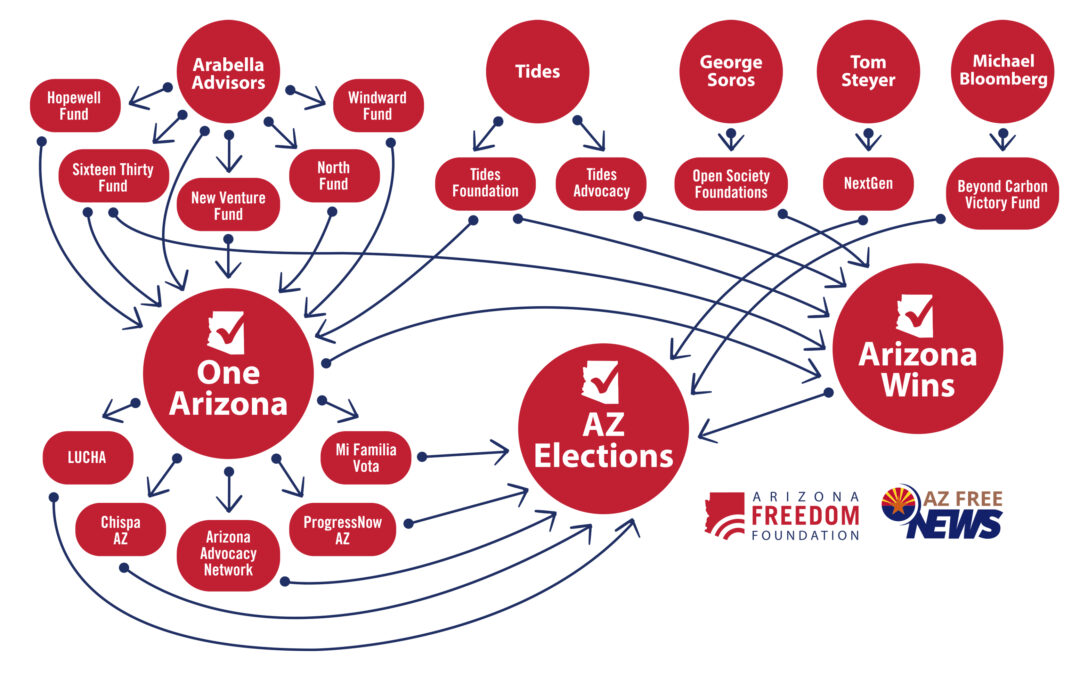
Arabella Advisors manages five nonprofits that funnel dark money funds into other leftist nonprofits and initiatives: New Venture Fund, Sixteen Thirty Fund, Hopewell Fund, Windward Fund, and the North Fund. Their influence is expansive, both nationally and in Arizona.
The five nonprofits all funded One Arizona, a coalition of leftist nonprofits, who in turn funded Living United for Change in Arizona (LUCHA), Chispa AZ, Arizona Advocacy Network, ProgressNow AZ, and Mi Familia Vota. Those nonprofits used that funding to advance their causes in Arizona’s elections.
An outgrowth of the New Venture Fund’s front initiative, We Mean Business Coalition, collaborated with the Carbon Disclosure Project and World Resources Institute to create the Science Based Targets initiative (SBTi). Last November, the Biden administration proposed granting decision-making power on defense contracts to SBTi. In February a key initiative of SBTi, the Advanced and Indirect Mitigation (AIM) Platform, launched at GreenBiz 23 in Scottsdale.
Another New Venture Fund initiative, Campus Vote Project, has a presence across 41 states. In Arizona, the initiative coordinates with Arizona State University, Mesa Community College, South Mountain Community College, Northern Arizona University, Eastern Arizona College, Cochise College, Chandler-Gilbert Community College, and Phoenix College to increase voter turnout among college students.
Prior to the 2020 election, only Mesa Community College and South Mountain Community College were recognized by the dark money-originating initiative.
Also concerning higher education, the New Venture Fund created a scholarship program fund that partnered with Northern Arizona University (NAU) last year to pay illegal immigrant students’ tuition.
The Sixteen Thirty Fund was a major funder to the nonprofit Way to Win, which spent $110 million in key states, including in Arizona, to ensure Democratic victories in 2020. Way to Win served as the sponsor to Progress Arizona (formerly ProgressNow Arizona), who was led by Gov. Katie Hobbs’ ousted spokeswoman, Josselyn Berry, until at least 2021.
Those listed as running Progress Arizona, according to their latest available tax return (2021), were:
Emily Kirkland (executive director): Arizona Education Association communications director; former senior political strategist for the Colibri Collective; former director of Organizing for 350 Massachusetts and communications coordinator for Better Future Project
Ariel Reyes (director): Instituto political director; former Arizona Wins political director; former lobbyist for the Torres Consulting and Law Group
Elsa O’Callaghan (director): consultant with Prickly Pear Consulting; executive director of Arizona Democratic Legislative Campaign Committee; former staffer for California Rep. Karen Bass (D); and former Planned Parenthood Los Angeles staffer
Belen Sisa (director): unemployed DACA recipient; former Democracy Initiative campaign manager; former communications staffer for Democratic congressional candidates Victor Reyes (New Mexico) and Mike Siegal (Texas), independent presidential candidate Bernie Sanders; and former staffer for Arizona Wins and Mi Familia Vota
Alexa-Rio Osaki (director): director of Arizona Asian American Native Hawaiian and Pacific Islander (AZ AANHPI) Advocates; Arizona Coalition for Change communications director
Josselyn Berry (chairman)
The Hopewell Fund and Sixteen Thirty Fund have issued much of the funding for Opportunity Arizona. Until 2021, one of the individuals behind that organization was Dacey Montoya: a principal player in many of the dark money groups, Democratic candidates, and progressive initiatives in Arizona.
Those listed running the organization, according to their latest available tax return, were:
Ben Scheel (executive director): director of Bright Phoenix; former deputy campaign manager for Phoenix city council candidate Karlene Parks
Ed Hermes (board president): attorney; Osborn Elementary School District governing board president; vice chair of the city of Phoenix’s Vision Zero Committee; Maricopa County Superior Court judge pro tempore; and Move Osborne Forward treasurer
Josh Zaragoza (board member): political consultant involved in Phoenix City Councilwoman Yassamin Ansari’s council campaign and ongoing congressional campaign; former chief of staff to Phoenix Councilwoman Laura Pastor; and former Human Rights Campaign organizer
Monica Pimentel (board member): Arizona Latino School Board Association president; Glendale Elementary School District governing board member; Maricopa County Deferred Compensation Committee member; and former Movimiento Estudiantil Chicanx de Aztlan (MEChA) vice president
Corinne Murdock is a reporter for AZ Free News. Follow her latest on Twitter, or email tips to corinne@azfreenews.com.
“This is what Arizonans have been asking for: a voting system that enhances our democracy and increases participation. It’s that simple… We know that when more people get involved and have a say, we have a state that reflects what Arizonans actually want.”
— Arizona Democratic Party Chairman, Senator Raquel Terán (D-Phoenix), speaking at a July 7 press conference about the now-invalidated, dark-money fueled Arizonans for Free and Fair Elections 2022 ballot initiative to roll back voter ID, allow same-day registration, allow outside money into elections offices, and thwart challenges to future ballot initiatives and election results.
– – –
There’s a powerful, secretive infrastructure gunning to flip Arizona blue. Its elements appear disparate, coincidental at best. In truth, each element has a specific role to play: some transient with the fervor and impact of an October surprise, others established with the consistency and familiarity that eludes scrutiny. It is the seeming disconnection of these elements that makes the left’s secretive infrastructure that much more powerful.
The principal source of power is money, and though the left often complains about dark money, they are its principal cultivator by far. Despite this fact, they’re very much in favor of a purported solution to dark money on the November ballot: the Voters Right to Know Act, or Proposition 211. Upon closer examination, the rationale for their support is clear: this proposition comes with neat carve outs ensuring that leftist dark money critical to their Arizona infrastructure remains untouched — namely from corporate media, Big Tech, most labor unions, and “nonpartisan” political action committees. If the proposition is successful, it will enable leftist actors to continue building onto their secretive infrastructure to gain a greater hold of Arizona politics.
If money is the lifeblood, then the body of the left’s secret infrastructure exists in the coordination of 501(c)(3) and 501(c)(4) nonprofits (C3 and C4, respectively), pop-up groups run by nonexistent people and entities that only exist for a few weeks around elections, mystery shell campaigns acting behind a veil on behalf of the Democratic Party and leftist organizations, and political action committees (PACs) dressing up their activity as grassroots work.
Dark money describes a shuffling of funds that intentionally obscures its origins and, ultimately, shapes its targeted political landscape to its liking. This shuffling is accomplished through networks of nonprofits, national organizations backed by a powerful few whose resources eventually shuffle down to more localized organizations.
As you read this article, more discernible traces of this leftist infrastructure are busy at work all around you. In the coming weeks, you will likely notice their fingerprints in campaign ads from groups with unfamiliar, novel names online, on the radio, on TV, and in your mail.
Some of those ads will originate from the Future Forward (FF) PAC, a D.C.-based organization funded initially by Facebook co-founder Dustin Moskovitz and a favorite of Silicon Valley Democrats. According to a trigger report, they paid nearly $246,500 collectively in recent weeks for ad campaigns opposing three of former President Donald Trump’s endorsed candidates: Mark Finchem for secretary of state, Kari Lake for governor, and Abraham Hamadeh for attorney general. Their ad buys were estimated to be a little over $82,100 per candidate.
Since nonprofits aren’t legally obligated to disclose their donors, even for election expenditures, they may trade funds back and forth in the dark at will. Effectively, the leftist infrastructure “washes” the money before it reaches its final destination — they’re arguably the best at it.
The leftist infrastructure far outspends the right. For example, in the 2020 Arizona Corporation Commission race, the left backing Democrats had around $10.2 million in outside spending versus Republicans’ $156,000.
Dark money critic Mark Kelly receives huge boost from dark money group in AZ Senate race https://t.co/lEPT40xutZ
A vast majority of this “washed” money traces back to a few with deep pockets: the Arabella Advisors (Washington, D.C.), the Tides Foundation (San Francisco, California), and George Soros (Katonah, New York). Each boasts revenues and expenditures in the billions annually.
Arabella Advisors issues funds through five distinct nonprofits: the Hopewell Fund, the Sixteen Thirty Fund, the New Venture Fund, the North Fund, and the Windward Fund. In the 2020 election, Arabella Advisors’ nonprofits funneled vast amounts of money into Arizona. The company has nearly $10 billion at its disposal. Their current president and CEO is Rick Cruz.
Arabella Advisors launched in 2005 under Eric Kessler: a self-described “serial entrepreneur” whose career began elsewhere within the left’s network, working as a national field director for the League of Conservation Voters (LCV). When the LCV executive director at the time, Bruce Babbitt (also former Arizona attorney general and then governor), moved up in the political world with the election of President Bill Clinton, Kessler got a boost, too. He became an Interior Department appointee under Babbitt. Once the Clinton administration ended, Babbitt joined former secretary of state Madeleine Albright’s National Democratic Institute (NDI), and shortly after, he launched Arabella Advisors. He remains a senior managing partner for the organization.
The Tides Foundation is one of many nonprofits within a larger network underneath the Tides Network, which is part of the Tides Nexus. It’s similar to another nonprofit within the network, Tides Advocacy (formerly the Tides Advocacy Fund, the Advocacy Fund, and the Tsunami Fund). The Tides Foundation is chaired currently by Roslyn Dawson Thompson, the former president and CEO of Texas Women’s Foundation (formerly Dallas Women’s Foundation), another left-wing nonprofit.
The Tides Foundation began in 1976 with Drummond Pike, a liberal political activist allied with Wade Rathke, who founded the defunct advocacy group esteemed by Secretary of State and gubernatorial candidate Katie Hobbs, Association of Community Organizations for Reform Now (ACORN). The organization received initial financial backing from Reynolds tobacco heiress Jane Lehman, who chaired the organization until her death in 1988.
Finally, George Soros is considered a principal financial backer for a wide array of Democratic Party efforts. Soros channels funds to various Arizona PACs and organizations through his Open Society Foundations (OSF). He also channeled funds through his Democracy PAC, which funneled over $1 million at least into Arizona for the 2020 election to Not Our Faith, Arizona Wins, and ProgressNow Arizona, respectively. The Democracy PAC gave $100,000 last year to Way to Lead PAC, chaired by Dacey Montoya. Montoya, also former chair of the now-inactive Not Our Faith, also owns the Money Wheel: a consulting firm that Democratic candidates and groups have paid hundreds of thousands into since 2018.
Leftist C3 and C4 nonprofits have a unique codependency in Arizona. While both receive tax-exempt income, C4s may engage in political activities like lobbying and campaigning while C3s generally may not.
Since C4s may engage in election activities, politically driven C3s fund C4s. However, those C3s don’t stop there. They ensure that their funds are spent properly by coordinating through grassroots lobbying. In contrast to direct lobbying, grassroots lobbying mobilizes the public on political issues.
In Arizona, major politically driven C3s include AZ Wins, One Arizona, ProgressNow AZ, and Save Our Schools Arizona (SOSAZ) Network.
One Arizona exemplifies the C3 to C4 relationship. This C3 nonprofit is a coalition of leftist groups, among which is Mi Familia Vota, a C4. One Arizona routes funds to Mi Familia Vota and coordinates grassroots lobbying efforts. Their biggest funders include the Tides Foundation, George Soros’ Open Societies Foundation, and several different organizations under Arabella Advisors.
Hundreds of organizers are out talking to Arizona voters now. They've been out since 6 am and will be out til the polls close.
C3 resources and support put the wind in C4 sails. In 2020, it was Mi Familia Vota that successfully sued to extend the voter registration deadline another 18 days — just 11 days before the Election Day.
BREAKING:Voter registration deadline has been extended to October 23rd 5pm! Thank you @MiFamiliaVota & @OVOV_AZ! #MFV and so many grassroots organizations have been hard at work for more than a decade to ensure our voices are heard at the ballot box! This year was no exception! https://t.co/iQf6fZ0Exb
— Raquel Terán #BlackLivesMatter (@RaquelTeran) October 6, 2020
The Pop-Up Groups
Another integral component of the left’s secretive infrastructure exists within various “pop-up groups.” These are political groups that appear shortly before an election and become inactive after the election ends, made up to appear like an authentic group of concerned citizens and not political activists working on behalf of a party.
Oftentimes, the identifying information given by these pop-up groups upon registration is untraceable: faulty or fake phone numbers, addresses, and personnel. Yet somehow, even with their tight deadline and obscurity, these pop-up groups manage to have enough voter contacts and resources for mass outreach efforts.
This year, a pop-up PAC by the name of “Defend Arizona Rights” registered in late June. As of this report, nearly all of their income — which came from Damon Ely, a Democratic state representative and attorney from New Mexico — went toward a website to oppose Proposition 309 (SCR1012), the ballot measure to require voter ID.
A prominent example of a pop-up group from 2020 was “Arizonans for Energy Independence,” which focused on the Arizona Corporation Commission race. They registered with the secretary of state about two weeks before the election. Their listed phone number led to an alarm business, their address was a shipping service location, and the only listed officer appears to be a ghost. Those who signed petitions from NextGen America received text from Arizonans for Energy Independence in late October.
NextGen America (formerly NextGen Climate) is one of multiple major leftist C4s that bankrolls the leftist infrastructure.
The Shell Campaigns
Much like pop-up groups, leftist shell campaigns are driven and largely funded by a political party. Unlike pop-up groups, however, these shell campaigns last for the entire election year and usually hire several identifiable staffers. Markers of a shell campaign include political attack-dog websites, ad campaigns, and artificial demonstrations staffed by professional activists staged to look spontaneous.
One example of a shell campaign from 2020 was Arizona Families First — not to be confused with Arizona Families F.I.R.S.T., an Arizona Department of Child Safety (DCS) program for parental substance abuse.
The Arizona Families First PAC was live for all of 2020, then went inactive after the election. The Arizona Democratic Party was the primary bankroller, pouring $1.7 million total into the PAC; the party launched the PAC with $45,000 contributions from February to March of 2020.
The PAC spent close to $2 million altogether on outreach: over $1 million on mailers, $916,900 on digital ads, $25,000 on radio ads, and $10,800 on its website. It also spent nearly $21,000 on legal services from Coppersmith Brockelman — a go-to law firm for Democrats, from which the newly appointed Biden nominee for the Ninth Circuit Court of Appeals, Roopali Desai, hailed. The director of Arizona Families First, Ramon Alvarez, earned over $70,400.
With the 2020 election concluded and their work done, the PAC refunded their remaining $15,400 back into the Arizona Democratic Party last February.
Other major funders of the Arizona Families First PAC included tens of thousands respectively from the National Institute for Reproductive Health Action Fund, Healthcare Rising AZ, Working for Working Americans Non-Federal Arizona PAC, 314 Action Victory Fund, and Trilogy Interactive.
Several corporations gave thousands to the PAC: Zillow, Pepsi, Intuit, and Sanofi. Additionally, the PAC received a smaller donation from one of the prominent families contributing to the state’s leftist infrastructure: Abby Rockefeller.
An example of a shell campaign from this year was Arizonans for Free and Fair Elections PAC. They launched last December with the purpose of getting their eponymous initiative on the ballot, which aimed to roll back voter ID, allow same-day registration, allow outside money into elections offices, and thwart challenges to future ballot initiatives and election results. AZ Free News issued a detailed report in July on the leftist infrastructure funding behind this shell campaign.
According to the secretary of state’s campaign finance reporting site, the last expenditure for that shell campaign was $50,000 to the Barton Mendez Soto law firm last November — a month before the PAC registered with the secretary of state.
The Left’s Use of Arizona-Based PACs to Shuffle Money
There are over 900 PACs listed as active through the Arizona Secretary of State. Of these, a handful serve as consistent conduits for the leftist infrastructure’s funds under the title of grassroots work. These include One Arizona/Arizona Wins, Mi Familia Vota, Arizona Advocacy Network, ProgressNow AZ, Living United for Change in Arizona (LUCHA), Opportunity Arizona, Mijente, PODER in Action, Forward Majority Action Arizona, Way to Lead Arizona (Way to Lead PAC), and Future Now Arizona.
None of them broke the secretary of state’s campaign finance top ten for major income and expenditures this year. There are others who made that list: those who have raised and spent mass amounts of funds in a short window of time this year. They may be classified as shell PACs integral to the leftist infrastructure since they assume a local identity while receiving and distributing funds from out-of-state Democratic billionaires and the three primary financiers of Democratic money (Arabella Advisors, Tides Foundation, and George Soros).
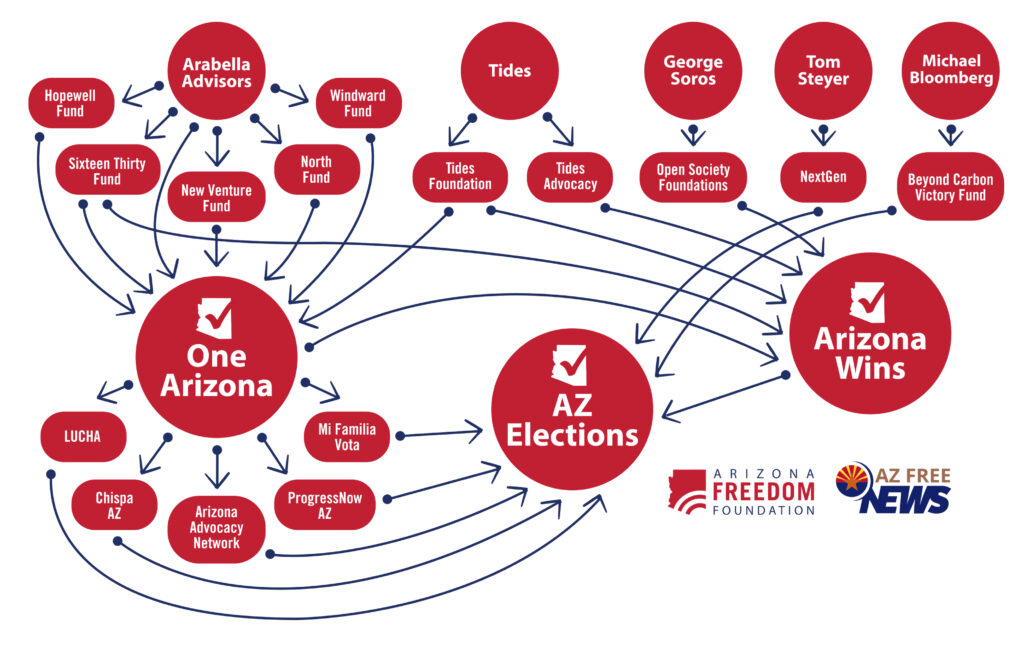
While not a complete pitcure, the above graphic illustrates some of the connections in the left’s secretive infrastructure and how they relate to Arizona elections.
According to the secretary of state’s campaign finance portal, these are the PACs with the top 10 incomes this year:
$8.2 million, The PAC for America’s Future – AZ
$7.6 million, Arizonans for Free and Fair Elections (review previous section for details)
$3.5 million, Arizonans Fed up with Failing Healthcare, or Healthcare Rising AZ
$2.2 million, Put Arizona First
$2 million, Worker Power PAC
$1.4 million, Our Voice Our Vote Arizona PAC
$1.3 million, DLCC Victory Fund
$775k, ActBlue Arizona
$737k, Arizona Pipe Trades 469
$665k, United Food & Commercial Workers Union of AZ Local 99
And these are the PACs with the top 10 expenses this year:
$5.2 million, Republican Governors Association (RGA) Arizona PAC
$3.4 million, Arizonans Fed Up with Failing Healthcare (Healthcare Rising AZ)
$3.3 million, The PAC for America’s Future – AZ
$2.2 million, Put Arizona First
$1.5 million, Republican Attorney Generals Association (RAGA) Arizona for Freedom PAC
$1.3 million, Arizonans for a Just Democracy
$885k, Planned Parenthood Votes
$817k, Southwest Regional Council of Carpenters Legislative Improvement Committee
$800k, National Rifle Association (NRA) Political Victory Fund
$786k, Arizona Pipe Trades #469
Of all these PACs, a prime example of the left’s money “washing” that’s also most cryptic in its origins and nature would be Arizonans for a Just Democracy. The PAC launched last July, with a mailing address located at the same UPS store in Phoenix as ProgressNow Arizona and Arizona Wins. Their website hasn’t been updated since their launch.
Arizonans for a Just Democracy only has four donors listed, of which three are: Merle Chambers, millionaire Democratic funder; the Arabella Advisors’ Sixteen Thirty Fund, and a ghost of a PAC called “The Future We Want.” That last PAC also has a mailing address at the same UPS store; its chair is Juliana Horwin, a former educator with the Arizona Education Association (AEA).
According to the Federal Election Commission (FEC), a similarly named Super PAC was active from 2018 to 2019 and its sole financier totaling $547,000 was a Phoenix-based PAC called “Citizens for Accountable Government” (yet somehow it spent over $716,000). Citizens for Accountable Government’s mailing address is also located at the same UPS store and shares the same treasurer as The Future We Want, Isis Gil of the Puente Human Rights Movement. Citizens for Accountable Government’s chair is Chris Love: the former Planned Parenthood Advocates of Arizona (PPAZ) chair. Their primary funds come from either The Future We Want or Arizona Wins.
Arizonans for a Just Democracy’s chair, Grecia Lima, is the national political director for Community Change (also known as Center for Community Change) and its advocacy arm, Community Change Action. Community Change receives mass funding from the Democratic network: Democracy Alliance, AFL-CIO, Planned Parenthood. The PAC’s treasurer is Sarah Michelsen: the senior campaign strategist for the ACLU, and as of June 2021 the owner of “Michelsen Strategies,” a Phoenix-based campaigning firm. From the moment Michelsen launched her firm until present, she’s raked in at least $18,300 from the Arizonans for a Just Democracy PAC.
Michelsen has worked with the Center for Progressive Leadership, Arizona Wins, NARAL Pro-Choice Arizona, Planned Parenthood Advocates of Arizona, and Bernie Sanders’ presidential campaign.
Then there’s PAC for America’s Future – AZ. Of their $8.2 million in income this year, not even half of a percent came from Arizonans ($16,800, composed of many individual donations ranging from $25 to $1,000). The vast majority of the PAC’s major funding came from Democrat billionaires. This PAC plays an integral role in ensuring Arizona’s leftist infrastructure is relied upon both locally and nationally — it passes along funds to PACs, organizations, and committees across other states. Only $106,000 went to Arizona candidates, all Democrats; $260,000 went to the Arizona Democratic Party. That’s four percent of their income this year.
As AZ Free News reported in August, about half of Healthcare Rising AZ’s funds came from the California union, SEIU United Healthcare Workers. Its main expenses were for signature-gathering efforts for its Predatory Debt Collection Act, a ballot initiative to thwart debt collection efforts.
The RGA Arizona PAC receives its funds from its national affiliate, the Republican Governors Association, and all of its expenditures went toward ad campaigns against Democratic gubernatorial candidate Katie Hobbs.
RAGA Arizona for Freedom has spent nearly equal amounts of over $700,000 each on ad campaigns to support Republican attorney general candidate Abraham Hamadeh and oppose Democratic attorney general candidate Kris Mayes.
Likewise, the NRA Political Victory Fund spent nearly equal amounts of over $400,000 each on ad campaigns to support Republican gubernatorial candidate Kari Lake and oppose Democratic gubernatorial candidate Katie Hobbs.
This is Part One in a series on the Democratic dark money network in Arizona. Be sure to sign up for our newsletter to be notified of Part Two in the series.
Corinne Murdock is a reporter for AZ Free News. Follow her latest on Twitter, or email tips to corinne@azfreenews.com.
One of the kingpins of Democratic dark money, 91-year-old George Soros (92 on Friday), lingers still behind the scenes of Arizona’s elections. His millions, traceable effectively wherever a Democratic candidate arises, may define the upcoming Maricopa County Attorney election. One of Soros’ main objectives is to grow his network of progressive prosecutors.
Soros made his mark in Arizona known through the 2016 elections. He was the primary financier of the Maricopa Strong PAC, spending over $2.3 million to defeat Maricopa County Sheriff Joe Arpaio (a success). Soros was also the primary financier of the Arizona Safety and Justice PAC, spending $1 million in the Maricopa County attorney’s race to defeat then-incumbent Bill Montgomery (a failure).
After 2016, Soros’ personal spending in criminal justice-related races appeared to cease entirely. The contentious 2020 election came and went without word of Soros’ millions flooding county races. Yet, Soros assured the country in an opinion piece for the Wall Street Journal last month that he remains committed to his goal of establishing liberal, reform-oriented prosecutors nationwide.
The idea that we need to choose between justice and safety is false. The agenda of reform-minded prosecutors is based on both common sense and evidence, and it helps to restore trust between the police and the policed. https://t.co/GBOwlrCkO9
Soros may have rejected the media attention for his direct financing, and opted to direct his funds through less overt channels: political action committees (PACs) entrusted to pass on the cash to his desired candidates.
Soros candidates are identifiable by the following criminal justice reform goals: bail abolition, reduced incarceration numbers, mental health response services (as opposed to police), diversion programs in lieu of trial, mental health and drug courts as alternatives to criminal courts,
Those who share a similar vision for criminal justice reform are Julie Gunnigle, Democratic candidate for Maricopa County Attorney, as well as Laura Conover, current Pima County Attorney.
Gunnigle pledged to expunge marijuana-related criminal records, reduce incarceration rates, end cash bail, oppose the death penalty, fight elongated sentences for gang and weapons-related charges, establish mental health response services, and avoid prosecution for abortion offenses. Gunnigle, who earned over 312,000 votes in the primary, faces off against incumbent Rachel Mitchell, who earned over 235,000 votes (beating Republican challenger Gina Godbehere, who earned over 175,000 votes).
What's on your ballot this election for Maricopa County Attorney?
🏥 Abortion rights ⚖️ Criminal legal reform 🌿 Universal and automatic expungements
Out of the latest PAC donations reported, Gunnigle received over $6,500 from Way to Lead Arizona. That PAC received $100,000 from Soros’ Democracy PAC last year, though it’s primarily funded by its national counterpart: Way to Lead PAC. That PAC has received millions combined from Soros, his family, or the organizations he either funds or founded, according to Federal Election Contribution (FEC) campaign finance records.
Gunnigle has denied that she benefited from Soros funding.
During her 2020 run for the county attorney’s office, Gunnigle received $12,900 from the Planned Parenthood Advocates of Arizona (PPAZ) PAC, nearly $10,900 from Arizona List PAC, and over $6,000 from Emily’s List PAC.
The SOS database reflects that PPAZ’s biggest donors are private individuals donating over tens of thousands of dollars each. However, PPAZ’s SOS profile doesn’t reflect their receipt of over $9,100 from Planned Parenthood Votes that year, who in turn received $2.5 million from September 2019 to August 2020 from Soros’ Democracy PAC according to FEC records.
Arizona List PAC received $2,500 from Arizona Wins that year, who received $350,000 from Soros’ Democracy PAC in June 2020. Arizona Wins has given tens of thousands to Arizona List since launching in 2008. Arizona List PAC has also received $6,000 every year, including this year, from Emily’s List PAC. Soros’ Democracy PAC gave Emily’s List a $1 million nonfederal contribution in early 2020.
Since 2020, the Soros-funded Emily’s List has given $525,000 to the Arizona Democratic Legislative Campaign Committee (ADLCC), a project of the Arizona Democratic Party co-founded by Secretary of State Katie Hobbs. This year so far, they’ve given $50,000 to the ADLCC.
Arizona Wins — who appears under several different profiles with variations of its name on the SOS database, such as “Arizona Wins!” and “Arizona Wins/One Arizona” — has received money from and sent money to Soros’ affiliated or founded organizations apart from Democracy PAC. This includes just under $100,000 given to Forward Majority Action Arizona, whose primary funder is its national arm, Forward Majority Action. Soros’ Sixteen Thirty Fund issued millions to Forward Majority Action throughout 2020, with an additional individual contribution of $200,000 from Soros’ eldest son, Robert.
Arizona Wins’ former program manager, Josselyn Berry, went on to become the executive director of a PAC that received $650,000 from Soros’ Democracy PAC in 2020: ProgressNow Arizona (sometimes listed as Progress Now Arizona). Berry, formerly the Arizona State Senate Democratic Caucus Communications Director, also serves as a staffer for the Arizona Democratic Party. Arizona Wins and Progress Now Arizona both listed the same address for campaign finance reports.
ProgressNow Arizona also received $25,000 from the Future Now Fund in 2020, whose Arizona arm has received thousands over the years from Soros’ daughter-in-law, Jennifer, and submitted about $509,800 to the Arizona Democratic Party in 2020.
Pima County’s attorney, Laura Conover, has pledged to advance criminal justice reform initiatives that align with Soros’ vision. Her campaign received funding from some of the same sources as Gunnigle.
Last December, Conover pledged to not charge individuals arrested for simple drug possession in order to avoid jail crowding. Most recently, Conover pledged to not give jail time to individuals who seek or assist with abortions. Among her goals: cease prosecutions for the “poor, sick, and addicted,” through efforts like abolishing cash bail and limiting deportations.
This here about sums it up. It's not that I would "like" to end cash bail. It's that I am going to go down to the jail every night and teach the prosecutors that work with me how to end cash bail until it is done. @EndCashBail@bailproject@LetsFreeAmericahttps://t.co/bzUVrXvSUC
In response to a constituent complaint on Facebook in 2020, Conover neither confirmed nor denied that she benefited from Soros funding.
“You may review my financials at your leisure. Bipartisan. Transparent. Sorry to disappoint,” wrote Conover’s campaign page.
According to the secretary of state’s (SOS) campaign finance records, the PPAZ PAC paid $12,900 to Conover’s campaign in July 2020. Conover’s campaign also received over $7,300 from the Arizona List PAC in 2020.
Soros’ money bleeds into other aspects of Arizona’s legal world. Incidentally, traces of his financial support touched the 2020 interests of newly-confirmed Ninth Circuit Court of Appeals judge: the accomplished, favorite Arizona attorney of the Democratic Party, Roopali Desai.
The funds benefited other left-wing criminal reform agendas in Arizona through Arizonans for Second Chances, Rehabilitation, And Public Safety: another PAC backed by Soros money, in addition to Big Tech’s Mark Zuckerberg. From June to September of 2020, the PAC received nearly $256,700 from the Alliance for Safety and Justice Action Fund, a project of Soros’ Tides Advocacy.
The PAC also received about $552,600 from Fwd.Us, Zuckerberg’s pro-immigration lobbying group co-founded with liberal megadonor Joe Green. Fwd.Us made headlines in late 2021 for bankrolling “farm teams” that produced at least five members of President Joe Biden’s immigration policy team.
From June to August 2020, the PAC paid out about $380,300 to the Coppersmith Brockelman law firm, where Desai has been a longtime partner. They also paid out over $3.3 million to AZ Petition Partners (dba Petition Partners): a signature-collecting company charged in November 2020 by the Arizona Attorney General’s office for illegal bonus programs. Desai is serving as one of the attorneys for the company’s appeal case.
That company also received $1.25 million from “Smart And Safe Arizona,” the PAC behind the eponymous ballot initiative, Prop 207, which successfully legalized recreational weed in the state. Desai authored Prop 207’s language. Desai also provided legal services for Prop 208, Invest in Education, whose eponymous PAC rallying for an additional income tax to increase teacher funding paid at least $150,000 to Petition Partners.
Corinne Murdock is a reporter for AZ Free News. Follow her latest on Twitter, or email tips to corinne@azfreenews.com.