Over the last four years Governor Katie Hobbs, the teachers’ unions, and their allies in the corporate media have been relentlessly attacking Arizona’s Empowerment Scholarship Accounts (ESAs) program, the most popular and successful school choice program in the country. Over 106,000 kids are currently using an ESA scholarship, with thousands more signing up each year.
Their most recent assault began last March, when the unions filed their ballot initiative in an attempt to gut ESAs. If passed, over 30,000 kids would have immediately lost their ESA scholarship or had their scholarship funds revoked because of the new restrictions. Another 400,000 children would have been permanently barred from participation in the program. The National Education Association (NEA) poured $7 million into this fight, hiring an army of paid circulators that were willing to say, and sometimes do, just about anything for a paycheck.
Interestingly, there were two different responses to this most recent threat. The response from most of Arizona’s school choice organizations and ESA families was a full-throated defense of the program. Within days, the AZ school choice coalition launched a countercampaign and made clear that ESAs would not go undefended. They fundraised, developed messaging, deployed grassroots “decline to sign” efforts, and crafted legislative countermeasures to put the unions on their heels.
And after the initiative was filed with the Secretary of State in July, a petition review was launched by the Goldwater Institute, which our organization helped support. That petition review revealed that thousands of signatures were either invalid or unlawfully collected by convicted felons. The result was that we proved in court that the NEA and Save our Schools was short of qualifying by nearly 15,000 signatures, and we knocked them off the ballot.
It was a pivotal victory in a long line of big wins for school choice in Arizona.
However, during this battle against the radical left, an alternative response to this attack emerged from the shadows: a belief that the only way to save the ESA program was to enact punitive regulations on the families that use the program. Rather than fighting back against the false attacks being levied against ESAs by the unions and the media, they preferred to make concessions that would make the program politically “attack-proof” in the future.
Sadly, this strategy has been tried in the past when dealing with the unions, and it almost resulted in irreversible disaster for our state.
Conceding the Issue to the Left Is the Quickest Way to Defeat
Our organization has seen this coordinated attack from the left before. Different issues, different talking points, but the same trajectory that involves goading us into accepting the other side’s terms of surrender…
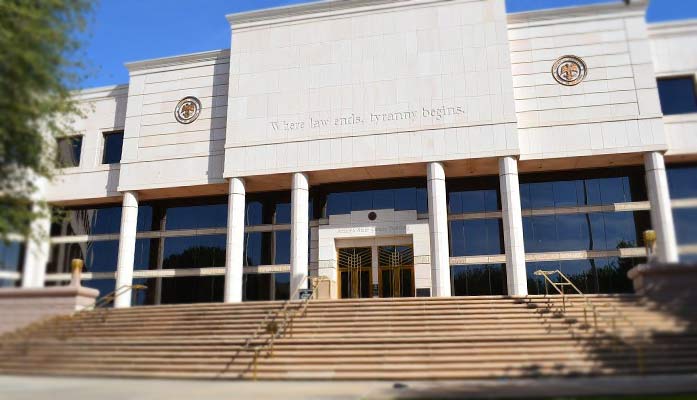
Teachers’ union activists were once again dealt a serious blow after the Arizona Supreme Court issued an order effectively removing an initiative from the ballot that aimed to undo the state’s universal school choice program.
Nearly four years ago to date, a similar initiative was removed from the ballot for failing to have the required number of signatures. Katie Hobbs, secretary of the state at the time and now the governor, held out on invalidating the ballot initiative.
The court’s order to recalculate the signature totals using the trial court’s formula, issued on Tuesday, is projected to have brought Proposition 212, the Protect Education Act, below the required signature total following a legal challenge filed by the Goldwater Institute in Clark v. Fontes.
Protect Education Accountability Now, the political action committee (PAC) behind the Protect Education Act, confirmed that the Arizona Supreme Court order meant their initiative would not qualify for the ballot.
The PAC blamed “big money in partnership with Republican lawmakers and the anti-public education lobby” for the initiative’s demise.
A spokesperson for the PAC stated that the initiative should have been included on the ballot regardless of the invalid signatures.
“This does not reflect what Arizona voters want. It does not reflect the overwhelming support of educators, parents and public school advocates across the state who volunteered their time and demanded a voice in reforming a program that abused taxpayer money and pulled funding from their neighborhood public schools,” said the spokesperson. “Instead, the hard-earned resources educators raised to fund this were buried under a mountain of big money, political power, and a system that consistently sides with special interests.”
— Protect Education Ballot Initiative (@ProtectEdAct) August 18, 2026
Activists submitted around 420,000 signatures to qualify for the ballot. Pending a review incited by the Goldwater Institute’s court challenge, the number of valid signatures will fall to a projected total of approximately 245,000. The initiative needed approximately 256,000 to qualify for the ballot.
Nearly 70,000 signatures were invalidated due to their discovery as duplicates or having been collected by legally ineligible circulators, like felons. The court also upheld the trial court ruling which invalidated entire sheets of signatures due to the petition circulator providing an address at which they weren’t living.
The ballot measure would have rolled back the universality of the Empowerment Scholarship Account (ESA) program by imposing an income cap.
The union-backed Protect Education Act appears to have fallen short of the valid signatures needed to make the November ballot.
In this special Keep Arizona Free Update with @Darla4freedom:
➡️ The campaign submitted roughly between 416,000-421,000 signatures, but after trial… pic.twitter.com/l7886cgtT9
The court also agreed with a lower court ruling that the ballot language drafted by Secretary of State Adrian Fontes was false and misleading because it used the term “voucher” to describe the ESA program. Vouchers must be spent immediately and only at certain approved schools, whereas ESA program funds may be rolled over and applied to various schooling types and educational resources.
The PAC behind this second failed initiative to end universal school choice raised more than $7.5 million and spent more than $7.2 million.
More than $6.5 million, or 87%, came from the National Education Association. $810,000, or nearly 11%, came from the Arizona Education Association.
Other major donors included $50,000 from the United Food and Commercial Workers Active Ballot Club, the PAC of a D.C.-based union; and $50,000 from Arizonans for Quality Education, a corporation or LLC based in Phoenix.
The latter entity was formerly known as Friends of ASBA, with ASBA standing for the Arizona School Boards Association, and was registered as a domestic nonprofit corporation, according to Arizona Corporation Commission (ACC) records.
AZ Free News is your #1 source for Arizona news and politics. You can send us news tips using this link.
The Protect Education Act is projected to fall more than 10,000 valid signatures short of the number required to qualify for Arizona’s November ballot after a court challenge removed thousands of petition signatures and county recorders completed their validity reviews.
The Arizona Free Enterprise Club (AFEC) announced Monday that applying the trial court’s rulings and county signature-validity rates leaves the initiative with approximately 245,000 valid signatures. Arizona law required the campaign to produce 255,949 valid signatures.
The calculation follows an expedited ruling Thursday from Maricopa County Superior Court Judge David McDowell in Clark v. Fontes, the lawsuit challenging the petitions submitted by Protect Education, Accountability Now, the political committee behind the initiative.
At the time of McDowell’s ruling, the final outcome remained unresolved because Maricopa and Apache counties had not yet completed their reviews. The Arizona Capitol Timesreported that the Secretary of State’s initial review had reduced the campaign’s submitted total to 389,376 signatures before the court considered challenges to individual circulators, petition sheets, and duplicate signatures.
🚨 BREAKING: “PROTECT EDUCATION ACT” FALLS SHORT
Based on the trial court’s ruling in Clark (@ClarkRimsza) v Fontes and county signature validity rates, the union-backed anti-ESA initiative does not have enough valid signatures to qualify for the November ballot.
McDowell’s ruling left 348,269 signatures presumptively valid before application of the counties’ random-sample validity rates. The court also addressed 24,369 duplicate signatures and challenges involving more than 110 petition circulators.
“The court agrees that it is conceivable that a double count could occur, but the court cannot make a decision based upon a hypothetical double counting of duplicate signatures,” McDowell wrote.
The initiative’s supporters submitted 421,451 signatures on July 2. Save Our Schools Arizona and the Arizona Education Association were among the organizations backing the campaign.
The Goldwater Institute filed its challenge July 20, alleging that tens of thousands of the submitted signatures should be rejected because of duplicate entries, defects in circulator registrations, and petitions collected by people who were legally ineligible to circulate them.
The amended complaint raised more than 73,300 objections. Those included allegations involving unregistered paid circulators, signatures collected before circulator registration, inaccurate addresses or contact information, identification problems, and circulators whose felony convictions or other legal circumstances allegedly made them ineligible.
McDowell ultimately invalidated signatures collected by several circulators. Four circulators were disqualified because of criminal histories. The judge also invalidated several thousand signatures collected by circulator Tyrone Crispell after finding his denial that he misrepresented the initiative to prospective signers was not credible.
AFEC said Monday that nearly 70,000 signatures were disqualified through the challenge, including duplicates and signatures gathered by legally ineligible circulators.
“This is a major victory for Arizona parents, students, and the integrity of our elections,” AFEC President Scot Mussi said. “This anti-school choice initiative and its union backers spent more than $7 million dollars trying to dismantle school choice in our state, but they still could not collect enough lawful, valid signatures to qualify for the ballot.”
Campaign-finance figures compiled by Transparency USA from Arizona disclosure records show the Protect Education, Accountability Now committee had reported more than $7.5 million in total expenditures through July 30. The National Education Association accounted for approximately $6.57 million in cash and in-kind contributions, while the Arizona Education Association contributed another $810,000.
The Protect Education Act, designated Proposition 212 during the ballot-review process, would make several changes to Arizona’s Empowerment Scholarship Account (ESA) program. The measure would generally limit eligibility to families earning $150,000 or less, with exceptions including students with disabilities, certain military families, and students assigned to poorly performing public schools.
The proposal would also establish additional requirements for participating private schools and tutors, restrict certain ESA expenditures, and generally require unused annual ESA funds to be returned to the state.
The signature dispute is separate from litigation over how Proposition 212 would be described to voters. Last week, Maricopa County Superior Court Judge Julie Ann Mata ordered Secretary of State Adrian Fontes to rewrite portions of the proposition’s descriptive title and “yes” and “no” statements after finding that the existing language omitted significant provisions of the measure. Judge Daniel Martin separately ordered revisions to the Arizona Legislative Council’s publicity-pamphlet analysis.
The teachers’ unions and their allies at Save Our Schools (SOS) have proven time and time again that they will do anything to kill universal school choice in Arizona.
They’ve fought expansion of the program. They’ve pushed to cap it. They’ve worked with activist reporters in the legacy media with ties to the Red for Ed teachers’ union to push false claims about it. And we all witnessed it four years ago when they made their not-so-triumphant proclamation that they had enough signatures to repeal the program—only to discover they had miscounted by more than 50,000 signatures.
But their latest attempt to overturn the program is their lowest yet.
Earlier this month, the teachers’ unions and SOS announced they had submitted more than 420,000 signatures for a ballot initiative that would end the universal eligibility of Arizona’s Empowerment Scholarship Accounts (ESA) program.
Given their track record, the Arizona Free Enterprise Club worked closely with the Goldwater Institute and other school choice advocates to review the petitions. What we found was far more disturbing than another failed signature count.
Dozens of Convicted Felons—Including Registered Sex Offenders—Hired to Collect Signatures
The teachers’ unions and SOS want Arizonans to believe that their “Protect Education Act” campaign is a grassroots effort led by concerned parents and educators. But they made a very different choice when it came time to build their campaign…
Several of the Maricopa County Board of Supervisors reviewed the recorder’s new signature verification process this week.
Supervisors Mark Stewart and Debbie Lesko visited the recorder’s office on Friday to observe what Recorder Justin Heap has promised to be a stronger approach to signature verification.
Also present were members of the Maricopa County Republicans and local election integrity advocates.
Currently with Maricopa County Recorder @azjustinheap, Supervisor @DebbieLesko, @MaricopaGOP, and several election integrity enthusiasts (@MerissaCaldwell) learning about the Recorder's new signature verification process.
— Mark Stewart Maricopa County Supervisor District 1 (@MarkStewart_AZ) February 6, 2026
Supervisor Stewart publicized some of the training materials given to elections workers tasked with signature verification, including metrics for accepting or flagging signatures based on broad and local characteristics.
The new format for signature verification has two levels of review, the first for the user and second for the manager. At the level one user review, two signature reviewers of differing political parties compare signatures with the reference signature on file.
Signatures with obvious matches based on characteristics may be accepted as good signatures, while signature comparisons that yield differences outweighing similarities must be flagged for level two review by a manager.
The level two managerial review concerns the review of all available signatures in a voter’s registration record, which can be upwards of 50 samples. The signature pool could include signatures from voter registration forms, verified early voting affidavits, and in-person sign-ins from rosters.
Signatures consistent with the signature pool would be approved and sent to another level two manager of a differing political party for review, while nonmatching signatures would be set aside for further action. The recorder’s office has a set limit of disposition types: no signature, household exchange, need packet (a catch-all disposition type), deceased (which flags National Voter Registration Act research), and pre-questioned signature.
That last disposition qualifies for automatic submission to another manager of a differing political party for level two review.
All signatures with any discrepancy at any levels are required to be part of a mandatory audit review, set at two percent currently.
Training materials also made clear the efforts by the recorder’s office to integrate user-friendly updates to signature review software.
Level one reviewer screens will display the current election affidavit signature alongside the historical affidavit signatures from newest to oldest, removing the old requirement for users to scroll to compare signatures.
The training materials also stressed that users should default to flagging signatures for review for any reasons other than a “good signature” determination.
The visit marked an unusual bright point in the strained relationship between the board and the recorder.
The board and recorder have been engaged in a year-long legal battle in the Maricopa County Superior Court over elections administration powers.
This week marked a particularly tenuous moment in the battle after board leadership issued subpoenas against three of the recorder’s staff members.
The Maricopa County Superior Court sided with the recorder on the issue and put in place a temporary restraining order against the board to halt the subpoenas.
Friday’s visit was not a signal by the two visiting supervisors that they were on the recorder’s side in this court battle. Lesko reposted statements from Board Chair Kate Brophy McGee addressing the subpoenas. Stewart issued his own statement recognizing the validity of arguments from both his fellow board members and the recorder’s office.
Supervisor Calls Out SSA Deadlock: Push for Transparent Talks, Voter-Centric Fixes, and Immediate Action
I have watched with growing frustration as the Board of Supervisors, our Elections Subcommittee, and the County Recorder’s Office have struggled to reach a resolution on the… pic.twitter.com/N1JRPQ1x5e
— Mark Stewart Maricopa County Supervisor District 1 (@MarkStewart_AZ) February 6, 2026
AZ Free News is your #1 source for Arizona news and politics. You can send us news tips using this link.