by Pam Kirby | Apr 7, 2025 | Opinion
By Pam Kirby |
Arizona families have watched a quiet crisis unfold in their local school districts. Board meetings once focused on academics and fiscal responsibility have become battlegrounds for political agendas and bureaucratic overreach. Parents have been silenced, transparency denied, and accountability brushed aside.
In the past few years, Arizonans have witnessed a series of troubling events that show just how far some school boards have strayed:
-
- In Scottsdale Unified, the board president’s father compiled a secret dossier on outspoken parents—including photos of their children—an alarming breach of public trust.
- Washington Elementary severed ties with Arizona Christian University over student teachers’ religious beliefs, only to reverse course after legal pressure.
- In Isaac School District, state officials placed the district under receivership after uncovering a $15 million financial crisis, triggering multiple investigations.
These aren’t isolated incidents—they’re symptoms of a larger collapse in trust, academic focus, and respect for families. And for too long, parents had no organized way to push back.
A Movement Takes Root
That tide is now turning—led by unapologetically conservative school board leaders who are rejecting political indoctrination and delivering real results that put students, families, and local values back at the center of education.
Founded in 2021, the Arizona Coalition of School Board Members is a non-partisan, 501(c)(3) nonprofit committed to restoring integrity, local control, and academic excellence in our public schools. This isn’t a national agenda—it’s a homegrown movement, created by and for Arizonans, to restore excellence and accountability in our schools. While others raise awareness, the Coalition equips board members with the tools, legal support, and training to lead with confidence and principle.
Unlike legacy education groups that push top-down mandates, the Coalition promotes governance rooted in Arizona values—academic rigor, parental involvement, and education freedom. With members in more than 50 school districts across 10 counties, the Coalition is building a movement of student-first leaders who aren’t just calling for change—they’re delivering it.
Real Wins Across Arizona
Coalition-backed board members aren’t just talking about reform—they’re making it happen. Here are three local victories already making an impact:
-
- Apache Junction Unified – Cell Phone Use Policy
Limits phone use during the school day, restoring classroom focus and discipline. It’s a practical fix to a problem every parent and teacher sees daily.
- Higley Unified – Staff Health and Safety
Bans COVID-19 vaccine and mask mandates for staff, reinforcing health freedom and parental values. This affirms the district’s commitment to individual rights, medical privacy, and protection from government overreach.
- Peoria Unified – Student Privacy Policy
Ensures multi-occupancy restrooms and overnight accommodations are designated by biological sex, while offering private alternatives as needed. It’s a firm stand for parental expectations, student safety, and local authority.
Empowering Voters, Building Leaders
Change doesn’t happen without an engaged public. That’s why Friends of the Coalition, a 501(c)(4), is leading a statewide voter education effort focused on school board elections and the issues affecting classrooms, transparency, and parental rights.
More than 500 individuals have attended our free School Board Bootcamp, designed to demystify the board member’s role. Dozens of those participants have since been elected—first in 2022, and again in 2024.
This is more than education—it’s about building a conservative leadership bench. Graduates of this movement are now serving in school districts, the Arizona State Senate, and even the Arizona Corporation Commission.
This Is the Moment
Arizona’s public education system is at a crossroads. Will it continue down a path dominated by bureaucracy and ideology—or return to a model that respects families, demands excellence, and puts students first?
With the Federal Department of Education steadily returning power to states and local communities, school boards now carry unprecedented responsibility. That shift brings both urgency and opportunity. Local leadership is no longer secondary—it’s the front line.
Thanks to the Arizona Coalition of School Board Members and Friends of the Coalition, Arizona conservatives are executing a strategic, multi-pronged plan—educating voters, equipping leaders, and empowering bold school board members.
This isn’t rhetoric. It’s results.
Whether you attend a Bootcamp, become a Coalition member, support candidates who share your values, or make a tax-deductible gift to sustain this work, there’s a role for everyone in this movement. The future of Arizona education will be decided by those who show up.
Pam Kirby is the Founder of the Arizona Coalition of School Board Members and Friends of the Coalition. She served on the Scottsdale School Board from 2010–2018 and continues to advocate for excellence, transparency, and local control in education.
by Matthew Holloway | Nov 29, 2024 | Education, News
By Matthew Holloway |
The Goldwater Institute released a report on Tuesday detailing the shocking expenditures of the Tolleson Union High School District (TUHSD). According to the report, the district has blown a total of $76,969 “on what amounted to luxury vacations for school board members and administrators,” per public records obtained by Goldwater.
In the space of two days, the board reportedly shelled out $42,000 in hotel costs, $22,000 of which was for the catering. And this was all for just thirty people. The math works out to a brutal $700 per person, per day.
Christopher Thomas, Goldwater’s director of legal strategy for education policy, told AZFamily, “Those are monies that could have been spent on teacher salaries and educational programs for students.”
According to Goldwater, despite the public access requirements of the state of Arizona’s Open Meetings Law, these “Board and Administrator Retreats,” which act as long-form working meetings, are essentially hidden from the taxpayer. Furthermore, Goldwater reported that, “As a result of the noted board member absences, many of the meetings held during the $42,000 retreat in 2024 lacked even a board quorum (a majority of the five-member board), meaning that under the law, these were not lawful meetings of the board at all.”
Thomas explained that the retreats, “lacked transparency that’s required by the Open Meeting Law.”
Matters of great public interest were reportedly decided at these retreats, including strategies for improving student participation and graduation rates, student attendance rates and test scores, and budget priorities and academic goals, all away from public and parental oversight.
The costs revealed did not include transportation or the hourly pay of those involved, as many of them were effectively “clocked-in” during these “retreats.”
TUHSD reportedly indulged board members and administrators at two four star resorts in 2023 and 2024: the JW Marriott Starr Pass in Tucson and the Hilton Sedona Resort at Bell Rock. Notably, Goldwater observed that although records pertaining to these expenses were requested in July, they weren’t released until the middle of November… after new bond and a budget overrides were approved by Tolleson Union voters and a member of the governing board was safely re-elected.
At the JW Marriott Starr Pass in Tucson for the board’s two-day 2023 Board/Administrator Retreat, TUHSD reportedly paid $33,969 to the resort, which included $22,061 on catering. In 2024, the three day retreat at Hilton Sedona Resort at Bell Rock ran up a tab of $42,154 for 36 people.
“The leaders in this school district do not fundamentally understand that they are working with public dollars, and that every one of those public dollars has got to be spent in a way that gives the maximum benefit to the taxpayer and accomplishes their educational mission,” Thomas said.
Comparatively, as Goldwater Institute and AZ Free News previously reported, the Creighton Elementary School District’s Governing Board and Administrative Team attended a three-day, $4,000-per-person “diversity, equity, and inclusion” (DEI) conference at a Napa Valley wine country resort in July, which also drew heavy criticism of district leaders.
Matthew Holloway is a senior reporter for AZ Free News. Follow him on X for his latest stories, or email tips to Matthew@azfreenews.com.
by Dennis Liles | Oct 29, 2024 | Opinion
By Dennis Liles |
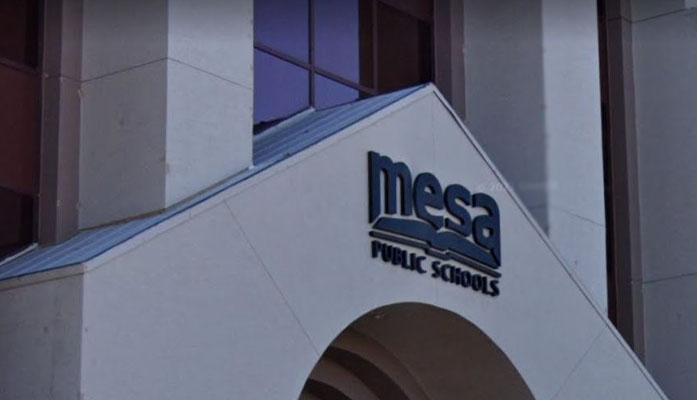
School board elections in Arizona are a non-partisan race, by law. In an ideal world, candidates should be focused on the well-being of students, academic achievement, and facilitating as much parental involvement as possible. That’s definitely true in Mesa, where the school board should be comprised of members who want to ensure that students are educated rather than indoctrinated.
But a recent news item by the local NBC affiliate chose to highlight partisan political party affiliation instead of focusing on how each candidate views their role as a potential Mesa school board member.
The story focused on three candidates running for the Mesa School Board as a slate: Courtney Davis, Josh Chilton, and Lacy Chaffee. Courtney Davis, in particular, is a current board member who was appointed by Steve Watson to replace Laura Ellingson in August 2023. The night she was sworn in was the first time she had ever attended a Mesa School Board meeting. The legacy media conveniently left this out. But that’s not all they left out.
In a typical biased move that’s become commonplace for the legacy media, the two opposing candidates—Sharon Benson and Ed Steele—were not offered an opportunity to be interviewed for the story. On top of that, they were given only a few hours to respond before the segment aired.
But here’s the truth about the three slate candidates. Davis, Chilton, and Chaffee have focused their campaign on social issues rather than actual student achievement. All three candidates have endorsements and stated positions that run counter to the values that are expected of elected school board officials. They all support males in female spaces, special transgender rights, Critical Race Theory, and eliminating school choice.
Davis, Chilton, and Chaffee have also been endorsed by Legislative District 9 Democrats, the anti-school choice group “Save Our Schools,” and the teachers’ union, Mesa Education Association.
Digging deeper, the Arizona Education Association endorsed legislative candidate Lorena Austin who promotes drag show fundraisers for her campaign. They have also endorsed Proposition 139, which will allow abortion up to fetal viability and would allow minors to get an abortion without any parental involvement, including notification.
Right now, the Mesa School District faces some significant headwinds with declining enrollment, reduced funding, and competition for students and teachers from charter and private schools. Shouldn’t that be the top priority rather than radical social issues?
Fixing Mesa’s problems requires new board members like Sharon Benson, who brings both a teaching background and small business expertise, and Ed Steele, who brings a wealth of business expertise and problem-solving ability to tackle the problems facing the Mesa district. Both Sharon and Ed have had children enrolled in the Mesa district and have a vested interest in keeping the district at the forefront of educational excellence.
Their goal is to support academic excellence, parental involvement, fiscal responsibility, teachers, safety, transparency, and accountability.
For this election, voters need to decide what they want: a radically aligned slate that is more interested in indoctrinating rather than educating students, or Sharon Benson and Ed Steele, who have the expertise, conservative values, and vision to keep Mesa Public Schools a leader in public education.
Dennis Liles is a Mesa resident and Precinct Committeeman in Legislative District 10.
by Tamra Farah | Oct 15, 2024 | Opinion
By Tamra Farah |
Free speech is dying in schools. Ian Prior with America First posted on X that the Loudoun County School Board Chair recently shut down public comment to “combat misinformation.” The Chair claimed that misinformation is rising, and the board must be vigilant in actively combating it. Since COVID, parents have taken to the microphone at Loudon County Public Schools (LCPS) board meetings nationwide to make public comments. Some respectfully, and some in outrage, have sought to hold the governing board accountable for unthinkable, immoral school incidents and an apparent reckless disregard for core academics.
Take, for example, another LCPS board meeting. A female student’s father became agitated about her daughter’s alleged recent assault in the girls’ bathroom by a boy wearing a skirt. When the LCPS Superintendent Scott Ziegler spoke up in response, he asserted that “the predator transgender student or person simply does not exist” and that “we don’t have any record of assaults occurring in our restrooms.” According to Fox News, a judge found the boy guilty, and the father filed a lawsuit against the school.
Suppression of free speech seems to be “in the air,” and it’s frightening to discover that some conservatives, once the bastion of free speech defenders, are taking on an authoritarian posture. School board members have been known to tell community members not to make public comments at their board meetings. Everyone has the right to sign up to make public comments under open meetings law while respecting board protocols and decorum when making comments.
Recently, in North Carolina, after making public comments at a board meeting, Pastor John Amanchukwu was put in handcuffs and escorted out. Amanchukwu travels the country speaking at school board meetings to defend public school kids from dangerous woke culture in the classroom. Maybe in a different style, he did what hundreds or thousands of us nationwide did when making public comments at school board meetings. He asserted that the Board allowing pornographic content and discussions on gender identity in schools was a violation of parental rights.
Free speech may not always be welcomed by the hearer, but we are entitled to our opinions. The freedom to speak up about issues of concern is a hallowed right unique in human history, as expressed in the First Amendment to the United States Constitution. It safeguards speech in the press, at an assembly, and the right to petition the government from governmental interference. Its protections include what we say and wear on a hat, a T-shirt, a sign, and other symbols. Yes, even at school board meetings.
However, freedom of speech appears to be eroding across the board, including on social media platforms. And this affects all issues of concern, including education. The recent SCOTUS case (Manhattan Community Access Corporation v. Halleck) determined that while freedom of speech applies to federal, state, and local governments, the First Amendment does not govern private entities. That makes sense. What doesn’t make sense is that this ruling is being applied to social media platforms. They are exempt from the responsibilities of a publisher. Yet, Facebook and other social media can regulate or restrict speech hosted on their platforms by manipulating algorithms to favor their friends and harm their enemies.
In addition to honestly examining whether our right to free speech is being infringed, we should also determine whether we are operating out of mutual respect when it comes to the free speech of others despite everyday differences of opinion. For example, what is the real reason that the Loudon County Public School Board decided to shut down certain kinds of speech at board meetings? Well, for one thing, in doing so, they are shutting down dissent. Government entity or not, this differs from where we should go as a society.
Tamra Farah has twenty years of experience in public policy and politics, focusing on protecting individual liberty and promoting limited government.
by Daniel Stefanski | Oct 3, 2024 | Education, News
By Daniel Stefanski |
Arizona voters in the state’s largest county will have the opportunity to hear from candidates for school board positions ahead of the November General Election.
Late last month, Maricopa County School Superintendent Steve Watson released a number of statements from candidates for 58 school board districts across his county.
143 candidate statements were published.
In a statement accompanying the release of comments, Watson said, “In every election we publish information about school board candidates, using their own words, because we’re committed to transparency and encouraging community engagement in our elections. School board races are not always the most high-profile, but they are still extremely important to the future of our neighborhoods and communities.”
There are 278 current Governing Board members, 235 Governing Board candidates seeking election, 177 Governing Board seats available this year, and 215 candidates appearing on the November ballot.
According to the press release issued by Watson’s office, “Of 235 candidates seeking a school board seat, 72 will automatically win a seat because only one candidate qualified for the ballot.”
Watson added, “Our largest districts have a lot of competition for these positions, while some of the smaller ones have less. It can be frustrating for voters to be told they can’t vote in a race because there was only one candidate running for the position.”
There were 81 elections canceled due to lack of competition, and 72 candidates appointed due to lack of competition.
Additionally, there are 20 write-in candidates, and nine seats with no candidates.
There are more than 750,000 students in Maricopa County.
Voters can access the statements from candidates here.
Early voting for the November General Election has already commenced in Arizona with more widespread ballot casting expected in the coming days.
Daniel Stefanski is a reporter for AZ Free News. You can send him news tips using this link.