Arizona’s bet on universal school choice is already paying off. At the same time that enrollment in the state’s Empowerment Scholarship Account (ESA) program is surging, the state’s revenue surplus has gone through the roof.
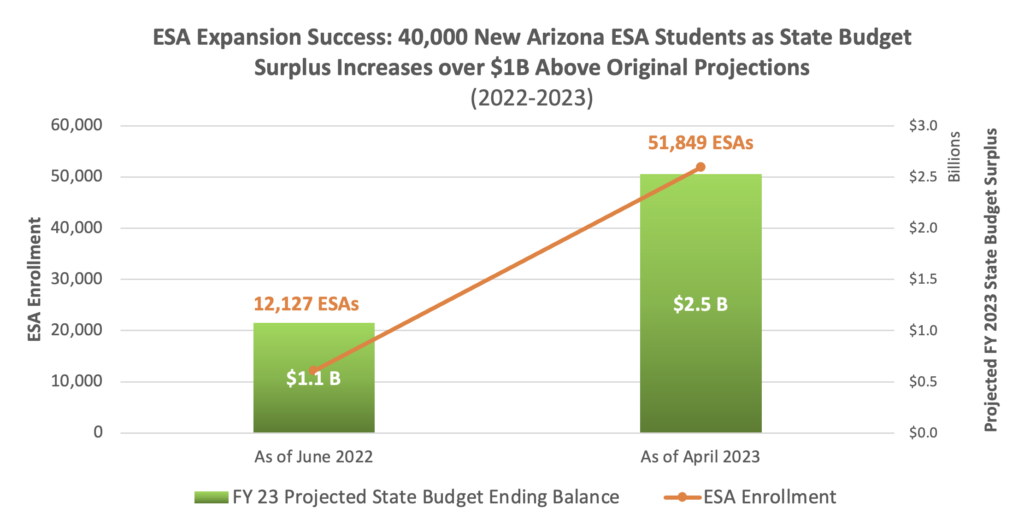
In the first four months of 2023 alone, enrollment in Arizona’s ESA program has soared by 7,000 students, bringing the total number of children served to over 51,000. And now, new data released this past week by the nonpartisan Joint Legislative Budget Committee (JLBC) show that over a similar period, the state’s estimated revenue surplus has surged by an extra $750 million, putting the total state budget surplus this year at $2.5 billion.
Before Arizona’s historic universal ESA expansion took effect, just 12,000 students were participating in the program. This means that during the first school year where every family in the state can use their child’s public education dollars to customize that student’s schooling, nearly 40,000 new students have received ESA support for private or at-home learning opportunities. And all this is happening as state coffers have overflown with over $1 billion dollars more in revenue than originally forecast.
Sources: Arizona Joint Legislative Budget Committee (JLBC) FY 2023 Appropriations Report: $1,077,036,700 projected FY 2023 ending balance based on enacted budget. Arizona JLBC Finance Advisory Committee April 2023 Briefing Materials: $2,530,157,100 projected FY 2023 ending balance (revised). Arizona Department of Education ESA Program 2022 Quarter 4 Report: 12,127 ESA students. Arizona Department of Education ESA Program Homepage as of April 17, 2023: 51,849 ESA students.
Indeed, this extraordinary economic momentum comes in the wake of Arizona enacting the nation’s first fully universal ESA program. Sponsored by state Representative Ben Toma and signed into law by former Governor Doug Ducey last summer, the new legislation took effect in September 2022.
Since then, leftwing activist organizations such as Save Our Schools (SOS) Arizona have attempted to portray the program as financially ruinous. Yet this same organization—whose leaders were forced to admit that they had miscounted the number of signatures they collected in opposition to the program last fall by more than 50,000—has again opted for partisan wish-fulfillment rather than numerical reality.
With a typical ESA scholarship award around $7,000 per student—that is, about half of the roughly $14,000 spent on average per student in a public district school—the ESA program now serves roughly two kids for the cost of each one in a traditional public school district.
Unsurprisingly, when compared to the roughly $15 billion now spent each year on Arizona public schools, the ESA program makes up only a sliver of total K-12 spending. Scholarship awards for students who’ve joined the program under the universal ESA expansion amount to roughly 2% of the total spending on public school students. In fact, despite claims by SOS and other opponents of school choice that ESAs have drained public schools of funding, state lawmakers increased ongoing public school funding by more than $600 million in the same year that the universal ESA expansion took effect.
In short, the ESA program makes up only a small share of the state’s spending on education, but with over 50,000 participants and growing, it will continue to provide a lifeline for all students in need. It’s already done just that for students with special needs and other vulnerable populations ever since Goldwater created the nation’s first ESA program in Arizona more than a decade ago—delivering life-changing results at lower costs than public school offerings.
Despite such real-world impacts on families, critics have doubled down to suggest that the program’s success is a sign of failure and financial unsustainability. Indeed, teachers union-aligned groups have suggested that because more students have opted into the ESA program than originally estimated, it must be too expensive. (Note the sharp contrast to their usual take on education spending, which is only ever portrayed as an investment, rather than a cost.)
It is true that demand for ESAs has already beaten initial estimates, and it is true that the expansion, which passed in the final days of last year’s legislative session, was enacted separately from the state budget—meaning ESA awards were not incorporated into the projected costs of the original budget. But ESA award amounts have already been factored into the state’s updated budget projections released this January for the current and upcoming fiscal year. In fact, it’s the very same state budget analysts who assume that the program will grow even further to 57,000 students by the end of this school year who also report the state is now sitting on a $2.5 billion cash surplus for next year. (Of note, that surplus is in addition to the state’s $1.4 billion rainy day fund, which former Governor Ducey and conservative lawmakers also accumulated to cushion the state from any future economic turbulence.)
The state budget analysts were characteristically cautious in their recommendations to spread out the massive war chest. They suggested that if all $2.5 billion were spent this year, the state budget would simply break even next year, before the balance increases again to an estimated $600 million surplus by 2026. But in any case, their projections make clear that the same Arizona lawmakers who unleashed universal school choice have helped steward robust economic vitality and have created a situation where Arizona lawmakers are again weighing how best to spend or return excess tax revenues. Indeed, as the JLBC analysts reported in January—even before the latest upward revisions—the state has enjoyed “an increase of $1.06 billion over the original revenue estimate included in the FY 2023 budget enacted in June 2022” due to “significantly stronger revenue growth than originally projected.”
There is no doubt that global financial uncertainty, the risk of fiscal and monetary mismanagement from Washington D.C., and warnings of mild or severe recessions should perennially weigh on the minds of state legislators. But when it comes to ESAs and the state’s financial solvency, one thing is clear: universal school choice and successful economic stewardship easily go hand in hand.
Arizona has just proven it.
Matt Beienburg is the Director of Education Policy at the Goldwater Institute. He also serves as director of the institute’s Van Sittert Center for Constitutional Advocacy.
The public school system in Arizona is a complete mess. But during the past few years, it really hit a new low.
Attempts to indoctrinate children with Critical Race Theory and radical gender theory have been spreading throughout our public school districts. COVID shutdowns have wreaked havoc on students’ education—especially low-income parents and children. In the meantime, public school spending surged during COVID while teacher pay didn’t keep pace. But that didn’t stop failed teachers’ unions like Red4ED from trying to use the “low teacher pay” narrative in their attempts to push more ridiculous tax increases on taxpayers like you.
Of course, all of this is only more infuriating when you consider that the majority of Arizona students continue to fail the statewide assessment. And ACT scores for Arizona students have fallen below the standards for our state universities. That’s why the Club made it a priority to drain the public school swamp in this past November’s election. And we saw some great success…
“This is what Arizonans have been asking for: a voting system that enhances our democracy and increases participation. It’s that simple… We know that when more people get involved and have a say, we have a state that reflects what Arizonans actually want.”
— Arizona Democratic Party Chairman, Senator Raquel Terán (D-Phoenix), speaking at a July 7 press conference about the now-invalidated, dark-money fueled Arizonans for Free and Fair Elections 2022 ballot initiative to roll back voter ID, allow same-day registration, allow outside money into elections offices, and thwart challenges to future ballot initiatives and election results.
– – –
There’s a powerful, secretive infrastructure gunning to flip Arizona blue. Its elements appear disparate, coincidental at best. In truth, each element has a specific role to play: some transient with the fervor and impact of an October surprise, others established with the consistency and familiarity that eludes scrutiny. It is the seeming disconnection of these elements that makes the left’s secretive infrastructure that much more powerful.
The principal source of power is money, and though the left often complains about dark money, they are its principal cultivator by far. Despite this fact, they’re very much in favor of a purported solution to dark money on the November ballot: the Voters Right to Know Act, or Proposition 211. Upon closer examination, the rationale for their support is clear: this proposition comes with neat carve outs ensuring that leftist dark money critical to their Arizona infrastructure remains untouched — namely from corporate media, Big Tech, most labor unions, and “nonpartisan” political action committees. If the proposition is successful, it will enable leftist actors to continue building onto their secretive infrastructure to gain a greater hold of Arizona politics.
If money is the lifeblood, then the body of the left’s secret infrastructure exists in the coordination of 501(c)(3) and 501(c)(4) nonprofits (C3 and C4, respectively), pop-up groups run by nonexistent people and entities that only exist for a few weeks around elections, mystery shell campaigns acting behind a veil on behalf of the Democratic Party and leftist organizations, and political action committees (PACs) dressing up their activity as grassroots work.
Dark money describes a shuffling of funds that intentionally obscures its origins and, ultimately, shapes its targeted political landscape to its liking. This shuffling is accomplished through networks of nonprofits, national organizations backed by a powerful few whose resources eventually shuffle down to more localized organizations.
As you read this article, more discernible traces of this leftist infrastructure are busy at work all around you. In the coming weeks, you will likely notice their fingerprints in campaign ads from groups with unfamiliar, novel names online, on the radio, on TV, and in your mail.
Some of those ads will originate from the Future Forward (FF) PAC, a D.C.-based organization funded initially by Facebook co-founder Dustin Moskovitz and a favorite of Silicon Valley Democrats. According to a trigger report, they paid nearly $246,500 collectively in recent weeks for ad campaigns opposing three of former President Donald Trump’s endorsed candidates: Mark Finchem for secretary of state, Kari Lake for governor, and Abraham Hamadeh for attorney general. Their ad buys were estimated to be a little over $82,100 per candidate.
Since nonprofits aren’t legally obligated to disclose their donors, even for election expenditures, they may trade funds back and forth in the dark at will. Effectively, the leftist infrastructure “washes” the money before it reaches its final destination — they’re arguably the best at it.
The leftist infrastructure far outspends the right. For example, in the 2020 Arizona Corporation Commission race, the left backing Democrats had around $10.2 million in outside spending versus Republicans’ $156,000.
Dark money critic Mark Kelly receives huge boost from dark money group in AZ Senate race https://t.co/lEPT40xutZ
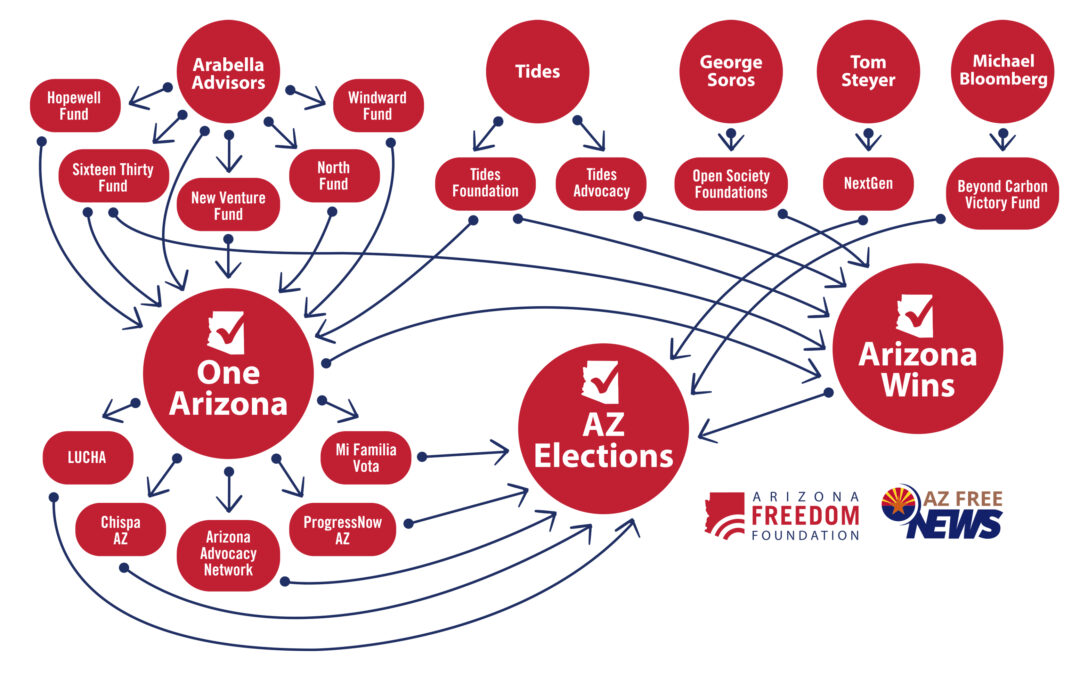
A vast majority of this “washed” money traces back to a few with deep pockets: the Arabella Advisors (Washington, D.C.), the Tides Foundation (San Francisco, California), and George Soros (Katonah, New York). Each boasts revenues and expenditures in the billions annually.
Arabella Advisors issues funds through five distinct nonprofits: the Hopewell Fund, the Sixteen Thirty Fund, the New Venture Fund, the North Fund, and the Windward Fund. In the 2020 election, Arabella Advisors’ nonprofits funneled vast amounts of money into Arizona. The company has nearly $10 billion at its disposal. Their current president and CEO is Rick Cruz.
Arabella Advisors launched in 2005 under Eric Kessler: a self-described “serial entrepreneur” whose career began elsewhere within the left’s network, working as a national field director for the League of Conservation Voters (LCV). When the LCV executive director at the time, Bruce Babbitt (also former Arizona attorney general and then governor), moved up in the political world with the election of President Bill Clinton, Kessler got a boost, too. He became an Interior Department appointee under Babbitt. Once the Clinton administration ended, Babbitt joined former secretary of state Madeleine Albright’s National Democratic Institute (NDI), and shortly after, he launched Arabella Advisors. He remains a senior managing partner for the organization.
The Tides Foundation is one of many nonprofits within a larger network underneath the Tides Network, which is part of the Tides Nexus. It’s similar to another nonprofit within the network, Tides Advocacy (formerly the Tides Advocacy Fund, the Advocacy Fund, and the Tsunami Fund). The Tides Foundation is chaired currently by Roslyn Dawson Thompson, the former president and CEO of Texas Women’s Foundation (formerly Dallas Women’s Foundation), another left-wing nonprofit.
The Tides Foundation began in 1976 with Drummond Pike, a liberal political activist allied with Wade Rathke, who founded the defunct advocacy group esteemed by Secretary of State and gubernatorial candidate Katie Hobbs, Association of Community Organizations for Reform Now (ACORN). The organization received initial financial backing from Reynolds tobacco heiress Jane Lehman, who chaired the organization until her death in 1988.
Finally, George Soros is considered a principal financial backer for a wide array of Democratic Party efforts. Soros channels funds to various Arizona PACs and organizations through his Open Society Foundations (OSF). He also channeled funds through his Democracy PAC, which funneled over $1 million at least into Arizona for the 2020 election to Not Our Faith, Arizona Wins, and ProgressNow Arizona, respectively. The Democracy PAC gave $100,000 last year to Way to Lead PAC, chaired by Dacey Montoya. Montoya, also former chair of the now-inactive Not Our Faith, also owns the Money Wheel: a consulting firm that Democratic candidates and groups have paid hundreds of thousands into since 2018.
Leftist C3 and C4 nonprofits have a unique codependency in Arizona. While both receive tax-exempt income, C4s may engage in political activities like lobbying and campaigning while C3s generally may not.
Since C4s may engage in election activities, politically driven C3s fund C4s. However, those C3s don’t stop there. They ensure that their funds are spent properly by coordinating through grassroots lobbying. In contrast to direct lobbying, grassroots lobbying mobilizes the public on political issues.
In Arizona, major politically driven C3s include AZ Wins, One Arizona, ProgressNow AZ, and Save Our Schools Arizona (SOSAZ) Network.
One Arizona exemplifies the C3 to C4 relationship. This C3 nonprofit is a coalition of leftist groups, among which is Mi Familia Vota, a C4. One Arizona routes funds to Mi Familia Vota and coordinates grassroots lobbying efforts. Their biggest funders include the Tides Foundation, George Soros’ Open Societies Foundation, and several different organizations under Arabella Advisors.
Hundreds of organizers are out talking to Arizona voters now. They've been out since 6 am and will be out til the polls close.
C3 resources and support put the wind in C4 sails. In 2020, it was Mi Familia Vota that successfully sued to extend the voter registration deadline another 18 days — just 11 days before the Election Day.
BREAKING:Voter registration deadline has been extended to October 23rd 5pm! Thank you @MiFamiliaVota & @OVOV_AZ! #MFV and so many grassroots organizations have been hard at work for more than a decade to ensure our voices are heard at the ballot box! This year was no exception! https://t.co/iQf6fZ0Exb
— Raquel Terán #BlackLivesMatter (@RaquelTeran) October 6, 2020
The Pop-Up Groups
Another integral component of the left’s secretive infrastructure exists within various “pop-up groups.” These are political groups that appear shortly before an election and become inactive after the election ends, made up to appear like an authentic group of concerned citizens and not political activists working on behalf of a party.
Oftentimes, the identifying information given by these pop-up groups upon registration is untraceable: faulty or fake phone numbers, addresses, and personnel. Yet somehow, even with their tight deadline and obscurity, these pop-up groups manage to have enough voter contacts and resources for mass outreach efforts.
This year, a pop-up PAC by the name of “Defend Arizona Rights” registered in late June. As of this report, nearly all of their income — which came from Damon Ely, a Democratic state representative and attorney from New Mexico — went toward a website to oppose Proposition 309 (SCR1012), the ballot measure to require voter ID.
A prominent example of a pop-up group from 2020 was “Arizonans for Energy Independence,” which focused on the Arizona Corporation Commission race. They registered with the secretary of state about two weeks before the election. Their listed phone number led to an alarm business, their address was a shipping service location, and the only listed officer appears to be a ghost. Those who signed petitions from NextGen America received text from Arizonans for Energy Independence in late October.
NextGen America (formerly NextGen Climate) is one of multiple major leftist C4s that bankrolls the leftist infrastructure.
The Shell Campaigns
Much like pop-up groups, leftist shell campaigns are driven and largely funded by a political party. Unlike pop-up groups, however, these shell campaigns last for the entire election year and usually hire several identifiable staffers. Markers of a shell campaign include political attack-dog websites, ad campaigns, and artificial demonstrations staffed by professional activists staged to look spontaneous.
One example of a shell campaign from 2020 was Arizona Families First — not to be confused with Arizona Families F.I.R.S.T., an Arizona Department of Child Safety (DCS) program for parental substance abuse.
The Arizona Families First PAC was live for all of 2020, then went inactive after the election. The Arizona Democratic Party was the primary bankroller, pouring $1.7 million total into the PAC; the party launched the PAC with $45,000 contributions from February to March of 2020.
The PAC spent close to $2 million altogether on outreach: over $1 million on mailers, $916,900 on digital ads, $25,000 on radio ads, and $10,800 on its website. It also spent nearly $21,000 on legal services from Coppersmith Brockelman — a go-to law firm for Democrats, from which the newly appointed Biden nominee for the Ninth Circuit Court of Appeals, Roopali Desai, hailed. The director of Arizona Families First, Ramon Alvarez, earned over $70,400.
With the 2020 election concluded and their work done, the PAC refunded their remaining $15,400 back into the Arizona Democratic Party last February.
Other major funders of the Arizona Families First PAC included tens of thousands respectively from the National Institute for Reproductive Health Action Fund, Healthcare Rising AZ, Working for Working Americans Non-Federal Arizona PAC, 314 Action Victory Fund, and Trilogy Interactive.
Several corporations gave thousands to the PAC: Zillow, Pepsi, Intuit, and Sanofi. Additionally, the PAC received a smaller donation from one of the prominent families contributing to the state’s leftist infrastructure: Abby Rockefeller.
An example of a shell campaign from this year was Arizonans for Free and Fair Elections PAC. They launched last December with the purpose of getting their eponymous initiative on the ballot, which aimed to roll back voter ID, allow same-day registration, allow outside money into elections offices, and thwart challenges to future ballot initiatives and election results. AZ Free News issued a detailed report in July on the leftist infrastructure funding behind this shell campaign.
According to the secretary of state’s campaign finance reporting site, the last expenditure for that shell campaign was $50,000 to the Barton Mendez Soto law firm last November — a month before the PAC registered with the secretary of state.
The Left’s Use of Arizona-Based PACs to Shuffle Money
There are over 900 PACs listed as active through the Arizona Secretary of State. Of these, a handful serve as consistent conduits for the leftist infrastructure’s funds under the title of grassroots work. These include One Arizona/Arizona Wins, Mi Familia Vota, Arizona Advocacy Network, ProgressNow AZ, Living United for Change in Arizona (LUCHA), Opportunity Arizona, Mijente, PODER in Action, Forward Majority Action Arizona, Way to Lead Arizona (Way to Lead PAC), and Future Now Arizona.
None of them broke the secretary of state’s campaign finance top ten for major income and expenditures this year. There are others who made that list: those who have raised and spent mass amounts of funds in a short window of time this year. They may be classified as shell PACs integral to the leftist infrastructure since they assume a local identity while receiving and distributing funds from out-of-state Democratic billionaires and the three primary financiers of Democratic money (Arabella Advisors, Tides Foundation, and George Soros).
While not a complete pitcure, the above graphic illustrates some of the connections in the left’s secretive infrastructure and how they relate to Arizona elections.
According to the secretary of state’s campaign finance portal, these are the PACs with the top 10 incomes this year:
$8.2 million, The PAC for America’s Future – AZ
$7.6 million, Arizonans for Free and Fair Elections (review previous section for details)
$3.5 million, Arizonans Fed up with Failing Healthcare, or Healthcare Rising AZ
$2.2 million, Put Arizona First
$2 million, Worker Power PAC
$1.4 million, Our Voice Our Vote Arizona PAC
$1.3 million, DLCC Victory Fund
$775k, ActBlue Arizona
$737k, Arizona Pipe Trades 469
$665k, United Food & Commercial Workers Union of AZ Local 99
And these are the PACs with the top 10 expenses this year:
$5.2 million, Republican Governors Association (RGA) Arizona PAC
$3.4 million, Arizonans Fed Up with Failing Healthcare (Healthcare Rising AZ)
$3.3 million, The PAC for America’s Future – AZ
$2.2 million, Put Arizona First
$1.5 million, Republican Attorney Generals Association (RAGA) Arizona for Freedom PAC
$1.3 million, Arizonans for a Just Democracy
$885k, Planned Parenthood Votes
$817k, Southwest Regional Council of Carpenters Legislative Improvement Committee
$800k, National Rifle Association (NRA) Political Victory Fund
$786k, Arizona Pipe Trades #469
Of all these PACs, a prime example of the left’s money “washing” that’s also most cryptic in its origins and nature would be Arizonans for a Just Democracy. The PAC launched last July, with a mailing address located at the same UPS store in Phoenix as ProgressNow Arizona and Arizona Wins. Their website hasn’t been updated since their launch.
Arizonans for a Just Democracy only has four donors listed, of which three are: Merle Chambers, millionaire Democratic funder; the Arabella Advisors’ Sixteen Thirty Fund, and a ghost of a PAC called “The Future We Want.” That last PAC also has a mailing address at the same UPS store; its chair is Juliana Horwin, a former educator with the Arizona Education Association (AEA).
According to the Federal Election Commission (FEC), a similarly named Super PAC was active from 2018 to 2019 and its sole financier totaling $547,000 was a Phoenix-based PAC called “Citizens for Accountable Government” (yet somehow it spent over $716,000). Citizens for Accountable Government’s mailing address is also located at the same UPS store and shares the same treasurer as The Future We Want, Isis Gil of the Puente Human Rights Movement. Citizens for Accountable Government’s chair is Chris Love: the former Planned Parenthood Advocates of Arizona (PPAZ) chair. Their primary funds come from either The Future We Want or Arizona Wins.
Arizonans for a Just Democracy’s chair, Grecia Lima, is the national political director for Community Change (also known as Center for Community Change) and its advocacy arm, Community Change Action. Community Change receives mass funding from the Democratic network: Democracy Alliance, AFL-CIO, Planned Parenthood. The PAC’s treasurer is Sarah Michelsen: the senior campaign strategist for the ACLU, and as of June 2021 the owner of “Michelsen Strategies,” a Phoenix-based campaigning firm. From the moment Michelsen launched her firm until present, she’s raked in at least $18,300 from the Arizonans for a Just Democracy PAC.
Michelsen has worked with the Center for Progressive Leadership, Arizona Wins, NARAL Pro-Choice Arizona, Planned Parenthood Advocates of Arizona, and Bernie Sanders’ presidential campaign.
Then there’s PAC for America’s Future – AZ. Of their $8.2 million in income this year, not even half of a percent came from Arizonans ($16,800, composed of many individual donations ranging from $25 to $1,000). The vast majority of the PAC’s major funding came from Democrat billionaires. This PAC plays an integral role in ensuring Arizona’s leftist infrastructure is relied upon both locally and nationally — it passes along funds to PACs, organizations, and committees across other states. Only $106,000 went to Arizona candidates, all Democrats; $260,000 went to the Arizona Democratic Party. That’s four percent of their income this year.
As AZ Free News reported in August, about half of Healthcare Rising AZ’s funds came from the California union, SEIU United Healthcare Workers. Its main expenses were for signature-gathering efforts for its Predatory Debt Collection Act, a ballot initiative to thwart debt collection efforts.
The RGA Arizona PAC receives its funds from its national affiliate, the Republican Governors Association, and all of its expenditures went toward ad campaigns against Democratic gubernatorial candidate Katie Hobbs.
RAGA Arizona for Freedom has spent nearly equal amounts of over $700,000 each on ad campaigns to support Republican attorney general candidate Abraham Hamadeh and oppose Democratic attorney general candidate Kris Mayes.
Likewise, the NRA Political Victory Fund spent nearly equal amounts of over $400,000 each on ad campaigns to support Republican gubernatorial candidate Kari Lake and oppose Democratic gubernatorial candidate Katie Hobbs.
This is Part One in a series on the Democratic dark money network in Arizona. Be sure to sign up for our newsletter to be notified of Part Two in the series.
Corinne Murdock is a reporter for AZ Free News. Follow her latest on Twitter, or email tips to corinne@azfreenews.com.
If you’re confused about the Arizona Empowerment Scholarship Account (ESA) program expansion to all Arizona K-12 students, you’re not alone. The recent passing of HB 2853, gives parents and guardians who opt out of the public-school option, a portion of taxpayer funds to use for tutoring, private school tuition, home schooling, and special-needs therapies. Much of the confusion comes from advocates for and against this expansion by complicating the issue with opposing scenarios.
I believe both sides of the debate must begin under the auspices of Arizona law. Specifically, the Parents’ Bill of Rights, which states: “All parental rights are reserved to a parent of a minor child without obstruction or interference from this state, including the right to direct the education, upbringing, moral or religious training and make all health care decisions for their minor child.”
Opponents to Arizona’s ESA program expansion, like Save Our Schools and teachers’ unions, who have tried and failed to get enough signatures to stop HB 2853, feel parents are unqualified and can’t be trusted with these taxpayer funds to direct the education of their children. The Democrats of Greater Tucson take that mistrust of parents to a heinous level in a recent post. They write “With no accountability protocols, this creates an opportunity for extremist-xenophobic-homophobic-white nationalist-MAGA groups to develop their own little Hitler Youth Academies to indoctrinate impressionable minors.” The four false cheering points of the anti-ESA crowd can be easily debunked with facts:
ESAs don’t siphon funds away from public schools: The inconvenient truth as explained by the Goldwater Institute is the “ESA program now gives back nearly $1,000 per child to the public school system each time a student switches to an ESA from a public school. This is because ESA students forfeit their funding from several pots of state taxpayer funded money (such as the ‘Classroom Site Fund’ and ‘Prop 123’ add-on revenues) when they leave their district or charter school, and all of that money gets redistributed back to the public school system instead. (For instance, for the 2022-2023 school year alone, the Classroom Site Fund raised $945 million dollars, with every one of Arizona’s 1.1 million public school students getting almost $900 each from it. ESA students, on the other hand, completely give up their claim to those dollars and instead send them back to their public-school peers, who end up with more money per pupil than they had before.” Read more here.
ESAs do have monetary accountability and transparency: According to the Arizona Department of Education’s 2022/2023 ESA Handbook, when an Account Holder enters into an ESA contract with the Department, the Account Holder is required to report all expenses made with ESA funds. To maintain ESA program eligibility, debit card receipts must be submitted in the quarter that the transaction occurred. Complete invoices or receipts must be included when submitting expenses or making payments in the “Class Wallet” platform. All required credentials must be included when submitting debit card receipts or reimbursements.
Parents can’t spend the ESA money on anything they want: The Arizona Department of Education’s 2022/2023 ESA Handbook is quite clear on their “Spending and Program Requirements” in Chapter 2. There are twenty-one out of seventy pages in this handbook explaining what is approved and unapproved spending. For instance, if your child needs a computer for online classes, you would think that is an approved expenditure, but it’s not.
ESAs have academic accountability and transparency: I find the teachers’ union claim to the contrary laughable after the Arizona Department of Education’s recent release of the state’s assessment data. Overall, only 41% of students passed the English component, and a mere 33% passed the math portion. Where is the accountability for this disaster?
The biggest inconvenient truth is that home-schooled and private school students outperform public school students on state standardized tests and college entrance exams. As the number of homeschooled children in the United States grows, the statistics of student outcome cannot be ignored. According to Think Impact, homeschooled students score between 80% and 90% regardless of their parents’ level of education. On average, homeschooling one child costs the parent(s) between $700 and $1,800.
Business Wire, a Berkshire Hathaway company, reports a Back to School Survey shows 47% of parents are considering dropping school and going to homeschooling. Results from the EdChoice survey in 2020 showed that the top reasons parents had considered homeschooling before the COVID-19 shut down included freedom in exploring their child’s interests; safety concerns about schools; schools did not meet the needs of the children; and parents wanted to mold their children as per their own practices and beliefs.
Our education system has become a bloated, bureaucratic mess that is desperately trying to hang on to power over our children that is not legally theirs to have. Schools have one job, and that is to give our children a great academic education and they are failing. Compared to other nations, the United States fell to 24th in high school literacy in 2012 and continues to decline.
Parents, guardians, and concerned citizens are on the front lines, exposing the inconvenient truths regarding problems in our schools. We need to give them our support. I don’t believe the teachers’ unions, Save Our Schools, and their media cohorts are going to give up after their first defeat to stop ESA expansion.
Please contact your state representatives and tell them to uphold Arizona law which gives our parents the right to direct the education of their children.
Michele Hamer is a candidate for the Prescott Unified School District Governing Board. You can find out more about her campaign here.
What’s the difference between 141,714 and 88,866? Take a few seconds to do the math, and feel free to use a calculator if you’d like.
If you answered 52,848, you’re correct! Congratulations and give yourself a pat on the back because your math skills are far superior to those of Save Our Schools (SOS) and the rest of Arizona’s teachers’ unions.
On Friday, SOS Executive Director Beth Lewis boldly proclaimed—with all the confidence in the world—that the wall of boxes she was standing in front of contained the signatures of 141,714 Arizona voters who supported a ballot initiative aimed at overturning universal Empowerment Scholarship Accounts (ESA) in Arizona. She was giddy. Her supporters cheered. SOS declared blocking universal school choice for all a “historic victory.” And corporate media jumped on the opportunity to push their narrative, accepting everything SOS said at face value.
But there was a problem. And that’s where simple math comes into play…