by Staff Reporter | Feb 27, 2026 | News
By Staff Reporter |
The Arizona Senate approved legislation to facilitate coordination between law enforcement and federal immigration agents.
SB 1055 passed 16-11, with all Republicans in support and all Democrats against.
The bill requires law enforcement to notify either Immigration and Customs Enforcement (ICE) or Customs and Border Protection (CBP) immediately following the arrest of an individual who is discovered to be an illegal alien.
The bill sponsor, Sen. Wendy Rogers (R-LD7), says this will give law enforcement the sense of security they deserve to appropriately process individuals with deportation orders. Rogers said her legislation was necessary to support safe neighborhoods and consistent enforcement within public safety.
“When someone is under arrest and unlawfully present in our country, law enforcement should never have to hesitate, second-guess, or worry about whether doing the right thing will jeopardize their career,” said Rogers. “For too long, unclear policies and political pressure have created confusion that undermines public safety and puts officers in an impossible position.”
Given the partisan nature of the bill, it’s highly likely the legislation will die under Gov. Katie Hobbs’ veto pen should it pass the House.
The first to speak against the bill during Monday’s floor vote was Assistant Minority Leader Catherine Miranda (D-LD11). She said the bill wasn’t needed. Miranda discouraged the idea that Arizona law enforcement needs to support ICE in deportation proceedings, since ICE agents were “terrorizing” communities across the nation.
“[SB1055 is] unnecessary and strives to increase fear in communities and empowers all law enforcement to act as ICE agents,” said Miranda.
During the committee hearing on the bill last month, Miranda said she carries all of her sensitive personal documents in her car — her birth certificate, Social Security card, and passport — just in case law enforcement questions her citizenship.
Sen. Sally Ann Gonzales (D-LD20) claimed the bill would cause racial profiling.
“Our communities are already, you know, not feeling well, not wanting to go to work, school, or otherwise because of what is happening in our communities with the federal immigration process that’s happening in and around our communities,” said Gonzales.
Sen. Analise Ortiz (D-LD24) called it an “anti-public safety bill” and “cruel.” Ortiz said the detainment facilities were “death camps.” She opposed the concept of deporting illegal aliens
“It is going to invite a violent, armed paramilitary force to have more unnecessary interactions with our communities,” said Ortiz. “ICE out of Arizona, ICE out of our communities.”
Similarly, Sen. Lauren Kuby (D-LD8) said ICE was too dangerous and relying on poorly trained and violent forces.
Majority Leader John Kavanagh (R-LD3) said it was effective government to have local law enforcement cooperating with federal law enforcement. Kavanagh lamented the likely veto from Hobbs.
“People who are accused of being here illegally need to be brought to justice,” said Kavanagh. “We shouldn’t be trying to hamper [the lawful execution of our laws].”
Sen. Jake Hoffman (R-LD15) reminded his colleagues across the aisle that the bill impacts individuals who were already arrested for committing a crime and in custody.
“It’s absurd that you would not want the criminals who come over illegally removed from this country. Apparently it’s just lawlessness run amok in this chamber. We are hearing [Democrats] advocate for not turning over illegal alien criminals to federal immigration law enforcement,” said Hoffman.
As a response to Democratic lawmakers citing the Minnesota deaths of anti-ICE activists Alexi Pretti and Renee Good, Hoffman read off a handful of the names of individuals murdered by illegal aliens, which prompted an outburst from the audience.
Minority Leader Priya Sundareshan (D-LD18) dismissed Hoffman’s list of victims, saying all illegal aliens who committed those crimes were facing charges unlike the officers involved in the Pretti and Good deaths. Sundareshan took issue that individuals arrested for civil violations, not just criminal violations, may face deportation.
“In this country we are innocent until proven guilty,” said Sundareshan.
Sen. Mitzi Epstein (D-LD12) said this would allow “perfectly innocent” individuals to be arrested and attacked.
“ICE has become an agency of thugs who do not follow the law,” said Epstein. “I am afraid of ICE agents.”
AZ Free News is your #1 source for Arizona news and politics. You can send us news tips using this link.
by Staff Reporter | Feb 23, 2026 | News
By Staff Reporter |
The Republican-led Senate is poised to vote on multiple bills that would impose greater restrictions on gender transition procedures in Arizona.
The Senate Health and Human Services Committee passed four bills targeting different aspects of gender transition procedures: Senate Bills 1014, 1177, 1094, and 1095. All with the exception of SB 1095 were heard in committee last week. All were passed without the support of Democratic lawmakers.
Progressive activists lined up to testify against the bills during the several committee hearings.
SB1095, which would ban gender transition procedures for minors, provoked testimony from several activist adults who identify as transgender.
Former Liberty Elementary School District governing board member, Paul Bixler, said SB1095 would harm, not help, children. Bixler, a man, identifies as a transgender woman.
Ruth Carter, an attorney, said SB1095 amounted to discrimination. Carter, a woman, identifies as a nonbinary individual.
Marilyn Rodriguez, Creosote Partners founder and lobbyist representing the ACLU, said SB1095 was impermissibly broad as written.
Sen. Lauren Kuby (D-LD8) called the bill discriminatory, and argued that lawmakers shouldn’t ban gender transition procedures since certain healthcare experts support those procedures as treatments for gender dysphoria.
“These are private, personal decisions, healthcare decisions, we shouldn’t be discriminating against transgendered youth or those who have gender dysphoria as is described,” said Kuby.
Sen. Analise Ortiz (D-LD24) said the legislature would be better focusing on making healthcare more affordable. Ortiz said the legislation was not only discriminatory but violative of parental rights laws.
“It bans healthcare for a specific group of people solely based on gender identity; that is discrimination no matter how you want to paint it,” said Ortiz.
Sen. Mark Finchem (R-LD1), the bill sponsor, disputed the narratives of his Democratic colleagues that healthcare experts were to be trusted fully and that gender transition procedures were appropriate for minors.
“To those who worship the grounds that doctors walk on: they also said cigarettes were good for you,” said Finchem. “[Permanently altering treatments like mastectomies] are decisions that kids are being talked into, in some cases. I didn’t just dream this bill up myself. This came from kids and parents. More kids than parents.”
Majority Leader John Kavanagh (R-LD3) questioned the logic of his Democratic colleagues that parents had a right to submit children to irreversible medical treatments, but not the right to decide whether their children should be called by certain pronouns or alternative names in school.
SB 1014 would require health insurers to offer coverage for detransition procedures should those insurers provide coverage for gender transition procedures. It would also issue reporting requirements on insurance claims for gender detransitions.
“Detransitioners are people too; they deserve the same care as those who are manipulated into believing they have gender dysphoria, which leads them to undergo gender transition surgery that they later regret,” said the bill sponsor, Sen. Janae Shamp (R-LD29), in a press release. “This legislative package puts their long-term well-being above politics and ideology.”
Jeanne Woodbury, a lobbyist for the ACLU, argued the reporting requirements within the bill would result in discriminatory outcomes.
Bixler, the transgender-identifying former school board member, claimed the bill would result in providers refusing to provide gender transition procedures.
SB 1177 would ban public funding for gender transition procedures.
Sen. Wendy Rogers (R-LD7), the bill sponsor, explained during Wednesday’s HHS hearing that she discovered taxpayers were funding gender transition treatments for prisoners. Rogers also discovered that individuals were being arrested on purpose in order to receive free gender transition treatments.
“Taxpayer dollars should never be used to bankroll irreversible procedures on children,” said Rogers in a later press release. “This legislation draws a hard line and makes clear that public funds will not subsidize experimental or life-altering interventions on minors.”
Ashton Allen expressed support on behalf of Center for Arizona Policy. Allen said subsidies should be tied to valid medical treatments, which he said gender transition procedures weren’t.
Woodbury, the transgender-identifying ACLU lobbyist, argued against Rogers’ claims and said the treatments were affordable. Woodbury also said an end to subsidization would lead to excessive medical risks associated with forced detransitions.
Minority Whip Rosanna Gabaldon (D-LD21) said ending subsidies was “extreme and punitive,” as well as “unfair and dangerous.”
Sen. Sally Ann Gonzales (D-LD20) accused Rogers of faking a story that individuals were getting themselves arrested in order to receive free gender transition treatments. Gonzales called the bill discriminatory.
Sen. Shamp questioned why drugs historically considered to be dangerous were suddenly ethical in the context of gender reassignment.
“Lupron was deemed cruel and unusual punishment being utilized in the prison system for sex offenders, rapists. But now we want Arizona taxpayers to pay for that drug to be utilized for gender reassignment? How the heck did we get here?” said Shamp.
SB 1094 would allow individuals to seek damages in court against physicians who performed gender reassignment surgeries on them as minors. Kavanagh sponsored the bill.
“When permanent procedures are performed on minors who suffer harm, there must be consequences,” said Kavanagh in a press release. “These reforms restore transparency and provide a pathway to just compensation for those harmed.”
AZ Free News is your #1 source for Arizona news and politics. You can send us news tips using this link.
by Matthew Holloway | Feb 16, 2026 | News
By Matthew Holloway |
Arizona lawmakers approved a Republican-sponsored bill granting full property tax exemptions to veterans with a 100% service-connected disability, advancing the measure with bipartisan support before it was signed into law last week.
The bill, HB 2792, was approved unanimously by the Arizona House and moved through the Senate as SB 1268 with near-unanimous support before reaching the governor’s desk. The House measure was sponsored by Majority Leader Carbone (R-LD25). Senator David Gowan (R-LD19) sponsored the corresponding legislation in the Senate.
According to Senate records, the sole dissenting vote was cast by Democratic Senator Sally Ann Gonzales, who represents Legislative District 20.
Under the legislation, a veteran determined by the U.S. Department of Veterans Affairs to have a 100% service-connected disability will qualify for a full property tax exemption on their primary home. The exemption also extends to surviving spouses, provided they remain in the residence and do not remarry.
“This bill keeps a simple promise,” Carbone said in a statement. “If a veteran sacrifices their health in service to America, the government should not tax them out of their home. We worked directly with county assessors to ensure the law is clear and properly implemented. Preserving homeownership for those who earned it is central to the House Republican Majority Plan and to preserving the American Dream. This law delivers direct relief, limits government reach, and stands up for veterans and their families.”
The change codifies and expands existing law that previously provided partial exemptions based on disability percentage and income limits. State personal exemption programs already allow a reduction in assessed value for certain disabled veterans, widows, and widowers, and can result in full relief in some cases.
In a post to X, Senate GOP leaders wrote, “Arizona Republicans are fighting to eliminate property taxes for veterans with 100% service-connected disabilities. SB 1268 and HB 2792 deliver full property tax relief on their primary residence. These men and women gave everything for our country. The least we can do is make sure they can stay in their homes.”
County assessors across the state have begun notifying eligible residents of the change and encouraging veterans and surviving spouses to file applications for the exemption through their local assessor’s offices. For example, the Santa Cruz County Assessor’s Office states that the new law is effective for the 2026 tax year and details documentation requirements, including VA disability certification and proof of property ownership.
Applications for individual exemption programs generally must be filed with county assessor offices by the February 28 deadline, according to the Maricopa County Assessor’s Office. This deadline may be extended to September 1 with an approved Exemption Deadline Waiver.
Speaking to reporters on Thursday, Carbone said, “This is about fairness. It’s about honoring service, and it’s about ensuring the most vulnerable among us can remain in their homes with dignity and integrity.”
The legislation brings Arizona in line with property tax relief policies in several other states that offer full or partial exemptions for disabled veterans on their primary residences.
Matthew Holloway is a senior reporter for AZ Free News. Follow him on X for his latest stories, or email tips to Matthew@azfreenews.com.
by Corinne Murdock | Jul 19, 2023 | Education, News
By Corinne Murdock |
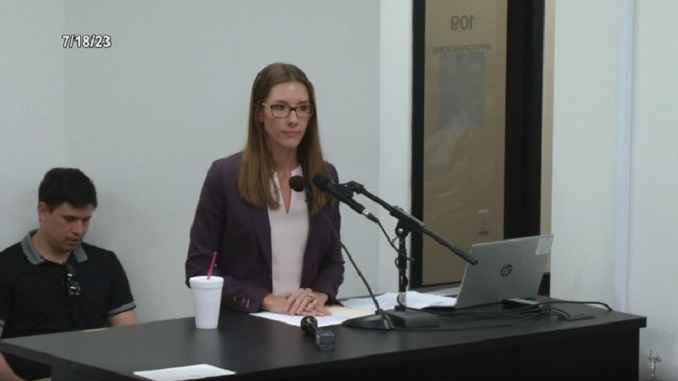
On Tuesday, a joint committee of the Arizona legislature launched an investigation into allegations of censorship at Arizona State University (ASU). Lawmakers issued a 60-day deadline to conduct the investigation.
The directive arose from the Joint Legislative Ad Hoc Committee on Freedom of Expression at Arizona’s Public Universities hearing concerning the T.W. Lewis Center, shuttered this year after the revocation of $400,000 in annual funding from its namesake, Tom Lewis, who cited “left-wing hostility and activism” as his reason for defunding the program.
Lewis’ contention arose from the efforts of 37 Barrett Honors College faculty members, who launched a coordinated campaign to prevent an event featuring prominent conservative speakers Dennis Prager and Charlie Kirk. Prager testified at Tuesday’s hearing; he also published an opinion piece on the event ahead of the hearing.
State Sens. Anthony Kern, co-chair (R-LD27), Frank Carroll (R-LD28), Sally Ann Gonzales (D-LD20), Christine Marsh (D-LD04), and J.D. Mesnard (R-LD13) served on the committee, as did State Reps. Quang Nguyen (R-LD01), Lorena Austin (D-LD09), Analise Ortiz (D-LD24), Beverly Pingerelli (R-LD28), and Austin Smith (R-LD29). Kern and Nguyen served as co-chairs.
“This is to get to the bottom of a state-funded university that is not meeting its obligation to freedom of expression and freedom of speech,” said Kern.
The center relied on an annual budget of around $1 million; ASU representatives explained that the center would live on through the classes taught, though the actual center itself and the executive director at its helm, Ann Atkinson, would be gone.
ASU Vice President of Legal Affairs Kim Demarchi explained that Lewis’ funding provided for career development and education. Demarchi testified that ASU considered what programs it could continue without Lewis’ funding, and declared that they could only sustain the faculty without Lewis’ funding. Demarchi also shared that the Barrett Honors faculty weren’t punished in any way for the letter or allegations of intimidation.
“It is possible it [their letter] has a chilling effect,” said Demarchi.
However, Demarchi clarified that a professor would have to explicitly threaten a student’s grade in order to be in violation of university policy.
Atkinson went public with the closure of the Lewis Center last month. (See the response from ASU). She told AZ Free News that the university turned down alternative funding sources that would make up for the loss of Lewis’ funding necessary to keep the Lewis Center running.
Nguyen opened up the hearing by recounting his survival of Vietnam’s communist regime as a child, and comparing that regime’s hostility to free speech to the actions of Barrett Honors College faculty.
“My understanding is that there is an effort to prevent conservative voices from being heard,” said Nguyen. “I crossed 12,000 miles to look for freedom, to seek freedom.”
Nguyen expressed disappointment that none of the 37 faculty members that signed onto the letter showed up to testify in the hearing. He said if he accused someone, he would show up to testify.
Democratic members of the committee contended that the event occurred and therefore censorship hadn’t taken place. Kern said the occurrence of the event doesn’t resolve whether freedom of speech was truly permitted, citing the closure of the Lewis Center.
ASU Executive Vice Provost Pat Kenney emphasized the importance of freedom of expression as critical to a free nation. Nguyen asked whether Kenney read the Barrett letter, and agreed to it. Kenney said the letter was freedom of expression. He claimed the letter didn’t seek cancellation of the event.
“When faculty speak out on their own like that, they’re covered on the same topic we’re here about, which is free speech,” said Kenney.
ASU representatives claimed near the beginning of the hearing that Lewis and ASU President Michael Crow had discussed the withdrawal of funding. However, toward the end of the hearing Kern announced that he’d received information from a Lewis representative that the pair hadn’t discussed the funding, and accused ASU representatives of lying.
Ortiz called the anonymous complaints from students hypotheticals because no formal complaints were lodged. She also claimed that the hearing was merely an attempt to delegitimize public and higher education. Marsh claimed that lawmakers shouldn’t consider the claims of student fears of retaliation because the students should’ve gone to ASU directly.
Nguyen asked whether ASU would defend guest speakers, such as himself, if ASU faculty were to lodge claims of white nationalism. Kenney said that, in a personal capacity, ASU faculty were free to make their claims, but not if they spoke out on ASU’s behalf.
Atkinson contested with the characterization that the Barrett faculty spoke out in their personal capacity. She pointed out that Barrett faculty signed the letter in their capacity as ASU faculty, emailed her using their ASU emails, and sent communications to students about opposing the event using ASU technology.
Ortiz announced receipt of a letter from the Arizona Board of Regents (ABOR) on the outcome of the requested investigation into the incident, the results of which Kern and the rest of the committee appeared to not have been made aware, determining that no free speech violations took place at ASU.
Marsh speculated that the professors didn’t show up because they faced death threats, citing media attention and conservative speaker Charlie Kirk’s Professor Watchlist. Kern said that would be a “lame excuse.” He also pointed out that the professors launched a national campaign and initialized bringing themselves into a bigger spotlight.
“You’re making excuses where we don’t know that’s the case,” said Kern.
Atkinson said that she could provide “dozens, if not hundreds” of students that could testify to experiencing faculty intimidation. She also claimed that Williams told her to avoid booking speakers that were political.
“We allow the speaker but you have to take the consequences,” said Atkinson, reportedly quoting Williams.
Atkinson testified that TV screen ads were removed and flyers were torn down following the Barrett Honors faculty letter. She also said she shared the information for the person responsible on June 13, yet it appears ASU took no action. ASU said they weren’t aware of any advertising for the event pulled.
Additionally, Atkinson testified that Williams pressured her to postpone the event “indefinitely.” She noted that Williams interpreted ASU’s policy of not promoting political campaigns as not allowing political speech at all.
“We were in an environment telling us that this was ‘hate speech,’” said Atkinson.
Atkinson said she was directed by leadership ahead of the event to issue a preliminary warning that the event contained potentially dangerous speech.
Gonzales told Atkinson that hate speech doesn’t qualify as constitutionally protected speech. However, the rules attorney corrected her that the Supreme Court ruled hate speech as protected.
ASU professor Owen Anderson also testified. He said that he’s previously had to get the free speech rights organization Foundation for Individual Rights and Expression (FIR) involved twice due to faculty attempts to suppress free speech. Anderson also said that faculty have attempted to restrict speech by adding anti-racism and DEI to policy on class content and annual reviews of professors.
“Insults abound, but rational dialogue is rare. What we need are administrators that call these faculty to higher conduct,” said Anderson.
In closing, Kern said he doesn’t trust ASU, the University of Arizona, or ABOR. He argued that ABOR hadn’t issued a real investigation and called their report “typical government fluff [and] garbage.” Kern also called for the firing of Barrett Honors College Dean Tara Williams.
Corinne Murdock is a reporter for AZ Free News. Follow her latest on Twitter, or email tips to corinne@azfreenews.com.
by Corinne Murdock | Jan 27, 2022 | News
By Corinne Murdock |
One of the main agenda items for Arizona Democrats in the legislature appears to be major election reform.
Three bills introduced recently would check several of the boxes on the Biden Administration’s election reform checklist: allowing counties to conduct mail-in elections for all elections, lifting the prohibition on ballot harvesting, and establishing automatic voter registration for felons, respectively. None of the bills have appeared before a committee for consideration.
The bill to expand mail-in elections, SB1149, was introduced by State Senator Sean Bowie (D-Chandler). There were seven cosponsors on the bill: State Senators Rosanna Gabaldon (D-Sahuarita), Sally Ann Gonzales (D-Tucson), Lisa Otondo (D-Yuma), Raquel Terán (D-Phoenix), and Diego Espinoza (D-Tolleson), along with State Representatives Jennifer Jermaine (D-Chandler), and Jennifer Pawlik (D-Chandler).
“A county may conduct a mail ballot election for any election administered by that county, including elections administered for federal and state offices and measures, and elections administered for that county and for a city, town, school district, or special district and for any other jurisdiction’s election administered by that county,” read the bill. “A countywide mail ballot election may be conducted only after a vote of approval by the county board of supervisors for that county and if sixty percent or more of the county’s registered voters are on the active early voting list prescribed by Section 16-544.”
Legalization of ballot harvesting, HB2094, was introduced by State Representative Athena Salman (D-Tempe), and gained six cosponsors: Andrés Cano (D-Tucson), Andrea Dalessandro (D-Sahuarita), Melody Hernandez (D-Tempe), Sarah Liguori (D-Phoenix), along with State Senators Juan Mendez (D-Tempe), and Terán.
The bill would strike all provisions related to intentional collection of voted or unvoted early ballots, and the class six felony that comes with that act.
The automatic voter registration legislation, HB2259, was introduced by State Senator Espinoza (D-) and gained Dalessandro and Solorio (D-) as cosponsors. The bill would automatically restore a felon’s right to vote upon conclusion of their probation or imprisonment.
Legislature Republicans have responded in kind with their own legislation. In particular, State Representative Jake Hoffman (R-Queen Creek) introduced three pieces of legislation to prohibit same-day voter registration, HB2237; to prohibit unmonitored ballot drop boxes for early-voted ballots, HB2238; and to require voter registration forms to include a statement notifying the registrant that their registration will be canceled if they permanently move to another state after registering to vote in Arizona, HB2243. All three bills passed through the House Government and Elections Committee narrowly on Wednesday, 7-6. Minority Leader Reginald Bolding (D-Laveen), Alma Hernandez (D-Tucson), Lorenzo Sierra (D-Avondale), Christian Solorio (D-Phoenix), Jermaine, and Liguori voted against them. Judy Burges (R-Prescott), Frank Carroll (R-Sun City West), John Fillmore (R-Apache Junction), Teresa Martinez (R-Oro Valley), Kevin Payne (R-Peoria), and John Kavanagh (R-Fountain Hills) joined Hoffman in voting for his bills.
Corinne Murdock is a reporter for AZ Free News. Follow her latest on Twitter, or email tips to corinne@azfreenews.com.
Page 1 of 11