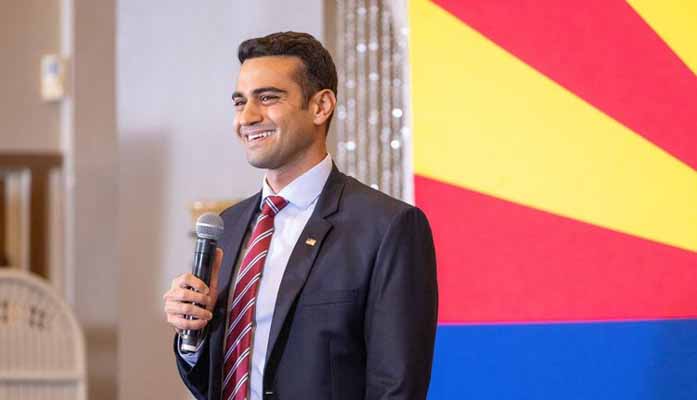
In a major show of support for America’s military heroes, Congressman Abe Hamadeh (R-AZ-08), alongside Senator Pete Ricketts (R-NE), has introduced two companion bills—the Service Members Tax Relief Act and the Tax Cuts for Veterans Act of 2025.
These bills would fully exempt all active-duty and reserve military income, as well as all service-related retirement payments and VA benefits, from federal income taxes.
The Service Member Tax Relief Act eliminates federal income tax on all pay received by active-duty and reserve members across the eight Federal Uniformed Services—including the Army, Marine Corps, Navy, Air Force, Space Force, Coast Guard, NOAA, and Public Health Service Commissioned Corps—as well as their Reserve and National Guard components when on federal orders. This includes base pay, enlistment and retention bonuses, education incentives, and all special and incentive pay.
The companion bill, Tax Cuts for Veterans Act of 2025, amends Section 122 of the Internal Revenue Code to permanently exclude all military retirement pay, retainer pay (Titles 10 and 14), and VA compensation, disability, and survivor benefits (Titles 37 and 38) from federal taxation.
“These bills are in keeping with my commitment to America First principles and advances President Trump’s Peace Through Strength agenda by alleviating the burdens on our service members in some small measure,” said Congressman Hamadeh, a former Army Reserve intelligence officer. “Our service members face high operational demands and cost-of-living pressures that outpace pay tables. So, anything we can cost-effectively do to ease those pressures should be done.”
Senator Pete Ricketts added, “Our servicemembers and veterans sacrifice for the country. We owe them more than we can ever repay. That’s why I’m working to ensure these brave women and men keep all the benefits they earn during military service. We also need to make sure that service members are set up for success when they transition back to civilian life. These bills strengthen our support for Nebraska servicemembers, veterans, and their families.”
Congressman Hamadeh has quickly emerged as a leading voice for America’s veterans and active-duty troops. In September, the House unanimously passed two of his bipartisan bills: the Edith Nourse Rogers STEM Scholarship Opportunity Act and the Health Professional Scholarship Program Improvement Act of 2025.
Congressman Hamadeh and Ricketts’ new bills are now pending in their respective chambers, already earning strong support from veteran advocacy organizations around the country.
Ethan Faverino is a reporter for AZ Free News. You can send him news tips using this link.
School bureaucrats who have mismanaged their finances are hoping that voters will blame a convenient scapegoat: families using Empowerment Scholarship Accounts (ESAs) to educate their children. As usual, their allies in the legacy media are trying hard to help them shift the blame—but the numbers don’t lie.
Channel 12 recently ran a story titled “Deer Valley teachers self-fund or rely on classroom wish lists for basics, while ESA parents buy luxury items with state tax dollars.” Most of the article reads like a press release from Deer Valley Unified School District Superintendent Curtis Finch, who claims that the ESA program has “zero accountability,” “no oversight,” and is “out of control.” Meanwhile, the article quotes teachers in Deer Valley who are spending hundreds of dollars from their own pockets to cover school supplies for their students.
The implication is clear: district schools are financially starved while ESA families waste money on frivolous luxuries. But the reality is exactly the opposite.
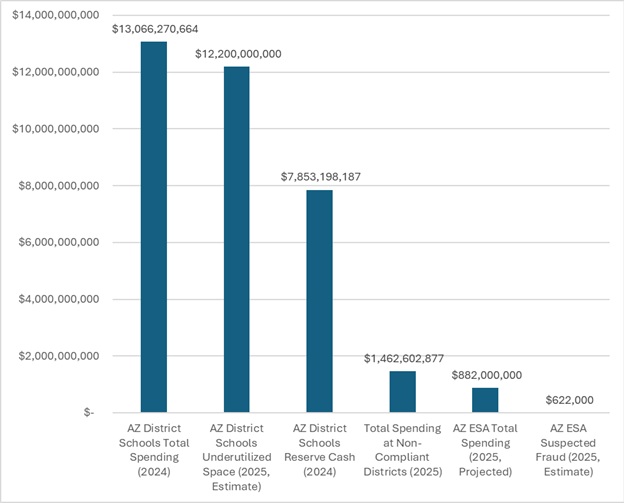
Misuse of the ESA program is vanishingly small. The Arizona Department of Education’s internal audit had turned up $622,000 in ESA funds that are “possible fraud or misuse.” That’s approximately 0.05% of total ESA spending over the past two years.
Misuse of funds in the ESA or any other public program must be detected, deterred, and punished. This is in fact happening in the ESA program, as the Arizona Department of Education had already found the misuse, suspended accounts of those responsible, and reports that it is “in the process of collecting more than $600,000” in improper spending. All of this makes the ESA program far more transparent and accountable than Arizona school districts, which do not post their purchases.
And while Deer Valley teachers may indeed purchase their own school supplies, it has nothing to do with the ESA program and everything to do with misplaced district priorities.
One of the oldest tricks in the school district advocate playbook involves pretending that teachers must buy their own classroom supplies because of a lack of funding. The Channel 12 story cites a Deer Valley biology teacher who said she “spends at least $500 of her own money every summer for her classroom.”
Days after the report aired, former Deer Valley school board candidate Tiffany Hawkins revealed that Deer Valley Unified had spent $560,407 to send students and staff on trips to Disneyland, Knott’s Berry Farm, Sea World, Universal Studios, and other destinations in Arizona, California, Hawaii, Indiana, and Texas. Apparently, the district leadership decided that these trips took precedence over classroom supplies for Deer Valley teachers.
Don’t hold your breath waiting for Channel 12 to cover that. Deer Valley Superintendent Finch—who recently faced charges of stonewalling public records requests and illegal electioneering on school grounds—attacked the ESA program for “out of control” spending with “zero accountability.” But his critiques of the ESA program much more accurately describe spending in his own district.
The Arizona Auditor General reports that Deer Valley spends $13,717 per pupil, meaning that a classroom of 25 students thus generates over $340,000 in total revenue. Where did this money go? Mainly not to teachers.
The Auditor General reports that Deer Valley average teacher pay is $2,163 below the state average. If Deer Valley is not prioritizing teachers, what is it prioritizing instead? The Auditor General report helpfully provides an answer: “high” and “very high” spending on administration and transportation, respectively, compared to a group of peer school districts.
The Goldwater Institute recently published a study of Arizona school superintendent compensation. Goldwater needed to use the open-records law to obtain this information, as districts compensate their superintendents in a variety of creative ways outside of their base salary, including providing either vehicles or “car allowances,” extra retirement benefits, and other perks.
The Goldwater Institute found that Deer Valley provides a total compensation package for their Superintendent of $290,505, including a car allowance of $10,000. This car allowance alone could have provided 20 teachers with $500 each for classroom supplies.
Even if one were to take the highly perverse view that students were the indentured servants of the school districts in which they reside, it would still be absurd for Deer Valley Unified officials to blame their problems on the ESA program. Arizona Department of Education reports show that 10,966 students lived within the boundaries of Deer Valley Unified but attended other public schools in 2024.
Deer Valley Unified meanwhile “drained” almost 3,000 students and their funding from other public schools. At the end of 2024, only 709 students had left a Deer Valley school to participate in the ESA program. Four different public schools outside Deer Valley Unified each have enrolled more students who reside in the district than the ESA program. Moreover 217 total public schools outside the district enroll Deer Valley Unified resident students.
Luckily, Arizona policymakers have decided that Arizona children are not merely funding units for their local school districts. Arizona families can use ESAs to choose the schools that are the best fit for the interests and aspirations of their children.
Arizona school districts have never had as much money as they have now, enough apparently to prioritize trips to California and perks for superintendents. If Deer Valley Unified officials hope to gain the enrollment of the thousands of resident students who have chosen to pursue their education elsewhere, a clear path forward would be to prioritize their funding.
Purchasing classroom supplies for teachers would be a great first step.
Matthew Ladner is a Senior Advisor for education policy implementation and Jason Bedrick is a Research Fellow at the Heritage Foundation’s Center for Education Policy.
Maricopa County has secured a spot among Arizona’s top destinations for retirees, according to a new study by SmartAsset.
The study evaluated counties across the United States based on three key factors: tax-friendliness, access to medical care, and social opportunities, putting Maricopa County as an ideal location for those planning the golden years of retirement.
To assess tax-friendliness, the study calculated effective income and sales tax rates for a retiree earning $35,000 annually from retirement savings, Social Security, and part-time work, determining disposable income after taxes.
For medical care, the study measured the number of doctors’ offices per 1,000 residents, and the same for social opportunities, which measured the number by recreation and retirement centers per 1,000, along with the percentage of seniors in each county’s population.
Maricopa County ranked sixth in Arizona with a Best Place to Retire Index score of 43.1.
The county excels in medical care access, with 3.28 medical centers per 1,000 residents, one of the highest rates in the state.
With a tax burden of 15.82% and an offering of 0.12 recreation centers and 0.4 retirement centers per 1,000 people, Maricopa County provides a balanced environment for retirees seeking affordability, healthcare, and an active lifestyle.
While its senior population is lower at 15.99% compared to the top-ranked La Paz County (42.23%), Maricopa County’s urban amenities and vibrant community make it a standout choice.
Retirement dreams of adventure and relaxation require careful financial planning, often overlooked within daily expenses.
Experts recommend saving 10%-15% of annual income and targeting 25 times the yearly expenses to replace 70%-80% of pre-retirement income. For example, if somebody spends $50,000 annually in retirement, they should aim to save around $1.25 million through 401k, retirement, and other investments.
Maricopa County’s high density of medical facilities ensures retirees’ healthcare needs are met, addressing the rising healthcare costs that often challenge retirement budgets. Its moderate 15.82% tax burden supports financial planning by allowing retirees to stretch their savings further.
Ethan Faverino is a reporter for AZ Free News. You can send him news tips using this link.
This year, the tax cuts from the Trump Tax Cuts and Jobs Act of 2017 were set to expire. Failing to extend the cuts would have resulted in a 22% tax hike for the average taxpayer. For Arizonans, it would have meant an average tax increase of $2,824. And there would have been an even larger tax increase for Arizona small businesses. Thankfully, earlier this summer Congress finally passed Trump’s One Big Beautiful Bill (OBBB), not only extending the personal income tax cuts from 2017 but making them permanent.
The OBBB also included several new tax provisions as well, such as no tax on tips and overtime, an increase in the standard deduction, full expensing and special depreciation for business, just to name a few. This assortment of changes to federal tax law now leaves states like Arizona with a big decision to make: provide partial conformity tax relief, full tax relief, or do nothing and provide no conformity tax relief at all.
This should be an easy choice, as choosing the non-conformity option would leave Arizona taxpayers with one big ugly tax bill to pay.
When we launched the American Conservative Values ETF (ACVF), we did it with an important mission in mind: to give voice to the millions of Americans who are sick and tired of watching their retirement dollars fund woke liberal corporate activism. That mission brought us face to face with a troubling trend: major U.S. companies using their platforms not to grow shareholder value, but to push divisive political agendas. One of the worst offenders is Airbnb.
That’s why, through First Amendment legal powerhouse Alliance Defending Freedom, we’ve filed a lawsuit against Airbnb. The lawsuit says Airbnb violated federal securities law and illegally excluded our shareholder proposal(s) from its 2025 proxy statement. Our proposal was simple.
We wanted Airbnb to explain the risks to its business from denying or restricting service to users based on their religion, political status, or Airbnb’s expansive speech codes. Instead of playing fair and following the law, we believe Airbnb broke the rules to shut us out. Here is a link to the lawsuit.
We believe Airbnb ignored SEC Rule 14a-8, which requires companies to notify shareholders within 14 days if they plan to exclude a proposal and give them an opportunity to challenge that decision. Airbnb didn’t do that. They just silently buried our proposal because it didn’t fit their politics.
Let me be blunt; This is what corporate viewpoint discrimination looks like in 2025. And we’re not going to let it stand.
We believe in free markets and free speech. As institutional investors, we believe that companies, especially publicly traded ones, should be focused on delivering value to their shareholders, not playing political referee. But Airbnb has turned itself into a culture war weapon. And now they’re shutting the door on shareholders who dare to question that approach.
We firmly believe that Airbnb’s behavior isn’t just wrong. It’s illegal. It undermines the entire purpose of shareholder democracy. Rule 14a-8 exists so that companies can’t pick and choose which viewpoints they allow on the proxy ballot. The SEC has made it clear that if a proposal meets the technical requirements, it belongs in front of all shareholders. Period.
When two different conservative groups (our co-plaintiff, The Heritage Foundation, also had a proposal ignored) submit 14a-8 compliant resolutions, those just get “lost in the mailroom.” That proves our point.
It’s our belief that Airbnb isn’t trying to stay out of politics. They’re just trying to silence one side of the political spectrum. Our proposals were lost in the mailroom while a proposal from a left-leaning group managed to make it to the ballot.
That’s why we’re taking this to court. This lawsuit isn’t just about one proposal or one company. It’s about defending the right of every investor including conservative investors to be heard. It’s about holding companies accountable when they break the law to protect their political biases. And it’s about making sure that our money isn’t used against us.
We’re grateful to stand with fellow conservative groups like The Heritage Foundation, our co-plaintiffs in the lawsuit in this fight. We’re grateful to be represented by excellent attorneys at ADF and Boyden Gray. Together, we’re demanding that Airbnb follow the law, include our proposals, and respect the rights of all shareholders, not just the ones who agree with their worldview.
We know this case could set a major precedent. If we win, it will send a loud and clear message to every boardroom in America. Conservatives will no longer be silenced. We have just as much right to shape the direction of the companies we invest in as anyone else. And we won’t stand by while biased corporations break the rules to push their agenda and shut us out.
So Airbnb had a choice. We believe they could have engaged with us, followed the process, and shown respect for their shareholders. Instead, they chose arrogance and exclusion. That choice now comes with consequences.
The woke bubble is bursting. The days of silent conservative investors are over. And we’re just getting started.
William Flaig is a contributor to The Daily Caller News Foundation and the Founder and CEO of the American Conservative Values ETF (ACVF). www.investconservative.com.