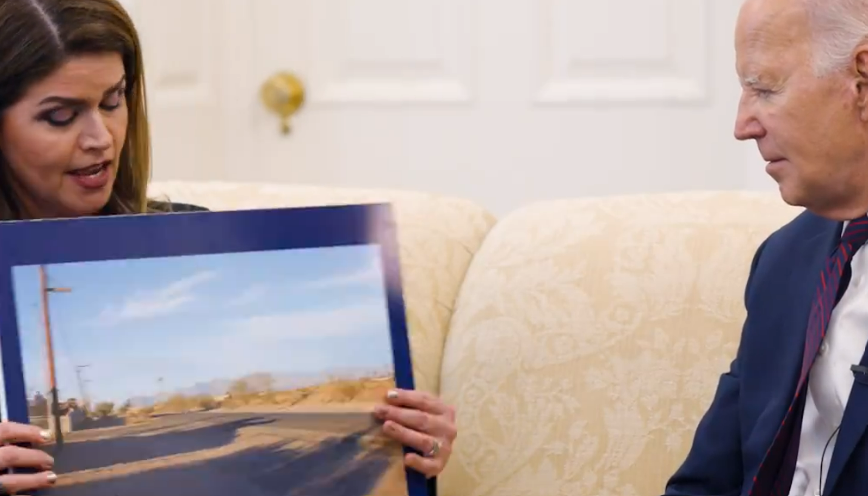
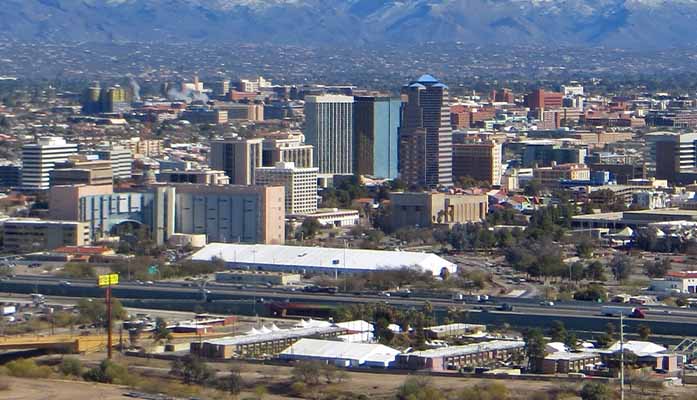
Tucson Mayor Regina Romero told President Joe Biden earlier this week that her plan to plant one million trees in the city by 2030 is on track, yet Tucson is falling far short: only about 100,000 have been planted as of last year.
The initiative, Tucson Million Trees (TMT), would require the city to plant over 128,000 trees annually to reach their goal. Averaging out the number of trees planted since TMT began in 2020, that means the city has only planted about 33,000 trees a year. Should that trend continue, the city will have around 330,000 trees planted by 2030.
“[M]y vision of planting a million trees by 2030 is becoming a reality,” claimed Romero.
I like to say: If you want to get a job done, give it to a mayor.
With some help from our Investing in America agenda, that’s the case for Mayor Romero, whose climate resilient efforts will transform neighborhoods in Tucson. pic.twitter.com/3C0KejvALR
The halted progress in tree-planting has persisted despite the extensive and varied funding sources committed to the initiative, including the $5 million grant issued last September from the USDA for which Romero thanked Biden. That USDA funding came from the Inflation Reduction Act.
The city’s inability to achieve its million-tree goal in a timely manner may have to do with who the city selected to lead the program.
When Romero launched the TMT initiative in April 2020, the city created the new position of “Urban Forestry Program Manager” to oversee it. That position originally paid up to $95,000 annually.
Tucson hired Nicole Gillett for that inaugural role, though it appears that her prior experience didn’t match the listed requirements and preferred qualifications of the program manager’s job description.
Prior to her hiring by the city, Gillett was a conservation advocate for the Tucson Audubon Society from 2017 to 2020. On LinkedIn, Gillett described her conservation advocacy as, mainly, activism for the protections of birds and their habitats.
Prior to that role, Gillett was a graduate student studying community flood resilience in New England — which consisted of small-town flood preparedness and response as well as community outreach — and before that, she earned a BA studying community integration in marine conservation efforts.
According to Tucson’s original job description, the city needed an Urban Forestry Program Manager that could demonstrate experience designing, implementing, monitoring, and evaluating urban forestry projects, as well as experience leading and managing a major urban forestry or related program. At a minimum, the city required the candidate to have at least three years of “managing complex projects and coordinating experts from different fields.”
As for preferred qualifications, the city asked for candidates with a minimum of five years of experience in “practical tree and plant appraisals,” a minimum of five years of “progressively responsible experience in forestry or a related area,” field experience related to the planting and maintenance of native trees, as well as a minimum of five years of community organizing and/or mobilizing.
The city further considered additional relevant experience to include certification from the International Society of Arboriculture; possession of a Tree Risk Assessment Qualification; experience developing, implementing, and evaluating comprehensive ecological restoration and monitoring plans; experience implementing adaptive management and developing socioecological success indicators for urban forestry projects; experience in the selection and management of trees as part of green stormwater infrastructure features; experience in Green Stormwater Infrastructure and data management related to urban forestry; experience in remote sensing and Green Vegetation Indices; knowledge and experience related to tree diseases and pests; experience with forestry-related public relations, communications, and marketing; and administrative experience related to budget management, procurement, and payments.
Additionally, current city partnerships have fallen short of the manpower needed to make progress on the initiative.
One of the city’s key partners to see TMT through is the nonprofit Tucson Clean & Beautiful. However, that nonprofit hardly makes a dent in the city’s goal.
Tucson Clean & Beautiful told the Arizona Daily Star that they aim to plant about 100 trees weekly, or over 5,000 trees a year. Their efforts, if consistently hitting 100 trees weekly every week for a decade, amount to just five percent of the million-tree goal.
‘The nonprofit also receives funding from other entities and corporations, including Target, Bank of America, the Arizona Department of Forestry and Fire Management, Republic Services, Southwest Gas, Circle K, Coca-Cola, Qwest, and REI.
Gillett’s former employer, Tucson Audubon Society, also received a portion of the $5 million federal grant to assist TMT, along with the Iskashitaa Refugee Network, Sonora Environmental Research Institute, and Watershed Management Group.
TMT is part of the city’s Climate Action program, which includes the expansion of electric vehicle infrastructure and usage, expansion of solar energy usage, establishment of Green Stormwater Infrastructure on public property, refurbishing buildings to be more energy efficient and climate resilient, and coordination of public cleanups.
TMT targets mainly poorer areas using a “Tree Equity Score” based on one by American Forests.
Corinne Murdock is a reporter for AZ Free News. Follow her latest on Twitter, or email tips to corinne@azfreenews.com.
Tucson has received nearly $71.5 million to cover progressive housing and emissions initiatives.
Around $50 million will go into housing, and $21.5 million will go into emissions reduction and elimination.
July brought the monsoons and a cool $71M! What a month! 🌦️🌦️ ☑️$50M- Choice Neighborhood Grant ☑️$21M- Low and no emissions grant#BringDollarsHomepic.twitter.com/PQ4OBW1Mcj
The city received $50 million out of a total $370 million awarded to eight communities by the Department of Housing and Urban Development (HUD) Choice Neighborhoods Implementation (CNI) initiative.
Tucson received the higher reward of $50 million alongside Birmingham, Alabama; Pittsburgh, Pennsylvania; Philadelphia, Pennsylvania; and Wilmington, Delaware. The remaining three recipients — Atlanta, Georgia; Lake Charles, Louisiana; Miami-Dade County, Florida — received $40 million.
Tucson’s $50 million will only partially cover the 550 new or rehabilitated housing units planned by the city— the city disclosed that it required $334 million more from public, private, and nonprofit benefactors to complete its plan.
408 of the 550 units concern the city’s 17-story public housing facility, Tucson House. The remainder will be established across three new developments.
The 550 units are part of the Transformation Plan of the Thrive in the ‘05 initiative: a 2.3 square mile area marked by Oracle Road and Miracle Mile. Tucson Mayor Regina Romero and the Tucson City Council adopted the plan last year.
HUD CNI is a progression of former President Barack Obama’s original Choice Neighborhoods program. The Obama administration sought to disrupt the consolidation of crime and poverty prevalent in purely public and HUD-assisted housing by engineering mixed-income neighborhoods: a mixture of either market-rate and welfare-discounted housing, or entirely welfare-discounted housing. The program also focuses on establishing other amenities, such as schools and businesses, to improve those areas.
In addition to the CNI, Tucson’s initiative includes the Community Based Crime Reduction (CBCR), an effort to increase reliance on community-based policing led by Nadia Roubicek with the Arizona State University (ASU) Office of Community Health Engagement and Resiliency (OCHER). CBCR was established through the Department of Justice (DOJ) Bureau of Justice Assistance (BJA) Innovation Suite (also called the Smart Suite).
There’s also the Workforce & Economic Development, a partnership with the City of Tucson Economic Initiatives and Pima Community College, which provides employment and business resources and opportunities.
The fourth focus of Thrive in ‘05 — Tucson Community Access, Referral, Education, and Service (CARES) — offers residents medical and behavioral health care liaisons.
In addition to the $50 million for government housing, the city also received nearly $21.5 million from the Department of Transportation’s Federal Transit Administration to decarbonize its Sun Tran transit system. The funding will cover the replacement of the city’s remaining diesel bus fleet with 39 compressed natural gas buses. Their cut comes from a total of nearly $1.7 billion in funding for similar transit emissions reduction or elimination initiatives spanning 46 states.
In addition to the $21.5 million, Tucson contributed nearly $5.4 million to the grant.
Corinne Murdock is a reporter for AZ Free News. Follow her latest on Twitter, or email tips to corinne@azfreenews.com.
The city of Tucson traded its water rights in return for $44 million in federal funding that will help pay for infrastructure.
The federal government agreed to pay the city $400 for every acre-foot of water conserved — the city traded away 110,000 acre-feet through 2025.
The city struck the deal with the federal government through provisions within last year’s Inflation Reduction Act (IRA). The White House announced in April that it would use $15.4 billion from the IRA and Bipartisan Infrastructure Law to combat drought. $4 billion of IRA funding was designated specifically for water management and conservation efforts in the Colorado River Basin.
Mayor Regina Romero said the trade qualified Tucson as the “standard in water conservation.”
#Tucson is setting the standard in water conservation. Under my leadership and the Council, the City of Tucson has signed an agreement with @usbr to voluntarily reduce our #water allocation from the #ColoradoRiver. https://t.co/WWgYY8PeMP
In order to receive the $400 per acre-foot in funding, Tucson signed onto a three-year agreement for conservation. This agreement made up the first component of the federal funding opportunity through the newly-established Lower Colorado Basin System Conservation and Efficiency Program (LC Conservation Program).
Other options for funding included a one-year agreement for $330 per acre-foot and a two-year agreement for $365 per acre-foot.
Earlier this month, Gov. Katie Hobbs joined California Gov. Gavin Newsom and Nevada Gov. Joe Lombardo in a pact to conserve three million acre-feet over the next three years. That totals $1.2 billion in federal funding.
This consensus proposal is a step in the right direction when it comes to taking urgent action to protect the #ColoradoRiver system; however, I ask all parties to immediately shift their focus to the future of the Colorado River post 2026.
The second component of the program consists of proposals for additional water conservation and efficiency projects, which the Department of the Interior (DOI) disclosed could involve “a variety of pricing options.” Proposals for this program component closed last November.
The third program component concerns proposals for “long-term system efficiency improvements” that would result in a “multi-year system conservation.” Proposals for this program component are currently open according to the DOI website, though former DOI public communications indicated that this component was scheduled to close earlier this year.
The DOI issued a letter last week in an attempt to spur interest in participation with the third program component.
The DOI noted that successful conservation efforts would include results in quantifiable, verifiable water savings in Lake Mead based on consumptive use reduction and recent history of use; addition of new water to the applicant’s water supply, enabling a consumptive use reduction of Colorado River water; submission from a Colorado River water delivery contract, entitlement holders, or Central Arizona Project water delivery contractor subcontract holders, including partnerships with those entities; demonstration of viability for full implementation, including by demonstrating financial and technical capability of the entity for initial implementation and long-term operations, maintenance, and replacement; and provision of monitoring to ensure the proposed benefits to the system are realized.
Recipients of the DOI’s encouragement-to-apply letter included the Arizona Department of Water Resources, the Arizona Game and Fish Department, the Arizona State Land Department, the Central Arizona Water Conservation District, EPCOR Water Arizona, and the University of Arizona.
Senior White House and DOI officials traveled to Arizona — as well as California, Colorado, and Nevada — to broker deals for water conservation efforts in April.
As part of the deal, the Biden administration set aside $233 million for the Gila River Indian Community, $36 million for Coachella Valley conservation, $20 million for four small surface water storage and groundwater storage projects in California and Utah, and over $54 million to repair aging water delivery infrastructure such as the Imperial Dam.
Corinne Murdock is a reporter for AZ Free News. Follow her latest on Twitter, or email tips to corinne@azfreenews.com.
Last week, Tucson residents exercised common sense by overwhelmingly rejecting Prop 412 in a special election. And whether you live in the city or not, this is a significant win for our future.
Disguised as a new agreement between the City of Tucson and Tucson Electric Power (TEP) to renew the Franchise Agreement for another 25 years using the current 2.25% fee, the proposal included a number of Green New Deal pet projects. Had it passed, it would have added a 0.75% “Community Resilience Fee” to fund the costs associated with building underground transmission facilities—and “projects that support the City’s implementation of the City’s approved Climate Action and Adaptation Plan.”
That would have meant:
Lengthy construction projects removing driving lanes from roads (Road Diets)
Permanently inhibiting access to small businesses
Reducing personal vehicles by 40% by 2050
Establishing Tucson as a 15-minute city with local travel restrictions removing personal choice
Now, the citizens of Tucson have spoken. And it’s clear that they don’t want Green New Deal mandates that take money from their wallet and freedom from their lives.
But make no mistake about it. TEP and its leftist ally Major Regina Romero are committed to their “climate change” agenda…
Tucson taxpayers are likely to be on the hook for the costs of public transit indefinitely.
The city council voted last Tuesday to make public transit free for good, according to Councilman Steve Kozachik, after three years of not charging for transportation services.
Kozachik clarified to the University of Arizona (UArizona) student newspaper that the council’s actions last week meant that they wouldn’t reinstate transit fares until the council took an affirmative vote to do so.
The council voted to extend free public transit through this December during last Tuesday’s study session at a cost of $4.6 million. According to Kozachik, this motion was within the context of the council’s true intention to keep public transit free indefinitely.
The council also moved to establish a task force of stakeholders to determine how to keep public transit free. Mayor Regina Romero expressed concern that the council was essentially kicking the can down the road.
“To be honest, we’re moving the item every six months, and so I think we really need to figure out what is the long-term solution,” said Romero. “If we don’t have long-term funding options, then we need to start talking about what’s a fair fare. We just need to make sure that we do have the possible stakeholders and investors in the system.”
Councilman Steve Kozachik cautioned that this strategy of holding out to inspire funding from stakeholders was likely to backfire. He added that it was “highly improbable” the council would actually move to reinstate fares after December.
“I don’t agree that us treading water on the decision about fares is necessary to get the other stakeholders to the table. I don’t agree with that as a negotiating strategy,” said Kozachik.
Councilman Paul Cunningham raised the concern that the task force may not actually accomplish its appointed task of sourcing adequate funding or structuring the reinstatement of fares, pointing back to a three-year trend over the COVID-19 pandemic of alleged complacency and falling behind on goals due to virtual meetings.
“As much as I wish I was Obi-Wan Kenobi who could, like, use the Force to see what’s going to unfold, I can’t,” said Cunningham.
The council opted to maintain their position of free public transit, despite not having funding secured beyond December. Current funding sources for the remainder of the year, totaling $4.1 million — a $486,000 deficit, which Tucson will cover through the public Investment Plan funds — come from hotel and motel taxes, the Tucson Medical Center partnership, SunTran efficiency expense reductions, and a Visit Tucson funding formula adjustment.
UArizona also gave about $780,000 gleaned from student fees to fund the public transit. However, the estimated annual cost of public transit reaches around $11 million.
Some council members also mentioned that they’re attempting to tap Raytheon for long-term funding.
Prior to this year, federal COVID-19 relief funds covered the transit costs. Fares were scheduled to resume on January 1 of this year, but the city opted to source funds to cover the cost.
Back in December, the council considered additional parking garage fees or property taxes to cover the transit costs.
Tucson isn’t the first city to attempt totally free transit in the state, let alone in the country. Phoenix’s Valley Metro offers free busing for its neighborhood circulators, and the first year of its streetcar services is free. The city also subsidized a limited number of free public transit passes in 2021 using $1 million of American Rescue Plan Act (ARPA) funds.
There are dozens of other cities around the country, as well as university campuses, that offer free public transit.
As AZ Free News reported just prior to the Tucson City Council’s most recent decision, community members have criticized the three-year-long trial run of free public transit as more of a burden than a help. Locals have complained to several media outlets that the free transit enables criminal behavior and public nuisances.
Unionized bus drivers have also complained, claiming that free transit has lowered the quality of passengers and required them to become the “transit police.”
Watch the Tucson City Council study session here:
Corinne Murdock is a reporter for AZ Free News. Follow her latest on Twitter, or email tips to corinne@azfreenews.com.