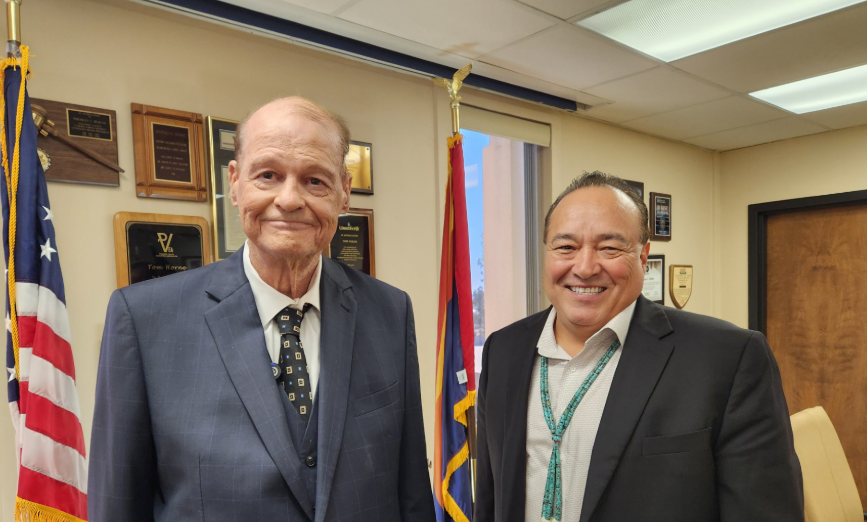
Native American students across Arizona are achieving significant improvements in reading and math proficiency, driven by targeted school improvement strategies, according to State Superintendent Tom Horne.
Notably, three schools in the Chinle Unified School District are now surpassing state averages in both math and English, making a transformative shift in educational outcomes. They saw an increase from 20% proficiency in 2023 to 34% districtwide.
“When I took office in January 2023, I was informed that the average proficiency rate for Native American students was five percent,” said Superintendent Horne in a press conference. “This was very upsetting to me, as it would affect the students’ employment prospects and quality of life. I said that we would change everything we were doing in that respect and give total focus to increasing proficiency rates among Native American students. I met with tribal leaders who were shocked to learn about the five percent number and agreed with me that action had to be taken.”
Through collaboration between the Offices of Indian Education and School Improvement, schools have received extensive support, such as teacher training, on-site visits, and leadership guidance, to help them and their students succeed.
Horne added, “With outstanding leadership from leaders of Native American districts, and our help, the proficiency rates of Native American students have soared.”
Other districts in the state have also reported extraordinary progress. Ganado Unified School District saw a 159% growth in students testing proficient in math and English, while Red Mesa Unified School District achieved a growth of 149%.
Baboquivari Unified School District recorded a 197% increase, Kayenta Unified School District a 122% jump, Sacaton Elementary District a 124% increase, and Tuba City Unified School District a 113% improvement.
Chinle Unified School District Superintendent Quincy Natay credited the success to a collective effort. “We are extremely proud of the progress our students and teachers have made,” Natay said. “These gains are a direct result of our governing board’s support of our vision and strategic plan, dedication of our educators, the support of our parents and communities, and the hard work of our students. We remain committed to building on this momentum and ensuring that all our students, across every grade level, have the opportunities and education to improve their quality of life.”
Ethan Faverino is a reporter for AZ Free News. You can send him news tips using this link.
The U.S. Department of Education released the 2024 National Assessment of Educational Progress (NAEP) results, known as the Nation’s Report Card, revealing historic lows in academic performance for eighth and twelfth-grade students in science, mathematics, and reading.
The data highlights persistent post-pandemic challenges and a widening achievement gap, prompting U.S. Secretary of Education Linda McMahon to call for a transformative shift in education policy.
“Today’s NAEP results confirm a devastating trend,” said Secretary McMahon in a statement released by the U.S. Department of Education. “American students are testing at historic lows across all of K-12. At a critical juncture when students are about to graduate and enter the workforce, military, or higher education, nearly half of America’s high school seniors are testing at below basic levels in math and reading. Despite spending billions annually on numerous K-12 programs, the achievement gap is widening, and more high school seniors are performing below the basic benchmark in math and reading than ever before.”
The 2024 NAEP results show significant declines in average scores compared to 2019:
8th Grade Science: The average score for eighth graders dropped for the first time since 2009, with 38% performing below the NAEP Basic level, a five-point increase from 2019. Only 31% scored at or above the Proficient level, down four points from 2019.
12th Grade Mathematics: The average score hit its lowest point since 2005, with 45% of twelfth graders scoring below Basic, a five-point increase from 2019. Only 22% achieved Proficient or above, which is down two points.
12th Grade Reading: The average score fell below all previous assessments since 1992, with 32% of twelfth graders below Basic, up two points from 2019, and 35% at or above Proficient, down two points again.
According to the National Center for Education Statistics, in the 2020-2021 school year, the United States (between local, state, and federal governments) spent $18,614 per student enrolled. This totals $927 billion in expenditures between public elementary and secondary schools.
Secretary McMahon added, “The lesson is clear. Success isn’t about how much money we spend, but who controls the money and where that money is invested. That’s why President Trump and I are committed to returning control of education to the states so they can innovate and meet each school and student’s unique needs.”
The data highlights a growing achievement gap, with lower-performing students at the 10th and 25th percentiles showing significant declines, while scores for the highest performers remained stable.
The report also reveals a rise in absenteeism, with 31% of twelfth graders missing three or more school days in the past month, up 26% from 2019. Additionally, only 33% of twelfth graders were deemed academically prepared for college in mathematics and 35% in reading, down from 37% in both subjects in 2019.
The NAEP assessments, conducted from January to March 2024, involved approximately 23,000 eighth graders in science and 43,600 twelfth graders in mathematics and reading. The results provide a snapshot of student performance across public and private schools.
Secretary McMahon emphasized the need for action across the U.S., saying, “If America is going to remain globally competitive, students must be able to read proficiently, think critically, and graduate equipped to solve complex problems. We owe it to them to do better.”
Ethan Faverino is a reporter for AZ Free News. You can send him news tips using this link.
The average eighth grader in Arizona has the lowest reading scores on record, and about the same mathematics scores as nearly 30 years ago.
The Nation’s Report Card (NCR) 2024 Reading State Snapshot Report showed that Arizona’s average scores for eighth grade students declined to 254, the lowest point on record over the past three decades.
Data reveals that gains made by fourth graders in math and reading in recent decades were undone or reduced in the last few years, and by the time the student hit the eighth grade they were at the same level or declining past historic average scoring across both math and reading.
Fourth graders improved their average reading scores slightly based on records dating back to 1998, matching the national trend of slight improvements to average reading scores before a steep decline the last few years. However, eighth graders have generally declined in their average reading scores based on records dating back to 1998, much aligned with the national trend of average scores.
For eighth grade reading, Arizona was lower than those in 18 states or jurisdictions, not significantly different from those in 28 states or jurisdictions, and higher than those in five states or jurisdictions.
NCR also found that black and Hispanic students in Arizona had average reading scores double digits lower than their white peers: 30 and 22 points, respectively. Neither of these disparities were determined to be “significantly different” from those retrieved nearly 30 years ago (21 and 25 points, respectively). Male Arizona students scored on average 11 points less than their female peers. Students identified as economically disadvantaged averaged 21 points lower in their scoring, again determined to be not statistically different from nearly 30 years ago (23 points).
Fourth graders improved in their average math scores based on records dating back to 2000, matching the national trend of improved average math scores. However, eighth graders declined their average math scores in recent years based on records dating back to 2000, matching the national trend of some improvements around the early 2010s before a steep decline in recent years.
For eighth grade math, Arizona’s average score was lower than those in 24 states or jurisdictions, higher than those in seven states or jurisdictions, and not significantly different from those in 20 states or jurisdictions.
NCR reported that black and Hispanic students in Arizona had average reading scores double digits lower than their white peers: both 32 points, respectively. Neither of these disparities were determined to be “significantly different” from those retrieved a little over 20 years ago (37 and 33 points, respectively). Male Arizona students scored on average six points higher than their female peers. Students identified as economically disadvantaged averaged 33 points lower in their scoring, again determined to be not statistically different from nearly 30 years ago (28 points).
The last science scores gathered date back to 2015, and the last writing scores date back to 2007.
Sandra Christensen, board member with the Paradise Valley Unified School District (PVUSD), claimed the decline in scores was because districts weren’t prioritizing academic excellence or student safety.
“We can no longer afford to govern districts like we did 10 years ago. Our students deserve better!” said Christensen. “We MUST focus on academic excellence and student safety. As a constitutional republic, elected officials report to you! Wake up and stop electing ‘get along to go along’ politicians that don’t listen to your voice!”
AZ Free News is your #1 source for Arizona news and politics. You can send us news tips using this link.
Democratic politicians and the liberal media made the first day of school all about welcoming migrant children. That’s sheer propaganda. Parents deserve the truth. The migrant surge is a disaster for their kids.
The surge will worsen our education system’s twin failures: plunging math and reading scores, and the failure to ensure newly arriving kids learn English so they can succeed, too.
Kimberly Carchipulla, who came from Ecuador and has been living at the Roosevelt Hotel in Manhattan with her son, brought him to school on Thursday and said through a translator, “What I want for him is a future.”
That’s what all parents want. But when migrant children are added to the class, the rest of the kids get less of their teacher’s attention. A teacher will have to focus on the needy newcomers who speak no English and may not have been to school before. For the rest, it could be a year of lost opportunities.
Public school students’ reading and math scores have been falling for decades, hitting a new low this year, according to National Assessment of Educational Progress tests. One reason is the soaring number of non-English-speaking students, up from only 9% of public school students in 1980 to nearly 25% now.
Until the 1960s, children arriving in this country were put in public school without interpreters and bilingual teachers. Children were taught in one language — English. No confusion. The current approach is a disaster for migrants and for the rest of the kids in class with them. The data don’t lie.
Now typically, a bilingual teacher and teaching assistants try to teach — math, science, art, any subject — in two or more languages, speaking English at times but also answering questions in Spanish and other languages. It’s chaos. Everyone learns less.
Jean Skorapa, superintendent for a rural school district in Maine, says the 67 migrant children enrolling in her district “are a tremendous, tremendous benefit”: “They make our community diverse and more well-rounded.” All true. But that’s happy talk.
What about the impact on learning? Geralde Gabeau, executive director of the Immigrant Family Services Institute in Massachusetts, explains that migrant children will be placed “in a first grade class with other students who already know their ABCs, who already know how to read, so those children are going to suffer.”
New York City has disastrously low reading scores. The influx of non-English-speaking students makes the challenge greater.
European countries are also grappling with waves of migrants. IZA, a European think tank, reports that “a high share of immigrant children in schools leads to lower test scores of native children.” Organization for Economic Cooperation and Development researchers report similar findings.
It’s not about race or ethnicity. It’s about too many languages spoken in the classroom.
Politicians would rather pander than address it. Connecticut Gov. Ned Lamont says, “From the bottom of my heart, I want to make sure this is the most welcoming state in the country.” Yet state education statistics show that the more “high-needs” kids in the class, including non-English-speaking students, the lower the reading and math scores for the others.
The current system is lose-lose, hurting migrant kids as well. They’re given too many opportunities not to learn English. Lamont, for example, is expanding translation services for parents and interpreters for students. That’s misguided. Families need to be prodded to learn English, not linger in a language ghetto.
Some school districts in New York state are experimenting with temporarily schooling newcomers separately, offering them months of intensive language preparation to succeed as English-speaking students. Good idea.
But the United Nations insists children have a “right” to be educated in their native language. Nonsense. It dooms them to low-paying jobs.
The vast majority of non-English-speaking students — 97% according to one report by the Federation for American Immigration Reform — lack English proficiency when they graduate from U.S. high schools. That’s the definition of failure.
Last week, mothers gathered outside Park Avenue elementary school in Port Chester, New York, to pick up their kids. Few spoke English. Some mothers had attended the same school decades earlier. Yet they can’t speak English. Tragic.
Tell the pols to stop romanticizing this lose-lose disaster and start fixing it.
Betsy McCaughey is a contributor to The Daily Caller News Foundation and a former lieutenant governor of New York and chairman of the Committee to Reduce Infection Deaths. Follow her on Twitter @Betsy_McCaughey. To find out more about Betsy McCaughey and read features by other Creators Syndicate writers and cartoonists, visit the Creators Syndicate website at www.creators.com.
It appears the costs of pandemic-era remote learning far outweighed the benefits, based on the average student’s comprehension in math and reading.
According to the latest National Assessment of Educational Progress (NAEP) data released Monday, Arizona students were middle of the pack in a nationwide decline. The state’s scoring revealed severe learning losses in math and nominal losses in reading.
Nationwide, the NAEP report revealed a negative correlation between remote learning and learning loss. Chalkbeat displayed the correlation through graphs. Public schools and large cities experienced the greatest decline in math scores.
In a press release, National Center for Education Statistics (NCES) associate commissioner Daniel McGrath warned that learning losses in math could limit STEM candidates.
“Eighth grade is a pivotal moment in students’ mathematics education, as they develop key mathematics skills for further learning and potential careers in mathematics and science,” said McGrath. “If left unaddressed, this could alter the trajectories and life opportunities of a whole cohort of young people, potentially reducing their abilities to pursue rewarding and productive careers in mathematics, science, and technology.”
The scores come after several years of Democratic leaders advocating for school closures amid the pandemic.
Julie Gunnigle, Democratic candidate for Maricopa County attorney, claimed in an August 2020 interview that remote learning would make kids smarter and stronger. Throughout the pandemic, she insisted that schools be restructured to prevent COVID-19 transmission before reopening.
“I think these kids are going to come out a lot stronger than, for example, my generation is. Like, having to cope with all of this. And a lot smarter, too,” said Gunnigle. “They’re going to be really prepared to brave this, well, brave new technological world.”
I love the ingenuity of Arizona schools working to get students the resources they need to succeed even when learning from home. https://t.co/Xi8W9qXVzx
Last October, Education Secretary Miguel Cardona told NPR that the number of school age-youth with mental health issues rose from 13-22 percent to 80 percent over the course of the pandemic. Last December, Surgeon General Vivek Murthy reported that the pandemic caused a mental health crisis in the nation’s youth.
“The COVID-19 pandemic further altered [youth] experiences at home, school, and in the community, and the effect on their mental health has been devastating,” stated Murthy.
Kathy Hoffman, incumbent Arizona Department of Education (ADE) superintendent, advocated for remote learning as recently as January. Like Gunnigle, Hoffman insisted that preventing COVID-19 illness was more important than an in-person education.
Given the severity of our state's situation and the virus's trajectory after the holiday period, Gov. @dougducey should order schools to remain in distance learning for a limited two-week period to align with quarantine protocols and current @azdhs benchmark recommendations.