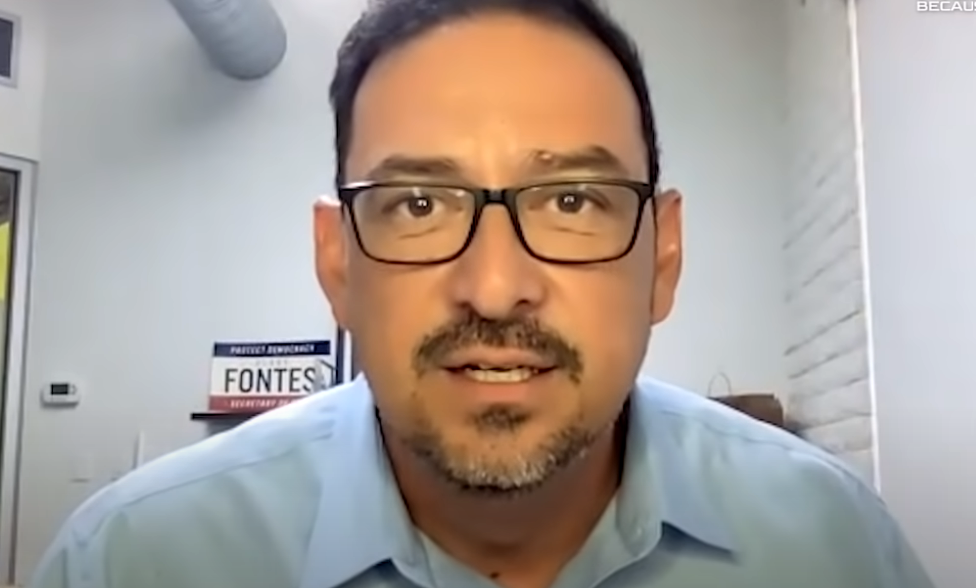
The Arizona Free Enterprise Club (AFEC) is demanding an investigation into an alleged misuse of taxpayer funds by Secretary of State Adrian Fontes.
AFEC published a press release on Tuesday accusing Fontes of misusing taxpayer funds by filing a “politically motivated” brief in the ongoing Arizona Supreme Court case, Smith v. Fontes. The organization also requested that Fontes recuse himself from all ballot tabulation procedures concerning the other initiatives.
“By filing his brief at the Arizona Supreme Court, Fontes unequivocally signaled his position that 40,000 duplicate signatures should be ignored and counted in favor of passing Proposition 140,” said AFEC in its press release. “In short, to Fontes, the ends justify the means to ensure that Arizona’s elections system can be operated like California’s radical system.”
AFEC and other critics compare the components within Proposition 140 to current election procedures exercised by California.
Proposition 140 seeks to remove the partisan split in primary voting — instead implementing open, or “jungle,” primaries — and determine winners using ranked-choice voting. Ranked-choice voting allows voters to rank their preferred candidates each election until one candidate accrues over 50 percent of the vote.
That claim of political motivation stems from Fontes’ role as a “team member” for the nonprofit organization (Save Democracy) supporting the political action committee (Make Elections Fair Arizona) pushing Proposition 140. Those two entities are also united by the involvement of Sarah Smallhouse as their president and treasurer, respectively: a longtime Democrat donor from Tucson who served as leadership for a University of Arizona board and the Southern Arizona Leadership Council.
Fontes’ brief petitioned the court to count any votes cast for Proposition 140, even if the ongoing review of the ballot-qualifying signatures determined that there weren’t enough signatures gathered. Fontes argued that the proposition should be considered valid since the ballots were already being printed with the contested proposition on them.
“Once the ballots have gone to print, it is in the hands of Arizona’s voters,” said Fontes. “The person contesting an issue (or candidate) can make a case to the voters, but the Courts cannot usurp the voters’ decision once it goes to them.”
AFEC sued to stop Proposition 140 earlier this summer after reportedly discovering that over half of the gathered signatures were in violation of state law — around 40,000 duplicates. Should all those alleged duplicate signatures be removed, the proposition would lack the number of signatures required to qualify for the ballot.
AFEC President Scot Mussi said in a statement that Fontes’ brief amounted to the secretary of state taking a side in a ballot measure rather than maintaining an impartial role in the elections process.
“Far from acting as a fair and impartial elections chief, Fontes has officially taken a side in a controversial measure that would be potentially on the ballot, showing Arizonans that he is using taxpayer dollars to make the case for a California-style amendment that would fundamentally transform the way we vote and select our candidates for public office,” said Mussi. “This is not saving democracy; this is trampling the will of the people and the laws that govern how elections should be executed.”
AZ Free News is your #1 source for Arizona news and politics. You can send us news tips using this link.
Arizona voters should be able to have complete trust in their elected officials to conduct themselves honorably, ethically, and lawfully in every matter concerning our sacred elections.
Too bad Secretary of State Adrian Fontes never got the memo.
In the midst of firing off baseless attacks against our organization after a court ruled in our favor against his radical Elections Procedures Manual, Fontes found a new way to violate the ethics of his office…and maybe the law.
Last week, in an unexpected, politically motivated, and potentially unlawful use of taxpayer dollars, Fontes filed a brief at the Arizona Supreme Court in an effort to ensure that votes for Prop 140 are counted in the November General Election—regardless of its eventual legality.
Think about that for a moment. By filing this brief, Adrian Fontes—the top election official in our state—unequivocally signaled his position that 40,000 duplicate signatures should be ignored and counted in favor of passing Prop 140. In short, this means that for Fontes, the ends justify the means to ensure that Arizona adopts a California-style election scheme that includes ranked-choice voting and jungle primaries. But that shouldn’t come as much of surprise…because it’s exactly what he’s been working for…
Secretary of State Adrian Fontes argued in a new brief for an ongoing court case that duplicate signatures shouldn’t be cause for Proposition 140 to be removed from the ballot. Challengers to the proposition say they found around 40,000 duplicate signatures.
Prop 140, the Make Elections Fair Act, proposes open primaries (called “jungle” primaries by opponents) which remove the partisan segregation defining Arizona elections, as well as the implementation of ranked-choice voting.
Fontes is one of the listed “team members” for Save Democracy, the nonprofit entity supporting the political action committee pushing the measure, Make Elections Fair Arizona.
Save Democracy’s president, Sarah Smallhouse, also serves as treasurer of the Make Elections Fair Committee. Fontes also conducted a webinar sponsored by Save Democracy in which he advocated for open primaries.
In the brief issued on Friday for the case Smith v. Fontes, Fontes argued that the proposition should be considered valid since the ballots had already gone to print with the contested proposition included. Otherwise, the secretary argued, the court would be denying Arizonans their right to “free and equal” elections.
“Once the ballots have gone to print, it is in the hands of Arizona’s voters,” said Fontes. “The person contesting an issue (or candidate) can make a case to the voters, but the Courts cannot usurp the voters’ decision once it goes to them.”
Fontes proposed that those challengers to the validity of Prop 140’s gathered signatures should seek recourse through future elections.
“After investing their time educating themselves about this ballot measure, it would be wrong for the Arizona electorate later to be told their vote will not be counted,” said Fontes. “Given the far-reaching implications of this Court potentially enjoining the canvass, the Secretary requests this Court to reconsider its previous ruling and affirm the principle that once the ballots have gone to print, any challenge must end.”
The Arizona Free Enterprise Club (AFEC) sued to stop the Make Elections Fair Act after reportedly discovering over half of the proposition’s gathered signatures were gathered in violation of state law.
🚨 Second lawsuit filed!!
If the unconstitutionality of the the radical Make Elections Fair Initiative wasn’t bad enough, it turns out after a thorough review of their petitions, that over half of their signatures have been collected in violation of state law! https://t.co/mUMNXsOub7pic.twitter.com/ztrwbIIFaw
— Arizona Free Enterprise Club (@azfec) July 27, 2024
The Arizona Supreme Court sided with AFEC’s challenge last month, ruling that the lawsuit should continue in order to determine whether the tens of thousands of challenged signatures were valid (around 40,000), even though ballots began to be printed on the same day it handed down its decision.
The state supreme court ordered that an injunction be issued preventing the counting of any votes on the proposition should it be discovered that the proposition lack the required number of signatures.
AFEC reported discovering that, of the 40,000 duplicates, around 250 individuals had signed their name five or more times. One individual reportedly signed 15 times.
AFEC has argued that the mass amount of duplicate signatures indicated that Fontes shouldn’t have approved the proposition for inclusion on the ballot in the first place.
With 40,000 duplicate signatures, it's clear that #Prop140 should’ve never been on the ballot in the first place because the people of Arizona don’t want to follow in California’s footsteps with jungle primaries or ranked choice voting.https://t.co/RXH6xGdcMG
For months we have been hearing that a small group of disgruntled political consultants and power-hungry politicians would be releasing their plan to scrap our century-old primary and general election system in favor of a confusing jungle primary/ranked choice voting scheme that will disenfranchise voters and empower special interests.
Well last week a group called “Save Democracy Arizona” rolled out their proposed election reform ballot initiative, and it is about as dysfunctional a plan as what we expected.
Reading through their proposed constitutional amendment, a sprawling 4 pages of poorly written language drafted in secret, it is abundantly clear that this won’t make elections any more transparent or fair except for the special interests who support it. And it does far more to disenfranchise voters and destroy democracy than actually save it…
Rep. Mary Peltola continues to have support among left-leaning American politicos, after emerging victorious in Alaska’s messy open-primary, ranked-choice general voting system in 2022.
Conservative Alaska voters, faced with a contentious field last year, awarded Peltola enough second-place votes to lock in her win.
As a candidate with low name recognition, Peltola committed to bipartisanship, saying she drew inspiration from the late Congressman Don Young. However, her voting record since November has revealed a different story.
Peltola’s support for Rep. Hakeem Jeffries as House speaker, casting 15 votes in his favor, was the first big item that raised eyebrows around the 49th state.
She voted against the Strategic Production Response Act and justified her absence during the final vote by claiming she was unaware voting was about to occur.
Peltola voted against the censure of Rep. Adam Schiff, who was the unethical impeachment manager for Speaker Nancy Pelosi during the now-discredited “Russia collusion” attack on former President Donald Trump.
Recently, she joined most Democrats in opposing the National Defense Authorization Act. The rationale behind her “no” vote lies in her desire for culture-war earmarks to fund military transgender treatments and surgeries, as well as paying military women a month of leave for late-term abortions. Peltola has also supported transgender males’ participation in female athletic competitions.
She voted against H.R. 5, the Parents Bill of Rights, and has been advocating for a national railroad strike, urging Starbucks baristas to unionize, and encouraging pizza workers in Alaska to do the same.
Peltola’s consistent absence is notable: She has missed 16 times more votes than the median Democrat House member. In a House with 435 members, she is number 12 for most missed votes.
While she participated in the women’s Congressional Softball game against journalists, she failed to show up for work the next day when almost all amendments to the National Defense Appropriations Act were voted on. Her inability to get out of bed deprives Alaskans of a voice in the House.
When she does vote, Peltola votes in line with Rep. Nancy Pelosi 84% of the time, Rep. Ilhan Omar 77%, and Rep. Alexandria Ocasio-Cortez 78%. Keep in mind that 53 percent of Alaskans voted for Trump.
Nick Begich, a lifelong Republican who ran for Congress in 2022, has seen enough. He decided to run again after witnessing Peltola repeatedly vote against Alaska’s values.
Although he faces the challenge of overcoming his relatives, who include well-known Democrats, Begich enjoys the continued support of his followers.
But Alaska’s unique method of selecting representatives, introduced with Ballot Measure 2 in 2020, deviates from the rest of the nation. It’s a tangled mess.
The open primary format eliminated the Republican Party of Alaska’s ability to independently choose its candidate for the general election.
Instead, all candidates, whether clowns or statesmen, participate in the same primary ballot. In 2022, this resulted in a massive ballot with 48 candidates.
The top four vote getters from the primary advance to the general election, where voters are then asked to rank the candidates in order of preference. If a voter’s preferred candidate loses, their vote is transferred to their next choice, granting them an opportunity to vote again. In this scheme, some voters get to vote more than once, while others’ votes are counted just one time.
Given the array of choices Alaskan voters had in November, which included three conservatives and one liberal candidate selected in the primary, it remains perplexing how a radical like Peltola emerged victorious.
Supporters of ranked-choice voting had promised that the system would eliminate extremists, but this is not how it worked in real life. Alaskans ended up with a de facto member of The Squad.
Will it happen again?
Begich begins his campaign with a solid base of one quarter of the likely vote this time around. However, with less than a year remaining until the primary ballot is set in Alaska, a lot can happen with campaign hijinks, as we saw in 2022.
Last year, Begich garnered support from major conservative organizations like Americans for Prosperity and Freedom Works for America, as well as the endorsement of the Alaska Republican Party.
And yet, the National Republican Congressional Committee (NRCC) is not structured to work well with the ranked-choice voting system, which in a state like Alaska all but guarantees the presence of multiple Republicans on a general election ballot.
This time around, the NRCC can and should focus on highlighting Peltola’s extreme positions to ensure that Alaskans can make a more informed decision in the upcoming 2024 primary and general elections.
For now, Alaskans are represented by a bait-and-switcher who holds some of the most mind-boggling positions in the history of the U.S. Congress. Alaska has the distinction of being the most conservative district in the country to be represented by a Democrat. We can do better.
National organizations like the NRCC, Freedom Works, Americans for Prosperity, and Club for Growth will be crucial in helping prevent a recurrence of 2022’s series of unfortunate events.