After publishing this Substack, I came across this video of a young woman’s “detransition” story. I also learned that Texas Christian University canceled an event featuring Chloe Cole, another “detransitioner” who travels the nation sharing her testimony. The fight to protect the next generation from the evils of “transgenderism” is far from over.
This quote is from the young woman who lived as a “male” for eight years but now regrets having a double mastectomy, full hysterectomy, and genital reconstruction surgery:
“I’m so angry…and so sad. It’s like a virus, or something, that infected me. And it happened so quickly…I can’t have kids. I’ll never lose my virginity. It’s like I’m left to just accept the scraps of the life that I could have had…I don’t know how to be okay with that. I hate when people [say], ‘Everything happens for a reason.’ No, this didn’t happen for a reason. It’s just a tragedy. Call it what it is.”
In the video, you can see what appears to be mutilation scars on her left forearm. Skin grafts are typically taken from this area to construct “a penis, urethra, scrotum, and the obliteration of the vaginal cavity with closure,” an operation known as phalloplasty (or “bottom surgery”). While it is possible to correct genital deformities, the damage to her body is irreversible, and the trajectory of her future is permanently altered. She can recover some femininity, but her womanhood is gone forever.
This is the expected end of social “transitioning,” cross-dressing, and using alternative names and pronouns—all of which can be concealed by false interpretations of student privacy laws. Also, when K-12 district representatives and employees implement DEI policies, host rainbow celebrations, and defend “gender identity,” they are advocating for all of the above. No one is born in the wrong body, and anyone who supports sterilizing and castrating minors should not be trusted around children.
I always bring the “transgender” agenda back to government education because it’s an area where many parents are still asleep at the wheel. Public schools (and increasingly some private schools) are the battlefield as board members, administrators, teachers, and counselors position themselves as the enemy of parental rights. Thankfully, parents are winning in the courts, and thousands of children will never undergo “transgender” medical malpractice. Still, parents must remain vigilant in the ongoing war to assert moral authority over their children.
It’s also important to bring attention to another group that’s not doing enough to tackle the “transgender” problem. Sadly, many Christians are aiding and abetting the spread of LGBTQ ideologies and practices. Keep in mind that “Christian” is a relative term associated with thousands of denominations and cults, and can be interpreted to mean a “good person.”
On February 25, 2025, Pew Research published survey results showing that “57% [up from 54% in 2014] of U.S. Christians say homosexuality should be accepted by society; 55% [up from 44% in 2014] say same-sex marriage should be legal.” The report also reveals 29% of Christians believe greater acceptance of “transgender” individuals is “a change for the better.” The latter is a baseline number, as researchers did not ask this question in previous case studies.
Oddly enough, Barna’s 2025 study shows Millennials and Gen Z have increased their church attendance. The report says, “The typical Gen Z churchgoer now attends 1.9 weekends per month, while Millennial churchgoers average 1.8 times—a steady upward shift since the lows seen during the pandemic. These are easily the highest rates of church attendance among young Christians since they first hit Barna’s tracking.”
Before we celebrate, let’s consider that in 2004, 51% of American pastors held a biblical worldview. By 2022, just 37% of pastors had sustained a biblical worldview, while 62% held syncretistic beliefs (that is, blending Christianity with other religions). In 2023, only 36% of pastors were “very effective” in helping Christians grow their faith over time. A mere 10% were “very effective” in “growing new converts into mature Christians,” while 12% encouraged believers to share their faith, and a measly 6% reached out to non-Christians.
These are sobering statistics, and, according to Barna, the increase among Gen Z still equates to attending church “less than half the time” of older generations. So, while young people are seeking truth, many will join ministries led by compromised leaders. Gen Z’s faith might grow over time, but they won’t share it outside the church, and what they learn may not have a lasting effect. In short, the American Church produces converts without conviction and consumers without consecration, who master religious transactions without transformation.
My fellow believers, none of this is a sign of “revival.”
I have lost count of how many times we canceled Netflix, rebooked Disney vacations, and chose Walmart over Target. Jumping on a trend is not good enough. We can’t be so preoccupied with our regularly scheduled programming that we fail to address the spirit of the age that’s consuming present generations.
Are we too holy to associate with LGBTQ people because their sin looks different than ours? Are we so loving that we can’t confront sin at all? Have we settled for inviting the lost to hear watered-down preaching because we’re too biblically illiterate to usher them into the Kingdom directly? If we’re honest, most Christians wouldn’t know how to minister to that broken woman in the video. We would say, “Jesus loves you,” and hand her a flyer for the next church event.
I agreed when the woman said destroying her body didn’t happen for a reason, and she called it a tragedy. The expression, “Everything happens for a reason,” is typically what believers (and nonbelievers) say when they lack the capacity to produce genuine empathy. It’s on par with “God works in mysterious ways,” a favorite among those who cannot discern the difference between coincidence and divine appointment. Neither of these phrases is found in Scripture.
The truth is, everything does not happen for a reason. Some things—and I would argue, living in a fallen world, that most things—happen as a consequence. Our beliefs influence our actions, and actions dictate outcomes. We can only help the next generation by imitating the Berean Christians (Acts 17:11), speaking the truth in love (Eph. 4:15), and investing time in young people beyond religious activities. Some sinners will never darken the doorway of your church, but they shouldn’t have to wait until Sunday to hear the gospel.
I challenge Christians to befriend an LGBTQ person, learn their story, and, when their heart is ready, preach the full gospel to them. Don’t stop at “Jesus loves you” and a church invitation. Tell them why He was crucified. Explain that He is not only our Friend—He is also our Judge. He extends mercy to those who repent and wrath to those who reject Him. Jesus came as a lamb, but He will return as a lion. Faith in His work on the cross is the only way to life, both now and for eternity.
Never separate love from truth.
Tiffany Benson is the Founder of Restore Parental Rights in Education. Her commentaries on education, politics, and Christian faith can be viewed at Parentspayattention.com and Bigviewsmallwindow.com. Follow her on socials @realtiffanyb.
After overcoming months of stonewalling, the Goldwater Institute has issued a report revealing that school district superintendents in Arizona are awarded some of the most lucrative public service contracts in the state.
The report, by Goldwater’s Director of Legal Strategy for Education Policy Christopher Thomas, uncovered perks including “car allowances,” performance bonuses, duplicate private retirement packages (“funding private retirement accounts on top of their already generous state pension benefits”), and “generous personal and vacation leave banks” that can be “cashed out.”
“For taxpayers, the secrecy should set off alarms,” Thomas said in an article for Goldwater. “Superintendents are not just any employee—they are the CEOs of their districts, the highest-paid public servants in many counties. They are also the only officials directly accountable to the elected school board. The superintendent’s job is important, and high salaries may be justified. But the current system of secrecy and delay erodes public trust.”
In a post to X, the Goldwater noted that the superintendents enjoy, “Duplicate retirement packages. Monthly car allowances large enough to lease high-end sports cars. Performance bonuses,” and added, “These are just some of the benefits that AZ school superintendents receive that make them among the state’s highest paid public employees…”
Duplicate retirement packages. Monthly car allowances large enough to lease high-end sports cars. Performance bonuses.
These are just some of the benefits that AZ school superintendents receive that make them among the state’s highest paid public employees…
In the text of the report entitled, “The Hidden Ways Arizona School Superintendents Are Paid,” Thomas analyzed contracts from 41 of the largest school districts in Arizona, extracted over four months despite “district stonewalling,” and “a tangle of complex contract provisions that school boards, and the superintendents themselves, deliberately design to mask the full measure of compensation from taxpayers.“
Perhaps the most egregious example highlighted in the report is the compensation package for the embattled Superintendent of the Tolleson Union High School District, Jeremy Calles.
Although the district ranks only 16th in size statewide—and continues to face corruption allegations while posting student proficiency rates below both state and peer averages (21% in math and 26% in English)—Superintendent Calles receives an annual compensation package of $491,360, exceeding that of every other surveyed superintendent by more than $100,000.
Calles’ full earnings include a base salary of $361,584, already the highest in Arizona by $111,000, per Goldwater, plus $72,316 in performance pay, substantial retirement contributions beyond his state pension, a car allowance, and the ability to bank up to 120 unused personal days for a potential $166,184 cashout upon his departure from office.
The Tolleson Union High School District is hardly unique in this respect, according to the report. Monthly stipends or “car allowances” are in place at districts ranging from $500 per month at Marana USD and Littleton ESD to as much as $1,250 per month in Amphitheater USD and Sahuarita USD. Some districts even offer these as annual lump sums, such as Tucson USD, which offers a cool $20,000 annually, or Laveen ESD, which comes in just shy at $19,475 per year.
Concluding his report for the Goldwater Institute, Thomas summarized both the extravagant compensation packages and the seemingly deliberate lack of taxpayer transparency into them. “Superintendents have important jobs. In each district, they are the one employee the school board hires, supervises, and may ultimately terminate,” he said. “The superintendent is responsible for student achievement, implementing board policy, recommending staff hires, and overseeing school district finances. They understandably command the highest salary in the school district. However, there should be greater transparency in just how much they are paid. Their contracts may be among the most important public documents held by school districts. Because of this, these contracts should be readily available to the public.”
Thomas further recommended corrective action, adding, “In addition, school districts should publish total compensation analyses for their superintendents, listing the value of all the perks that are included in their contracts. It is likely that most school board members do not fully understand how their superintendent is paid, nor all the sources of compensation the superintendent receives. Surprisingly, many have never even seen the superintendent’s contract, and some have been denied access when they’ve requested it.”
The legacy media seem to be on a mission: tear down Arizona’s groundbreaking school choice program with false accusations and inaccurate reporting.
Fortunately, facts don’t lie, even if the media does.
The Arizona Capitol Times declared this week in astonishing terms, “Education department under fire for approving $124M in improper ESA [education savings account] purchases.”
Such astronomical levels of fraud would seem to threaten the very foundations of the historic school choice revolution that has swept the nation. There was just one problem, the headline was completely false.
Not only were the supposed dollar amounts exaggerated up to 100 times greater than the amounts of improper spending actually reported by the department, but these purchases weren’t even approved in the first place.
Here’s the story the media won’t tell: Arizona’s 2022 adoption of a fully universal ESA program has been a nation-leading success, allowing parents across the state to give their children an education best suited to their needs.
To its credit, the Times quickly retracted its original headline and issued a formal correction admitting “an inaccurate dollar amount” in its first draft and eliminating the suggestion that the purchases were “approved.” Unfortunately, such journalistic ethics appear not to be shared by the Times’ more ideological media counterparts in Arizona, particularly those of the teachers’ union-aligned 12News team, who have resolutely declined to correct or retract their false reporting.
12News’ Craig Harris, for instance, has repeatedly and falsely declared that the state has “approved” ESA purchases for iPhones, televisions, and other non-educational items over the past year.
But all those purchases haven’t been approved, as the State Board of Education’s ESA Handbook—ratified by members appointed by both former Gov. Doug Ducey and Gov. Katie Hobbs—makes clear. The document expressly states that while families’ ESA purchases under $2,000 are promptly reimbursed by the state, these items “are not deemed ‘approved’ by the Department, until they are audited OR the timeframe to audit the orders has passed [2 fiscal years].” Just like their tax returns filed with the IRS, these families’ ESA purchases are processed up front and subject to enforcement afterwards.
Yet, 12News either knowingly misrepresented the status of these orders or else incompetently failed to perform basic due diligence to learn how the program operates.
By 12News’ anti-ESA logic, the IRS should apparently also withhold refunds to taxpayers until their tax returns have been audited potentially years later, rather than promptly when the returns are filed.
Unfortunately, this is not the first time that 12News’ anti-school choice reporters have been exposed in such light. In 2018, Harris (then with the Arizona Republic) falsely reported that Arizona charter schools produced worse student graduation rates and worse outcomes on the state A-F letter grade system than district schools. Both claims turned out to have been fabricated results stemming from a faulty, agenda-driven data analysis by Harris’ team.
In 2024, 12News’ Joe Dana likewise doubled down on false claims that ESAs cost state taxpayers more than the public school system per student by conveniently ignoring major sources of public school funding. The state’s Classroom Site Fund, for example, allocates over $1,000 for every public school student in the state and gives not a penny to ESA families.
Undeterred by journalistic standards, Dana’s 12News team also went further, deceptively extracting a fragment of a statement given by the state’s budget director (given in response to a completely different question) to suggest the ESA program had created unprecedented strain on the state budget.
The Heritage Foundation’s Matt Ladner and Jason Bedrick have already exposed a litany of deceptive claims flowing from outlets like 12News, while more prestigious national news organizations like The Washington Post have seen their recent anti-ESA narratives similarly debunked. Yet none of these outlets have expressed any contrition for their deceptive coverage.
Indeed, in perhaps the richest of ironies, Harris’ 12News team recently attacked ESAs for “hurting” high-performing schools like Arizona charter network BASIS by competing with it for students. Never mind that Harris previously attacked BASIS for its alleged poor stewardship of taxpayer funds. Now that it is clear he and the media were on the wrong side of that school choice debate as well, they have simply shifted to a new enemy in their war on parents.
Looking at the whole of Arizona’s education landscape, there is no question that those who seek to defraud the state—whether via the traditional public school system or its competitors—should be prosecuted to the full extent of the law. But if there is a scandal in our education system, it is the dishonest reporting by journalists who are more disturbed by parental empowerment than by the tens of billions of dollars squandered year after year in chronically poor performing public schools.
Matt Beienburg is the Director of Education Policy at the Goldwater Institute.
The Common Sense Institute’s recent report, Echoes in the Halls: Arizona School Districts’ Growing Problem with Empty Buildings and Empty Buses (August 2025), quantifies a reality that many parents and educators in Arizona already sense: the traditional district school system is struggling to adapt to the new education marketplace. The report highlights a staggering mismatch between student enrollment and district assets. District schools across the state now operate with seventy-eight million square feet of unused space—capacity for more than six hundred thousand students who are not there—representing assets valued at more than twelve billion dollars. Since 2019, district enrollment has fallen by nearly fifty thousand students, while close to forty percent of incoming kindergarteners are now enrolling outside their local district.
The story of transportation is equally telling. Even as eligible bus ridership has dropped by forty-five percent, districts have added more than three thousand new vehicles, bringing annual transportation spending to more than half a billion dollars. At the same time, capital expenditures have surged by sixty-seven percent in just five years, reaching nearly nine billion dollars, with hundreds of new buildings added even as families continue to leave for other options. The evidence points to a system built on assumptions of perpetual growth, unable to pivot as students migrate toward charter schools, private schools, and homeschooling.
The question is not whether Arizona has too many empty classrooms and idle buses—the report makes that clear—but why the system finds it so difficult to adapt. The answer lies not in the commitment of teachers and administrators, but in the political structure that governs districts themselves. For more than a century, Arizona’s districts have operated under locally elected boards with broad political and taxing authority. This design once served an important democratic purpose, anchoring schools to their communities. But in an environment defined by choice and specialization, it has become a straitjacket.
What is clear for anyone with any visibility on the governance model districts operate within is that the political cycle ensures instability. Board turnover, electioneering, and the shifting priorities of competing constituencies disrupt long-term strategy. Every few years, districts are thrown off course by new agendas, new mandates, new programs, new superintendents, and a seemingly unending supply of divisive debates. In a consumer-driven education market, where parents prize clarity, stability, and quality, such volatility is profoundly counterproductive.
By contrast, Arizona’s most successful education providers—charter networks like Great Hearts and BASIS—operate under governance models insulated from political churn. Their boards are mission-driven and stable, enabling them to stay focused on long-term priorities and to deliver a coherent and trustworthy experience. Families know what to expect from a BASIS or a Great Hearts school. Each has built a distinctive value proposition and a consistent culture, refined over years without disruption from local political battles. Governance stability has been essential to their growth and attraction, and it is no accident that they are now among the most sought-after public schools in the state.
The one-size-fits-all assumption that once defined public education—that a child would simply attend the local district school—has evaporated. Today, nearly half of Arizona’s students are educated outside of their neighborhood district school. Parents are no longer defaulting to their assigned option; they are actively choosing models that align with their values and aspirations for their children. They want education providers that are both distinctive and stable—schools that can deliver excellence without being buffeted by every election cycle or politicized by the latest ideological controversy.
The traditional political governance of districts is increasingly out of sync with these expectations. It undermines the very qualities—consistency, coherence, and focus—that families prize. Meanwhile, two generations of charter operators in Arizona have demonstrated that nonprofit governance structures free from political cycles can create durable, attractive, and scalable school systems. These operators are not without challenges, but they have proven that clarity of mission and insulation from politics allow for the steady building of educational brands that families trust.
The lesson is plain: if Arizona’s districts are to thrive rather than decline, they must be unshackled from their archaic political governance model. Continuing to operate under structures designed for the early twentieth century ensures further erosion of parent confidence and continued inefficiencies in managing billions of dollars of underutilized assets. A new path is needed, one that allows districts to reimagine themselves as nonprofit education management organizations, brings simplicity and flexibility to sources and uses of capital, allows for the restructuring of real estate portfolios, and the establishment of governance models capable of long-term stewardship. It would mean shifting from political governance to mission-driven governance, from reactive cycles to strategic stability. Nothing about this would be easy. It will take a thoughtful integration of the tax and governance issues that are best considered by a new commission of governance transformation.
Such a transformation is not about abandoning public education but about liberating it. It would align districts with the same best practices that have made Arizona’s most successful charters so attractive to families. It would give teachers a more stable environment in which to do their work, free from the whiplash of shifting political priorities. It would give parents confidence that their schools are governed for the long-term benefit of students, not for short-term political gain. And it would give students schools that are full, focused, and flourishing, rather than echoing with the costs of inefficiency.
The Echoes in the Halls report demonstrates that Arizona has reached a tipping point. Families have embraced choice, and the state’s education landscape has been reshaped accordingly. What remains is for governance to catch up with this reality. The way forward is not to cling to political structures of the past, but to free districts from them so they can compete on the same terms as the schools parents are already choosing. Only then can the empty classrooms and idle buses be replaced with what every community wants most: the sound of students learning in schools built on mission, stability, and trust.
Erik Twist is the Principal Partner and President of Arcadia Education. He served as President of Great Hearts Arizona from 2017 to 2022.
Channel 12 continued its clumsy crusade against school choice this week with a breathless report about fraudsters abusing Empowerment Scholarship Accounts to buy diamond rings and necklaces, flights and hotel stays, and even lingerie.
It paints a picture of a program rife with abuse. But is it?
The Arizona Department of Education gave Channel 12 the records for more than 1.2 million ESA requests. Yet when askedrepeatedly what percentage of those requests were fraudulent, Channel 12’s reporter refused to comment.
Why? Because the truth undermines the anti-ESA narrative.
The salacious report is intended to persuade policymakers who support ESAs to impose regulations that would undermine the ESA program. It goes without saying that anyone engaged in fraud should be prosecuted to the fullest extent of the law, and the Arizona Department of Education is appropriately cracking down on fraudsters. But before policymakers rush to amend the ESA program, they should know the context that Channel 12 left out.
ESA Misspending Is a Tiny Fraction of Total ESA Spending
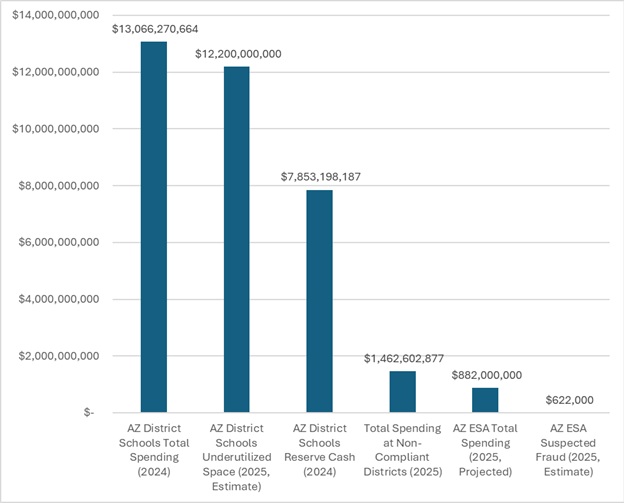
The ESA program currently serves about 90,000 students at a projected cost of $882 million this year and $939 million next year, or about 6.7% of the $14 billion spent on Arizona’s district schools. Families can use ESAs to purchase a wide variety of educational expenses to customize their child’s education.
The typical ESA student receives about $7,500 per year, compared with more than $15,300 per pupil at Arizona’s district schools. Students with special needs—who account for more than 19% of ESA students, compared with 14% of district school students—can receive more funding, although the accounts are still worth 90% of what the state spends on similarly situated students at public schools. According to the Common Sense Institute, “a disproportionate share of middle-income households use an ESA.”
On Tuesday, the Arizona Department of Education revealed that their internal audit had turned up $622,000 in ESA funds that are “possible fraud or misuse.”
That’s less than one-tenth of 1% of total ESA spending.
Ignoring Mountains, Covering Molehills
Meanwhile, there are 30 school districts that the Arizona Auditor General currently deems to be non-compliant with state reporting requirements or that have internal control deficiencies. The total spending in those districts is more than $1.4 billion, more than the total spending of the ESA program. Yet aside from its coverage of the disastrous overspending in the Isaac Elementary School District, Channel 12 has barely covered it at all.
For that matter, Channel 12 has ignored the $7.8 billion that Arizona school districts are holding in cash reserves. That’s about $7,000 per pupil. The reserves have grown $2 billion in two years, yet Channel 12 doesn’t evince even the slightest curiosity about why.
Nor is anyone at Channel 12 interested in the $12 billion worth of unused and underutilized buildings that districts are sitting on, often just to prevent private or charter schools from buying them.
Channel 12 found space in the aforementioned ESA exposé to mention that a judge recently ruled that the state supposedly “isn’t properly funding capital needs for its public schools,” but the station had no space to mention that school districts are sitting on $20 billion in cash reserves and underutilized buildings.
Indeed, Channel 12 has barely covered any of these facts even as they pump out multiple anti-ESA stories each week, despite the fact that the ESA program is dwarfed by the spending at non-compliant districts, district school cash reserves, and underutilized buildings.
School-choice opponents and their media allies are hyper-focused on ESA misspending because they want to pressure lawmakers to undermine the program via regulation.
The Arizona Department of Education adopted its risk-based auditing strategy—automatically approving ESA spending requests below $2,000, then auditing accounts on the back end—because Superintendent Tom Horne’s previous “review every penny” approach was causing massive backlogs and delays in approving expense requests and reimbursements.
There were nearly 11,000 transactions in quarter 3 of this year alone. It’s impossible for the department’s staff to review each transaction in a timely manner, but parents trying to teach their kids can’t wait months just to buy a textbook or pay their child’s tutor or school.
To Horne’s credit, he listened to parents and made some incremental improvements that make it easier for parents to use the program. Now a tiny percentage of ESA holders are taking advantage of the looser rules, but they will be forced to pay the money back and could face prosecution.
The Arizona Department of Education has suspended 400 accounts due to improper spending —just 0.4% of the total accounts—and has referred some to the Attorney General for further investigation and prosecution.
Punishing fraudsters is necessary. Every government program is subject to some amount of fraud and abuse, and it’s incumbent upon public officials to implement rules that keep fraud as close to zero as possible. But it is not in the public interest to undermine a program’s effectiveness, especially when that program is helping kids get access to a better education and a brighter future.
School-choice opponents are using misspending as a pretext. If that was their real concern, they’d be raising alarms about all the waste, fraud, and abuse in the district school system. They’re not really concerned with stopping the 0.4% of ESA holders committing fraud, they just don’t want the program to work for 99+% of families just trying to do right by their kids.
Supporters of education freedom and opportunity should ignore the manufactured outrage and work to ensure that the ESA program works well for the families it serves.
Jason Bedrick is a Research Fellow at The Heritage Foundation’s Center for Education Policy.