by Jason Bedrick | Mar 13, 2026 | Opinion
By Matthew Ladner & Jason Bedrick |
It is said that a lie travels halfway around the world before the truth can get its pants on. But when the truth finally catches up, it tends to arrive with receipts.
In recent weeks, anti-school-choice activists have accused Arizona’s popular Empowerment Scholarship Account (ESA) program of having a ludicrously high rate of misspending. That narrative, repeated endlessly despite being repeatedly debunked, has now collided with an inconvenient reality: the Arizona Department of Education’s own data tell a starkly different story, one that exposes the “unaccountable ESA” myth for what it always was: a misleading talking point masquerading as journalism.
On Thursday, the Arizona Department of Education published the results of a random audit of the ESA program, finding very low rates of misspending relative to other publicly funded programs and even less fraud. Less than 2% of ESA funds were spent on unallowed items, and 0.3% of the funds were spent on items considered “egregious” or fraudulent. The department is in the process of recouping those funds.
The department’s audit has punctured the gross distortions of Phoenix-based journalist Craig Harris of Channel 12, who had misrepresented the ESA program as being rife with fraud. The department called Harris’s claims “ridiculous,” “reckless,” and “a total misinterpretation of data provided by [the department] to Channel 12.”
Harris had claimed that 20% of ESA purchases represented misuse of funds based upon an examination of only a small portion of total ESA purchases—384,478 of the 1.8 million total ESA transactions since December 2024, approximately 20% of the total.
But it was not a random sample. The Arizona Department of Education had selected these purchases under a risk-based audit for additional scrutiny, so it was not a random sample that one could use to extrapolate rates of misuse in the ESA program. Instead, the risk-based pool was far more likely to contain misuse than the average purchase.
In other words, among the 20% of ESA purchases flagged for additional scrutiny, the department found 20% to be misspending. Harris, however, extrapolated the risk-based results on to the entire universe of ESA purchases. This represented a blatant distortion because the remaining purchases outside of the risk-based sample were far less likely to involve misspending.
Think of it this way: imagine that a reporter read a study showing that 20% of Americans were obese and that 20% of obese Americans had diabetes, then he ran a story claiming that 20% of all Americans had diabetes. Such a claim would be a complete distortion of the data, a conclusion that is entirely unsupported by the facts.
Harris was warned both publicly and privately that his “analysis” was deeply misleading. Nevertheless, he continued to repeat his “20% misuse” claim on television and social media.
The Arizona Department of Education decided to set the record straight by auditing a random sample of thousands of Arizona ESA purchases. The audit’s conclusion: “About 2% of purchases are unallowable expenses and only 0.3% represent fraud or egregious purchases.”
In short, Harris’s “analysis” on misspending was off by a factor of 10, and his accusations of fraud were off by nearly a factor of 100.
And although Harris made it seem like one in five ESA parents were buying diamond rings, the reality is that egregious purchases represented a vanishingly small percentage of ESA spending. Most of the unallowed items appear to have been innocent mistakes.
The Arizona Department of Education explained the difference between unallowable purchases and egregious purchases/fraud in a press release:
The submission of a purchase that is deemed unallowable does not constitute fraud. Most are innocent mistakes, such as an error in a form that must be resubmitted, or educational items that are not on the allowable list but that the user could have in good faith believed were permitted. Some examples would be backpacks, lunch boxes and water bottles.
A ridiculous figure of 20% fraud has been circulating concerning ESA purchases which resulted from a total misinterpretation of data that we provided to Channel 12.
Cracking down on misspending is important, but so is keeping things in perspective. The rate of improper payments for the Arizona ESA program, at 1.9%, stands far below a variety of programs which ESA opponents support, such as Medicaid (7.4%), food stamps (9.3%), and unemployment insurance (14.4%). Moreover, the Arizona Department of Education actively recovers misspending, and refers serious cases for criminal prosecution to punish criminal activity and to deter fraud.
Indeed, the only reason we know about the miniscule level of unallowed purchases in the ESA program is because it is so transparent—far more transparent than district schools, which do not report transaction-level data to state officials, let alone the public. Given the rash of recent scandals in Arizona’s district school system, one can only imagine what we would find if given access to information about every purchase that district schools have made, as we have for the ESA program.
In the interests of transparency and accountability, state lawmakers should require the district schools provide the same level of information about purchases as ESA families.
Harris has not yet retracted his false reporting. Instead, he has doubled down on his errors, erroneously claiming that the department’s audit was “largely skewed” and based on “a miniscule sample.” This claim is particularly ironic given that Harris erroneously treated a risk-based sample—which is inherently skewed—as though it was representative of the entire population. A random sample, by contrast, is representative of the whole.
Facts are stubborn things. So too, apparently, are anti-school-choice activists who can’t let go of the false narrative they pushed in the face of overwhelming evidence to the contrary.
Matthew Ladner is a Senior Advisor for education policy implementation and Jason Bedrick is a Senior Research Fellow at the Heritage Foundation’s Center for Education Policy.
by Tiffany Benson | Mar 10, 2026 | Opinion
By Tiffany Benson |
When asked, “What was the original purpose of public education?” A.I. gave this response:
The original purpose of public education in the U.S. focused on fostering a literate, cohesive, and obedient citizenry to support a new democracy, ensure social order, and provide basic religious instruction.
Since at least 1962, public education has been heavily influenced by secularists. As a result, students are not literate or cohesive, and their obedience has been co-opted into secrecy and rebellion against parents. Of course, democracy means mob rule.
How did we get here?
One obvious answer lies in the worldview of secular humanism. The ideologies of this religion threatens to turn innocent children into a godless, genderless, enraged monolith. Secularism is a parasite that causes symptoms of mental illness, moral confusion, and self-induced hysteria. Parasitic infestations have three phases: growth, reproduction, and transmission.
The growth of secularism in K-12 education manifests as:
- Social emotional learning (SEL)
- Evolutionary theory
- Ethnic studies (CRT)
- Diversity, Inclusion, and Equity (DIE)
- Rainbow flags and gay celebrations on campus
- The acknowledgement and acceptance of every religion but Christianity
The reproduction of secularism in K-12 education manifests as:
- Law enforcement protests during educational hours
- Counselors secretly transitioning students’ gender
- Sex education for kindergarteners
- Children judging their peers by skin color
- School officials referring minors to abortion clinics
- Boys invading girls’ sports and private spaces
The transmission of secularism from K-12 education to society manifests as:
- High school graduates with little to no reading, writing, or math skills
- Increased sexual activity, STDs, and unwed pregnancies among youth
- High abortion rates among women in their 20s
- Low IQ citizens who predominantly vote for radical policies
- Emotional immaturity, violence, and lack of personal responsibility
- Suicide and premature death
The average American child, from age 4 to 17, will spend about 14,000 hours in school. Most of these students will undergo secular brainwashing in the form of “academic standards,” “core competencies,” and state testing. Parents have been lulled into a false sense of trust, abdicating their rights and responsibilities to government workers. Even “good” educators (the conservative ones who remain fearfully silent) shouldn’t have unchecked influence over a child’s mental, emotional, or moral development.
The pervasive ignorance of secularism explains why people interpret “separation of church and state” to mean Christians can’t pray, read Scripture, or invoke the name of God publicly. Secularism is also why Americans call the United States a “democracy.” The secularist worldview is so morally inferior that it can only be defended by calling opponents racists, white supremacists, fascists, and homophobes.
The demonization of Christianity, prayer, and Bible reading has only escalated as Arizona lawmakers attempt to pass legislation that fortifies First Amendment rights and parental rights in K-12 education.
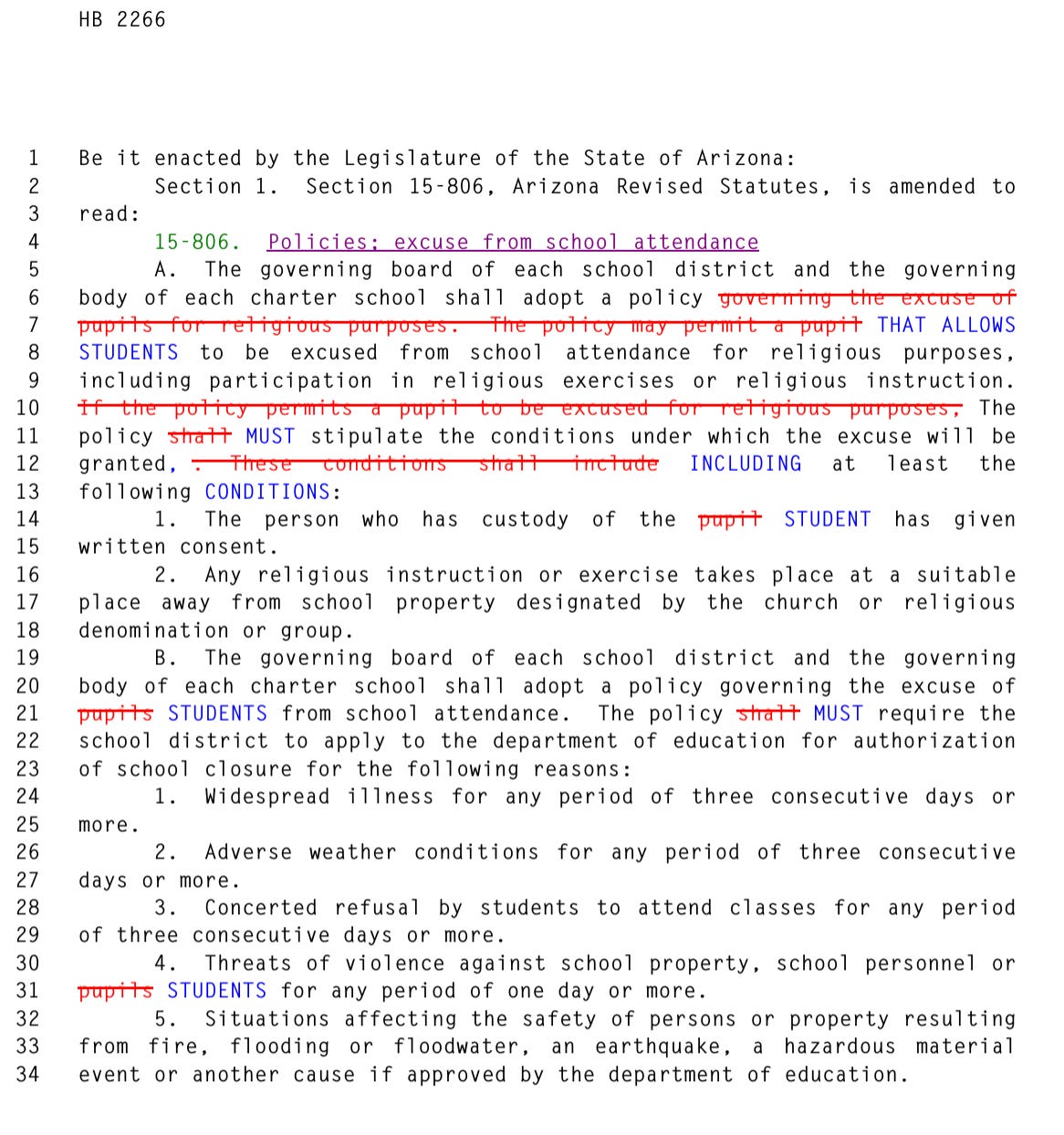
Secularists linked LifeWise Academy—an organization with a mission to offer Bible education to public school students during school hours—to Arizona House Bill 2266. Secularists claim bussing children to nearby churches for Bible studies during the school day is harmful to academic communities. But encouraging kids to walk off campus with “F— ICE” t-shirts during educational hours is okay? Only in the mind of a secularist.
Deer Valley board member and AZ legislator, Stephanie Simacek (D-LD2), called Lifewise “a controversial, far-right, religious instruction program.” Regarding HB 2266, the secularist told her constituents she would “continue to oppose bills that do nothing to serve public education.” Essentially, high moral standards, respecting authority, and taking responsibility for one’s actions have no place in taxpayer-funded, government schools.
The life’s purpose of a secularist boils down to persecuting Christians, opposing common sense legislation, and infiltrating public school systems to spread anti-Christ propaganda through immoral policies and curricula on all grade levels. Secularism is a spiritual, intellectual, and emotional drain on every generation. No child should be entrusted to an institution that’s predominantly run by godless people.
Parents must continue to seek alternative learning methods and regain control over their kids’ education. Don’t let secularism destroy their innocence and corrupt their moral character. Furthermore, taxpayers should keep rejecting bonds and overrides. Don’t incentivize sleazy administrators and weak board members to advance a secular agenda. Let the schools close and the buildings be repurposed. The kids will be fine if more parents and silent educators step up.
Public education—especially in Arizona—is a colossal failure. The lie of “separation of church and state” must be exposed. Steering children back to God is the only way to defeat secularism and defend our Constitutional Republic. Support constitutional legislation like AZ House Bill 2266 and the Empowerment Scholarship Account (ESA). Support Christian organizations like LifeWise Academy. Most importantly, support parental rights in K-12 education for all American families.
Tiffany Benson is the founder of Restore Parental Rights in Education and host of The Myth of Education Podcast. Her commentaries on public education and Christian faith can be viewed at Parentspayattention.com and Bigviewsmallwindow.com. All views and opinions expressed by Tiffany are her own.
by Ethan Faverino | Feb 20, 2026 | Education, News
By Ethan Faverino |
Arizona lawmakers have introduced legislation aimed at preventing disruptions to public school operations by prohibiting teacher strikes and coordinated work stoppages, while tying state funding more closely to in-person classroom instruction.
House Education Committee Chairman Matt Gress (R-LD4) and Senate Education Committee Chairman Hildy Angius (R-LD30) are advancing the proposal as a striker amendment to House Bill 2313.
The measure would make it unlawful for teachers in Arizona public school districts and charter schools to engage in strikes or any organized efforts to halt work against their employers.
Teachers who participate in such collective actions would forfeit key employment protections, including civil service status, reemployment rights, and benefits or privileges associated with their public school positions. These penalties would apply only to group participation in strikes or work stoppages—individual employment decisions or absences would not be affected.
“Taxpayers fund instruction delivered in classrooms,” stated Rep. Gress in a press release announcing the striker. “When adults coordinate mass callouts to shut down campuses, that is a strike in practice. It robs students of instructional time and throws working parents into chaos. Public schools exist to educate children. If someone organizes a work stoppage, they should not retain the privileges and protections of public employment. If regular school days are moved online because of coordinated political action, funding must reflect that.”
In addition, the bill directs the Arizona Department of Education to cut down a school’s base support funding when remote instruction increases as a direct result of an organized work stoppage. The legislation includes safeguards for schools operating under approved alternative instructional models, full-time online programs, or during declared emergencies.
Lawmakers say the proposal is a response to events in late January, when thousands of teachers and staff members in Tucson called out sick in connection with a nationwide protest. This action led to the temporary closure of around 20 campuses in the Tucson Unified School District, disrupting student learning and creating challenges for families.
“Parents should not wake up to closed campuses because of organized protests,” added Senator Angius. “The Tucson closures showed how a coordinated call-in can shut down learning overnight. This legislation restores accountability and stability for families and keeps the focus where it belongs, on students in seats and classrooms open.”
Consideration of the striker amendment to HB 2313 is expected soon.
Ethan Faverino is a reporter for AZ Free News. You can send him news tips using this link.
by Staff Reporter | Feb 13, 2026 | Education, News
By Staff Reporter |
Arizona Superintendent of Public Instruction Tom Horne believes the new federal guidance on prayer in schools serves as a pathway to further purge K-12 of diversity, equity, and inclusion (DEI).
Horne said the administration’s characterization of speech compulsion made it clear that DEI presented an impermissible threat to religious freedoms.
“The new guidance issued by the U.S. Department of Education states that ‘No public school, teacher, or school official should ever coerce or press a student to engage in speech or affirm a viewpoint that would violate the student’s sincere religious beliefs,’” said Horne. “Numerous DEI precepts violate widespread religious beliefs, such as urging students to change genders, age-inappropriate sexual lessons, and other elements that may demean a student’s religious beliefs.”
Horne clarified that the new guidance doesn’t permit schools to coerce religious expression, either. Both the superintendent and the guidance cited the 2025 Supreme Court decision, Mahmoud v. Taylor, which found that public schools mandating curriculums endorsing homosexuality and transgenderism were violating religious freedom.
“No public school, teacher, or school official should ever coerce or pressure a student to engage in speech or affirm a viewpoint that would violate the student’s sincere religious beliefs,” stated the guidance. “[A] public school cannot require a student group to adopt a particular viewpoint in order to be recognized by the school if the viewpoint violates the student members’ religious beliefs. School officials also cannot express hostility toward religious student groups by demeaning their beliefs.”
The guidance, issued last week, addresses the issue of DEI elements in the context of requirements under federal law to advise on constitutionally protected prayer in public elementary and secondary schools. This updated version replaces the last guidance issued under the Biden administration in 2023.
Horne offered a marked copy of the guidance highlighting key new provisions across the four parts of the nine-page guidance.
In order to receive federal funding, local education agencies (LEAs) must certify in writing to the Arizona Department of Education (AZED) by Oct. 1 every year that none of their policies prevent or otherwise deny participation in constitutionally protected prayer in public K-12 schools.
AZED will establish processes by which the LEAs provide that certification and by which complaints may be filed against noncompliant LEAs. AZED must also send a list of noncompliant LEAs to the Department of Education by Nov. 1.
Presently, AZED requires LEAs to answer on Critical Race Theory and DEI as part of public reporting of school grades to assist with parental choice in schools.
“We will add this question to our list and report answers not only on our website, but also, as required, to the federal government,” said Horne. “Those with unsatisfactory answers to this question will then be deprived of federal funds.”
The guidance further clarified that the Trump administration’s perspective on religious freedom within schools was unlike the “wall of separation” view undertaken by previous administrations. It cited the most recent Supreme Court decision on prayer by school officials, Kennedy v. Bremerton School District, which found that a high school football coach had a right to engage in prayer on the field after games.
“This is not the familiar but legally unsound metaphor of a ‘wall of separation’ between religious faith and public schools,” stated the guidance. “It is rather a stance of neutrality among and accommodation toward all faiths, and hostility toward none, deeply rooted in our nation’s history, traditions, and constitutional law — a stance that upholds our Constitution’s ‘recognition of the important role that religion plays in the lives of many Americans.’”
AZ Free News is your #1 source for Arizona news and politics. You can send us news tips using this link.
by Staff Reporter | Feb 1, 2026 | Education, News
By Staff Reporter |
Arizona Senate Republicans are refusing to let a parental rights bill die under Gov. Katie Hobbs’ heavily-used veto pen.
Senate Republican leadership revived the legislation through a concurrent resolution, passed out of committee on Wednesday. This legislative pathway allows the slim Republican majority to avoid another inevitable veto from the governor.
SCR 1006 from Senate Majority Leader John Kavanagh (R-LD3) directly challenges the supremacy of transgender-affirming policies and practices within schools.
“Parents have a fundamental right to know what’s happening with their kids at school, and students deserve privacy and safety. No 14-year-old girl should be forced to stand naked in a shower with an 18-year-old man who thinks he’s a girl,” said Kavanagh. “Families shouldn’t be sidelined, and schools shouldn’t be forced into confusion. This reflects what most Arizonans already believe, and it gives them the final say.”
If passed, the resolution would have voters decide whether to require schools to obtain parental permission prior to engaging in transgender-affirming behaviors: referring to a minor student by a name other than the one listed on school records, or referring to a minor student using pronouns that differ from that student’s biological sex.
Voters would also decide whether public schools must provide reasonable accommodations: access to a single-occupancy or employee restroom or changing facility for any individual unwilling to use the facility designated for their biological sex.
Lastly, voters would decide whether individuals could sue public schools for subjecting them to transgender-affirming policies, such as encountering an individual of the opposite sex in a restroom or changing facility designated for their biological sex, or being required to share sleeping quarters with a person of the opposite sex.
Gov. Hobbs vetoed two bills that contained these legislative provisions last year (SB 1002 and SB 1003). In identical letters, Hobbs said the state had more pressing matters than asserting parental rights over transgenderism within schools.
“[These] bill[s] will not increase opportunity, security, or freedom for Arizonans. I encourage the legislature to join with me in prioritizing legislation that will lower costs, protect the border, create jobs, and secure our water future,” said Hobbs.
AZ Free News is your #1 source for Arizona news and politics. You can send us news tips using this link.