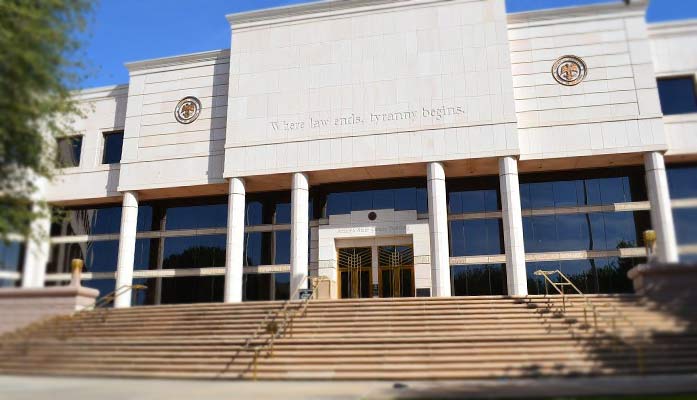
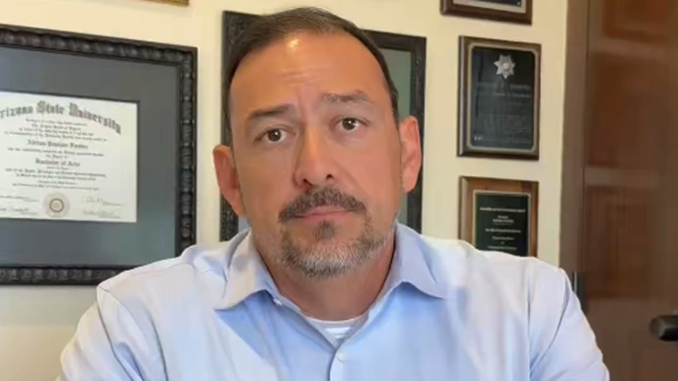
Teachers’ union activists were once again dealt a serious blow after the Arizona Supreme Court issued an order effectively removing an initiative from the ballot that aimed to undo the state’s universal school choice program.
Nearly four years ago to date, a similar initiative was removed from the ballot for failing to have the required number of signatures. Katie Hobbs, secretary of the state at the time and now the governor, held out on invalidating the ballot initiative.
The court’s order to recalculate the signature totals using the trial court’s formula, issued on Tuesday, is projected to have brought Proposition 212, the Protect Education Act, below the required signature total following a legal challenge filed by the Goldwater Institute in Clark v. Fontes.
Protect Education Accountability Now, the political action committee (PAC) behind the Protect Education Act, confirmed that the Arizona Supreme Court order meant their initiative would not qualify for the ballot.
The PAC blamed “big money in partnership with Republican lawmakers and the anti-public education lobby” for the initiative’s demise.
A spokesperson for the PAC stated that the initiative should have been included on the ballot regardless of the invalid signatures.
“This does not reflect what Arizona voters want. It does not reflect the overwhelming support of educators, parents and public school advocates across the state who volunteered their time and demanded a voice in reforming a program that abused taxpayer money and pulled funding from their neighborhood public schools,” said the spokesperson. “Instead, the hard-earned resources educators raised to fund this were buried under a mountain of big money, political power, and a system that consistently sides with special interests.”
— Protect Education Ballot Initiative (@ProtectEdAct) August 18, 2026
Activists submitted around 420,000 signatures to qualify for the ballot. Pending a review incited by the Goldwater Institute’s court challenge, the number of valid signatures will fall to a projected total of approximately 245,000. The initiative needed approximately 256,000 to qualify for the ballot.
Nearly 70,000 signatures were invalidated due to their discovery as duplicates or having been collected by legally ineligible circulators, like felons. The court also upheld the trial court ruling which invalidated entire sheets of signatures due to the petition circulator providing an address at which they weren’t living.
The ballot measure would have rolled back the universality of the Empowerment Scholarship Account (ESA) program by imposing an income cap.
The union-backed Protect Education Act appears to have fallen short of the valid signatures needed to make the November ballot.
In this special Keep Arizona Free Update with @Darla4freedom:
➡️ The campaign submitted roughly between 416,000-421,000 signatures, but after trial… pic.twitter.com/l7886cgtT9
The court also agreed with a lower court ruling that the ballot language drafted by Secretary of State Adrian Fontes was false and misleading because it used the term “voucher” to describe the ESA program. Vouchers must be spent immediately and only at certain approved schools, whereas ESA program funds may be rolled over and applied to various schooling types and educational resources.
The PAC behind this second failed initiative to end universal school choice raised more than $7.5 million and spent more than $7.2 million.
More than $6.5 million, or 87%, came from the National Education Association. $810,000, or nearly 11%, came from the Arizona Education Association.
Other major donors included $50,000 from the United Food and Commercial Workers Active Ballot Club, the PAC of a D.C.-based union; and $50,000 from Arizonans for Quality Education, a corporation or LLC based in Phoenix.
The latter entity was formerly known as Friends of ASBA, with ASBA standing for the Arizona School Boards Association, and was registered as a domestic nonprofit corporation, according to Arizona Corporation Commission (ACC) records.
AZ Free News is your #1 source for Arizona news and politics. You can send us news tips using this link.
The Protect Education Act is projected to fall more than 10,000 valid signatures short of the number required to qualify for Arizona’s November ballot after a court challenge removed thousands of petition signatures and county recorders completed their validity reviews.
The Arizona Free Enterprise Club (AFEC) announced Monday that applying the trial court’s rulings and county signature-validity rates leaves the initiative with approximately 245,000 valid signatures. Arizona law required the campaign to produce 255,949 valid signatures.
The calculation follows an expedited ruling Thursday from Maricopa County Superior Court Judge David McDowell in Clark v. Fontes, the lawsuit challenging the petitions submitted by Protect Education, Accountability Now, the political committee behind the initiative.
At the time of McDowell’s ruling, the final outcome remained unresolved because Maricopa and Apache counties had not yet completed their reviews. The Arizona Capitol Timesreported that the Secretary of State’s initial review had reduced the campaign’s submitted total to 389,376 signatures before the court considered challenges to individual circulators, petition sheets, and duplicate signatures.
🚨 BREAKING: “PROTECT EDUCATION ACT” FALLS SHORT
Based on the trial court’s ruling in Clark (@ClarkRimsza) v Fontes and county signature validity rates, the union-backed anti-ESA initiative does not have enough valid signatures to qualify for the November ballot.
McDowell’s ruling left 348,269 signatures presumptively valid before application of the counties’ random-sample validity rates. The court also addressed 24,369 duplicate signatures and challenges involving more than 110 petition circulators.
“The court agrees that it is conceivable that a double count could occur, but the court cannot make a decision based upon a hypothetical double counting of duplicate signatures,” McDowell wrote.
The initiative’s supporters submitted 421,451 signatures on July 2. Save Our Schools Arizona and the Arizona Education Association were among the organizations backing the campaign.
The Goldwater Institute filed its challenge July 20, alleging that tens of thousands of the submitted signatures should be rejected because of duplicate entries, defects in circulator registrations, and petitions collected by people who were legally ineligible to circulate them.
The amended complaint raised more than 73,300 objections. Those included allegations involving unregistered paid circulators, signatures collected before circulator registration, inaccurate addresses or contact information, identification problems, and circulators whose felony convictions or other legal circumstances allegedly made them ineligible.
McDowell ultimately invalidated signatures collected by several circulators. Four circulators were disqualified because of criminal histories. The judge also invalidated several thousand signatures collected by circulator Tyrone Crispell after finding his denial that he misrepresented the initiative to prospective signers was not credible.
AFEC said Monday that nearly 70,000 signatures were disqualified through the challenge, including duplicates and signatures gathered by legally ineligible circulators.
“This is a major victory for Arizona parents, students, and the integrity of our elections,” AFEC President Scot Mussi said. “This anti-school choice initiative and its union backers spent more than $7 million dollars trying to dismantle school choice in our state, but they still could not collect enough lawful, valid signatures to qualify for the ballot.”
Campaign-finance figures compiled by Transparency USA from Arizona disclosure records show the Protect Education, Accountability Now committee had reported more than $7.5 million in total expenditures through July 30. The National Education Association accounted for approximately $6.57 million in cash and in-kind contributions, while the Arizona Education Association contributed another $810,000.
The Protect Education Act, designated Proposition 212 during the ballot-review process, would make several changes to Arizona’s Empowerment Scholarship Account (ESA) program. The measure would generally limit eligibility to families earning $150,000 or less, with exceptions including students with disabilities, certain military families, and students assigned to poorly performing public schools.
The proposal would also establish additional requirements for participating private schools and tutors, restrict certain ESA expenditures, and generally require unused annual ESA funds to be returned to the state.
The signature dispute is separate from litigation over how Proposition 212 would be described to voters. Last week, Maricopa County Superior Court Judge Julie Ann Mata ordered Secretary of State Adrian Fontes to rewrite portions of the proposition’s descriptive title and “yes” and “no” statements after finding that the existing language omitted significant provisions of the measure. Judge Daniel Martin separately ordered revisions to the Arizona Legislative Council’s publicity-pamphlet analysis.
Republican leaders of the Arizona legislature are suing Secretary of State Adrian Fontes for allegedly misrepresenting a ballot measure to preserve school choice funding for military families.
Arizona Senate President Warren Petersen (R-LD14), the Republican nominee for attorney general, and House Speaker Steve Montenegro (R-LD29) sued Fontes to prevent the ballot measure language from going to voters.
The 66-page verified complaint accused Fontes of drafting ballot language that intentionally undermines the constitutional amendment, Proposition 145, in order to give a leg up to a competing ballot proposition to end the universality of the Empowerment Scholarship Account (ESA) program.
The language for Prop. 145’s descriptive title reads:
“Would nullify Proposition 212 (below) if voters enact it this election; prohibits the state from sweeping funds from certain state-run scholarship accounts if the student’s parent has provided certain active-duty military service; nullifies all laws that would sweep any such funds, including unrelated provisions of those laws.”
The yes/no language reads:
“A ‘yes” vote shall have the effect of amending the Arizona Constitution to: (1) nullify Proposition 212, which imposes spending and income limits on the Empowerment Scholarship Account (ESA) program, if the people enact that Proposition during this election; (2) prohibit the state from sweeping funds from certain state-run scholarship accounts if the student’s parent has provided certain active-duty military service; and (3) nullify all parts of any law that would sweep any such funds, including unrelated provisions of those laws, applying retroactively to all laws enacted on or after November 1, 2026.
A ‘no’ vote shall have the effect of maintaining current constitutional provisions related to scholarship accounts and allowing Proposition 212 to go into effect if voters enact it this election.”
According to the lawmakers, Fontes’ Prop. 145 ballot language allegedly skimped on and buried details of how the proposed constitutional amendment would preserve military families’ school choice funding. Much of the language, they say, used “partisan, argumentative framing” of Prop. 145 as a direct nullification of Proposition 212, or the Protect Education Act.
Prop. 212 seeks to end the ability for all Arizona students to enter the ESA program by imposing an income cap. It would also require approved curriculum for the release of ESA funds, degrees and background checks for ESA-funded tutors, accreditation or administration of state standardized tests for ESA-funded schools, and revocation of unspent ESA funds for public school usage.
The lawmakers argued that the “impermissibly misleading” ballot language focused more on Prop. 145’s potential future impacts on Prop. 212, in conflict with Arizona law, rather than summarizing the essential change in existing law. They claimed the ballot language is biased, argumentative, and fails to state the measure’s impact on existing law.
Attorney General Kris Mayes signed off on the ballot language.
Montenegro accused Fontes of “play[ing] political games” at the expense of military families.
“Instead of giving voters a fair description, Fontes turned the Secretary of State’s Office into a platform for Democrats’ anti-school-choice talking points,” said Montenegro. “Military families deserve better. I’ll see him in court.”
Adrian Fontes claims to support our veterans, yet he is using official ballot language to play political games with the children of military families. Prop. 145 safeguards their scholarship funds and protects school choice. Instead of giving voters a fair description, Fontes…
The teachers’ unions and their allies at Save Our Schools (SOS) have proven time and time again that they will do anything to kill universal school choice in Arizona.
They’ve fought expansion of the program. They’ve pushed to cap it. They’ve worked with activist reporters in the legacy media with ties to the Red for Ed teachers’ union to push false claims about it. And we all witnessed it four years ago when they made their not-so-triumphant proclamation that they had enough signatures to repeal the program—only to discover they had miscounted by more than 50,000 signatures.
But their latest attempt to overturn the program is their lowest yet.
Earlier this month, the teachers’ unions and SOS announced they had submitted more than 420,000 signatures for a ballot initiative that would end the universal eligibility of Arizona’s Empowerment Scholarship Accounts (ESA) program.
Given their track record, the Arizona Free Enterprise Club worked closely with the Goldwater Institute and other school choice advocates to review the petitions. What we found was far more disturbing than another failed signature count.
Dozens of Convicted Felons—Including Registered Sex Offenders—Hired to Collect Signatures
The teachers’ unions and SOS want Arizonans to believe that their “Protect Education Act” campaign is a grassroots effort led by concerned parents and educators. But they made a very different choice when it came time to build their campaign…
Former Arizona Governor Doug Ducey is blasting the anti-ESA ballot measure, which is currently facing a legal challenge from the Arizona Free Enterprise Club and the Goldwater Institute. Under Ducey’s leadership, Arizona became the nation’s leader in school choice.
The Goldwater Institute filed a lawsuit earlier this week, challenging the validity of signatures submitted for the proposed “Protection Education, Accountability Now Act,” a ballot initiative that would place new restrictions on Arizona’s Empowerment Scholarship (ESA) program.
According to the lawsuit, the initiative required 255,949 valid signatures to qualify for the November ballot but allegedly submitted enough invalid signatures to fall below that threshold. It contends that tens of thousands of petition signatures are subject to disqualification and raises concerns about the campaign’s signature-gathering process.
Goldwater claimed that more than 75% of the signatures were collected by paid circulators rather than volunteers and questioned whether some petition circulators met legal standards.
Out-of-state special interests are spending millions to buy their way onto Arizona's ballot. Today, Goldwater filed suit challenging the invalid signatures submitted for this anti-school choice measure. We will keep fighting to defend the rights of Arizona families and protect…
— Goldwater Institute (@GoldwaterInst) July 20, 2026
Ducey criticized the proposed initiative, arguing that it would eliminate educational options for families participating in the ESA program.
“Once again, we are reminded how little these out-of-state unions care about Arizona students and their parents,” stated Ducey. “This measure would strip tens of thousands of Arizona families of educational choices they have made for their children, forcing students out of the schools that are serving them well and back into schools they chose to leave. That is unacceptable, and we will vigorously challenge this measure at every possible step.”
Arizona’s ESA program currently serves more than 100,000 students, allowing eligible families to use state education funds for private school tuition, homeschooling expenses, and other approved educational costs.
Supporters of the program argue it expands educational opportunities and parental choice, while opponents have raised concerns about its cost and oversight.
The Goldwater Institute alleged that the ballot initiative is backed by out-of-state special interest groups seeking to limit Arizona’s school choice program.
“This is a shameless attack on Arizona’s parents, funded by an out-of-state union,” said Victor Riches, President and CEO of the Goldwater Institute. “They’re trying to game the system by turning in tens of thousands of invalid signatures in an effort to destroy the most successful school choice program in the country. This won’t happen on our watch.”
The Arizona Free Enterprise Club announced that it joined the legal challenge in support of the Goldwater Institute’s lawsuit. Greg Blackie of the organization will serve as a plaintiff in the case.
They Claim to Protect Children. Look Who They Hired!!
Arizona Free Enterprise Club @azfec Joins Legal Challenge to Union-Backed Anti-ESA Initiative. Save Our Schools and the teachers unions claim their anti-ESA campaign is about protecting children.
— Arizona Free Enterprise Club (@azfec) July 21, 2026
According to the Arizona Free Enterprise Club, it worked alongside the Goldwater Institute and other school choice advocates to review petition signatures and identify what they describe as “serious irregularities”.
The organization said the complaint also raises concerns about individuals hired to circulate petitions, including allegations involving circulators with criminal histories.
Arizona Free Enterprise Club President Scot Mussi released a statement, saying election laws should be enforced equally for all ballot initiatives.
“Save Our Schools and the teachers unions have spent years accusing ESA families of fraud and demanding greater scrutiny of parents, said Mussi. “Now, their own campaign is facing serious questions about the people they hired to gather signatures. Arizona’s election laws must be fully enforced. If this campaign failed to collect enough lawful and valid signatures, it must not qualify for the ballot.”
The challenged initiative is backed by Save Our Schools Arizona, the Arizona Education Association, and other organizations that have, for years, supported additional limits on ESA eligibility.
Ethan Faverino is a reporter for AZ Free News. You can send him news tips using this link.