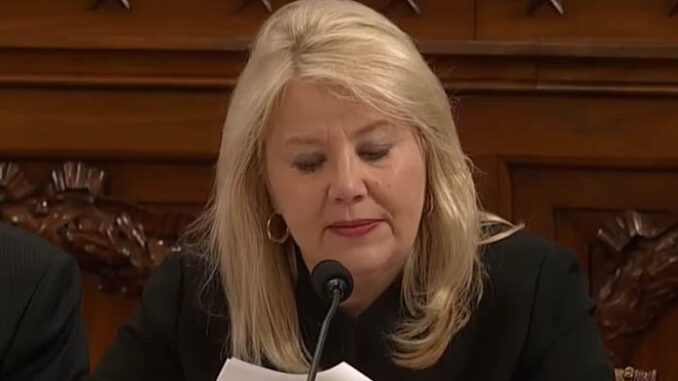
As Maricopa County voters begin casting ballots in the off-year election, Supervisor Debbie Lesko is raising concerns about Proposition 409 — a $898 million bond proposal to fund major upgrades for Valleywise Health, the county’s public hospital system.
“I’m not a fan of Prop. 409, the Valleywise Health ballot measure,” Lesko wrote on X. “This is a new tax in addition to their existing tax. If this passes, we’ll be paying for two Valleywise bonds on our property taxes.”
I'm not a fan of Prop 409, the Valleywise Health ballot measure. This is a new tax in addition to their existing tax. If this passes, we'll be paying for 2 Valleywise bonds on our property taxes.
The measure, now appearing on ballots mailed to voters this week, would allow the county to issue bonds backed by property taxes to improve and expand Valleywise facilities across the region. The hospital system says the funding would be used to construct a new 200-bed behavioral health facility, expand emergency services, and replace aging community health centers.
If approved, Prop. 409 would raise property taxes by 11 cents per $100 of assessed limited property value. Valleywise leaders and public health advocates argue the investment is essential to meet growing mental health needs across the Valley. Supporters say the measure reflects the community’s commitment to improving access to behavioral health services and modernizing the hospital’s aging infrastructure.
The Arizona Public Health Association and Maricopa County Medical Society have also endorsed the proposal, calling it a nonpartisan issue with long-term benefits for residents. However, Lesko’s opposition highlights lingering taxpayer concerns about rising costs. Critics argue that approving the new bond would result in residents paying for two concurrent Valleywise property tax levies — the existing one from an earlier bond and the new one under Prop. 409.
Mail ballots were sent out on October 8, and voters have until October 24 to request one by mail. Ballots should be mailed back by October 28 to ensure timely delivery or dropped off at a designated county drop box. Election Day is November 4, when all ballots will be counted. As debate continues, voters will decide whether the benefits of expanding Maricopa County’s public health system outweigh the costs of another property tax increase.
Jonathan Eberle is a reporter for AZ Free News. You can send him news tips using this link.
Republican leaders in the Arizona Legislature are highlighting a string of tax cuts they say are aimed at providing relief to working families, renters, and small business owners across the state. Over the past three years, lawmakers have passed three separate tax measures that they argue will reduce financial burdens for everyday Arizonans.
The most recent change, Senate Bill 1069, was approved last month and is set to take effect on January 1, 2026. The legislation raises Arizona’s business personal property tax exemption to $500,000, a move Republican lawmakers say will particularly benefit small businesses by cutting down on tax bills for equipment and other property used in daily operations.
In 2023, the legislature also passed Senate Bill 1184, which bans municipal excise taxes on residential leases starting in 2025. Supporters say the measure will help renters by prohibiting local governments from adding extra taxes to apartment and home leases, a cost often passed directly to tenants.
That same year, lawmakers enacted the Arizona Families Tax Rebate through Senate Bill 1734. The rebate provided one-time direct payments to Arizona households: up to $750 for single filers and up to $1,500 for joint filers. Families received $250 per child under 17, while older dependents qualified for $100 each.
Senate President Warren Petersen praised the tax cuts as part of a broader conservative approach to governance.
“At a time when families are feeling squeezed, we’re doing what government should—getting out of the way and letting our hardworking taxpayers keep more of what they earn,” Petersen said in a statement. “These tax cuts aren’t handouts. They’re the result of smart, conservative leadership that puts everyday Arizonans first.”
Petersen also framed the tax policy as aligned with President Donald Trump’s “America First” agenda, signaling that Arizona Republicans see these moves as part of a larger national effort to spur growth and reduce government intervention.
Democratic lawmakers, meanwhile, have raised concerns in past sessions that cutting taxes could limit state and local governments’ ability to fund essential services, including education and infrastructure. However, GOP leaders maintain that the state’s healthy revenues give them room to ease tax burdens without sacrificing core programs.
With these three measures now on the books, Arizona Republicans are positioning themselves as champions of taxpayer relief ahead of the 2026 legislative session and upcoming election cycles.
Jonathan Eberle is a reporter for AZ Free News. You can send him news tips using this link.
The Maricopa County Board of Supervisors (MCBOS) has released a “Truth in Taxation Notice,” announcing that it will hold a hearing on June 23rd as part of its annual budget process. The new budget will lower the combined primary and secondary “overall tax rate.” However, the primary property tax rate is remaining flat which would increase homeowners’ property taxes due to the increase in property values in Maricopa County.
According to the County Supervisors, the FY 2026 Budget “lowers the overall tax rate” and “is $269.5 million below the maximum amount allowed by state law, meaning the county collects less in taxes than it could.” But as stated in the notice, it would increase the primary property tax levy by 1.81%, raising homeowners’ property taxes on a $100,000 house from $113.85 to $115.91. The Maricopa County Truth in Taxation Calculation factors the current primary property tax levy, and the net assessed valuation, excluding the value of new construction. The Maricopa County Truth in Taxation Calculation factors the current primary property tax levy, and the net assessed valuation, excluding the value of new construction, which appears to generate the net decrease in the overall tax.
The release from the MCBS also provided a disclaimer stating that, “The Board does not control property values. However, as property values increase, the tax levy for existing property owners will also increase. And as a result, some property owners may be subject to a slight tax increase due to positive property value market adjustments in a growing economy.”
The FY 2026 Tentative Budget has been approved unanimously by the Board of Supervisors.
The public will be able to comment on the tentative budget between now and the final vote which is scheduled for June 23, 2025. pic.twitter.com/wQh06Uutke
In a statement released with the preliminary budget on May 19th Maricopa County Board of Supervisors Chairman Thomas Galvin, District 2 said, “I promised as Chairman that we would be good stewards of taxpayer dollars, and with this budget, we are showing how government can run efficiently and effectively to enhance public safety and promote economic prosperity. This budget ensures Maricopa County won’t just weather the storm of economic uncertainty but will thrive. And I’m pleased to be keeping a promise to improve compensation for the courageous and dedicated members of MCSO.”
The County Supervisors stated that they were able to “decrease the property tax rate slightly, bringing the overall rate to 1.348, down 0.37% from the prior year.” The new budget per the board does not decrease existing programs and services.
Supervisor Mark Stewart, District 1 stressed, “While many counties are imposing taxes at the maximum rate permitted under state law, Maricopa County’s tax levy remains $269.5 million below that limit. Our approach is not limited to reduced taxation—we’re also delivering significant cost savings through greater operational efficiency, such as moving county personnel out of expensive leased spaces, while also investing in public safety and making our parks more enjoyable for all Maricopa County residents.”
“The County’s conservative budgeting philosophy has long protected county taxpayers from potential economic downtowns or unanticipated costs,” Vice Chair Kate Brophy McGee, District 2 added. “I’m proud to vote for such a responsible budget that puts money where it matters—with nearly 50% going to public safety.”
Supervisor Debbie Lesko, District 4 emphasized the board’s partnership with Maricopa County Sheriff Jerry Sheridan in developing the budget, stating “The best way to keep our communities safe and crack down on criminal activity is to fully support our law enforcement professionals, not just with words, but with action. Over the past few months, the Board has worked in partnership with Sheriff Sheridan and our Human Resources and Budget teams on a fiscally responsible plan to boost compensation for MCSO patrol and detention staff. I’m looking forward to finalizing those details before the approval of a final budget in June.”
Editor’s Note – This article was updated to accurately reflect the distinction between the tax rate which the Maricopa County Board of Supervisors controls, and the overall tax levy which is a combination of property values and the property tax rate.
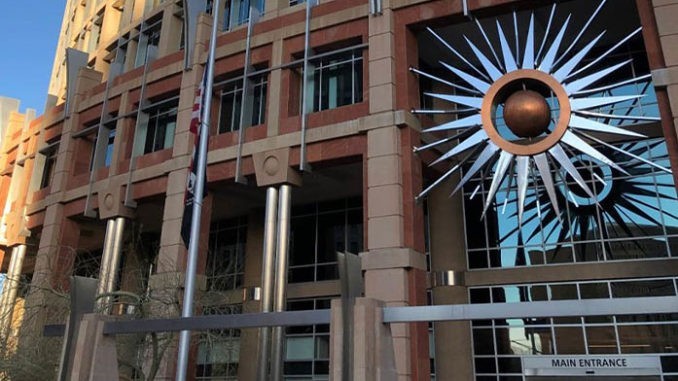
The city of Phoenix will be in court on Wednesday over a lawsuit against its arrangement waiving $8 million in property taxes for a private real estate developer downtown.
The Arizona Court of Appeals will hear the case, Paulin v. City of Phoenix. The Goldwater Institute filed the lawsuit in May 2022.
Goldwater Institute Vice President for Litigation Jon Riches claimed the property tax exemption violated both the Arizona Constitution and court precedent prohibiting the use of taxpayer dollars to benefit private interests.
“Arizona courts have been clear time and again: taxpayer dollars are to be put to public use, not to benefit private, special interests,” said Riches.
Phoenix waived the property taxes on a downtown high-rise development project by assuming the legal title from real estate developer Hubbard Street Group and leasing the property back to them. The city did so in order to capitalize on Arizona’s Government Property Lease Excise Tax (GPLET) abatement provisions. In so doing, the city of Phoenix ensured the Hubbard Street Group protection would be saved from having to pay millions in property taxes for the term of the lease — eight years. After that better part of the decade is up, the city will return the title back to the developer.
The Goldwater Institute maintains that this workaround adopted by the city amounts to, essentially, tax evasion: an abuse of GPLET and a loss of a revenue stream at a burden to other taxpayers.
As reported previously, the city of Phoenix assumed ownership after it declared the developer’s project, “Skye on 6th,” to be part of a slum or blighted area. As part of their arrangement with the city’s assumption of their legal title to the development, Hubbard Street Group agreed to pay over $500,000 in rent to the city, $30,000 to two school districts, and dedicate 10 percent of its residential units to workforce housing.
Skye on 6th is marketed as “the height of luxury.” The most affordable rooms (studios listed at 400 square feet) start at $1,500 a month. The most expensive rooms are on their penthouse floor, where rent starts at $4,500 a month and goes up to over $6,700 a month.
The project cost nearly $88 million to develop.
One of the represented taxpayers in the case, Bramley Paulin, successfully sued the city last year, Paulin v. Gallego, when he challenged the city’s restriction on temporary signage for the Super Bowl LVII. The Maricopa County Superior Court ruled the city’s resolution on signage was an unconstitutional restraint on free speech and delegation of government power.
Paulin and the other taxpayer in the case, Mat Englehorn, reside and own businesses in the Phoenix area.
The oral arguments are scheduled to occur on Wednesday at 9:30 am.
In 2020, the Maricopa County Superior Court ruled against a similar GPLET arrangement between the city of Phoenix and another high-rise developer.
In his ruling, Superior Court Judge Christopher Coury questioned whether GPLET could be relevant any longer given the tendency for abuse.
“This judicial officer questions whether the death knell for the GPLET’s usefulness has rung,” wrote Coury.
AZ Free News is your #1 source for Arizona news and politics. You can send us news tips using this link.
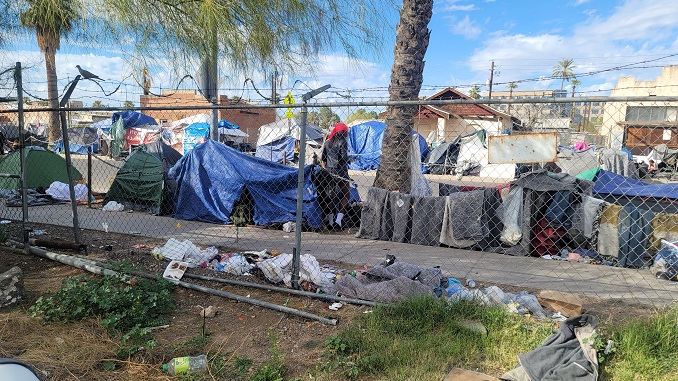
Arizonans looking for more information about a ballot measure that addresses the state’s growing homelessness issues can access vital research from a local think tank organization.
Late last month, the Common Sense Institute Arizona (CSI) released a report “on the economic and fiscal impact of Proposition 312, finding that there is indeed a link between the increase in homelessness and declining property values.”
According to CSI, “Proposition 312 is aimed at tackling Arizona’s growing homelessness crisis, offering property owners the opportunity to receive tax relief for costs incurred due to unmitigated public nuisances, such as homelessness, vandalism, property crime, and drug use.”
The report from CSI found “that under the status quo, property owners in areas with unmitigated public nuisances are seeing their values decrease in real value [while] homelessness is on the rise.”
“The rising rates of crime, homelessness, and drug activity in key areas of Phoenix appear to have taken a toll on property values and overall economic activity,” said Glenn Farley, Director of Policy & Research for CSI. “In this kind of environment of declining relative property values and higher crime rates, there are ongoing problems requiring mitigation – like security and cleanup costs. In practice, though, the real impact is likely to be preventive: local governments may ultimately be more proactive about mitigating these nuisances if this proposal is enacted than they are today.”
The Arizona-based Goldwater Institute took a position in support of Proposition 312 ahead of the November General Election. On its website, the influential organization wrote, “We saw it in Phoenix’s homeless Zone when the city allowed lawlessness to run wild. We saw it in Tucson, too. Amid rampant homelessness, hardworking Arizona taxpayers are being forced to bear the burden of a city’s refusal to do its duty to protect public health and safety, paying out of pocket to install fences, hire security, clean up garbage, human waste, and other hazardous materials themselves. Prop 312 ensures that when government fails to enforce existing laws regarding illegal camping, loitering, pollution, and other nuisances, taxpayers will no longer be forced to foot the bill.”
Proposition 312 was made possible by the Arizona State Legislature earlier this year, when Republicans led the way to pass HCR 2023, which, if eventually passed by state voters in November, would “allow a property owner to apply for a primary property tax refund if the owner documents expenses caused by a city, town or county adopting a policy, pattern or practice which declines to enforce existing laws or the maintaining of a public nuisance” – according to the overview provided by the state House.
In a statement after the successful passage of the bill out of his chamber, Senate President Warren Petersen said, “There are instances where local governments routinely and repeatedly fail their citizens by not enforcing laws. An example of this would be the City of Phoenix’s handling of the former homeless encampment known as ‘The Zone.’ This area was not only a public safety and public health disaster for those who camped there, but it was also a detriment to the livelihoods of small business owners who set up their shops in the area.”
Petersen added, “Money talks, and as a way to encourage municipalities to enforce the law, Speaker Toma and I teamed up to sponsor HCR 2023/SCR 1006. This measure is a ballot referral that would protect law-abiding citizens. If approved by voters, property owners would be allowed to request a refund for expenses incurred to mitigate the problem, up to the amount of their property tax liability. The funds would be deducted from the local government’s state shared revenue.”
The chamber’s president also noted that “all Senate Democrats voted ‘no’” on the referral.
The key findings from CSI about Proposition 312 are as follows:
“Problem increasing: Crime, drug overdoses, unsheltered homelessness, and other public nuisances have risen dramatically in Arizona and the greater Phoenix area since 2019. But the impacts are disproportionate: the problem has become more visible in certain parts of the city. This creates a negative economic impact for those parts of the city where local officials have failed to enforce existing laws
“Property Value Loss: Commercial properties in Phoenix affected by unmitigated public nuisances have seen market rent appreciation fall to just 15.7% between 2019 and 2023, compared to the citywide rate of 30.2%. This represents up to $2.1 billion in lost property value due to slower appreciation in areas with high levels of homelessness, crime, and public nuisances.
“Increased Crime: In areas with high public nuisance activity, the average crime rates for drug offenses, burglaries, robberies, and arson were between 3 to 5 timeshigher than the Phoenix average, driving up costs for property owners due to increased security measures and property damage.
“Impact on Businesses: Businesses located in areas with elevated public nuisance levels experience significantly lower property appreciation and higher vacancy rates. The economic toll of unmitigated public nuisances has made it harder for businesses to thrive in these areas.”
During the legislative process this year, representatives from Barry Goldwater Institute for Public Policy Research, QuikTrip, Arizona Free Enterprise Club, Arizona Chamber of Commerce, Arizona Food Marketing Alliance, and the National Federation of Independent Business, indicated their support for the proposal on the Arizona Legislature’s Request to Speak system. Representatives from the League of Arizona Cities & Towns, Living United for Change in Arizona, Arizona Coalition to End Sexual and Domestic Violence, Professional Fire Fighters of Arizona, Arizona Association of Counties, County Supervisors Association of Arizona, Arizona Housing Coalition, and several state cities and towns, signed in to oppose the measure.
Interested voters can read the full CSI report regarding Prop 312 here.
Daniel Stefanski is a reporter for AZ Free News. You can send him news tips using this link.