by Alexander Kolodin | Jan 5, 2026 | Opinion
By Alexander Kolodin |
Cuius est solum, eius est usque ad coelum et ad inferos. Also known as the ad coelum doctrine, it means: “Whoever owns the soil owns everything up to the heavens and down to the depths.” This includes gold, silver, oil—or groundwater—that may be below.
In basic property law, the ad coelum doctrine comes with the “right to exclude,” which is the right for landowners to keep, sell, use, protect, and conserve their property—including preventing others from taking it.
Sic utere tuo ut alienum non laedas, also known as the “no harm” principle, means: “Use your own property in such a way that you do not injure the property of another.” This includes groundwater.
Articulated by John Locke in his Second Treatise of Civil Government, the “no harm” principle represents the biblical golden rule: “Do unto others what you would have them do unto you.”
These principles form the foundation of American property law. And in Arizona, they were part of our groundwater code—that is, until 1953, when they were taken away.
Arizonans had property rights to groundwater
According to the Arizona Supreme Court in Davis v. Agua Sierra Resources (2009), Arizona’s common law on groundwater “evolved from the territorial-day view that a landowner has a property interest in groundwater underlying the surface estate.”
Indeed, as Ted Steinberg wrote in Slide Mountain: “Private property in the underground was real all right. At least there were a lot of people in Arizona who believed in it.” According to him, Arizona farmers swore they owned the groundwater beneath their feet, just like the ad coelum doctrine said they did.
In 1904, the Territorial Supreme Court of Arizona affirmed farmers’ beliefs, stating in Howard v. Perrin that “percolating waters are the property of the owner of the soil.”
After statehood, the Arizona Supreme Court upheld the territorial view, stating in Maricopa County Municipal Water Conservation District No. 1 v. Southwest Cotton Co. (1931) that groundwater was “the property of the owner of the land,” subject to the rules of the common law, which included the “no harm” principle and biblical golden rule.
These affirmations confirmed what landowners already knew: that the groundwater was theirs, and they had a right to use it as long as they did not harm the rights of others.
But this framework is very different than the ‘free-for-all’ we have today, which does not recognize private property rights or the golden rule.
What happened? How did we get here?
Arizonans’ property rights were taken away
In the mid-1900s, a dramatic shift occurred. Armon Cheatham, an industrial cotton farmer, sunk eleven wells near Laveen, creating a large cone of depression that dried up thirty-eight other landowners’ wells.
The small landowners had been using their water for modest means, like household use and ranching. Tom Bristor, one of those landowners, sued to protect his private property rights, enforce the ad coelum doctrine, and uphold the golden rule.
But in a sudden reversal of precedent, the Arizona Supreme Court in Bristor v. Cheatham (1953) rejected the territorial view and replaced the golden rule with a new doctrine called “beneficial use.”
This dealt the first blow—eliminating John Locke’s “no harm” principle and opening the door for anyone to pump as much as they wanted, “without limitation and without liability to another owner.”
Twenty-eight years later, the Arizona Supreme Court dealt the final blow, declaring in Town of Chino Valley v. City of Prescott (1981), that “there is no right of ownership of groundwater in Arizona prior to its capture and withdrawal from the common supply,” eliminating the ad coelum doctrine in our state.
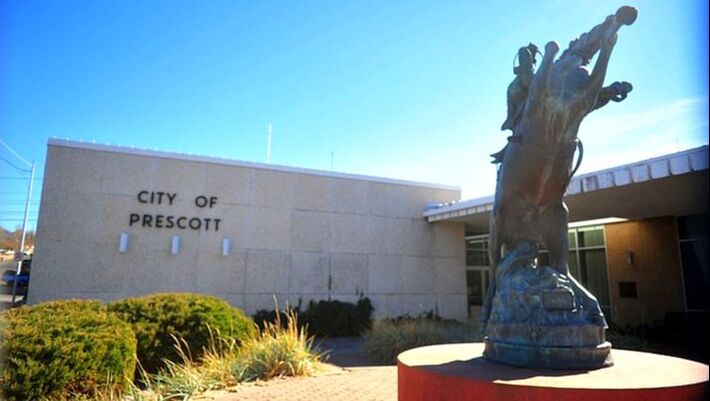
Here, small well owners in Chino Valley sued to stop the City of Prescott from taking their water and piping it 17 miles away under the state’s new 1980 Groundwater Management Act.
Although their wells hadn’t gone dry yet, they argued that the city’s scheme (and the state’s new groundwater law) constituted a “taking” that required just compensation, including for future groundwater supplies that hadn’t been pumped but that residents wanted to ensure would be available for future use.
Unfortunately, the Court sided with big government and the city, ruling that the water beneath their property wasn’t theirs until they pumped it—ending the ad coelum doctrine and handing full control over to the government.
This was the final nail in the coffin for private property rights—eliminating the right to exclude and declaring all groundwater a public resource, shared by all but owned by none, preventing anyone from protecting or conserving a discrete supply and leading to the situation we have today.
Ownership of subsurface groundwater should never have been taken away
The judges who decided the 1953 case were all Democrats, and the governor who adopted the 1980 law was Democrat Bruce Babbitt. They broke from our state’s traditional values and sided with corporate industry over small landowners, leaving everyday citizens helpless against the political and financial elite.
Had Arizona’s leaders maintained the traditional values that founded our country, we would not be in the situation we’re in today.
Fortunately, the detrimental effects of these negative decisions can be reversed. We can correct the mistakes of the past and return private property rights back to the people.
Only then can we ensure a fair system that restores what was taken, upholds our founding values, and allows property owners to protect and conserve the groundwater beneath their feet.
Alexander Kolodin serves Legislative District 3 in the Arizona State House and has been practicing election law in Arizona for over a decade. He is currently running to be Arizona’s next Secretary of State.
by Matthew Holloway | Dec 2, 2025 | News
By Matthew Holloway |
Jim Griset, the proprietor of a souvenir store, an art gallery, and a Harley Davidson shop in Prescott, has secured a hard-fought victory in his efforts to bring his vision of a new hotel to the city’s historic downtown. Represented by Goldwater Institute attorney Jon Riches, Griset’s victory successfully overturned a City Council ruling that upheld the Prescott Preservation Commission’s denial of his permit.
According to the Goldwater Institute, Griset has sought to transform three buildings he already owns on Prescott’s historic Whiskey Row into a hotel. The buildings already house his existing businesses, but he has endeavored since 2023 to bring the hotel into being that would “complement the surrounding architecture and preserve the charm and character that make Prescott special.”
As noted by Goldwater, none of the buildings in question are listed as historic. Still, they are located within the city’s designated historic district and thus require approval from the Preservation Commission.
Writing for Goldwater Riches explained:
“When Jim first submitted his application in 2023, the commission rejected it—not based on any clear or objective standards, but in response to NIMBY [not-in-my-backyard] opposition and vague impressions. Instead of pointing to identifiable criteria in the city’s preservation code, the commission relied on subjective notions like whether the design was ‘respectful’ of the district’s ‘intimate scale.’
Those terms don’t appear anywhere in the law. They’re not defined. They’re entirely subjective—which is exactly what the law is supposed to prevent.”
The law Riches refers to is The Permit Freedom Act, a Goldwater Institute-developed law enacted in 2023. He notes, “The Act prohibits local governments from making new rules midstream or applying vague, subjective standards to block lawful use of private property. And that is precisely what Prescott did.”
When Griset applied for the permit and was denied, he reportedly took the commission’s feedback, revised his designs, and worked to meet the standards set. “Yet every time he met the standards placed before him, the standards seemed to change,” Riches wrote.
When the denial was appealed to the Prescott City Council, the Council ruled against Griset. The council brought in a neutral historic preservation expert, who found that Griset had met the standards, and Goldwater attorneys brought the potential violation of the Permit Freedom Act to the City’s attention. Goldwater told the city, “Based on this review, under the Permit Freedom Act, there was simply no legal criteria authorizing the denial of his permit,” per Riches. However, the Commission again ruled 3-2 against Griset and his hotel plans.
Riches noted that in 2024, Prescott’s City Council sold the old City Hall building to a property developer with similar plans for a four-story hotel in the very same district. But it wasn’t rejected by the Commission or Council.
On November 4th, the City Council heard Mr. Griset’s appeal. Riches wrote, “Several council members spoke openly about the importance of private property rights and the need for fair, consistent rules—not decisions driven by subjective preferences or political pressure. Members of the public echoed the same: government rules must be fair, consistent, and objective. They should not favor some over others.”
Riches concluded, “Property owners in Prescott, and across Arizona, deserve certainty. They deserve to know the rules before they invest. When government shifts the rules or invents new ones as it goes, it undermines confidence, deters investment, and violates the law.”
The council voted to overturn the Preservation Commission’s decision. Mr. Griset’s hotel plan is pending approval from Prescott’s city zoning and planning commission and, subsequently, from the Council. A water service agreement will also require approval.
Matthew Holloway is a senior reporter for AZ Free News. Follow him on X for his latest stories, or email tips to Matthew@azfreenews.com.
by Jonathan Eberle | May 31, 2025 | News
By Jonathan Eberle |
Arizona homeowners will soon have greater freedom to add accessory dwelling units (ADUs) to their properties, thanks to a new law aimed at easing housing constraints and expanding property rights across the state.
House Bill 2928, signed into law last week, was spearheaded by House Majority Leader Michael Carbone. The legislation establishes statewide rules that limit local governments’ ability to restrict ADUs—also known as casitas or guest houses—on lots zoned for single-family homes.
“Arizona homeowners should be able to use their property without being buried in red tape,” said Carbone. “Whether it’s for an aging parent, a young adult, or a rental opportunity, ADUs are a practical solution—and it’s time the law recognized that.”
Under HB 2928, counties must adopt consistent standards by January 1, 2026, or default provisions outlined in the law will automatically take effect. The bill bars local governments from imposing strict design standards, excessive parking requirements, or costly infrastructure upgrades that have historically made ADUs difficult to build.
Key provisions of the law include prohibiting rules that require a preexisting relationship between homeowners and ADU occupants; limiting fees and setback requirements that raise construction costs; and allowing both attached and detached ADUs by right on single-family lots.
The legislation includes carveouts for tribal lands, military zones, high-noise areas, and utility easements. It also permits counties to require septic evaluations where appropriate.
Supporters argue the measure is a meaningful step toward addressing Arizona’s housing affordability challenges. By enabling more flexible use of existing properties, lawmakers say the bill will help ease pressure on housing supply without large-scale development.
“This law gives homeowners more freedom, cuts through bureaucracy, and ensures Arizona families can thrive,” Carbone said.
The reform aligns with broader goals outlined in the House Republican Majority Plan, which emphasizes reducing government intervention and promoting individual rights.
As Arizona continues to experience rapid population growth, lawmakers on both sides of the aisle have expressed interest in finding creative housing solutions. ADUs—long used in other states as a way to increase density without altering neighborhood character—are increasingly seen as a tool to meet that demand.
With HB 2928 now law, the focus shifts to implementation, as counties work to meet the 2026 deadline for adopting the required rules.
Jonathan Eberle is a reporter for AZ Free News. You can send him news tips using this link.
by Matthew Holloway | Feb 3, 2025 | News
By Matthew Holloway |
Congressman Eli Crane (R-AZ-02) announced the reintroduction of a bill to rollback and nullify Biden administration policies that flew in the face of the sovereignty of native American property owners and tribal governments.
The congressman explained the need for this corrective measure, saying in a press release, “Secretary Haaland and President Biden engaged in selective sovereignty driven by extremists with no concern for Navajo interests or the energy needs of all Americans.”
He continued, “I’m proud to reintroduce this bill that would invalidate the Biden admin’s meddlesome ban. Together, with the Trump Administration, I’m confident we will be able to advance tribal interests, unleashing energy sovereignty and prosperity.”
The bill was drafted in reaction to a 2023 Public Land Order that banned the resource development of 336,404.42 acres of federal mineral estate surrounding the Chaco Canyon National Historical Park until 2043, barring Navajo citizens allotted the land from profiting from any possible mineral leases.
At the time, Navajo Nation Council Speaker Crystalyne Curley said, “The Navajo Nation attempted to compromise by proposing a 5-mile buffer as opposed to the 10-mile,” as reported by Cactus Politics. However, she continued, “The Biden Administration has undermined the position of the Navajo Nation with today’s action and impacted the livelihood of thousands of Navajo allotment owners and their families.”
The Energy Opportunities for All Act would nullify and negate Public Land Order No. 7923, thereby declaring the restrictive order to “have no force or effect.”
During the 117th Congress, the House Committee on Natural Resources voted to bring the bill to the floor in a bipartisan decision after Navajo Nation President Buu Nygren offered his testimony in committee. Nygren said, “I appreciate Rep. Eli Crane for introducing this piece of legislation. The Navajo Nation continues to be an energy-producing tribal Nation. I support the Navajo people having a say in how their land and minerals are developed. In this case, the Navajo allottees have an important right to have their voices heard.”
Politico reported Friday that the Navajo Nation is also pursuing a route through the courts to fight the Biden administration’s action through a lawsuit filed in New Mexico Federal Court.
In the complaint filed in the U.S. District Court, the Navajo Nation argued, “From the very beginning of this process, Defendants have single-mindedly pursued an exact ten-mile buffer without sufficient analysis or explanation of why that particular number was chosen or how it relates the actual topography and geology of the landscape or the location of the Chacoan sites.”
The tribal leaders went on to allege that the Department of the Interior, under the previous administration, made the controversial decision without consultation from the tribe’s members to address the economic consequences to communities already beset by financial struggle.
Matthew Holloway is a senior reporter for AZ Free News. Follow him on X for his latest stories, or email tips to Matthew@azfreenews.com.
by Staff Reporter | Aug 23, 2024 | Economy, News
By Staff Reporter |
A radical Democrat state representative is attempting to return to her middle-of-the-road legislative district for a new term in office.
State Representative Lorena Austin is running for reelection in Arizona Legislative District 9, which covers the city of Mesa. According to the Arizona Independent Redistricting Commission, the district is likely one of the most competitive in the state, with a 2.6% vote spread in the Commission’s nine focus elections. Democrats are slightly favored in the district, having won in five of those nine focus elections.
Despite her district being more moderate in its political makeup, Austin has demonstrated a propensity to become one of the most extreme leftist members of the Arizona Legislature on almost every issue.
In a struggling state and national economy, where many families are struggling to get by in life, keep their jobs, and save for their children’s futures, Austin showed no mercy with her votes. This year, she was one of a handful of members to vote against HCR 2002, which stated that the legislature recognizes, encourages, and continues to support Arizona’s beef producing farmers, ranchers, and families. Last year (2023), she voted no on SB 1131, which would have prohibited a county, city, or town from levying a tax on rental property.
Austin is also opposed to individual property rights, as her votes have indicated. In 2023, she was one of 14 members to vote against final passage of a bill prohibiting protestors from targeting people in their own homes by protesting on their residential property (SB 1023).
This latest legislative session (2024), Austin voted no on SB 1129, which would have allowed a property owner or the owners’ agent to request from law enforcement the immediate removal of a person who is unlawfully occupying a residential dwelling. She also opposed SB 1073, which would have established a new form of the existing offense of obstructing a highway or other public thoroughfare and classified this new form of the offense as a class 6 felony (which was introduced in response to protestors blocking traffic).
Austin’s legislative record extends, too, into bouts of radical socialism. In 2023, she co-sponsored HB 2610, which would have created a state-owned bank. Additionally, she co-sponsored HB 2653, which would have established that “restaurants and other food service establishments in this state may only serve water and disposable straws to customers on request.” Earlier this year, Austin voted no on HB 2629, which would have established November 7 of each year as Victims of Communism Day and required the State Board of Education to create a list of recommended resources for mandatory instruction on the topic in certain public school courses.
The Democrat lawmaker has refused to support solutions to help her state end the border crisis affecting almost every community in Arizona – not to mention elsewhere in the nation. In 2023, Austin co-sponsored HB 2604, which would have permitted the Arizona Department of Transportation to issue a driver’s license or nonoperating ID to a person without legal status in the United States. And in this most recent legislative session, she voted no on HB 2621, which would have deemed that the trafficking of fentanyl across Arizona’s border is a public health crisis and directed the Arizona Department of Health Services to do everything within its power to address the crisis. She also opposed SCR 1042, which proclaimed the legislature’s support for the people and government of the state of Texas in its efforts to secure our nation’s southern border.
Austin has an awful record in office on crimes against children. In 2023, she voted against SB 1028, which would have prohibited a person or business from engaging in an adult cabaret performance on public property or in a location where the performance could be viewed by a minor. She also voted no on SB 1583, which would have mandated that a level one sex offender who commits specified sexual offenses is required to register on the internet sex offender website if the offender was sentenced for a dangerous crime against children.
This most recent legislative session (2024), Austin continued her spree of opposing legislation that would have protected more Arizona children from horrific crimes committed against them. She voted no on SB 1236, which would have specified that any offender who was convicted of or adjudicated guilty except insane for sexual crimes against children, whether completed or preparatory, and was 18 years of age or older at the time of the offense, must be included on the internet sex offender website. She also opposed HB 2835, which would have established knowingly observing a nude minor for the purpose of engaging in sexual conduct for a person’s sexual gratification as a form of criminal sexual exploitation of a minor. And Austin voted no on a ballot referral (SCR 1021), which would statutorily require an adult who is convicted of a class 2 felony for any child sex trafficking offense to be sentenced to natural life imprisonment.
As with many of her fellow Democrats running for the state legislature, Austin promotes endorsements from left-leaning organizations for her campaign for the Arizona House of Representatives, including Moms Demand Action, Planned Parenthood Advocates of Arizona, Save Our Schools Arizona, Progressive Turnout Project, HRC in Arizona, AEA Fund for Public Education, NARAL Pro-Choice Arizona, Stonewall Democrats of Arizona, Arizona Education Association, Progressive Change Campaign Committee, Emily’s List, and Human Rights Campaign PAC.
There is one endorsement for Austin that appears to be absent from her website, from the Jane Fonda Climate PAC. Austin’s support from this PAC may be one of the most concerning for voters researching her record and determining which direction they want to see for their district. This PAC asserts that “major solutions are stopped cold: the Green New Deal, Build Back Better, clean energy investments, ending billions in tax subsidies to the fossil fuel industry – all because of politicians backed by Big Oil.”
The Green New Deal pushed by the Jane Fonda Climate PAC is the same championed by New York Congresswoman Alexandria Ocasio-Cortez, who is one of the most progressive lawmakers in the U.S. House of Representatives.
The district is currently represented by two Democrats in the state House of Representatives. Austin and her fellow Democrat incumbent, Seth Blattman, ran unopposed in the recent primary election. Austin received 10,353 votes, and Blattman obtained 8,741 votes. They will face off against Republicans Mary Ann Mendoza and Kylie Barber, who also ran unopposed in the primary election. Mendoza garnered 10,429 votes, and Barber received 10,136 votes.
November’s General Election will be the second time that Mendoza has been pitted against Austin and Blattman. In 2022, Austin and Blattman defeated Mendoza and her running mate, Kathy Pearce, to assume their offices for the 2023 Arizona legislative session.
Correction: A previous version of this article listed the incorrect vote totals for the candidates. The totals have now been updated with the latest results from the Arizona Secretary of State website.
AZ Free News is your #1 source for Arizona news and politics. You can send us news tips using this link.