In a hearing on Wednesday with Maricopa County Superior Court Judge Frank Moskowitz, the fate of Prop 140, the open primary, ranked-choice voting initiative, could be decided.
The final report of the court-appointed Special Master, Retired Arizona Superior Court Judge Christopher Skelly, has revealed that of the original 41,387 pairs of signatures challenged, a total of 37,657 or approximately 99%, were in fact duplicates. In a press release on the case April Smith v. Fontes, the Arizona Free Enterprise Club noted that the determination by Judge Skelly now places Prop. 140 thousands of signatures short of the minimum qualification to appear on the Nov. 5th ballot. To be precise, it would be 3,300 signatures short of the standard reaffirmed in the Arizona Supreme Court ruling Mussi v. Hobbs (2022).
Scot Mussi, President of the Arizona Free Enterprise Club said in a statement, “As we knew all along, Prop 140 lacks the signatures required for this measure to even make it to the ballot in the first place, let alone be considered by voters in November. Even though they knew about the illegitimacy of these duplicate signatures, the special interests behind this initiative attempted to run out the clock on this challenge through obstruction and delay. They were caught, and now we hope the court does the right thing and enjoin the measure from tabulation in the fall.”
As previously reported by AZ Free News, the extent of the signature duplication was extreme and brazen with 250 individuals reportedly signing five or more times, and a single individual signing no less than fifteen times. You can see the exhibit here.
In the text of Judge Skelly’s determination, hundreds of the alleged duplicates were overruled and removed from consideration and 3,333 were removed from consideration by agreement of attorneys on both sides. While the signatures were classed into “exact matches” and “near matches,” Skelly writes that he was instructed to “not read anything into those descriptions and I did not.”
Judge Skelly found that “Plaintiffs had proved by clear and convincing evidence that 37,657 signatures were duplicates— that the same person had signed more than once.”
SHARE: The group that supposedly wants to “make elections fair” (including Adrian Fontes) is content to do so by counting duplicate signatures. 🤯https://t.co/RXH6xGdKCe
Writing about the dupicate signature issue in August, the AZFEC criticized the group behind Proposition 140, the “Make Elections Fair PAC,” stating that the group which seeks to import “California-style elections to our state—got very creative in their signature gathering efforts. In fact, you could say that in many ways, they excelled in duplicating their work. And that’s exactly why Prop 140 should be invalidated.”
“This is outrageous,” AZFEC wrote, encouraging readers to examine the evidence themselves.
“This isn’t a debate about dubious matches or concerns of same family members with the same name being confused as a duplicate. All the duplicates submitted to be removed were the same name and same address that aligned with what was on the voter file. Under state law, you are only allowed to sign a petition once, so they should have been removed. Instead, thousands of people were allowed to sign the initiative petition sheets multiple times, and those signatures were counted.”
Judge Frank Moskowitz will hold the next hearing on Prop. 140 on Wednesday.
The Arizona Free Enterprise Club (AFEC) is demanding an investigation into an alleged misuse of taxpayer funds by Secretary of State Adrian Fontes.
AFEC published a press release on Tuesday accusing Fontes of misusing taxpayer funds by filing a “politically motivated” brief in the ongoing Arizona Supreme Court case, Smith v. Fontes. The organization also requested that Fontes recuse himself from all ballot tabulation procedures concerning the other initiatives.
“By filing his brief at the Arizona Supreme Court, Fontes unequivocally signaled his position that 40,000 duplicate signatures should be ignored and counted in favor of passing Proposition 140,” said AFEC in its press release. “In short, to Fontes, the ends justify the means to ensure that Arizona’s elections system can be operated like California’s radical system.”
AFEC and other critics compare the components within Proposition 140 to current election procedures exercised by California.
Proposition 140 seeks to remove the partisan split in primary voting — instead implementing open, or “jungle,” primaries — and determine winners using ranked-choice voting. Ranked-choice voting allows voters to rank their preferred candidates each election until one candidate accrues over 50 percent of the vote.
That claim of political motivation stems from Fontes’ role as a “team member” for the nonprofit organization (Save Democracy) supporting the political action committee (Make Elections Fair Arizona) pushing Proposition 140. Those two entities are also united by the involvement of Sarah Smallhouse as their president and treasurer, respectively: a longtime Democrat donor from Tucson who served as leadership for a University of Arizona board and the Southern Arizona Leadership Council.
Fontes’ brief petitioned the court to count any votes cast for Proposition 140, even if the ongoing review of the ballot-qualifying signatures determined that there weren’t enough signatures gathered. Fontes argued that the proposition should be considered valid since the ballots were already being printed with the contested proposition on them.
“Once the ballots have gone to print, it is in the hands of Arizona’s voters,” said Fontes. “The person contesting an issue (or candidate) can make a case to the voters, but the Courts cannot usurp the voters’ decision once it goes to them.”
AFEC sued to stop Proposition 140 earlier this summer after reportedly discovering that over half of the gathered signatures were in violation of state law — around 40,000 duplicates. Should all those alleged duplicate signatures be removed, the proposition would lack the number of signatures required to qualify for the ballot.
AFEC President Scot Mussi said in a statement that Fontes’ brief amounted to the secretary of state taking a side in a ballot measure rather than maintaining an impartial role in the elections process.
“Far from acting as a fair and impartial elections chief, Fontes has officially taken a side in a controversial measure that would be potentially on the ballot, showing Arizonans that he is using taxpayer dollars to make the case for a California-style amendment that would fundamentally transform the way we vote and select our candidates for public office,” said Mussi. “This is not saving democracy; this is trampling the will of the people and the laws that govern how elections should be executed.”
AZ Free News is your #1 source for Arizona news and politics. You can send us news tips using this link.
Arizona voters should be able to have complete trust in their elected officials to conduct themselves honorably, ethically, and lawfully in every matter concerning our sacred elections.
Too bad Secretary of State Adrian Fontes never got the memo.
In the midst of firing off baseless attacks against our organization after a court ruled in our favor against his radical Elections Procedures Manual, Fontes found a new way to violate the ethics of his office…and maybe the law.
Last week, in an unexpected, politically motivated, and potentially unlawful use of taxpayer dollars, Fontes filed a brief at the Arizona Supreme Court in an effort to ensure that votes for Prop 140 are counted in the November General Election—regardless of its eventual legality.
Think about that for a moment. By filing this brief, Adrian Fontes—the top election official in our state—unequivocally signaled his position that 40,000 duplicate signatures should be ignored and counted in favor of passing Prop 140. In short, this means that for Fontes, the ends justify the means to ensure that Arizona adopts a California-style election scheme that includes ranked-choice voting and jungle primaries. But that shouldn’t come as much of surprise…because it’s exactly what he’s been working for…
Secretary of State Adrian Fontes argued in a new brief for an ongoing court case that duplicate signatures shouldn’t be cause for Proposition 140 to be removed from the ballot. Challengers to the proposition say they found around 40,000 duplicate signatures.
Prop 140, the Make Elections Fair Act, proposes open primaries (called “jungle” primaries by opponents) which remove the partisan segregation defining Arizona elections, as well as the implementation of ranked-choice voting.
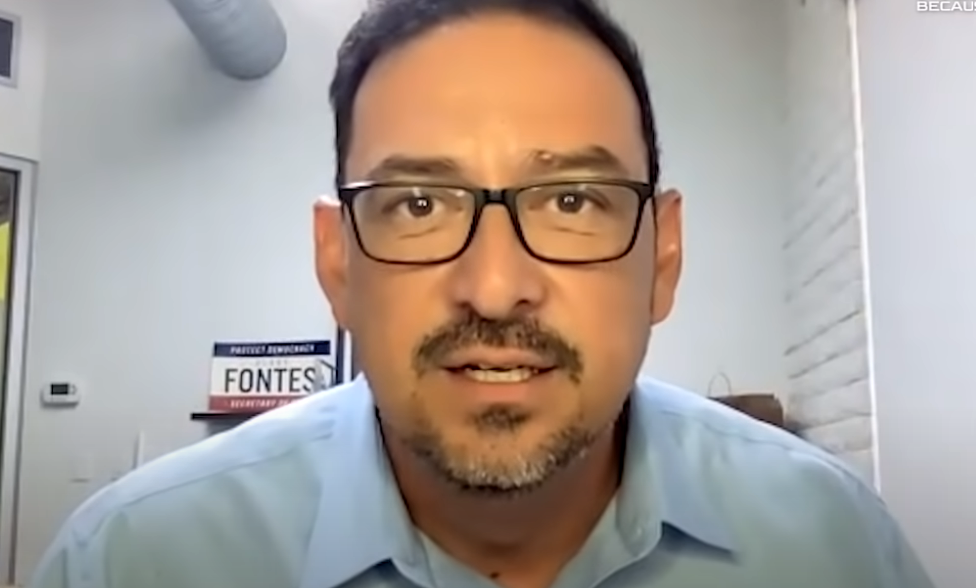
Fontes is one of the listed “team members” for Save Democracy, the nonprofit entity supporting the political action committee pushing the measure, Make Elections Fair Arizona.
Save Democracy’s president, Sarah Smallhouse, also serves as treasurer of the Make Elections Fair Committee. Fontes also conducted a webinar sponsored by Save Democracy in which he advocated for open primaries.
In the brief issued on Friday for the case Smith v. Fontes, Fontes argued that the proposition should be considered valid since the ballots had already gone to print with the contested proposition included. Otherwise, the secretary argued, the court would be denying Arizonans their right to “free and equal” elections.
“Once the ballots have gone to print, it is in the hands of Arizona’s voters,” said Fontes. “The person contesting an issue (or candidate) can make a case to the voters, but the Courts cannot usurp the voters’ decision once it goes to them.”
Fontes proposed that those challengers to the validity of Prop 140’s gathered signatures should seek recourse through future elections.
“After investing their time educating themselves about this ballot measure, it would be wrong for the Arizona electorate later to be told their vote will not be counted,” said Fontes. “Given the far-reaching implications of this Court potentially enjoining the canvass, the Secretary requests this Court to reconsider its previous ruling and affirm the principle that once the ballots have gone to print, any challenge must end.”
The Arizona Free Enterprise Club (AFEC) sued to stop the Make Elections Fair Act after reportedly discovering over half of the proposition’s gathered signatures were gathered in violation of state law.
🚨 Second lawsuit filed!!
If the unconstitutionality of the the radical Make Elections Fair Initiative wasn’t bad enough, it turns out after a thorough review of their petitions, that over half of their signatures have been collected in violation of state law! https://t.co/mUMNXsOub7pic.twitter.com/ztrwbIIFaw
— Arizona Free Enterprise Club (@azfec) July 27, 2024
The Arizona Supreme Court sided with AFEC’s challenge last month, ruling that the lawsuit should continue in order to determine whether the tens of thousands of challenged signatures were valid (around 40,000), even though ballots began to be printed on the same day it handed down its decision.
The state supreme court ordered that an injunction be issued preventing the counting of any votes on the proposition should it be discovered that the proposition lack the required number of signatures.
AFEC reported discovering that, of the 40,000 duplicates, around 250 individuals had signed their name five or more times. One individual reportedly signed 15 times.
AFEC has argued that the mass amount of duplicate signatures indicated that Fontes shouldn’t have approved the proposition for inclusion on the ballot in the first place.
With 40,000 duplicate signatures, it's clear that #Prop140 should’ve never been on the ballot in the first place because the people of Arizona don’t want to follow in California’s footsteps with jungle primaries or ranked choice voting.https://t.co/RXH6xGdcMG
On Tuesday, a judge considered the ongoing matter of Prop 140 in April Smith v. Fontes. The case involves a challenge of the validity of Arizona’s ranked choice voting initiative signatures.
At the end of the hearing, the number of challenged signatures was whittled down from over 40,000 to approximately 38,100 to be reviewed by a special master appointed by Maricopa County Superior Court Judge FrankMoskowitz.
Court observers are questioning if the outcome of the case has already been determined in Moskowitz’s mind.
It was evident that there was confusion between the judge and counsels for the plaintiffs, the Make Elections Fair Arizona PAC, and the Arizona Secretary of State on how to determine whether signatures already eliminated by County authorities or the Secretary of State would be present in either the full number of signatures or in “extrapolations.” The extrapolations are created by multiplying a 5% sample by 20 under existing statute to create a “validity rate” that can be applied to the sum total of signatures.
The hearing seemed expressly focused on how much of the evidence of duplicate signatures the court should exclude from consideration, rather than as the Supreme Court directed in Mussi v. Fontes, to “determine whether the exhibits prove any duplicate signatures by clear and convincing evidence.”
Judge Moskowitz appeared more concerned with determining how many exhibits do not prove duplicate signatures, saying, “They’re done. It’s over. It doesn’t matter if the remaining 31,000 or whatever it is are in fact duplicates and maybe double counted, maybe not give ’em credit and say they weren’t double counted. If you can get 4,800 that were double counted, it’s over,” describing what he expects to see in a brief from Make Elections Fair PAC.
Attorney Daniel Arellano, representing Plaintiffs April Smith, Nira Lee, and Joshua Davidian pushed back against this notion saying, “First of all, I just to be clear, I mean these all sound like categorical arguments to me, which I think are precisely what the Supreme Court said not to do. I’ve not seen briefing of this issue. There’s a preview of it. (…) I’ve not actually seen any legal argument on this, but as I listened to this argument here today, judge, I think, again, I forget if it’s Leah v. Hobbs or Leah v. Reagan, but one of the two definitely says that we get to invalidate signatures for reasons other than, in addition to, and outside of the 5% sample. And so if the premise of the committee’s argument is that it is, we have to go with what the county hasn’t validated because that is already multiplied times 20, and we can’t invalidate anything in addition to or separate from that. That is I think a proposition that the Supreme Court has squarely rejected.”
He added, “I think the point is I don’t think we can use this as an avenue to foreclose line by line review of the 38,000 signatures.”
But Judge Moskowitz was quick to retort: “No, I understand that. But even if I said yes, clear and convincing all 38,000, it says proceed accordingly. And my proceed accordingly is my next step is going to be how do I know of whatever number is of duplicates hasn’t been already invalidated. How do I know this signature hasn’t already been invalidated? And I think that would be in the proceed accordingly part of the Supreme Court’s order.”
However, the order from Arizona Supreme Court Chief Justice Ann Scott Timmer made the court’s priority clear, “The trial court must continue with determining whether the initiative is supported by a sufficient number of qualified signatures. This determination should be made as expeditiously as possible to provide the parties and the public certainty.”
In a thread posted to X, the Arizona Free Enterprise Club (AZFEC) paraphrased a comment from the organization’s President Scot Mussi, “This isn’t a debate about dubious matches or concerns of same family members with the same name being confused as a duplicate. All the duplicates submitted to be removed were exact name and address matches that aligned with what was on the voter file. Under state law, you are only allowed to sign a petition once, so they should have been removed. Instead, thousands of people were allowed to sign the initiative petition sheets multiple times, and those signatures were counted.”
This isn’t a debate about dubious matches or concerns of same family members with the same name being confused as a duplicate. All the duplicates submitted to be removed were exact name and address matches that aligned with what was on the voter file.
In a press release the organization cited from the evidence presented that:
When the Prop 140 Committee submitted their signatures to the Secretary of State, around 250 people had signed five or more times.
One individual had signed 15 times.
All those signatures were included in the final tabulation by the Arizona Secretary of State.
In a status update hearing held late on Wednesday, it was determined that Retired Arizona Superior Court Judge Christopher Skelly will lead the signature verification effort as court-appointed Special Master. During the meeting, Judge Moskowitz again referred to a possible stopping point for the signature review, asking Arellano, “Not to be looking at this for one side or the other, but there is a number of 4,800. And the only reason I say that number is because it’s the lowest number we’re talking about. But if that 4,800 number of duplicates is reached um… Does he stop if he knocks out whatever that number is 4,800 of duplicates? So you don’t get to your 33,000 something, something number Mr. Arellano? Does he just stop?”
Arellano, representing the plaintiffs, responded that the Special Master should be checking in with attorneys from both sides “periodically,” however, he added, “We’ve not set that up as any particular kind of benchmark. Nor do I know that we’d be comfortable doing so, since it sort of sets that up as like a goal of sorts.”
The signature checking effort is expected to run through September 16th with a hearing to discuss legal briefs from both sides on Friday.