by Matthew Holloway | Mar 10, 2025 | News
By Mathew Holloway |
The verdict is in on Governor Katie Hobbs’ “Operation Desert Guardian” from Arizona’s Border Sheriffs, and it isn’t good for the Democrat governor.
As the governor faces dwindling popularity poll numbers, fellow Democrat Pima County Sheriff Chris Nanos bailed on a lengthy online conference about Hobbs’ border task force, saying “I don’t need another task force.” Noting his membership in four other collaborative efforts combating drugs and human trafficking, he noted, “I’m sorry, I just don’t. And so, I’m out.”
Nanos said his department will not be participating in a devastating blow to the governor’s initiative, given that Pima County covers approximately 31.6% or nearly a third of Arizona’s border with Mexico. The move also has serious political implications. Nanos was one of Hobbs’ biggest supporters during her campaign, even going so far as to cut a campaign ad for her.
Yuma County Sheriff Leon Wilmot, a Republican, offered similar pushback saying, “Let’s not waste state tax payer money on building something that doesn’t need to be rebuilt.”
Both sheriffs were reportedly taken aback by Hobbs’ surprise Executive Order and offered serious criticism of her and the goals of the operation. They told reporters that the work the task force is set to tackle is already being done and would be duplicative, not an added benefit.
“The state is not going to come in to rescue us and be the savior of what we’ve been dealing with,” Wilmot said, noting that the border Sheriffs’ departments offer a wealth of ground-level experience. “They need to come in and be a partner.”
According to a follow up report from AZCentral, Yuma County will participate after a meeting with Hobbs earlier this week.
Speaking with KGUN, Cochise County Sheriff Mark Dannels had his own doubts, “My budgets are already fulfilled. They’re maximized. And so if there are expectations that my office will be doing something without the budget, chances are we won’t do it… I can’t do it.”
Dannels asked, “What’s the cost to my agency? What’s it going to mean for resources? What are they going to take care of that I don’t already have?” He expressed that he wasn’t made aware of the task force, and though he has hopes it could complement his department’s actions, he said, “I don’t know. I have not seen an operational plan.”
Republican Governor’s Association Rapid Response Director Kollin Crompton suggested Hobbs’ political motives in a statement to AZ Free News saying, “Katie Hobbs’ desperate attempt to cover up her open border policies won’t work, and border county sheriffs of both parties know she’s a disaster. Arizonans want a secure border and safe communities, that’s not possible as long as Katie Hobbs is governor.”
Matthew Holloway is a senior reporter for AZ Free News. Follow him on X for his latest stories, or email tips to Matthew@azfreenews.com.
by Matthew Holloway | Feb 22, 2025 | News
By Matthew Holloway |
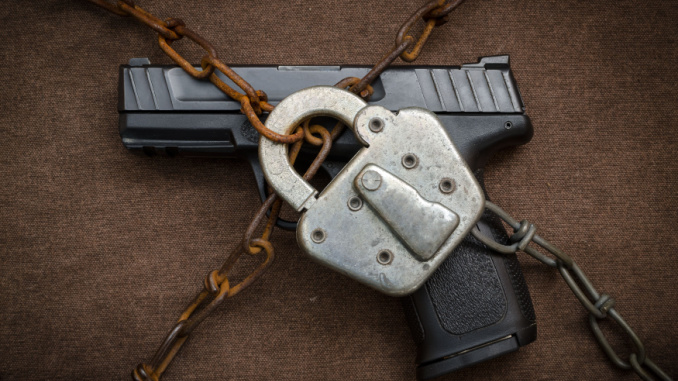
Pima County Superior Court Judge Greg Sakall issued a ruling earlier this week striking down Pima County Ordinance 2024-2. The ordinance was passed by the County Board of Supervisors in March 2024 and levied a fine of $1,000 against legal gun owners who failed to report a lost or stolen firearm within two days. According to the Goldwater Institute, which led the legal fight, the board appeared to be fully aware of the ordinance’s illegality “when it brazenly passed the ordinance.”
Goldwater took up the case of Air Force veteran Chris King and the Pima County-based Arizona Citizens Defense League. The group argued before the court that unless authorized by the Arizona legislature, no county or municipality in the state is legally permitted to enact any rule or ordinance that is firearms-related and exceeds any regulations already passed by the state.
In his ruling, Judge Sakall agreed that the county board’s actions violated multiple provisions of state law, writing that there is “no genuine issue of material fact,” and that the ordinance was pre-emptively rendered illegal by A.R.S. § 13- 3108(B) and (D) which state:
B. “A political subdivision of this state shall not require the licensing or registration of firearms or ammunition or any firearm or ammunition components or related accessories or prohibit the ownership, purchase, sale or transfer of firearms or ammunition or any firearm or ammunition components, or related accessories.”
D. “A political subdivision of this state shall not enact any rule or ordinance that relates to firearms and is more prohibitive than or that has a penalty that is greater than any state law penalty. A political subdivision’s rule or ordinance that relates to firearms and that is inconsistent with or more restrictive than state law, whether enacted before or after July 29, 2010, is null and void.”
As noted by Goldwater when it issued a letter to the board on behalf of the Arizona Citizens Defense League, the ordinance was passed even after “a majority of the board made comments prior to passage of the ordinance recognizing that firearms regulations belong at the state level.”
The majority Democrat board also ignored the objections of the sole dissenting Supervisor, Republican Steve Christy, who warned during the board’s March 2024 meeting: “Are we opening up Pima County to numerous lawsuits with various entities including issues with the state legislature as this definitely has conflicts with it?”
Christy suggested that the move by the board’s Democrat majority was intended as a “a typical diversion and detraction,” from the county’s more pressing issues such as illegal immigration.
Democrat Supervisor Dr. Matt Heinz even implicitly observed that such lawmaking is the purview of the state government when he said what he referred to as “impactful meaningful reform that affects gun safety” would only happen “if there is a Democrat Governor, Senate, and House in the state of Arizona.”
King, an NRA-certified firearms instructor who had a firearm stolen when his home was burglarized while he was deployed on active-duty outside the state, praised the ruling saying, “I’m grateful the court recognized that Pima County officials are not above the law. Firearm owners like me shouldn’t have to pay exorbitant fines as punishment for being robbed.”
Goldwater Staff Attorney Parker Jackson added in a statement, “Today’s ruling is a significant victory for the rule of law, for gun owners statewide, and for the state’s ability to prevent rogue cities and counties from creating a confusing patchwork of local firearm restrictions.
Matthew Holloway is a senior reporter for AZ Free News. Follow him on X for his latest stories, or email tips to Matthew@azfreenews.com.
by Matthew Holloway | Jan 14, 2025 | News
By Matthew Holloway |
A new study based on FBI crime data has identified the areas most afflicted by crime in the state of Arizona and found Mohave County to be a crime hotspot.
According to the research by Suzuki Law, through analysis of crime rates per 100,000 residents in each county’s jurisdiction, Mohave County ranked highest followed by Pima and Yuma Counties, La Paz County, and finally Maricopa County rounding out the top five.
The report found:
- “Mohave County holds the top place with a total crime score of 99.54. Its monthly average property crime rate is 167.9 per 100,000 residents, about 121% above the statewide average of 76.1. The county has a violent crime rate of 108.5, roughly 74% higher than the statewide average of 62.2.
- Pima County follows in second place with a total crime score of 88.27. The average monthly property crime rate stands at 168.2 per 100,000, the highest among all counties in Arizona. On the other hand, the county’s violent crime rate of 83.7 is 35% above the statewide average of 62.2.
- Coming in third, Yuma County has a crime score of 86.86. Its average monthly property crime rate of 124.0 per 100,000 is nearly 63% above Arizona’s average. Yuma County has the highest violent crime rate in Arizona, at 109.3. This is around 76% higher than the statewide average of 62.2.
- La Paz County ranks fourth with a crime score of 79.43. Here, the monthly property crime rate is 140.5 per 100,000, about 85% more than the state average of 76.1, and the violent crime rate of 82.3 is 32% above the state average of 62.2.”
A spokesman for Suzuki Law commented on the clear disparity favoring crimes against property saying, “The data indicates that property crimes are a major issue in Arizona, especially in counties like Mohave, Pima, and Yuma. While all types of crime have serious implications for community safety, the prevalence of property offenses in these counties demands focused attention from law enforcement and policymakers.”
Maricopa County, despite the obvious handicap of having the largest population by far, ranked relatively low at fifth place with an property crime rate of 105.6 per 100,000, about 39% higher than the state average of 76.1 and with violent crime at 71.3 or about 15% over the state average of 62.2.
In the top ten ranking, five counties are notably absent: Pinal, Apache, Graham, Navajo and Santa Cruz.
Top 10 Arizona Counties by Overall Crime Rate Score
1. Mohave County — 99.54
2. Pima County — 88.27
3. Yuma County — 86.86
4. La Paz County — 79.43
5. Maricopa County — 63.99
6. Gila County — 61.62
7. Yavapai County — 54.10
8. Cochise County — 46.21
9. Greenlee County — 43.20
10. Coconino County — 39.08
The law firm suggested that the installation of proactive security measures are among the most effective deterrents but stressed the need for legal assistance for victims. “Installing home security systems is one of the most effective ways to protect your property, with studies showing it can reduce burglary risks by up to 60%.” The attorneys also called for personal vigilance, situational awareness, and the avoidance of high crime areas.
Community-led initiatives are also valuable. “Neighborhood watch programs have proven to reduce crime rates by 16% in participating areas,” they observed.
The Mohave County Sheriff’s Office was contacted to comment on this report but did not reply by the publication deadline.
Matthew Holloway is a senior reporter for AZ Free News. Follow him on X for his latest stories, or email tips to Matthew@azfreenews.com.
by Daniel Stefanski | Dec 5, 2024 | News
By Daniel Stefanski |
A southern Arizona elections official is facing a potential investigation over her jurisdiction’s execution of the recent November General Election.
On Monday, state Representatives Teresa Martinez and Rachel Jones sent a request to Arizona Attorney General Kris Mayes, asking her office to conduct an investigation “into the Pima County Recorder Gabriella Cazares-Kelly’s handling of the 2024 General Election.”
The Republican lawmakers raised a number of issues stemming from the election in Pima County, including “shutting down of early ballot request portal, inmate voter registration program, [and] handling of undeliverable and returned ballots.”
“Election integrity is the foundation of our democracy, and voters deserve to know their elections are being administered fairly, lawfully, and transparently,” said Representative Martinez. “The numerous irregularities and lack of accountability from the Pima County Recorder’s Office demand a full investigation.”
“When nearly 4,000 voters face barriers to requesting a ballot, and when questions about unlawful voting and ballot processing are met with silence, it’s clear that immediate action is needed to restore public trust,” added Representative Jones.
In their letter to Mayes, the two legislators wrote, “Arizonans deserve free, fair, and transparent elections. In light of your recent decision to immediately investigate President-Elect Donald Trump over his speech (although you later determined his remarks were protected by the First Amendment), we hope you will agree that Recorder Cázares-Kelly’s alarming conduct administering the 2024 General Election warrants a thorough investigation.”
The Pima County Recorder appears to be a proud Democrat activist alongside her nonpartisan position as an election official. During this just-completed elections cycle, Cázares-Kelly posted a picture with Jane Fonda, and boasted about shaking former President Barack Obama’s hand at a political event.
Cázares-Kelly also shared a video of Mayes dancing at a political rally in October.
Daniel Stefanski is a reporter for AZ Free News. You can send him news tips using this link.
by Matthew Holloway | Nov 2, 2024 | News
By Matthew Holloway |
The office of Pima County Recorder Gabriella Cázares-Kelly has become the center of the latest election controversy in Arizona. On October 19th, the county’s online portal to request vote-by-mail ballots was shut down when voting officials claimed the site was overwhelmed with the quantity of requests. The shutdown occurred a week prior to the Oct. 25th deadline.
According to the Tucson Sentinel, as an alternative, the county office posted a notice at the top of the disabled form page instructing voters to call-in to the office in order to request a mail-in ballot.
Arizona Senator Justine Wadsack announced Wednesday that she is launching an investigation into the allegations against Cázares-Kelly’s office “following potential violations which may have suppressed thousands of Southern Arizona voters.”
“I was truly shocked to learn our County Recorder’s Office had done this,” Senator Wadsack said in a statement. “These actions are absolutely unacceptable, undermine the integrity of our elections, and raise serious questions regarding voter suppression. This has affected my current constituents and my community, and I want to make sure their votes are protected as well as votes for all candidates involved. I’m here to make sure there’s accountability for the laws that appear to have been broken. My message to voters is to get out today and vote in person to ensure your vote is not suppressed.”
In a letter of inquiry sent to the County Recorder, Wadsack wrote, “You certainly know that, under Arizona law, ‘an elector may make a verbal or signed request to the county recorder’ for an early ballot. Ariz. Rev. Stat. Ann. § 16-542(A) (emphasis added). Further, your office must mail voters the early ballot ‘within forty-eight hours after receipt of the request.’ Ariz. Rev. Stat. Ann. § 16-542(D). It appears clear that your office violated both requirements.”
Arizona Reps. Rachel Jones and Cory McGarr issued a similar inquiry on Oct. 24th to Cázares-Kelly following allegations that the Recorder’s office, on receipt of undeliverable ballots or those returned due to an outdated address, sent notice that the voters mailed ballot was “received,” creating confusion.
Per the Sentinel, Cázares-Kelly’s office sent alerts to approximately 4,000 voters in a mass email to notify them that their requests for a mail-in-ballot were canceled and instructed them to contact the office by phone to request a ballot, citing Marion Chubon, chief deputy to the Pima County Recorder, who ordered the shutdown. Chubon told reporters that the office didn’t inform the press as they “didn’t think it was a story.”
Chubon, responding to the outlet, explained that although the state law requiring ballots be sent within 48 hours of a request (as referred to by Sen. Wadsack), “was a consideration, obviously, and we weren’t going to fulfill those requests in that time. So we chose the more effective option – bottom line, getting those people their ballots that they needed.” However, the state law doesn’t allow for the County Recorder to make such a determination and cast aside requests that have already been submitted.
Subsequently, over 3,000 phone calls were fielded by the office on Oct. 21st and some 1,858 new requests were processed. Between that Monday and Friday another 2,829 requests were handled to the tune of approximately one every four minutes. Chubon told the outlet that she was confident that most of the voters whose requests were thrown out had received one. However she noted that, “We can’t guarantee that every single person called us to get a ballot, but we’re pretty confident that the majority of those were second requests… and those who didn’t fit into that category may have had a hold on their record and wouldn’t have gotten a ballot.”
“We just didn’t think it was a story,” Chubon added. “We were literally just trying to meet our statutory obligations and serve the voters. Like I said, over the weekend, we were processing unprecedented amounts of ballots. We have staff working 12-hour days, seven days a week, including the recorder and myself. We’re all working every day. It was just, ‘Let’s get these people their ballots.’ That was our focus. We would never, intentionally, not try to alert the media.”
Matthew Holloway is a senior reporter for AZ Free News. Follow him on X for his latest stories, or email tips to Matthew@azfreenews.com.