The city of Phoenix reported having an 82 percent success rate with admitting The Zone’s homeless into shelters after a court order to clean up the infamous downtown homeless encampment.
The majority success rate came just ahead of the court-ordered deadline last week, Nov. 4. Of the 716 homeless in The Zone, 590 consented to entering a shelter according to Rachel Milne, director of the Office of Homeless Solutions. That’s a success rate of over 82 percent.
Milne also said that they managed to reconnect some of those sheltered homeless with their families, or got them established with treatment programs. Milne says that shelter only serves as the beginning of securing permanent housing for the homeless.
“We need to make sure those 590 individuals that did move on to an indoor location now have the support systems and the proper services to help them in their homelessness,” said Milne.
That concern relates to the recidivism rates of The Zone’s residents, something noted by the Maricopa County Superior Court when it ordered the city to clear The Zone.
In his ruling, Judge Scott Blaney criticized city officials equating 70 percent of individuals accepting services as a permanent movement from the streets. Blaney ruled the data as potentially misleading, noting that the city wasn’t able to disclose how many of those individuals accepted a “free hotel room for the night” before returning to The Zone the next day.
As part of their compliance with the court order, the city established clear signage prohibiting encampments and other related criminal activity around the area that formerly housed The Zone.
🧵INBOX: Welcome to The Zone, the epicenter of the homeless crisis that @CityofPhoenixAZ refuses to solve. This man is one of many that will likely live and die on these streets under the city's current approach to homelessness. I investigated & uncovered shocking details… pic.twitter.com/snb8QkvjsA
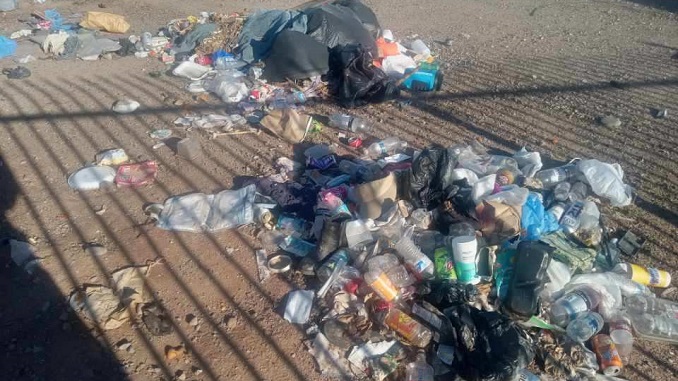
AZ Free News published a series of reports on the nature of The Zone: rampant crime and lawlessness: murders and assaults, drug use and dealings, prostitution, gang violence, theft and property destruction, bordered all around by knee-deep and blocks-long biohazards.
One of the lawyers that sued the city over its handling of The Zone, Ilan Wurman, marveled at the success rate the city of Phoenix experienced when forced to meet a court deadline to help the homeless.
“We did it. Because of our lawsuit, the City has cleared the Zone,” said Wurman. “And look at the huge number of folks who ACCEPTED SHELTER. Just incredible.”
We did it. Because of our lawsuit, the City has cleared the Zone. And look at the huge number of folks who ACCEPTED SHELTER. Just incredible.
K-12 schools in Arizona are currently flush with cash. Between billions in increased state spending from the legislature, COVID cash from the feds, and declining student populations, district school spending is at an all time high. But next week, voters across Arizona will decide the fate of 23 bond requests from schools that total a historic $3.5 billion.
This level of borrowing being sought by local school districts is both unwise and unnecessary, especially given the large amounts of money that have been pumped into the system. State funding has increased so quickly in the last 36 months that the legislature decided to override the constitutional spending limit the last two fiscal years. This is funding over and above the formulaic cap in the constitution that exists to protect taxpayers from runaway and unaccountable spending.
And contrary to what you probably hear from teachers’ unions and their sycophant friends in the media, lawmakers continue to increase school spending with every state budget. With all this new spending, district schools receive more money per student than ever before, and it’s not even close.
Not included in the state spending cap, however, are federal funds. And when schools were shut down during COVID, the federal government poured trillions of dollars into them. Many of the school districts asking their taxpayers to hand over hundreds of millions of dollars in bonds next week are still sitting on a pile of unspent COVID cash…
A local team’s unexpected run to the pinnacle of the baseball world has given its city an economic boon.
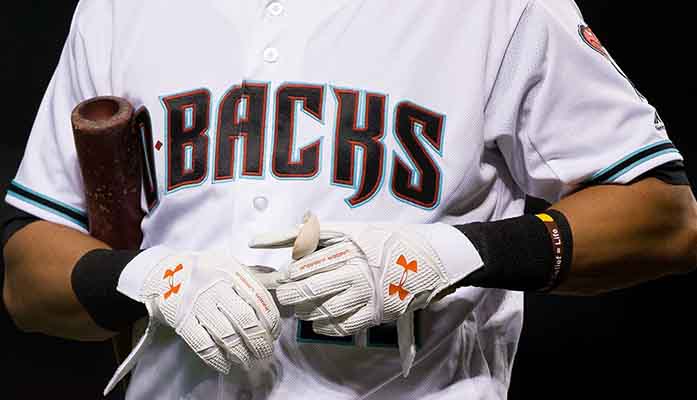
The Arizona Diamondbacks weren’t expected to go too far during the 2023 Major League Baseball postseason, but the team has proven its doubters and detractors very wrong over the past few weeks, reaching the World Series for the first time since 2001. This journey through October provides an infusion of tens of millions of dollars to the City of Phoenix and the State of Arizona, giving the local economy millions of extra reasons to cheer on their team.
Glenn Farley, the Arizona Director of Policy & Research for the Common Institute, published a piece about the expected economic impact for the region based on the hometown team’s surge through the playoffs. He wrote that “because the events are unplanned and non-competitive, the typical costs associated with attracting and hosting a major event are largely missing during a World Series, and successful hosting depends on a cities natural economic base and infrastructure rather than disposable infrastructure developed specifically for the event.”
Farley pointed out that the State of Arizona’s sports and tourism sector “employs 167,000 people,” and that “those tourism and hospitality workers were already on hand to support visitors and consumers for the unexpected World Series windfall.”
The economic benefits of the World Series in Arizona follow a busier-than-normal year for the Valley’s national sports scene. Researchers from Arizona State University found that the January Fiesta Bowl for college football garnered $170 million, the February Phoenix Open for golf another $277 million, and the February Super Bowl for the NFL topped out at $1.3 billion. The first full Cactus League Spring Training season since 2019 also brought hundreds of millions of dollars to Arizona towns and cities. In addition, Arizona hosted an early round of the World Baseball Classic back in March.
Researchers also have shared that the two cities that hosted the World Series in 2022 earned $68 million and $78 million, respectively, from economic spending attached with their team’s individual trips to the Fall Classic.
In his post, Farley added, “The state’s impending successful hosting of a World Series, following a Super Bowl and during an ongoing recovery for the state’s conventions and tourism, is another opportunity to celebrate its success in cultivating a robust and diverse local economy – including young and healthy infrastructure, a large and perennial tourism industry, and an innovative approach to taxes and regulations that supports business development.”
Daniel Stefanski is a reporter for AZ Free News. You can send him news tips using this link.
The term “family friendly” has come to include public displays of genitalia, according to the Phoenix Mayor’s take on the latest city-sponsored Pride Festival over the weekend.
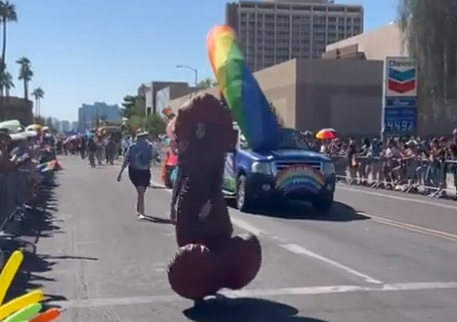
Gays Against Groomers, an activist group against promoting LGBTQ+ ideology in children, posted about the inflatable penis costume’s inclusion in the Pride Festival parade. The organization also reported individuals in the nude and in fetish costumes, along with the public display of “condom bars.”
Yesterday at Phoenix's Pride parade there was a literal penis marching in the festivities. Of course the event was marketed as "family friendly." There were hundreds of children in attendance, as our team on the ground witnessed.
Gallego also issued a proclamation declaring a weekend-long festivity of Pride and urged all to celebrate.
“We want to be a city that supports everyone, and I am so pleased to have a great city council that is right there with me,” said Gallego. “I’m going to ask the entire city of Phoenix to celebrate Pride this weekend.”
Gallego’s proclamation appears to conflict with city policy, which states that mayoral proclamations “must not take sides in matters of political, ideological, or religious controversy, or individual convictions.”
The city also served as the Grand Marshal of the parade. Councilmembers Laura Pastor and Debra Stark represented the city’s Fast-Track Cities initiative, which seeks to eliminate HIV/AIDS and discrimination against the sexually-transmitted disease.
Phoenix, what a way to show your PRIDE! 🏳️🌈🏳️⚧️
I had the honor of attending this year’s Phoenix Pride Parade as a Grand Marshal, representing @cityofphoenixaz Fast-Track Cities with Councilwoman @debrastarkphx.
Also present and supportive of the festival were Secretary of State Adrian Fontes and Gov. Katie Hobbs.
“Phoenix Pride is a powerful reminder that love unites us all,” said Hobbs in an X post (formerly known as Twitter).
Phoenix Pride is a powerful reminder that love unites us all. Joining last night’s festivities & celebrating the light of the LGBTQ+ community strengthened my commitment to building an Arizona for everyone. #phxPridepic.twitter.com/PW5u6LAHoI
Scottsdale Unites for Educational Integrity (SUEI), a coalition of parents and community members, accused educators promoting Pride materials of sexualizing children under the guise of inclusivity.
“Teachers who are pushing sexual content in schools and hanging pride flags in classrooms are not ‘inclusive.’ They are sexualizing children,” stated SUEI.
Teachers who are pushing sexual content in schools and hanging pride flags in classrooms are not "inclusive." They are sexualizing children. https://t.co/4Cdsexv7Uf
— Scottsdale Unites for Educational Integrity (@ScottsdaleUnite) October 23, 2023
One of the other main festival events was the Erotic World tent; unlike the parade, that event was marketed as closed to adults.
One of the festival sponsors was Castle Megastore, the Tempe-based sex toy store chain.
Other sponsors of the Pride Festival included Albertsons and Safeway, Amazon, APS, The Arizona Republic, the Arizona Lottery, Bank of America, Banner Health, BlueCross BlueShield Arizona, Bud Light, Circle K, Coca-Cola, Corona, Cox, CVS, Discover, DriveTime, Edward Jones, El Jimador Tequila, GoDaddy, Greater Phoenix Equality Chamber of Commerce, Intel, Jack Daniels, Leslie’s pool service, Liberty Mutual Insurance, Nascar, Nationwide, PetSmart, Phoenix New Times, Phoenix Suns, ShakeShack, Snooze, SRP, Starbucks, Target, Univision Arizona, Walmart, and Waymo.
Gilbert’s fire and police departments also made an appearance at this year’s Pride Festival parade, despite controversy last year over whether they misused taxpayer funds to attend last year’s parade.
Corinne Murdock is a reporter for AZ Free News. Follow her latest on Twitter, or email tips to corinne@azfreenews.com.
The city of Phoenix will supplement its drinking water supply using recycled wastewater as early as 2030.
Last week, the city approved the expenditure of over $30.4 million to reopen the Cave Creek Water Reclamation Plant (CCWRP) that closed in 2009 amid the Great Recession. In all, construction of the plant is projected to exceed $300 million.
The Black & Veatch Corporation (BV) will oversee construction of the CCWRP. Upon its completion, the plant will treat eight million gallons of wastewater daily.
BV is a global construction company specializing in energy, water, telecommunications, and government services headquartered in Overland Park, Kansas, with self-reported U.S. revenues of over $4.25 billion last year.
The EPA defines the process of deriving drinking water from treated wastewater as “potable water reuse.”
Phoenix trails behind the city of Scottsdale, which has been the only facility in the state permitted for a pilot program of recycling wastewater into drinking water since 2018. Scottsdale Water Executive Director Brian Biesemeyer said that wastewater recycled into drinking water could hit Scottsdale homes as early as 2025.
The Arizona Department of Environmental Quality (ADEQ) is anticipated to propose rulemaking on drinkable, recycled wastewater by the end of this year.
The state of California announced earlier this summer that it planned to establish wastewater recycling systems to reclaim wastewater as drinking water, known as direct potable reuse. Currently, California puts recycled wastewater into an underground aquifer that naturally filters and purifies the water, known as indirect potable reuse.
The CCWRP officially closed due to slow population growth in the surrounding area, after beginning operations in 2002.
The city gave BV $660,000 in July 2017 to conduct a Phase I Feasibility Study to identify design limitations, alternatives for improved performance, and opportunities for reducing operational costs.
In December 2019, following completion of the study, the city gave BV an additional award ceiling of up to $25 million for additional engineering services for CCWRP. This included construction documents, construction administration, and inspection services.
By February 2020, the city gave BV over $12.3 million for the study, additional engineering services, as well as another expanded scope of services, as part of Phase II of the CCWRP.
This $30.4 million to BV falls within their Phase III plans for the CCWRP.
Last November, the city approved an additional $5 million for BW’s services.
Corinne Murdock is a reporter for AZ Free News. Follow her latest on Twitter, or email tips to corinne@azfreenews.com.