The city of Phoenix paid out $1 million to a mother after two adult brothers were shot and killed during a violent domestic dispute in which police responded. The council agreed to the settlement on Monday, which was originally agreed upon in court on May 18.
In October 2020, police responded to a domestic dispute call placed by Lillian Cocreham, the mother of George Cocreham, 43, and Emmett Cocreham, 44. The mother said that her two sons were engaged in a verbal altercation, that one of her sons had a rifle, and that both men would attempt to attack the officers. She also advised the 911 operator that the police had come to her residence multiple times before due to her sons.
The mother alleged to the 911 operator that she initially called the crisis response line, but hung up after 45 minutes of no response. The mother also said she was afraid her elder son, Emmett, would kill her.
“I am fearful for my life,” said the mother. “I’m barricaded in my bedroom. I’m afraid my son Emmett will beat me up and kill me.”
Upon responding to the Cocreham residence, police reported that they saw one of the brothers holding a rifle despite orders to drop it. Police fired after the brother holding the rifle, George, raised and pointed it at Emmett. Police reported that in pointing the gun at Emmett, George was also pointing the gun in the direction of responding officers.
The brothers repeatedly ignored officers’ commands throughout the entire interaction.
The day after the shooting, an uncle of the Cocreham brothers toldABC15 he didn’t blame the officers because the brothers had a history of family violence, some of which warranted prior police response to the house.
Cocreham filed a $12 million notice of claim in April 2021, alleging that police had wrongfully killed her two sons and issued $10,000 in damage and repairs to her property. The claim alleged that police failed to defuse the situation, didn’t provide evidence that the brothers were armed or fired their weapons, and didn’t provide timely medical care to the brothers after they were shot.
“The two deaths resulted directly from the supervising officers’ failure to gain command and control of the scene and of a non-combative situation well within their grasp,” stated the claim. “[The officers] individually and collectively inflamed a domestic disturbance call into an unacceptably chaotic situation.”
Cocreham sued the city later that year in the Arizona District Court.
In an interview concerning the settlement, Cocreham said that she was still working to recover over the damage her home sustained.
“It cost the city money, it cost taxpayers money, it cost the victims money, but it cost you your soul,” said Cocreham. “They’ll try to bring you down as much as you can, they can and they love it, but you know what? You didn’t win this time, because I didn’t lose my boys.”
Corinne Murdock is a reporter for AZ Free News. Follow her latest on Twitter, or email tips to corinne@azfreenews.com.
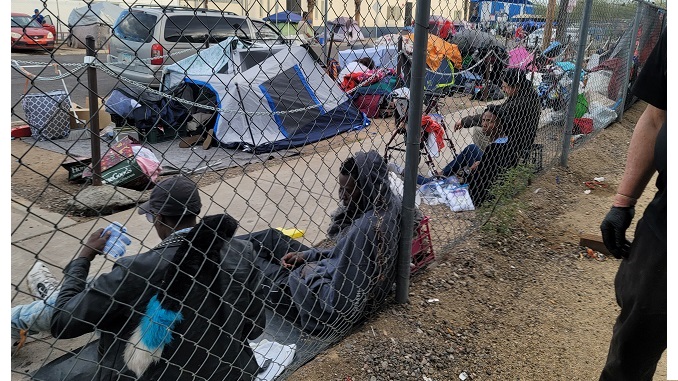
The city of Phoenix sought advice on handling homelessness from another city plagued by the same problem: Portland, Oregon.
City officials attended a “homelessness summit” in May. Officials included Gina Montes, deputy city manager; Rachel Milne, director of the Office of Homeless Solutions (OHS); Scott Hall, deputy director of OHS; Titus Mathew, director of the city’s housing department; Sean Connolly, assistant chief of operations for Phoenix Police Department (PPD); Brian Fruendentahl, commander of PPD; Luke Christian, assistant city attorney.
“Given our issues and the continued increase in unsheltered homelessness, the crime and other complex problems, we have been in touch with other communities to see what we can learn (both from their successes and mistakes),” wrote Montes in an invitation email for the event.
Officials from the cities of Mesa and Glendale were invited on the trip, but it appears from records obtained by AZ Free News that a visit to Portland either didn’t sound appealing or beneficial. In a March email exchange, the city of Mesa’s deputy city manager, Natalie Lewis, asked why Montes and the city of Phoenix felt the need to go to Portland as well as Seattle, Washington — another proposed location for a homelessness summit.
Glendale’s director of community services, Jean Moreno, concurred with Lewis’ remarks.
“Our feedback was the same as Mesa’s — happy to participate but not sure Portland is the right field trip,” wrote Moreno.
Montes responded that Phoenix could learn much from Portland’s mistakes. She revealed that many of the issues facing Phoenix currently were the same as those Portland faced in the past. Meaning: Portland could be Phoenix’s future, if changes aren’t made.
“The reason we are interested in Portland is honestly because a lot of the same issues are happening here that happened there years ago. They made a lot of mistakes that they are paying for now. I’m concerned that our community trajectory is pointing in a similar direction,” wrote Montes. “I understand if Portland is not of interest to others and promise not to be offended!”
The homeless in Portland have taken over residential neighborhoods and public streets, with residents telling reporters that the crime-riddled mass encampments decimated quality of life.
Lewis turned down the invitation, sharing that she may attend a potential future trip to either San Antonio or Houston, Texas, potentially around the same time as this fall’s ICMA Conference in Austin, Texas. Lewis added that the breakup of the mass homeless encampment known as The Zone would likely impact her city.
“Also, I foresee the work to dismantle/relocate will impact Mesa. I am open to having a regional discussion on this (when Phx is ready) so that we are all working to minimize impact of the shift,” wrote Lewis.
Montes issued the proposal to visit either Portland or Seattle on March 29: two days after the Maricopa County Superior Court ordered the city to clean up The Zone.
Estimates of the homeless population in the Portland area hovers around 5,000, based on Multnomah County data. Phoenix’s homeless population sits around 3,000.
AZ Free News asked Montes whether city officials would attend similar summits in other cities who’ve mitigated homelessness in recent years such as Austin, Texas. Montes didn’t respond by press time.
City of Phoenix officials were also joined by officials from the Maricopa Association of Governments (MAG), Maricopa County, and the city of Avondale. MAG representatives were Continuum of Care officials Amy St. Peter, deputy executive director, and Katy Gentry, regional homelessness program manager. Maricopa County officials were Jacqueline Edwards, human services director, and T.J. Reed, homelessness programs manager. City of Avondale representatives were Cherlene Penilla, assistant city manager; Dale Nannenga, chief of the Office of Public Safety; Memo Espinoza, chief of Avondale Police; Manuel Rios, sergeant of Avondale Police; and Brian Planty, homeless services manager.
The cost for the trip, for all 16 officials in attendance, likely totaled around $10,000. (Based on averages of flight, hotel, and per diem costs compiled from MAG travel request forms).
Corinne Murdock is a reporter for AZ Free News. Follow her latest on Twitter, or email tips to corinne@azfreenews.com.
The city of Phoenix is being sued over its capitalization of a loophole to shield high-rise luxury apartments from up to an estimated $7 million in property taxes.
The city of Phoenix effectively agreed to relieve private real estate developer Hubbard Street Group of around $7 million in property taxes by taking ownership of their property, “Skye on 6th,” and declaring it part of a slum or blighted area while the developer continues to operate and manage the property. In return, the developer agreed to pay a total of $525,000 in rent to the city, pay $32,000 to two school districts, and dedicate 10 percent of its residential units to workforce housing for the eight years of the lease. The city arranged this deal through the state’s statutory provisions outlining the Government Property Lease Excise Tax (GPLET).
Check out this latest photo of our Skye on 6th project in Phoenix, Arizona! This project is 26 stories tall and will contain 309 apartment units when it is completed in Summer 2023. For more on this project and the impact is has had on the area, visit: https://t.co/GtaGohHPwdpic.twitter.com/TpokC6d6Jp
In the case Paulin v. City of Phoenix, two taxpayers represented by the Goldwater Institute sued the city over allegedly violating the Arizona Constitution’s Gift Clause and Evasion Clause.
Since local governments are exempt from property taxes, GPLET enables governments to accrue revenue on its property by leasing to businesses. The Goldwater Institute, on behalf of the two Phoenix taxpayers, argues that the city took advantage of GPLET by assuming ownership of the property of interest to a private business in order to provide a special tax break to that business. Although the government sustains a reduced revenue stream and taxpayers pay more under such an arrangement, the Goldwater Institute alleges that local politicians may claim business growth while paying off the business with a tax write-off.
“[U]nder this arrangement, private property is conveyed in form to the government while in substance being owned and operated by a private party for the sole purpose of evading property taxes to which other taxpayers are subject,” stated the complaint. “The result of this arrangement is a gift of public resources to a private business, and a conveyance of property to evade taxes in violation of Arizona’s Constitution.”
Those poised to lose out on their share of the $7 million in tax payments would include the city, Maricopa County, Maricopa County Community College District, Central Arizona Project, Maricopa Special Healthcare District, Fire District Assistance Tax, and special taxing districts for library and flood control. Phoenix Elementary School District and Phoenix Union High School District are the two school districts receiving the tens of thousands to reportedly offset their share of the lost tax revenue.
The Goldwater Institute also disputed the city’s characterization of the contested property as located in a slum or blighted area: a condition required for an eight-year tax abatement as provided in the GPLET agreement between Phoenix and the developer.
A hearing on the case took place last week in the Maricopa County Superior Court. The city argued that taxpayers upset by their arrangement with the developer were truly upset with the existence of GPLET. The city contended that the taxpayers should petition lawmakers to reform GPLET law to prevent their actions.
Counsel for the city also contended that any claims that their actions violated the Gift Clause would render GPLET impossible to use.
The city also claimed that Hubbard Street Group was chosen through the request-for-proposal (RFP) process, and disputed the claim that Hubbard Street Group approached the city first.
The Goldwater Institute argued that there were no actual reservations of ownership, control, or management of the property. They also argued that the city never intended to hold onto the property itself, but always intended to convey the property back to the lessee. Counsel for the developer contended that claim, referencing a contract provision that the property will be owned by the city.
In a statement, Goldwater Vice President for Litigation Jon Riches said that Phoenix’s use of GPLET is unconstitutional.
“The Arizona Constitution prohibits the transfer of property to evade taxes that are otherwise owed and that other taxpayers must pay,” said Riches. “Here, the city of Phoenix allowed private property to be transferred to the city even though it will never be used as city property so that one special interest could avoid paying taxes on it. We are hopeful the court will agree this artificial transfer violates the Constitution.”
In 2020, the Maricopa County Superior Court struck down a similar GPLET arrangement between the city of Phoenix and another high-rise residential developer. Four months later, the city entered into the currently-contested GPLET agreement with Hubbard Street Group.
A ruling on the case may occur sometime within the next several months.
Corinne Murdock is a reporter for AZ Free News. Follow her latest on Twitter, or email tips to corinne@azfreenews.com.
The city of Phoenix received $10 million in federal funding to establish an equitable “Cultural Corridor” near Phoenix Sky Harbor Airport.
The city announced the funding over the weekend, which originated from the Rebuilding American Infrastructure with Sustainability and Equity (RAISE) program. The $10 million came from $1.5 billion in a discretionary fund through the RAISE program opened up in December.
With these recent RAISE funds, the city of Phoenix will develop vacant lots west of the airport. In a press release, the city identified neighborhood stability, identity creation, and economic expansion as their primary goals.
Although the $10 million came this month, final drafting for the Cultural Corridor was published in April 2020. According to these draft plans, the corridor will serve as a multicultural heritage trail navigable via public transit.
Seven individuals were proposed as those to be featured on the trail: Father Albert Braun, Cesar Chavez, Sister Mary Luca Junk, Silvestre Herrera, Wing Ong, Calvin & Georgie Goode, and John Lewis. Each individual will receive their own themed “zone” within the Cultural Corridor: the Goode-Luca-Ong Community Champion Zone, the Silvestre Herrera Heroism Zone, the Cesar Chavez Labor & Civil Rights Zone, the Father Albert Braun O.F.M. & Medallion of Honor Zone, and the Anne Ott Education Zone.
Additionally, seven landmarks were selected: Historic Sacred Heart Church, Santa Rita Center, Ann Ott School, Silvestre Herrera School, Tanner Church and other churches in the area, Austin Market, and neighborhood parks.
The draft plan also identified 65 properties that were either currently listed as or eligible to be enlisted as historic at the national or local level.
The final draft for the corridor also identified seven areas as historic neighborhoods: the Eastlake Park Neighborhood, El Campito Barrio, Golden Gate Barrio, Cuatro Milpas Barrio, Ann Ott Neighborhood, Green Valley Neighborhood, and Rio Salado San Juan Bautista Neighborhood.
This is the latest round of federal funding for the project. The city received a Federal Aviation Administration (FAA) grant for its implementation phase from 2017 to 2019.
Mayor Kate Gallego said in the weekend press release that the grant would issue warranted recognition to communities surrounding the airport.
“This grant will enable us to honor the legacies, histories, and identities of existing communities while also improving safety and mobility in the region,” said Gallego.
The Cultural Corridor arose from the airport’s Land Reuse Strategy that first began in early 2016. Developments on the vacant land include a workforce training center, mixed-use residential properties, commercial lots abutting mixed-use office spaces, and a public park adjacent to a commercial recreation facility. The Cultural Corridor would run from the light rail terminal near East Washington and South 7th streets, down South 16th Street, along East Buckeye Road, along East Pima Street, and southbound past the I-17 until it hits the Rio Salado River.
Several private developments will be established near the light rail terminal where the Cultural Corridor begins: apartments, mixed-use residential, condominiums, commercial spaces, and a hotel.
RAISE grants aren’t the only source of DOT funding for infrastructure. In March, Tucson received another $900,000 from the DOT’s Reconnecting Communities Program to build another biking and pedestrian bridge, covering about 56 percent of the total project cost of $1.6 million. They were approved while 10 other Arizona cities, counties, and one nonprofit were denied funding. The DOT revealed that it prioritized projects engaged in equity and environmental justice work.
The debut of the Biden administration’s RAISE grants saw one award in Arizona: over $10.6 million to the city of Yuma to convert a historic building into a multimodal public transit center. Project costs totaled over $17.7 million.
RAISE is a continuation of its predecessors dating back to 2009, former President Obama’s first year in office: formerly Better Utilizing Investments to Leverage Development (BUILD) and initially Transportation Investment Generating Economic Recovery (TIGER). Through 2022, all three programs have issued over $12.1 billion in grants for 934 projects, 18 of which were Arizona-based projects. RAISE alone has issued over $3.2 billion in grants to 255 projects since launching in 2021.
Last year, the RAISE program gave over $75 million to four projects in Arizona: $261,000 to Navajo County for a regional multimodal planning study of 16 miles of pedestrian and bicycle pathway (total project cost: $290,000); $25 million to Phoenix to build a bicycle and pedestrian bridge over the Rio Salado River (total project cost: $34.5 million); $25 million to Tucson to rebuild a bridge less than a mile in length, expand a street from four to six lanes, and build a new bicycle and pedestrian bridge (total project cost: $95.4 million); and nearly $25 million to the Colorado Indian River Tribes to reconstruct 10 miles of road.
Corinne Murdock is a reporter for AZ Free News. Follow her latest on Twitter, or email tips to corinne@azfreenews.com.
The city of Phoenix may create a new court to handle the crimes committed by the homeless. The new specialty court, the Phoenix Community Court, would cost well over $2 million to operate annually, with a $46,000 start-up cost.
Phoenix has three other specialty courts, one of which addresses crimes committed by the homeless on a county-wide basis: the Maricopa County Regional Homeless Court (MCRHC). The other two courts address crimes committed by veterans and the mentally ill, respectively.
The Phoenix City Council approved the court’s creation during last week’s Public Safety and Justice meeting. The council report noted that most homeless individuals were being cited or arrested on minor charges in the traditional criminal justice system, which the council said didn’t afford enough opportunities for services to address their needs.
The new court would take in all crimes except domestic violence offenses and assault.
At this stage in the policymaking process, the city is deciding between several entry methods for admitting eligible homeless criminals into the Phoenix Community Court.
The first method would be identification during arraignment prompted by a Phoenix Police Department citation or prosecutor’s office complaint. The second method would be through police booking an eligible individual into jail, followed by the Office of Homeless Solutions offering the individual resources as they determine eligibility for the new court.
The new court would have a Community Court Team craft a customized service plan for eligible criminals. Such a plan would include specific milestones to track progress, with regular court appearances. A criminal’s successful completion of the plan would result in either dismissal of the case, a reduced charge, or a suspended sentence.
“The Phoenix Community Court will be centered around a holistic and compassionate approach to provide long-term solutions that will positively impact individuals currently experiencing homelessness, and benefit the entire community,” stated the city plan.
To start, the new court would hire 11 full-time positions across several city departments and 10 contracted navigators. The 11 city employees would cost over $1.4 million annually, while the 10 navigators would cost $620,000 annually. Rapid response funding, which concerns staff efforts to expedite housing placement or other similar initiatives, would cost $150,000 annually. Administrative costs would total $25,000.
The 11 full-time positions include an assistant attorney, legal assistant, and casework services coordinator for the public defender’s office; two attorneys, a court or legal clerk, legal assistant, and administrative assistant in the prosecutor’s office; two bailiffs in the municipal court; and a program manager in the Office of Homeless Solutions.
The 10 contracted navigators would break down as follows: one managing the entire navigation team, two focusing on working with individuals identified in regular court proceedings, three engaging throughout the community at the early stages of the court process, and four assisting individuals entering through the jail court.
The one-time start-up costs for the new court would consist of $30,000 for three vehicles, and $15,000 for “other equipment.”
Corinne Murdock is a reporter for AZ Free News. Follow her latest on Twitter, or email tips to corinne@azfreenews.com.