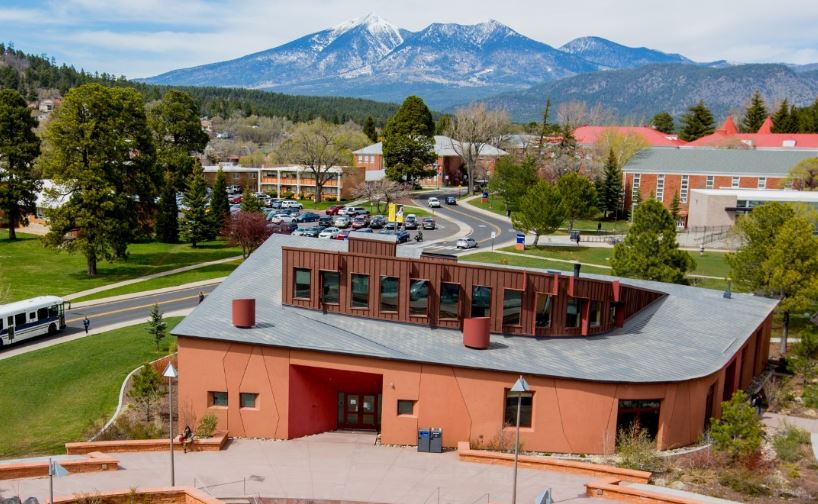
Northern Arizona University (NAU) admitted that it purposefully admitted more Hispanic students in order to receive more federal funding.
The Department of Education (ED) rewards higher education institutions for having a certain racial makeup within their student population, called a “Hispanic-Serving Institution.”
In order to achieve HSI status, colleges or universities must have Hispanic students making up at least 25 percent of their full-time equivalent student population, as well as a significant number of students requiring needs-based financial aid.
NAU President José Luis Cruz Rivera said accomplishment of their HSI designation in 2020 was intentional in an interview last week with Diverse Issues in Higher Education.
“NAU applied for classification and then appointed key leadership to ensure we serve our Hispanic students well,” said Cruz Rivera. “It’s not just about meeting the number threshold, but rather about really carrying out our mission and supporting the success of our students.”
Hispanics aren’t the only racial group that NAU has prioritized. NAU pledged free tuition to Native Americans in November. In March 2021, NAU launched multiple initiatives totaling $1.3 million to increase the number of both Native American and Hispanic science, technology, engineering, and math (STEM) graduates.
Following their HSI classification, NAU began to prioritize Hispanic students through their strategic plan, NAU 2025 – Elevating Excellence. These prioritizations include Hispanic-specific retention strategies concerning financial aid, mental health services, and community building; hiring and retention strategies to attract more Hispanic faculty; and faculty training to better understand Hispanic students.
HSI federal programming was reestablished in 2021 through an executive order by President Joe Biden: the White House Initiative on Advancing Educational Equity, Excellence and Economic Opportunity for Hispanics (Initiative). The concept originated in 1990 under former President George H.W. Bush, but fell out of use in subsequent administrations until Biden was elected.
As part of the initiative, Biden established the Advisory Commission on Advancing Educational Equity, Excellence, and Economic Opportunity for Hispanics. The commission convened in its inaugural meeting earlier this month.
Included in the 21-member commission are three Arizonans. One of them is NAU’s program director and teacher for its Arizona K12 Center, Juliana Urutubey.
Urutubey was named the 2021 National Teacher of the Year and the 2019 Chicanos por La Causa Esperanza Latina Teaching Award while working as an educator in Las Vegas, Nevada. Urutubey recently relocated to Phoenix and joined NAU’s Arizona Teacher Residency.
Chicanos por La Causa has been intertwined with several major controversial events in recent years, including a federal pandemic loan fraud investigation; membership with the Aspen Institute, the liberal think tank that played a major role in the cover-up of investigative reporting on Hunter Biden’s laptop; and funding to pass propositions outlawing debt collection efforts and awarding in-state college tuition rates to illegal immigrants.
Another Arizonan on the commission is Anna Maria Chávez: President and CEO of the Arizona Community Foundation. Chávez was formerly the CEO of Girl Scouts of the USA; director of intergovernmental affairs, urban relations and community development/military affairs advisor, and deputy chief of staff for former Gov. Janet Napolitano; and several Clinton administration positions, including legal counsel for the Federal Highway Administration, attorney advisor in the Office of the Counsel to the President, senior policy advisor to former Secretary of Transportation Rodney Slater and SBA Administrator Aida Alvaraz.
Chávez has also served as Executive Vice President and Chief Growth Officer for the National Council on Aging; in June 2020, she became the executive director and CEO of the National School Boards Association (NSBA) and currently serves as an ex-officio director on its Board of Directors; in 2021, Chávez was appointed as the inaugural chief impact officer of Encantos and president of their online presence. Encantos investors include Kapor Capital, Steve Case’s Revolution Rise of the Rest Fund, Chelsea Clinton’s Metrodora Capital, and L’ATTITUDE Ventures.
The third is Teresa Leyba Ruiz, who became the senior vice president and chief advocacy and programs officer for Education Forward Arizona (EFA) in April. Ruiz formerly served as the president of Glendale Community College (GCC), part of the Maricopa County Community College District (MCCCD), having worked in various leadership roles with GCC for over a decade. Ruiz also participated in the Aspen Institute’s 2018-19 Presidential Fellows Program (as mentioned earlier in this article, the Aspen Institute played a major role in covering up the Biden laptop scandal).
EFA received millions from AmeriCorps, the Arizona Department of Education, and Helios Education Foundation in recent years. They also received funding from a wide swath of major entities, including MCCCD and NAU: Alliance Bank of Arizona, Arizona State University, Bank of America, Blue Cross Blue Shield of Arizona, Maricopa County, the Salt River Project, State Farm, University of Arizona, and Wells Fargo. Leaders from a number of these entities serve on EFA’s board of directors.
Per their agenda, the commission discussed ways they could advance educational equity in K-12 and higher education using Biden’s budget, reviewed federal data on Hispanics, and discussed means of strengthening career pathways for Hispanic advancement.
Corinne Murdock is a reporter for AZ Free News. Follow her latest on Twitter, or email tips to corinne@azfreenews.com.
Jonathan Haidt is a professor at NYU, an acknowledged leader in the field of social psychology, and a champion of free speech. He recently faced a requirement that all scholars wishing to present research to the Society for Personality and Social Psychology were to submit a statement explaining “whether and how this submission advanced the equity, inclusion, and antiracism goals of SPSP.”
He resigned instead. This was no small sacrifice, but Haidt takes his principles seriously. Moreover, as he pointed out on his way out the door, “Most academic work has nothing to do with diversity.”
Scholars working, for example, on ultra-bright, nano-structured photo emission electron studies would be required to present their “anti-racist” bona fides. Academics in all disciplines, as well as administrators, would be forced to “betray their quasi-fiduciary duty to the truth by spinning, twisting or otherwise inventing some tenuous connection to diversity.”
This is not just another quibble among pointy-headed academics. Refusing jobs to dissenters is meant to quash the last remnant of open debate in American higher education.
Our universities, particularly the elite, were once celebrated as sanctuaries for unpopular ideas, where free discourse was sacrosanct and none need face fear of censure over doctrinal disputes.
But when the Left achieved numerical domination in the majority of universities over recent decades, their mindset evolved into rooting out the few dissenters in their midst, or, better yet, blocking them from getting a job in the first place.
The reason so-called anti-racists feel justified in forcing their views into unrelated disciplines, such as the hard sciences, is that they view the entire world through the lens of race. Ibram S. Kendi, the leading proponent of anti-racism, writes “there is no such thing as a non-racist or race-neutral policy.”
Their opinions on everything from raising taxes (good) to merit-based promotion in schools (bad) are race-based. It follows that if you disagree with their views, then you’re a racist.
The philosophy of anti-racism is profoundly anti-education and anti-merit. Colleges and universities are less and less committed to the search for truth or the transmission of knowledge. Instead, they are in thrall to the endless dictates of the ironically titled “social justice” bureaucracy.
DEI offices, larger than many academic departments (and better paid), are now sprouting in the halls of academia. 25% of all universities now mandate DEI statements from job applicants, and 40% more are considering jumping on the bandwagon.
DEI statements are loyalty oaths to race-based ideologies, similar to those required by authoritarian regimes throughout history. They often demand evidence of the applicant’s past support of such notions as Critical Race Theory, which holds that an individual’s tendency to racial bias can be reliably determined from their skin color.
To our state’s shame, Arizona’s universities have enthusiastically thrown themselves into the front lines of this movement. According to a Goldwater Institute report, Arizona State University last fall required DEI loyalty oaths for 81% of all job applicants. NAU was at 73% while the University of Arizona demanded 28% bend the knee to be considered for a job.
Such required ideological allegiance makes a mockery of the value of any research these aspiring scholars may do. The results are predetermined. In 2020, two major research organizations and 16 scientific societies issued a joint statement that researchers “must stand against the notion that systemic racism does not exist.” No research was cited.
Topics like urban crime, immigration, and welfare fraud are rarely studied when only the approved narrative is permitted anyway. Ignoring data inconsistent with the agenda gives us startling conclusions as when “scientists” proclaimed that family dinners and church services were COVID “superspreaders,” while massive racial protests and pro-abortion rallies were no problem.
The Left has a way with words. Diversity now means rigid conformity. Equity stands for unearned equal outcomes. Inclusion means exclusion of dissenters.
But Americans are starting to catch on. Outraged parents are protesting overt racism in school curricula. A growing number of universities and corporations are pulling back on DEI mandates. In Arizona, SCR 1024 is a proposed constitutional amendment that will hopefully be on the ballot next election. It would eliminate racist instruction in our public schools.
Take heart.
Dr. Thomas Patterson, former Chairman of the Goldwater Institute, is a retired emergency physician. He served as an Arizona State senator for 10 years in the 1990s, and as Majority Leader from 93-96. He is the author of Arizona’s original charter schools bill.
Racist policies have no business in Arizona. And in 2010, our state’s voters made that clear when they passed Proposition 107. This amendment to Arizona’s Constitution banned affirmative action programs in the state that were administered by statewide or local units of government, including state agencies, cities, counties, and school districts. But as we’ve become all too familiar with here in the U.S. and the state of Arizona, politicians and bureaucrats have figured out ways to skirt the language in our constitution. That’s led to where we are today.
Under the guise of words that sound harmless enough like “diversity,” “equity,” and “inclusion” (DEI), Critical Race Theory (CRT) and similar programs largely flew under the radar and have been used to indoctrinate our students. Floods of parents eventually caught on, making it their mission to stop the invasion of CRT and DEI in our school districts. And while the newly elected Superintendent of Public Instruction, Tom Horne, has already taken steps to stop such indoctrination in our schools, there’s more work to be done.
Northern Arizona University (NAU) will provide free tuition regardless of income to Native Americans from Arizona tribes but requires other races to fall below a certain financial threshold to qualify. NAU President José Luis Cruz Rivera described the arrangement as a cornerstone for the university’s equity work.
“Ensuring access to an affordable, high-quality education is a key part of NAU’s vision to deliver equitable postsecondary value,” stated Cruz Rivera.
Celebrating NAU's Access2Excellence expansion with a round dance with members of NAU's Native community 🪶 pic.twitter.com/GIg2hw5DlV
This arrangement falls under NAU’s financial aid program “Access2Excellence” (A2E) which launched last April. However, the university didn’t offer this free tuition for Arizona tribal members until last November, after NAU’s Native American Advisory Board pushed for its creation.
Initially, A2E was intended to provide tuition-free college for all students, regardless of race, if their household incomes were at or below $65,000. When A2E launched last spring, approximately 50 percent of Arizona households met that threshold.
✨ Introducing the @NAU Access2Excellence initiative 📚NAU will provide a tuition-free college education for EVERY AZ resident with a household income of $65,000 or below – assuring tuition will be fully covered by scholarships and financial aid. ➡️ https://t.co/O4qAcFxMeupic.twitter.com/xbRhOpF7Ja
NAU stated in a press release that the special free tuition offer for Native American students was part of its “strategic priority” to be the leading university serving Indigenous people nationwide. Ann Marie Chischilly, vice president of the Office for Native American Initiatives, said that this offering represented NAU’s commitment to prioritizing Native Americans.
“We are dedicated to being the nation’s leading institution serving the indigenous peoples and providing a clear and affordable pathway to an exceptional education,” said Chischilly.
"We pride ourselves on our service to Native American students & the communities they represent. Extending #A2E eligibility for our Arizona tribal members is an important step as we plant seeds for the success of future generations of Native American students." –@NAUPresidentpic.twitter.com/T1bLhtvuz1
Free tuition is one of the latest in NAU’s latest initiatives focused on uplifting Native Americans. In January, NAU pledged $10 million to prioritize Native American and Indigenous people in curriculum and recruitment efforts.
Through the work of Seven Generations Signature Initiative, NAU will contribute to the advancement of Indigenous knowledges and scholarship, strengthen partnerships & propel Indigenous student success. pic.twitter.com/P5P8NoNv14
Last March, NAU launched multiple initiatives totaling $1.3 million to increase the number of both Native American and Hispanic science, technology, engineering, and math (STEM) graduates. These initiatives focus on training STEM faculty in anti-racism, revising graduate admissions processes to increase inclusivity and diversity, creating additional supports exclusively for Indigenous and Hispanic students, offering exclusive campus opportunities for Indigenous and Hispanic students’ families.
Department of Biological Sciences professor Catherine Propper predicted that these initiatives would increase anti-racist educational practices in education beyond NAU.
“In this way, we can bring about equity-oriented change in STEM fields by building leadership among faculty to contribute to institutional change, eliminate structural barriers and reduce disproportionality and systemic inequities in STEM fields,” said Propper.
Cruz Rivera asserted that greater funding and research efforts for recruitment, training, and placement on Native American and Hispanic students was an equitable necessity to spur these groups’ economic mobility.
“Together, we can propel more low-income, first-generation students and students of color to the middle-class and beyond,” said Cruz Rivera. “Support for HSIs will pave the way for less inequality, more social mobility and broader economic prosperity in America.”
In June 2021, the Arizona Department of Education (ADE) awarded NAU with $1 million to advance culturally responsive Native American pre-K-12 educators.
The A2E program goes into effect this fall. Those admitted to NAU for fall 2023 or spring 2024 semesters qualify.
Corinne Murdock is a reporter for AZ Free News. Follow her latest on Twitter, or email tips to corinne@azfreenews.com.
Northern Arizona University (NAU) pledged $10 million to prioritize Indigenous people in their curriculum, or “indigenize” it. The funds will build up the Seven Generations Signature Initiative (7SGI) for the next three years starting this spring.
$5 million of the funding comes from the Mellon Foundation, a New York-based grantmaking nonprofit; the other half came from the NAU Foundation (NAUF). NAU classifies Indigenous peoples as Native Americans/American Indians), Alaskan Natives, Native Hawaiians, Native Pacific Islanders, and other global Indigenous peoples.
The funding will back development of an Indigenous-focused open educational resources initiative; increase recruitment of faculty advancing Indigenous-focused scholarship; establishment of a new center for Indigenous “knowledge holders,” partners, artists, and tribal leaders; and expansion of a Indigenous-focused housing program that serves around 150 students, or .5 percent of the student population.
Through the work of Seven Generations Signature Initiative, NAU will contribute to the advancement of Indigenous knowledges and scholarship, strengthen partnerships & propel Indigenous student success. pic.twitter.com/P5P8NoNv14
According to NAU data, there were just over 900 students (3.2 percent) who identified solely as Indigenous. 841 students (2.9 percent) identified as Native American or Alaskan Native, while 68 students (0.2 percent) identified as Native Hawaiian or Native Pacific Islander.
With multiple races factored, over 1,900 students (6.7 percent) identified as Indigenous. Over 1,500 (5.3 percent) identified as Native American, Alaskan Native, Native Hawaiians, or Native Pacific Islander.
In a press release last month, NAU President José Luis Cruz Rivera expressed hope that the university would become the national leader in service to Indigenous people.
“The breadth of this $10 million Seven Generations Signature Initiative demonstrates how NAU has infused its commitment to Indigenous Peoples into all our work, from leading scholarship and meaningful engagement to student belonging and success,” said Rivera.
Lena Fowler, NAU Indigenous Advisory Board chair, said that this $10 million funding would ensure that the university was a “home-away-from-home” for Indigenous students.
Armando Bengochea Mellon Foundation senior program officer said that indigenizing the curriculum was “bold, inspiring, and necessary.”
NAU derived 7SGI after producing their roadmap for the next several years, “NAU 2025 – Elevating Excellence,” which focuses mainly on advancing diversity, equity, and inclusion (DEI). The roadmap made a specific commitment to expand the focus on Indigenous students, faculty, and staff.
Specifically, the roadmap promised to establish Indigenous-specific pre-college pathways and recruitment, culturally responsive programming and pedagogy, and campus environments to increase Indigenous enrollment and retention. It also promised to implement equitable, not equal, efforts to recruit, retain, and support Indigenous faculty and staff. Equity orchestrates exact equal outcomes, while equality affords equal resources or opportunities.
Under this roadmap so far, NAU also funded thousands for a project expanding “Indigenous Pathways to a PhD in STEM-H.” The university is currently processing further proposals under its $1 million second call for proposals. Awards will be announced in April.
NAU also expanded its initiative affording free tuition to Native Americans from any of Arizona’s 22 federally recognized tribes last November, regardless of household income. However, non-Native American applicants are only eligible for free tuition if they’re first-time undergraduate students with a family income of $65,000 a year or less.
The decision to prioritize Native American Arizonans over non-Native American Arizonans reflects NAU’s commitment to equity over equality.
"Now more than ever, NAU will be affordable and accessible and offer a robust and intentional community of support for Native American and Indigenous students who entrust their educational journey to the university." 📧 Full message from @naupresident: https://t.co/YRl9potMPE. pic.twitter.com/rBVO4w7PAe