by Ethan Faverino | Sep 6, 2026 | News
By Ethan Faverino |
A majority of Arizona voters oppose additional large data center development, with opposition becoming even stronger when voters are asked to weigh economic benefits against concerns over water, electricity, and infrastructure, according to a new poll from Noble Predictive Insights.
The Arizona Public Opinion Pulse (AZPOP), conducted August 10-13, among 1,040 registered Arizona voters, including 923 likely voters, found that 57% of registered voters oppose additional large data centers in the state. Thirty percent support additional development, while 13% remain unsure.
Opposition was particularly strong, with 35% of voters saying they strongly oppose additional large data centers compared with 9% who strongly support them.
The poll also found that voters become substantially more opposed when presented with the potential tradeoffs associated with data center development.
Sixty-one percent said Arizona should limit additional data center development because of concerns over water use, electricity demand, and infrastructure costs. Just 18% said the state should encourage additional development because of potential investment and tax revenue.
The poll found support for limiting additional data center development across all major political groups.
Fifty-four percent of Republicans, 71% of Democrats, and 61% of Independents said Arizona should limit additional development when water, electricity, and infrastructure concerns were included in the question.
The preference for limits also crossed ideological lines. Seventy-eight percent of liberals, 60% of moderates, and 52% of conservatives favored limiting additional development.
Even among Republicans who identify more strongly with President Trump than the Republican Party, 51% favored limits, compared with 32% who favored encouraging additional development.
The divide among Republicans was more pronounced when voters were simply asked whether they supported or opposed additional data centers.
Among registered Republicans, 42% supported additional development and 46% opposed it.
Trump-first Republicans supported additional data centers 49% to 37%, while Republicans who identified more closely with the party than Trump opposed additional development 53% to 37%.
However, both groups shifted toward limiting development when the question included concerns about water, electricity, and infrastructure.
The results were also similar across different types of communities. Fifty-nine percent of urban voters, 62% of suburban voters, and 64% of rural voters favored limiting additional data center development.
The Center Square reported that at least six Arizona local governments — Chandler, Marana, Phoenix, Mesa, Mohave County, and Tucson — have enacted regulations governing data centers.
Founder and CEO of Noble Predictive Insights, Mike Noble said the findings could make data center development an increasingly important issue for Arizona policymakers and candidates, particularly as voters weigh the industry’s economic benefits against concerns over the state’s water, electricity, and infrastructure capacity.
“Data centers have moved from an economic-development talking point to a test of governing competence,” Noble said. “The candidate who can show voters a credible plan for water, electricity, and infrastructure will have the advantage on this issue.”
Despite the polling results, supporters of continued data center development argue that Arizona should not respond to public concerns by restricting an industry they say can bring investment, jobs, and tax revenue into the state.
Jen Springman, coalition’s manager for the Goldwater Institute, told The Center Square that Arizona should continue its traditional approach of encouraging economic development and innovation.
“We don’t hold back entrepreneurs with overregulation,” Springman said. “That’s been Arizona’s recipe for success. Arizona cannot and should not turn away from that. That’s exactly what will happen if we allow fear of data centers to scare us into shutting down development.”
Springman argued that some of the opposition to data centers has been driven by misinformation and said existing facilities are already operating in Arizona while providing jobs and contributing to the state’s economy.
She acknowledged concerns about electricity, water, and land use but argued that those issues should be addressed without halting development.
Regarding water use, Springman said newer data centers can use closed-loop recycling systems and dry-air cooling to reduce consumption. She also pointed to the potential for data centers to generate significant tax revenue and provide high-paying jobs.
The debate comes as Arizona faces growing pressure over how to accommodate the rapidly expanding demand for data centers while balancing their effects on power, water, and other infrastructure.
Ethan Faverino is a reporter for AZ Free News. You can send him news tips using this link.
by Ethan Faverino | Sep 24, 2025 | Education, News
By Ethan Faverino |
A new Arizona Public Opinion Pulse (AZPOP) survey from Noble Predictive Insights (NPI) reveals that Arizona voters favor greater parental control over education and support restrictions on classroom discussions about race, gender, and sexuality.
However, the data reveals a striking trend: political affiliation, rather than parenting status, is the primary driver of these education policy preferences.
NPI conducted the survey from August 11-18, 2025, polling 948 registered Arizona voters with a margin of error of ±3.18%.
The survey found strong support for increased parental involvement in education, with 48% of voters believing parents should have more control over educational content, 30% saying current levels are appropriate, and 13% favoring less parental influence.
Parents with children under 18 (51%) and those with adult children (50%) show slightly higher support for increased control compared to non-parents (46%).
Political affiliation, however, reveals evident divides: 67% of Republicans advocate for more parental control, compared to just 30% of Democrats and 45% of Independents.
NPI Founder and CEO, Mike Noble, commented on these results, saying, “This data exposes a counterintuitive reality where partisan identity outweighs personal family circumstances in shaping education policy views.”
On the issue of limiting classroom discussions about race, gender, and sexuality, 50% of Arizona voters support restrictions, while 38% oppose them. Parents with children under 18 show stronger support (58%) compared to those with adult children (50%) or non-parents (45%), indicating a greater concern among parents with school-age children about exposure to sensitive topics in the classroom.
Political affiliation again proves to be the dominant factor. A striking 71% of Republicans favor restrictions compared to only 34% of Democrats. Independents are nearly split, with 43% supporting restrictions and 45% opposing them, reflecting broader ideological tensions.
The survey challenges the assumption that parenting status primarily shapes education policy views. Instead, partisan identity drives preferences, with Republicans prioritizing parental rights and limits on sensitive topics, viewing schools as potential sources of ideological influence.
Democrats, conversely, emphasize professional educator judgment and oppose restrictions they see as censorship. Independents remain divided, grappling with balancing parental authority and educational freedom.
“Arizona’s education debates have become a perfect storm of cultural anxiety and political division,” said Noble. “While parents naturally want influence over their children’s education, we’re seeing partisan identity increasingly drive policy preferences more than actual family experience.”
Ethan Faverino is a reporter for AZ Free News. You can send him news tips using this link.
by Staff Reporter | Sep 18, 2025 | News
By Staff Reporter |
Arizona voters have low confidence in their elected leaders at both the state and national levels, according to a new poll.
The poll from Noble Predictive Insights, conducted in August, surveyed over 900 voters across the state.
Democrats have the least confidence in the state (56 percent), followed closely by independents (55 percent), and then Republicans (52 percent).
The poll also asked Arizonans if they thought the state is better off now than it was four years ago with the COVID-19 pandemic, wildfires, and the Maricopa County ballot audit.
Most of the respondents said they preferred the state of the state and nation four years ago compared to the present. Mike Noble, founder and CEO of Noble Predictive Insights, said in a press release these latest polling results indicate that Arizonans don’t believe the government they elected is delivering on its promises.
“Arizonans are signaling that they want to see tangible progress – whether it’s cost of living, housing, water, or the ability of leaders to work past gridlock, voters are looking for reasons to feel the state and the country are on a better path. Right now, they just don’t see it,” said Noble.
50 percent of Democrats expressed a preference for the 2020 state of Arizona to now, followed by 40 percent of independents, and 37 percent of Republicans.
The results didn’t vary too much across generational demographics. About one-quarter of voters across age groups expressed satisfaction with the present state of Arizona, and 40 percent across generational groups expressed dissatisfaction with the present.
When asked about the state of the nation four years ago compared to now, 74 percent of Democrats said the country is worse now, followed by 54 percent of independents, and 24 percent of Republicans.
The majority of Republican subgroups among respondents expressed greater satisfaction with the present state of the nation compared to four years ago.
Younger respondents (aged 18 to 29) had the most pessimism about the trajectory of the country. 23 percent of young voters expressed greater satisfaction with the country presently compared to four years ago. 53 percent of young voters expressed much less satisfaction.
Those above the age of 65 had less of a divide. 42 percent said the country is better off now than it was four years ago, and 50 percent said the country is worse off.
The top five concerns for respondents were, in order: affordable housing (38 percent Republican, 41 percent Democrat, 54 percent independent); inflation (48 percent Republican, 45 percent Democrat, 38 percent independent); immigration (62 percent Republican, 29 percent Democrat, and 39 percent independent); health care (34 percent Republican, 41 percent Democrat, and 40 percent independent); and education (23 percent Republican, 27 percent Democrat, and 23 percent independent).
Those outside the top five, in order, were: taxes, unemployment rate, climate change, gun policies, abortion, income gap, national defense, something else not listed, and LGBT rights.
Rankings for those categories were established by summarizing the totals from the responses of the three voter groups.
Overall, respondents expressed the opinion that immigration was overrepresented in political discourse and elected officials’ focus.
AZ Free News is your #1 source for Arizona news and politics. You can send us news tips using this link.
by Ethan Faverino | Sep 11, 2025 | News
By Ethan Faverino |
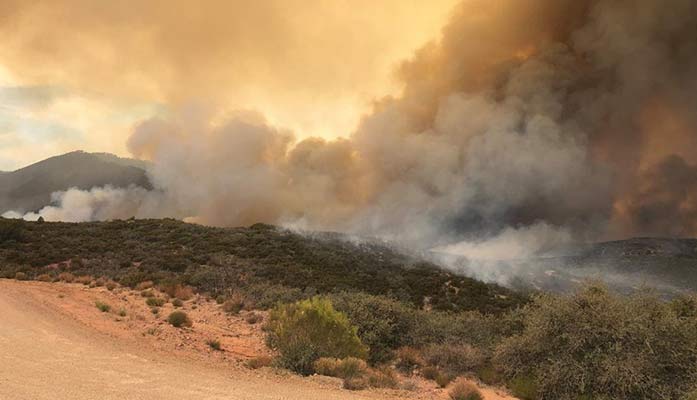
Arizona voters are deeply concerned about wildfires and are calling for a shift in state policy toward proactive forest and land management to prevent catastrophic fires, according to recent polling.
The survey, conducted by Noble Predictive Insights (NPI), found an overwhelming 78% of Arizona voters express concern about recent wildfires, with bipartisan alarm cutting across political divides.
Both Republicans and Democrats report identical levels of concern at 82%, while 70% of Independents share similar worries. This concern spans generations, with 80% of voters aged 65+ and 76% of those aged 18-29 voicing concerns.
In Maricopa County, 76% of voters express concern about recent wildfires, with 36% being very concerned, while Pima County reports a higher level of concern at 80%, with 48% being very concerned, reflecting its proximity to recent wildfire activity. Rural counties also show elevated concern at 80%, with 48% very concerned, likely due to their direct exposure to forested areas.
Notably, educational attainment correlates with heightened awareness, as 82% of college graduates and postgraduates express concern compared to 68% of those with a high school degree or less.
Despite recognizing wildfires as a pressing threat, only 18% of voters believe Arizona is well-prepared for future wildfire emergencies.
A majority (52%) acknowledge some level of preparation but see room for improvement, while 21% say the state is not prepared at all. Republicans (22%) and Democrats (21%) are slightly more optimistic about preparedness than Independents (12%), highlighting varied perceptions of state leadership’s efforts.
Maricopa County voters are slightly more optimistic on preparation, with 18% believing the state is well-prepared, compared to 17% in Pima and 20% in rural counties. However, all regions agree that significant gaps remain (54% in Maricopa, 51% in Pima, 50% in rural counties).
Arizona voters are clear in their preference for long-term prevention over short-term firefighting or recovery efforts. A striking 43% identify improved forest and land management as the top priority for state wildfire policy, far outpacing support for increased firefighting funding (23%) or post-fire recovery assistance (15%).
This prevention-first mandate holds across party lines, with 53% of Republicans, 41% of Democrats, and 35% of Independents prioritizing forest management.
“Wildfires touch every community in Arizona, and voters are telling us they do not think the state is ready enough for what lies ahead,” said Mike Noble, NPI Founder and CEO. “What is most striking is the consensus. Whether Republican, Democrat, or Independent, voters overwhelmingly want prevention to be the top priority.”
Ethan Faverino is a reporter for AZ Free News. You can send him news tips using this link.
by Daniel Stefanski | Dec 16, 2024 | News
By Daniel Stefanski |
Arizonans appear to be in a slightly better mood following the results of the 2024 General Election.
This past week, Noble Predictive Insights released the results of a recent survey in Arizona, showing “voters expressing a mix of hope and ongoing concerns about key state issues.”
Forty-four percent of respondents indicated that Arizona was on the “right track,” while fifty-six percent believed that their state was moving in the “wrong direction.”
Although those numbers show Arizona has much work to do to flip the outlook of its direction among voters, the numbers were improved from the last survey in August, when sixty percent of respondents thought their state was headed ‘south’ compared to forty percent who indicated that their state was tracking “northward.”
The survey – the Arizona Public Opinion Pulse (AZPOP) – took place between November 20-25 – approximately two weeks after the election.
“Republicans are optimistic and energized after Trump’s win while Democrats are discouraged – Gallego’s win was a victory for Democrats, but it wasn’t enough to improve their outlook,” said Mike Noble, NPI Founder & CEO. “But Arizona voters are pragmatic. They know that there is still work to be done in the state, and there is fertile ground for positive change – if leaders can rise to the occasion.”
The shift in the numbers comes largely courtesy of the two major political parties responding to the results of the election in November. From August to November, Republicans who believed that the state was headed in the right direction increased by twenty-two percent, while Democrats who thought Arizona was tracking in the wrong direction grew by seventeen percent.
While Republicans and Democrats had largely diametric reactions in the aftermath of the election, Independents were much more cautious in their opinions. From August to November, Independents’ optimism grew by three percent, while their pessimism decreased by three percent, according to the AZPOP.
Arizona Republicans are still reveling in many of their election victories from last month – chief among those being the overwhelming performance from President-elect Donald J. Trump in the Grand Canyon State, as he captured the state’s eleven electoral votes on his way to a commanding lead in the Electoral College over Democrat Kamala Harris. Republicans also expanded their narrow majorities in the state House and Senate, increased and retained control of key Maricopa County positions, swept the Arizona Corporation Commission races, and managed to pass a handful of ballot propositions, including one on border security to give local communities more resources and tools to better protect citizens.
Daniel Stefanski is a reporter for AZ Free News. You can send him news tips using this link.