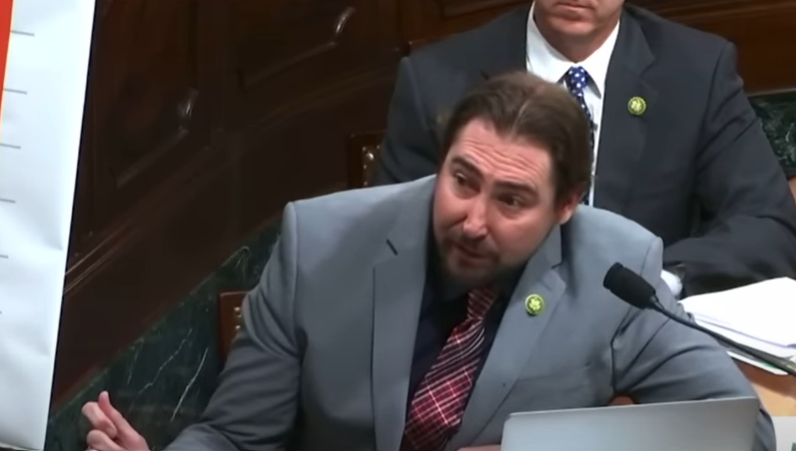
Arizona Republican Congressman Eli Crane (R-AZ-02) celebrated President Donald Trump’s Executive Order using emergency authority to keep the Cholla Power Plant in Navajo County in operation.
“While most politicians ignore the will of We the People, President Trump takes decisive action. By saving the Cholla Power Plant from imminent closure, hardworking Arizonans will maintain their jobs and livelihoods,” Rep. Crane said in a statement. “For years, radical environmentalists tried to destroy the once thriving coal industry. Under President Trump’s leadership, those days are officially over. This is a huge win for Navajo County, and I applaud the President and his team for delivering.”
In a statement signing the Executive order Trump said, “I am instructing Secretary Wright to save the Cholla coal plant in Arizona, which has been slated for destruction. We’re going to keep those coal miners on the job. We’re going to have that plant opening and burning beautiful, clean coal in a very short period of time.”
The text of the Executive order stated, “America’s coal resources are vast, with a current estimated value in the trillions of dollars and are more than capable of substantially contributing to American energy independence, with excess to export to support allies and our economic competitiveness.”
“Our nation’s beautiful clean coal resources will be critical to meeting the rise in electricity demand due to the resurgence of domestic manufacturing and the construction of artificial intelligence data-processing centers.”
The move by Trump was also praised by Navajo Nation President Buu Nygren who shared a lengthy statement to X, saying in part, “Today marks a pivotal moment for energy policy in the United States. As President Trump signs an executive order aimed at revitalizing the coal industry, I want to emphasize the importance of including tribal nations like the Navajo Nation in this national conversation.”
Nygren added, “The harmful policies of the past have unfairly targeted coal, but those tides are turning. Last year, the U.S. produced over 1 billion tons of coal, and even now, we are producing more than 500 million tons annually. If the federal government is serious about increasing domestic energy production, enhancing permitting, and bolstering energy security, it must work in partnership with tribal nations. Together, we can strengthen local economies, generate revenue, and create good-paying jobs in historically underinvested areas like ours. For the Navajo Nation, coal is more than an export—it has powered our homes and our economy since the mid-20th century. Our people have depended on the royalties, wages, and tax revenues from this industry for generations. Coal has also remained a primary heating source for many Diné families.”
STATEMENT FROM NAVAJO NATION PRESIDENT BUU NYGREN ON TRUMP'S EXECUTIVE ORDER SUPPORTING COAL DEVELOPMENT
WASHINGTON – Navajo Nation President Buu Nygren today issued this statement on President Trump’s Executive Order Supporting Coal Development across the U.S.:
— Navajo Nation President Buu Nygren (@BuuVanNygren) April 8, 2025
Speaking with AZCentral, APS, which owns the Cholla Power Plant stated, “APS stopped generating electricity at Cholla last month, in accordance with federal regulations and due to increasing costs that have made the plant uneconomical to operate.”
The utility said, “We plan to preserve the site for potential future-generation uses, including the possibility of nuclear power. At this time, APS has already procured reliable and cost-effective generation that will replace the energy previously generated by Cholla Power Plant.“
The contradictory statement leaves questions around whether the plant will resume operation in the immediate future.
Congressman Eli Crane (R-AZ-02) announced the reintroduction of a bill to rollback and nullify Biden administration policies that flew in the face of the sovereignty of native American property owners and tribal governments.
The congressman explained the need for this corrective measure, saying in a press release, “Secretary Haaland and President Biden engaged in selective sovereignty driven by extremists with no concern for Navajo interests or the energy needs of all Americans.”
He continued, “I’m proud to reintroduce this bill that would invalidate the Biden admin’s meddlesome ban. Together, with the Trump Administration, I’m confident we will be able to advance tribal interests, unleashing energy sovereignty and prosperity.”
The bill was drafted in reaction to a 2023 Public Land Order that banned the resource development of 336,404.42 acres of federal mineral estate surrounding the Chaco Canyon National Historical Park until 2043, barring Navajo citizens allotted the land from profiting from any possible mineral leases.
At the time, Navajo Nation Council Speaker Crystalyne Curley said, “The Navajo Nation attempted to compromise by proposing a 5-mile buffer as opposed to the 10-mile,” as reported by Cactus Politics. However, she continued, “The Biden Administration has undermined the position of the Navajo Nation with today’s action and impacted the livelihood of thousands of Navajo allotment owners and their families.”
Rep. @EliCrane_CEO has introduced legislation reversing a Biden Administration ban on mineral leasing land in Chaco Canyon, allowing the Navajo Nation to invest in energy development.
The Energy Opportunities for All Act would nullify and negate Public Land Order No. 7923, thereby declaring the restrictive order to “have no force or effect.”
During the 117th Congress, the House Committee on Natural Resources voted to bring the bill to the floor in a bipartisan decision after Navajo Nation President Buu Nygren offered his testimony in committee. Nygren said, “I appreciate Rep. Eli Crane for introducing this piece of legislation. The Navajo Nation continues to be an energy-producing tribal Nation. I support the Navajo people having a say in how their land and minerals are developed. In this case, the Navajo allottees have an important right to have their voices heard.”
Politico reported Friday that the Navajo Nation is also pursuing a route through the courts to fight the Biden administration’s action through a lawsuit filed in New Mexico Federal Court.
In the complaint filed in the U.S. District Court, the Navajo Nation argued, “From the very beginning of this process, Defendants have single-mindedly pursued an exact ten-mile buffer without sufficient analysis or explanation of why that particular number was chosen or how it relates the actual topography and geology of the landscape or the location of the Chacoan sites.”
The tribal leaders went on to allege that the Department of the Interior, under the previous administration, made the controversial decision without consultation from the tribe’s members to address the economic consequences to communities already beset by financial struggle.
A recent release from the Northeast Arizona Native Democrats has raised concerns about the ethical and legal considerations involved with partisan operatives helping voters fill out and mail in their ballots.
According to the release from Northeast Arizona Native Democrats, the group held a “Ballots, Stew & Socks event,” in Sawmill, AZ, a village on the Navajo reservation described as “a remote, census-designated area in the Navajo Nation,” boasting a population of less than 800.
The Democrat group explained their mission writing:
“In that small town, our team was able to engage with over 50 voters, some who had traveled far distances, and helped them fill out and mail their ballots on time.
While in Sawmill, we were joined by a truck-load of Pinon Pickers who shared a bowl of stew with us, while talking about the issues they care about. After this engaging, inspiring conversation, they thanked us for the information we provided and committed to voting early.”
The question of legality for holding an event to assist in mailing ballots, such as the Sawmill effort, could be unlawful under A.R.S. 16-1005(H), which states: “A person who knowingly collects voted or unvoted early ballots from another person is guilty of a class 6 felony. An election official, a United States postal service worker or any other person who is allowed by law to transmit United States mail is deemed not to have collected an early ballot if the official, worker or other person is engaged in official duties.”
As the event appeared on Facebook, it advertised: “Free Meal, Warm Socks, Voter Info.” This could potentially run afoul of A.R.S. 16-1005(C), which states, “It is unlawful to receive or agree to receive any consideration in exchange for a voted or unvoted ballot. A person who violates this subsection is guilty of a class 5 felony.”
Recent legal battles have been fought pertaining to everything from providing food and water to voters as they wait in line, to Elon Musk’s efforts to forward a petition by offering a $1 million giveaway each day until the election with winners chosen from the signatories.
However, specifically in Arizona and under Arizona law, these electioneering efforts carried out in the Navajo community by the Democratic party could prove to be illegal if challenged.
The Navajo Nation spoke out again this week against the Biden administration’s efforts to undermine fossil fuel development. Their reservation is the largest of all, spanning across three states along the Four Corners Monument: Arizona, New Mexico, and Utah.
In an interview with Fox News, Navajo Nation Oil and Gas Company CEO James McClure explained that fossil fuels earn them over $75 million in annual revenue — over half of the tribe’s annual budget — yet, the Biden administration hasn’t given support in recognition of that “very important” fact.
“The current administration has worked to support the Navajo Nation on most clean energy initiatives,” McClure told Fox News Digital. “The same cannot be said of oil and gas development.”
Navajo Nation President Jonathan Nez and the Navajo Nation Council oppose the Biden administration’s plans to eradicate fossil fuel development. The Department of Interior (DOI) will soon implement a 20-year ban on oil and gas leasing. President Joe Biden first announced the ban last November, as part of his ongoing pledge to counter climate change with fossil fuel eradication.
The ban would jeopardize the $6.2 million annual royalties earned by the tribe. The DOI has told reporters repeatedly that the Biden administration would ultimately support tribes’ desired land use.
Tribes deserve a seat at the decision-making table before policies that impact their communities are made. The first-ever Secretary’s Tribal Advisory Committee will help Tribal leaders engage with the highest levels of the @Interior on issues that matter most to their people. https://t.co/CfJQ4YieVw
However, that promise stands in conflict with Biden’s rhetoric around fossil fuels. During a Democratic National Committee fundraiser in March, Biden said that those profiting off of fossil fuels needed to sacrifice for the greater good of the country.
“My message is, it’s time in this time of war, it’s not a time of profit. It’s time for reinvesting in America,” said Biden. “This crisis is another indication why we need to get off dependency on fossil fuels.”
Conrad Stewart, the Crow Nation of Montana’s director of energy and water, also stressed to Fox News that their tribes’ economic well-being depends on fossil fuel development.
“A war on coal is a war on Crow,” said Stewart.
That phrase, “war on coal,” refers to the continuation of former President Barack Obama’s policies within the Biden administration. During Department of Energy (DOE) Secretary Jennifer Granholm’s confirmation hearing last January, Granholm disclosed that “jobs might be sacrificed” under these policies.
Joe Biden's Energy Secretary nominee Jennifer Granholm admitted that there are “jobs that might be sacrificed” with Biden’s federal lands fracking banhttps://t.co/drlVfgMKNqpic.twitter.com/FpkofBzgZ7
Around the time of Granholm’s confirmation hearing, the Ute Indian Tribe asked the U.S. Interior Department for an exemption to the suspension on federal and tribal land leases and permits for oil and gas.
Reservations produce over 3 percent of the country’s oil and gas reserves untapped; according to a 2014 report, their lands contain about 20 percent of the oil and gas reserves, and 30 percent of domestic coal reserves west of the Mississippi River. A report from S&P Global Platts estimated that 12 of the 326 tribal reservations produce significant oil.
Another major tribe that relies heavily on fossil fuel development is the Three Affiliated Tribes of the Fort Berthold Indian Reservation in North Dakota. Their chairman, Mark Fox, estimated in 2020 that oil accounted for 90 percent of their revenue. Last year, Fox told Fox News that fossil fuels ensured that their forthcoming generations would have a home.
Not all Native American tribes oppose the Biden administration’s efforts to curb fossil fuel development. Those tribes that don’t rely on those resources, such as the Standing Rock Sioux, support the Biden administration.
Corinne Murdock is a reporter for AZ Free News. Follow her latest on Twitter, or email tips to corinne@azfreenews.com.
The Navajo Nation has filed a lawsuit against the U.S. Department of Interior and the Office of Navajo and Hopi Indian Relocation in an attempt to secure the proper conclusion of federal relocation for over 16,000 Navajos, something that was previously ordered to be completed in 1986.
The lawsuit filed in late August with the U.S. District Court for the District of Arizona in Prescott on behalf of the Nation and more than 50,000 of its affected citizens seeks a court order forcing the U.S. Office of Navajo and Hopi Indian Relocation (Office of Relocation) to remain open and provide the relocation assistance, and community facilities and services promised and mandated by Congress decades ago.
According to the lawsuit, the Office of Relocation established in 1988 and its predecessor, the Navajo and Hopi Indian Relocation Commission, have relocated over 3,700 households of Navajo families comprising over 16,000 Navajo citizens from their ancestral lands within the 2.5 million acres of the 1882 Reservation.
But the Nation alleges the Office of Relocation has failed to provide relocation services for many other households, and has failed to ensure the availability of community facilities and services -such as water, sewers, roads, schools, and health facilities- for households at on-reservation relocation sites.
The Relocation Act is the compilation of Congressional actions dating back to the Navajo-Hopi Settlement Act of 1974 and its subsequent amendments, including the Navajo and Hopi Indian Relocation Amendments Act of 1980 and the Navajo and Hopi Indian Relocation Amendments of 1988. It involves mandatory relocation of Navajos off some Reservation land partitioned off for members of the Hopi Tribe.
The Nation’s lawsuit puts forth claims on behalf of itself and over 50,000 of its citizens being adversely affected by the ongoing failure of the Office of Relocation to properly discharge its federal duties, which included implementing a Congressionally approved relocation plan.
The Office of Relocation traces its start to 1943 when a 642,000-acre area of the Reservation designated as District 6 was set aside for the exclusive use of the Hopi Tribe. Eventually all Navajo residents of District 6 were evicted by the U.S. government.
The remaining 1.8 million or so acres of the Reservation were for the “joint, equal, and undivided” (JUA) use of both Tribes. However, conflicts over the JUA continued for several years, and by 1974 a partition plan was enacted for the forced relocation of thousands of Navajos off what became known as Hopi Partitioned Land (HPL).
The lawsuit calls the still ongoing relocation of Navajos from HPL “the largest forced relocation of any racial group in the United States since the relocation and internment of Japanese-Americans during World War II.”
Hopis also had to leave what came known as Navajo Partitioned Land (NPL), and according to government reports that part of the relocation was completed by 2013.
The Settlement Act 1974 tasked a Navajo and Hopi Indian Relocation Commission with developing a relocation plan. It also required a reduction in livestock grazing on JUA lands, which harmed several Navajo farmers and ranchers.
In addition, the U.S. Bureau of Land Management was ordered to acquire land from the Navajo Nation within Arizona and Mexico “to be held in trust” for the Nation. Those lands would come to be known as “New Lands” and would be where many of the relocatees were placed.
Over the years, Congress passed laws related to a formal Relocation Plan under which the United States had a duty to assure schools, roads, power, and other facilities for relocation to the New Lands. Other provisions of the Settlement Act took effect in July 1981 with a five-year deadline for relocation to be completed.
However, a report by the U.S. Government Accountability Office (GAO) in 1991 noted that only 68 percent of the eligible families had been relocated. By then, the July 1986 deadline had been missed by five years.
In 2005, a Congressional hearing noted that the cost of the federal relocation program over the preceding 36 years was almost half a billion dollars, which was more than 10 times what Congress estimated in 1974. The cost was also equivalent to what the United States was spending at the time in Iraq every 36 hours, the lawsuit states.
By 2018, the Office of Relocation announced it planned to cease operations and transfer its activities to another agency, even though the Department of Interior admitted the Relocation Act did not authorize such a move. Hundreds of Navajo relocation-certified households were still awaiting services at the time. Many others had the right to pursue eligibility by filing a claim with the federal court of appeals, the Department of Interior reported.
Even so, the Office of Relocation contended it had “fulfilled the duties it was legislatively assigned by providing relocation benefits to all individuals who were found eligible and that other services such as infrastructure should be provided by another permanent agency.”
The Navajo Nation and the Hope Tribe oppose the transfer, which even the Bureau of Indian Affairs admits “could further delay relocation.” The GAO worries that transferring relocation to another agency “likely would increase” program costs and delay completion of relocation.
“July 2021 was the 35th anniversary of the statutory deadline to complete relocation,” the Nation’s lawsuit states. “However, relocation still has not yet been completed and significant issues and work remain outstanding to complete relocation.” In addition, not all of the 400,000 acres of New Lands has been acquired and transferred as required under the Relocation Act, the lawsuit points out.
But it isn’t just direct relocation services to families that the Office of Relocation is accused of failing to provide.
The Office of Relocation is also responsible for developing community facilities and services, such as water, sewers, roads, schools, and health facilities, as well as power, telephone, and other utilities, at the relocation sites, many of which are on the New Lands, which is wholly populated by Navajo relocatees and their families.
According to the lawsuit, many relocatees and their communities (known as Chapters) rely on extensive unpaved roads that are in poor condition, live in homes with no indoor plumbing or easy-access potable water supplies, and do not have proper watering systems for livestock.
“Many communities with many relocatees lack sufficient electricity or appropriate septic or sewer systems,” the lawsuit contends. “These issues are especially problematic for elders during cold winters. There also are inadequate schools in many relocate areas,” which require students to commute hours each way to school.
“Finally, many Chapters seriously impacted by relocation lack adequate access to health and emergency facilities, which places all lives there at greater risk,” the lawsuit alleges. “This extreme delay is also unreasonable because it fundamentally concerns human health and welfare.”
The Nation is asking for an injunction prohibiting the Office of Relocation from shutting down. The lawsuit also seeks an order compelling the Department of Interior to ensure all Relocation Act services and benefits are made available without further delay.
An answer is expected to the filed by the U.S. Government later this month.