by AZ Free Enterprise Club | Jun 8, 2026 | Opinion
By the Arizona Free Enterprise Club |
For generations, Arizona’s wide-open land has supported ranchers, farmers and the communities that helped build our great state.
Then, the climate activists came along.
Armed with nothing more than junk science from climate “experts” like Al Gore and Alexandria Ocasio-Cortez, they got busy imposing costly green energy mandates on states across the country—and Arizona’s political and corporate elites eagerly fell in line. Our state’s utilities committed themselves to achieving “Net Zero” emissions by 2050, a goal that will cost ratepayers billions of dollars while doing little to meaningfully impact the environment.
But higher utility bills are only part of the cost.
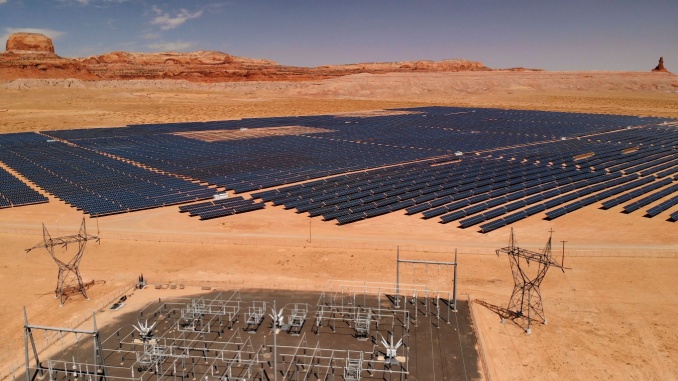
Not wanting to disappoint some of her largest campaign contributors, Arizona Governor Katie Hobbs has been quick to bend the knee to the Green New Scam time and time again. Now, these decisions are not only hitting families in the wallet, but they are transforming our state’s beautiful countryside into an industrial playground for massive, foreign-backed solar and wind developments.
Under Hobbs, the Arizona State Land Department has increasingly operated like a business partner for the solar industry instead of a steward of Arizona’s public lands. The agency now maintains detailed maps identifying the “best” locations for solar development across the state, effectively helping direct industrial solar companies toward Arizona’s most desirable land.
But surely, they must be doing the same for other industries?
Nope…
>>> CONTINUE READING >>>
by Matthew Holloway | Oct 14, 2025 | News
By Matthew Holloway |
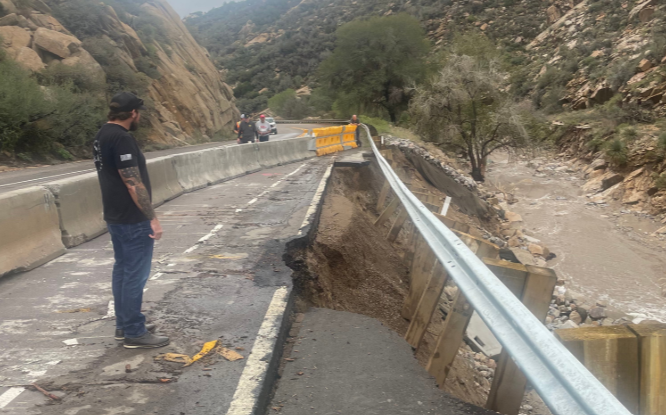
With tropical storm-fueled rains hammering various parts of Arizona and flood losses mounting, the U.S. Small Business Administration (SBA) announced that low-interest loans are now available for the victims of severe flooding in Coconino, Gila, Graham, Maricopa, Navajo, Pinal, and Yavapai Counties, as well as tribal nations.
The SBA is offering low-interest federal disaster loans to eligible businesses, nonprofits, residents, and tribal nations—similar to those provided for the Dragon Bravo Fire victims in September.
In a post to X announcing the relief for Gila County, Congressman Eli Crane (R-AZ02) called for continued prayers for those hit by the massive flooding. Remnants of Hurricane Priscilla hammered the area over the weekend, adding to late September’s monsoon deluge that devastated Globe-Miami.
Crane wrote: “@SBAgov has declared an economic disaster due to the severe flooding in Gila County. Through this declaration, SBA’s Economic Injury Disaster Loan (EIDL) program is available to eligible businesses, private nonprofits, and residents,” providing a link to resources.
He followed up: “Please continue to keep those impacted by the devastating floods in Gila County in your prayers. For those affected, @SBAgov is offering Business Physical Disaster Loans, Home and Personal Property Loans, and Economic Injury Disaster Loans.”
According to the SBA:
“Businesses and nonprofits are eligible to apply for business physical disaster loans and may borrow up to $2 million to repair or replace disaster-damaged or destroyed real estate, machinery and equipment, inventory, and other business assets.
“Homeowners and renters are eligible to apply for home and personal property loans and may borrow up to $100,000 to replace or repair personal property, such as clothing, furniture, cars, and appliances. Homeowners may apply for up to $500,000 to replace or repair their primary residence.
“Applicants may be eligible for a loan increase of up to 20% of their physical damage, as verified by the SBA, for mitigation purposes. Eligible mitigation improvements include insulating pipes, walls and attics, weather stripping doors and windows, and installing storm windows to help protect property and occupants from future disasters.”
The Economic Injury Disaster Loan (EIDL) program is also available to help small businesses, nurseries, and non-profit organizations with financial losses directly related to this disaster.
For more information, the SBA directs victims to visit this website. They can apply online, call SBA’s Customer Service Center at (800) 659-2955, or email disastercustomerservice@sba.gov.
“When disasters strike, SBA’s Disaster Loan Outreach Centers play a vital role in helping small businesses and their communities recover,” Chris Stallings, associate administrator of the Office of Disaster Recovery and Resilience at the SBA, said in a press release. “At these centers, SBA specialists assist business owners and residents with disaster loan applications and provide information on the full range of recovery programs available.”
Matthew Holloway is a senior reporter for AZ Free News. Follow him on X for his latest stories, or email tips to Matthew@azfreenews.com.
by Ethan Faverino | Aug 28, 2025 | News
By Ethan Faverino |
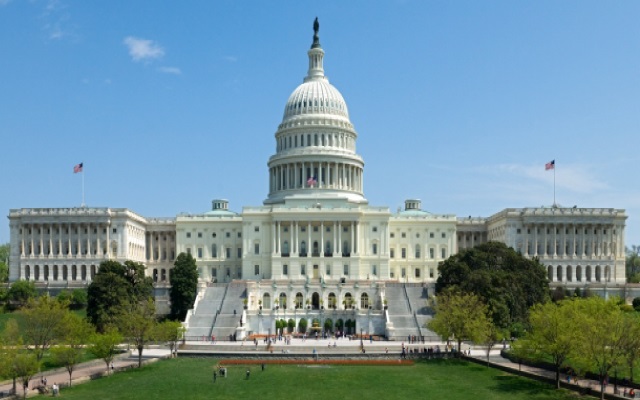
Through the One Big Beautiful Bill Act, the U.S. House of Representatives reauthorized the Radiation Exposure Compensation Act (RECA) through December 31, 2028, and enacted its largest-ever expansion.
This act broadens eligibility to include new populations, such as Northern Arizona counties and additional uranium workers, while continuing support for those affected by the U.S. nuclear weapons program.
The expanded RECA provides a one-time, lump-sum payment of up to $100,000 to qualifying individuals or their survivors, offering critical restitution for those who developed serious illnesses due to radiation exposure.
Representative Eli Crane (AZ-02) announced that the reauthorized act now covers individuals in Coconino, Yavapai, Navajo, Apache, Gila, and Mohave counties in Arizona affected between January 1951 and November 1962, as well as uranium workers employed in covered occupations from January 1, 1942, to December 31, 1990.
The program also extends to onsite participants of nuclear tests and those impacted by the Manhattan Project waste.
RECA provides a non-adversarial alternative to litigation, requiring no proof of causation. Claimants qualify by demonstrating a compensable disease and presence in a designated area or occupation during specified periods.
The program, administered by the Department of Justice, is designed to resolve claims efficiently, using existing records to minimize administrative costs for both claimants and the government.
The four qualifying categories are Downwinders, onsite participants, uranium workers, and Manhattan Project waste victims.
Downwinders are individuals who developed certain cancers after radiation exposure from U.S. nuclear tests between 1944 and 1962.
The program now includes several Arizona counties along with eligible areas in Idaho, New Mexico, Utah, and Nevada.
To qualify, individuals must have lived in one of the areas during a specific time period and have been diagnosed with a compensable disease such as leukemia, multiple myeloma, lymphoma, or certain primary cancers.
On-site participants were individuals present at U.S. atmospheric nuclear tests before January 1, 1963, and later developed a compensable disease.
Uranium workers also receive compensation for individuals employed in uranium mining, milling, core drilling, ore transport, or remediation efforts in mines or mills located in Colorado, New Mexico, Arizona, Wyoming, South Dakota, Washington, Utah, Idaho, North Dakota, Oregon, or Texas between January 1, 1942, and December 31, 1990.
To qualify, uranium workers must have been employed for at least one year during the time period and been diagnosed with a compensable disease such as lung cancer, pulmonary fibrosis, silicosis, pneumoconiosis, cor pulmonale related to lung fibrosis, or renal cancers.
Lastly, Manhattan Project waste victims get compensation for individuals exposed to Manhattan Project waste in designated areas of Missouri, Tennessee, Alaska, and Kentucky.
To qualify, individuals must have lived, worked, or attended school for at least two years after January 1, 1949, in designated zip codes and have a compensable disease.
The expanded Radiation Exposure Compensation Act delivers long-overdue justice, honoring those whose lives were forever changed by radiation exposure.
Ethan Faverino is a reporter for AZ Free News. You can send him news tips using this link.
by Matthew Holloway | Aug 23, 2025 | News
By Matthew Holloway |
Congressman Eli Crane announced that the U.S. Small Business Administration (SBA), under President Trump, is offering low-interest federal disaster loans to help businesses, nonprofits, and tribal nations recover from the devastating 2025 wildfires. The loans respond to the Dragon Bravo and White Sage fires, which scorched the Northern Rim of the Grand Canyon and the Kaibab Plateau in Northern Arizona.
The federal disaster declaration, issued by the SBA on August 13th, covers the Arizona counties of Coconino, Gila, Mohave, Navajo, and Yavapai, as well as the tribal nations of the Navajo Nation, Hopi Tribe, Havasupai Tribe, Hualapai Tribe, and San Juan Southern Paiute Tribe.
According to a press release from the SBA, “The loan amount can be up to $2 million with interest rates as low as 4% for businesses and 3.625% for PNPs with terms up to 30 years. Interest does not accrue, and payments are not due until 12 months from the date of the first loan disbursement. The SBA sets loan amounts and terms based on each applicant’s financial condition.”
The administration clarified that the Economic Injury Disaster Loan (EIDL) is available to eligible businesses, small agricultural cooperatives, nurseries, and PNPs with financial losses directly related to the disaster. However, the administration noted it is “unable to provide disaster loans to agricultural producers, farmers, or ranchers, except for aquaculture enterprises.”
The SBA explained that the purpose of the loans is “for working capital needs caused by the disaster, and are available even if the business did not suffer any physical damage. They may be used to pay fixed debts, payroll, accounts payable, and other bills that could have been paid had the disaster not occurred.”
As of this report, the Dragon Bravo fire has burned over 145,000 acres and is 62% contained. It has cut a swath of destruction from the north rim of the Grand Canyon northward along both sides of Arizona State Route 67 for about 12 miles and then along the east side of the State Route for nearly another twenty miles, leaving a scar almost 16 miles wide at its widest point.
The White Sage fire has burned nearly 59,000 acres and is 95% contained after spreading in a widening eastward arc from White Sage flat through the Kaibab National Forest toward Coyote Valley.
In July, Governor Katie Hobbs met with Trump administration officials, including Secretary of the Interior Doug Burgum, to coordinate with federal authorities on the Dragon Bravo wildfire, days after Congressman Paul Gosar (R-AZ09) joined a growing bipartisan coalition of Arizona leaders calling for an investigation into it. The fire claimed the historic Grand Canyon Lodge along with 50-80 other structures in the area in mid-July.
For more information about the SBA EID loans or to apply, please click here, call SBA’s Customer Service Center at (800) 659-2955, or email disastercustomerservice@sba.gov.
Matthew Holloway is a senior reporter for AZ Free News. Follow him on X for his latest stories, or email tips to Matthew@azfreenews.com.
by Matthew Holloway | Nov 22, 2024 | News
By Matthew Holloway |
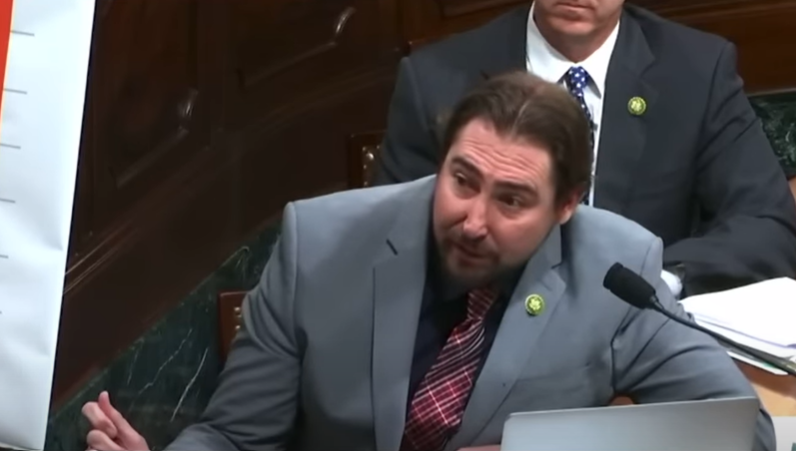
Congressman Eli Crane (R-AZ-2) announced Wednesday that H.R. 3047 which he proposed to transfer Federal Land within the Apache-Sitgreaves National Forest to the northern Arizona communities of Pinedale and Alpine, has made it through the House Committee on Natural Resources. Specifically, the bill addresses the needs for both communities for expanded cemetery space which, being surrounded by federal land, is nearly impossible for the towns or private buyers to acquire.
The bill is cosponsored by Congressman Paul Gosar (R-AZ-9) and would convey 2.5 acres of National Forest System land to Navajo County for the Pinedale Cemetery expansion and 8.06 acres of National Forest System land to Apache County for the Alpine Cemetery expansion.
The office of Rep. Crane noted that for over a decade both communities have struggle with locating appropriate cemetery space, often needing to lay loved ones to rest in cemeteries over a hundred miles away from the communities in which they lived and died.
Navajo County Supervisor Daryl Seymore wrote, “The community of Pinedale has a long and rich pioneer history, and the residents are proud of that heritage. Pinedale is a community where generations of families live, grow, and raise their families. This bill will allow families to lay their loved ones to rest in the place that their family member loved so much. I’m grateful to Congressman Crane and his staff for their work on this bill and his support of the Pinedale community.”
Crane said in a statement, “I’m pleased to report that my bill passed out of the House Committee on Natural Resources and awaits consideration on the House Floor. These communities have storied histories, and they deserve to lay their loved ones to rest in the place that means so much to them.”
The Congressman credited the community of the Church of Jesus Christ of Latter Day Saints adding, “This piece of legislation is one of the first bills I introduced in Congress and is a testament to the strength of the Latter-Day Saints Community in Northern Arizona. I appreciate Supervisors Seymore and Nelson for their leadership, and we will continue to do everything we can to push this bill through the legislative process.”
Apache County Supervisor and Board Vice-Chairman Nelson Davis wrote, “As a County Supervisor and Vice-Chairman of the Board of Apache County, I have seen firsthand the ‘very real needs’ of the communities that I represent. Recently, the effort put forth by you and your staff in securing the conveyance of USFC land immediately adjacent to the Alpine Community Cemetery is representative of meeting that ‘very real need.’”
Following the passage of the bill through the House Committee on Natural Resources, Chairman Bruce Westerman said, “Oftentimes, the smallest solutions can have the most meaning. Congressman Crane’s legislation to convey important parcels of land to the Apache and Navajo counties will help communities properly lay to rest their loved ones. This is the type of thoughtful work that makes Rep. Crane such an important asset to his constituents.”
Matthew Holloway is a senior reporter for AZ Free News. Follow him on X for his latest stories, or email tips to Matthew@azfreenews.com.